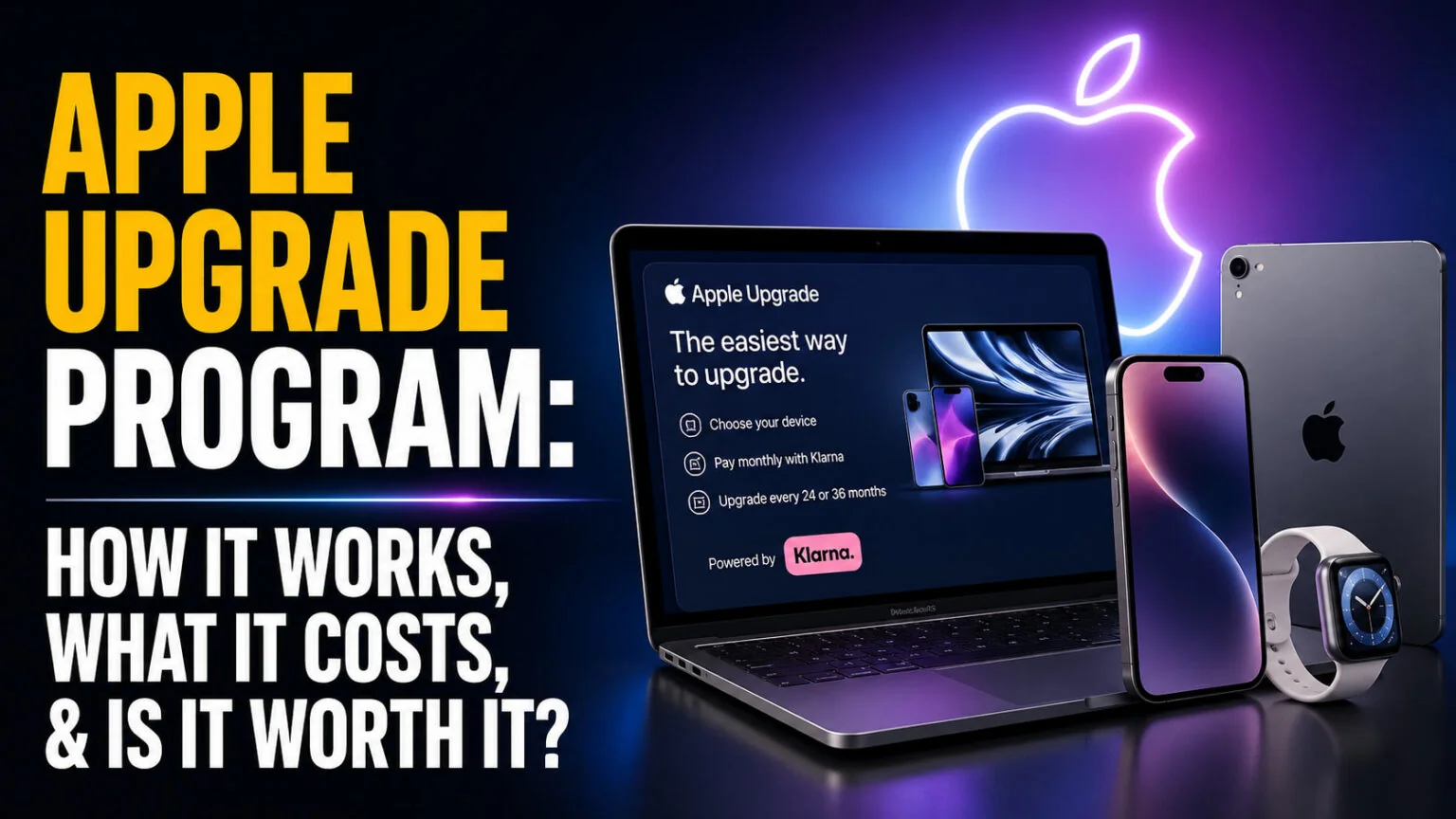
Apple a lancé l’Apple Upgrade program le 28 juillet 2026 et a mis fin à l’iPhone Upgrade Program le même jour. La location d’un Mac démarre à 24,99 $ par mois, celle d’un iPhone à 17,99 $, et le financement provient de Klarna plutôt que d’Apple. Le programme est réservé aux États-Unis et couvre l’iPhone, l’Apple Watch, le Mac et l’iPad.
La couverture du lancement vous a donné les tarifs mensuels. Ce qu’elle ne vous a pas donné, c’est le chiffre qui décide vraiment si la location est un choix malin, à savoir ce que l’appareil coûte si vous le gardez. Nous avons fait ce calcul pour chaque Mac éligible en utilisant la propre formule de rachat d’Apple, et le résultat est plus favorable que ne le laissent penser les tarifs affichés. Voici comment le programme fonctionne, ce qu’il coûte réellement, et qui devrait l’ignorer complètement.
Les points essentiels
- L’Apple Upgrade program a été lancé le 28 juillet 2026 et a remplacé l’iPhone Upgrade Program, qu’Apple a retiré aux États-Unis le même jour.
- La location d’un Mac s’étale sur 24 ou 36 mois et démarre à 24,99 $ par mois. L’iPhone et l’Apple Watch s’étalent sur 12 ou 24 mois.
- Le prix de rachat d’Apple correspond au prix public moins les mensualités que vous avez déjà réglées, si bien que les mensualités plus le rachat final reviennent exactement au prix de vente. Racheter l’appareil à la fin revient de fait à un financement sans intérêts.
- Le Mac mini, le MacBook Neo et le Studio Display sont exclus, tout comme l’iPhone 16, l’iPhone 16 Plus, l’Apple Watch SE et l’iPad A16.
- AppleCare+ n’est plus inclus. L’ancien iPhone Upgrade Program le comprenait. Il coûte désormais de 9,99 $ à 13,99 $ par mois en supplément.
Qu’est-ce que l’Apple Upgrade Program ?
Apple Upgrade est un programme de location, pas un plan de paiement. Klarna Inc. est propriétaire de l’appareil et vous payez des frais mensuels pour l’utiliser. C’est la distinction la plus importante, car elle change ce qu’il vous reste au terme de la période.
Vous pouvez louer un iPhone, une Apple Watch, un Mac et un iPad via l’Apple Store en ligne, l’application Apple Store ou un Apple Store physique. L’inscription exige une vérification de solvabilité légère, qu’Apple présente comme une consultation « qui n’aura pas d’impact sur leur cote de crédit ». Vous devez aussi être un résident américain âgé de 18 ans ou plus et disposer d’un Social Security Number ou d’un ITIN.
Pourquoi Apple a mis fin à l’iPhone Upgrade Program
Si vous avez cherché l’Apple Upgrade program en pensant à l’ancienne formule iPhone, ce produit n’existe plus. Apple a proposé l’iPhone Upgrade Program de 2015 jusqu’au 28 juillet 2026, date à laquelle il a été abandonné aux États-Unis en même temps qu’était lancé Apple Upgrade.
Les membres actuels ne sont pas contraints de partir immédiatement. Le moment venu de remplacer votre iPhone, vous passez à Apple Upgrade, basculez vers Apple Card Monthly Installments, achetez comptant ou optez pour un financement par l’opérateur. Les deux programmes sont des produits différents, et cette différence compte davantage que ne le suggère leur nom commun.
Comment fonctionne l’Apple Upgrade Program ?
Le mécanisme est simple une fois que vous acceptez de louer plutôt que d’acheter.
- Configurez l’appareil que vous voulez sur le site d’Apple ou en magasin.
- Choisissez Apple Upgrade comme mode de paiement au moment de payer.
- Passez une vérification de solvabilité légère, qui n’affecte pas votre cote de crédit.
- Payez Klarna chaque mois, via l’application Klarna.
- À la fin de la période, passez à un nouveau modèle, achetez l’appareil comptant ou rendez-le et repartez sans engagement.
La durée dépend du produit. Le Mac et l’iPad s’étalent sur 24 ou 36 mois, tandis que l’iPhone et l’Apple Watch s’étalent sur 12 ou 24 mois. La reprise d’un appareil que vous possédez déjà réduit la mensualité, mais le crédit est réparti sur les mensualités plutôt que déduit dès le départ.
Un paiement manqué ne bloque pas votre appareil. Klarna reporte le montant manqué sur le mois suivant sans frais de retard, mais trois paiements manqués consécutifs mettent fin à la location et rendent le solde total immédiatement exigible.
Tarifs de l’Apple Upgrade Program pour le Mac
Voici les tarifs mensuels publiés pour les configurations de base. La propre note d’Apple confirme les chiffres du MacBook Pro, en citant « un MacBook Pro 16 Go avec un prix d’achat de 1999 $ » à 38,99 $ par mois sur une période de 36 mois et 53,99 $ sur une période de 24 mois.
| Mac | Prix d’achat | Location sur 24 mois | Location sur 36 mois |
|---|---|---|---|
| MacBook Air 13 pouces M5 | 1 299 $ | 34,99 $/mois | 24,99 $/mois |
| iMac M4 | 1 499 $ | 40,99 $/mois | 28,99 $/mois |
| MacBook Pro 14 pouces M5 | 1 999 $ | 53,99 $/mois | 38,99 $/mois |
| Mac Studio M5 Max | 2 499 $ | 67,99 $/mois | 48,99 $/mois |
Apple a fait passer le Mac Studio à la génération M5 le 25 août 2026, et le M5 Ultra qui se place au-dessus de ce tableau se loue à partir de 110,10 $ par mois sur 36 mois, pour un prix de 5 499 $. Une réserve compte si vous achetez une machine sérieuse. Chaque tarif publié couvre une configuration de base, et Apple n’a pas publié de tarifs de location pour une mémoire ou un stockage étendus.
Ainsi, un MacBook Pro avec 64 Go ou 128 Go de mémoire unifiée coûtera nettement plus par mois que les 38,99 $ affichés. Vous ne verrez le vrai chiffre qu’une fois la configuration établie au moment de payer.
Ce que l’Apple Upgrade Program coûte vraiment pour devenir propriétaire
C’est la partie que personne n’a publiée, et c’est celle qui tranche la question. Apple énonce la règle clairement dans ses conditions de location Apple Upgrade.
Les frais de l’option d’achat correspondent au prix public moins les mensualités de location que vous avez réglées, moins les remises restantes ou le crédit de reprise.
Appliquez cette formule et quelque chose d’utile en ressort. Vos mensualités de location sont déduites du prix de vente, si bien que les mensualités plus le rachat final totalisent exactement ce que le Mac coûte à l’achat comptant.
Pas approximativement. Exactement.
| Mac | Payé sur 36 mois | Rachat pour devenir propriétaire | Coût total pour devenir propriétaire |
|---|---|---|---|
| MacBook Air 13 pouces M5 | 899,64 $ | 399,36 $ | 1 299,00 $ |
| iMac M4 | 1 043,64 $ | 455,36 $ | 1 499,00 $ |
| MacBook Pro 14 pouces M5 | 1 403,64 $ | 595,36 $ | 1 999,00 $ |
| Mac Studio M5 Max | 1 763,64 $ | 735,36 $ | 2 499,00 $ |
Chaque ligne retombe sur le prix affiché. Un MacBook Pro loué sur 36 mois vous coûte 1 403,64 $ de mensualités, laissant 595,36 $ pour le posséder, ce qui totalise les 1 999 $ que vous auriez payés dès le premier jour. Concrètement, cela fait d’Apple Upgrade un financement sans intérêts avec un paiement final à la fin, à condition que vous rachetiez l’appareil.
Le piège, c’est l’autre voie. Si vous continuez à changer d’appareil à la fin de chaque période, vous payez indéfiniment et ne possédez jamais rien. C’est le comportement que le programme est conçu pour encourager, et c’est là que la location cesse d’être maligne.
Quels appareils sont éligibles, et ce qu’Apple a exclu
La liste des exclusions est courte et révélatrice. L’annonce d’Apple indique que « l’iPhone 16, l’iPhone 16 Plus, l’Apple Watch SE, le MacBook Neo, le Mac mini, l’iPad (A16) et le Studio Display ne sont pas proposés dans le cadre de l’Apple Upgrade program ».
| Mac éligibles | Exclus |
|---|---|
| MacBook Air (M5) | Mac mini |
| MacBook Pro (famille M5) | MacBook Neo |
| iMac (M4) | Studio Display |
| Mac Studio (M5 Max, M5 Ultra) |
Deux autres restrictions prennent les gens au dépourvu. Il n’y a aucune remise éducation sur les locations, ce qui représente un coût réel pour quiconque achèterait autrement via le magasin éducation d’Apple, et les appareils reconditionnés ne sont pas éligibles non plus. Si vous comptiez combiner le tarif étudiant avec un paiement mensuel, cette combinaison n’existe pas. Les étudiants qui pèsent plutôt le coût des logiciels trouveront peut-être notre guide des meilleurs outils d’IA pour les étudiants plus utile.
Ce que l’Apple Upgrade Program signifie si vous achetez un Mac pour le travail d’IA
Le calendrier n’est pas un hasard. Apple a augmenté les prix de presque tous les Mac le 25 juin 2026, sous l’effet du coût des composants de mémoire et de stockage, les centres de données d’IA absorbant l’approvisionnement en DRAM. Le MacBook Air de base est passé de 1 099 $ à 1 299 $ et le MacBook Pro d’entrée de gamme de 1 699 $ à 1 999 $, de nombreux modèles grimpant de 20 pour cent ou plus.
Tim Cook a décrit la situation des composants comme une « crue centennale » et n’a pas mâché ses mots sur la conséquence.
Malheureusement, les hausses de prix sont inévitables.
Tim Cook, PDG d’Apple
La mémoire est précisément là où le travail d’IA local fait mal. Faire tourner des modèles sur l’appareil réclame avant tout de la mémoire unifiée, et c’est le composant dont le prix a le plus bougé. Sur le M5 Max, les extensions de mémoire de 64 Go et 128 Go ont doublé de prix, et un MacBook Pro 16 pouces au maximum affiche désormais un total à cinq chiffres.
Les machines les moins chères sont celles que vous ne pouvez pas louer
Voici la partie gênante. Le Mac mini est exclu, et le mini est justement la machine vers laquelle la plupart des gens se tournent quand ils veulent l’entrée la moins chère possible dans l’IA locale. Il en va de même pour le MacBook Neo.
Apple vous louera volontiers un Mac Studio à 2 499 $, mais pas un mini à 799 $.
Cela oriente le programme vers les machines les plus chères, ce qui est vraisemblablement l’objectif. Si vous envisagiez un mini de toute façon, notre analyse pour savoir si un Mac mini vaut vraiment le coup pour l’IA explique pourquoi la réponse est souvent non, avant même que la location entre en jeu.
Là où la location aide vraiment
Pour les machines à forte mémoire, répartir un paiement sans intérêts sur 36 mois est une façon raisonnable d’absorber une hausse de prix que vous n’avez pas demandée. Un Mac Studio M5 Max à 48,99 $ par mois est plus facile à justifier que 2 499 $ d’un coup, et le total est identique si vous rachetez l’appareil. Quiconque compare des configurations devrait commencer par notre guide du meilleur MacBook pour le travail d’IA. Les acheteurs de machines de bureau devraient se renseigner sur le Mac Studio M5 Ultra, qui sort le 22 septembre, avant de s’engager sur une période de trois ans.
Trois ans, c’est une longue location pour du matériel dans un cycle de produits actif. C’est là le vrai risque, pas l’argent.
Il vaut aussi la peine de se demander si vous avez besoin du matériel tout court. Une bonne partie du travail qui pousse les gens vers un Mac à forte mémoire tourne parfaitement bien dans le cloud. Notre tour d’horizon des alternatives à Apple Intelligence pour le Mac couvre les options qui n’impliquent pas un échéancier de paiement sur trois ans.
Apple Upgrade vs achat comptant vs Apple Card
| Apple Upgrade | Apple Card Monthly Installments | Achat comptant | |
|---|---|---|---|
| Vous en êtes propriétaire | Seulement si vous payez le rachat | Oui | Oui |
| Intérêts | Aucun si vous rachetez | 0 % | Aucun |
| AppleCare+ | Séparé, de 9,99 $ à 13,99 $/mois | Séparé | Séparé |
| Vérification de solvabilité | Légère, sans impact sur la cote | Oui, Apple Card requise | Non |
| Durées Mac | 24 ou 36 mois | 12 mois | Sans objet |
| Remise éducation | Non | Oui | Oui |
Apple Card Monthly Installments reste l’option la plus nette si vous y êtes éligible, car vous possédez l’appareil comptant à la fin et conservez l’accès au tarif éducation. Le programme Upgrade l’emporte sur la durée, puisque 36 mois de mensualités plus petites valent mieux que 12 mois de mensualités plus grosses si la trésorerie est la contrainte.
L’Apple Upgrade Program vaut-il le coup ?
Apple Upgrade vaut le coup si vous comptez acheter l’appareil à la fin de la période. Vos mensualités sont déduites du prix de vente, si bien que les mensualités plus le rachat égalent ce que le Mac coûte comptant, ce qui en fait un financement sans intérêts sur trois ans au maximum. Pour une machine dont le prix a grimpé de 20 pour cent en juin, c’est une façon utile d’étaler les dégâts.
C’est un mauvais rapport qualité-prix dans deux cas. Si vous prenez la voie de la mise à niveau à la fin de chaque période, vous ne possédez jamais rien et les paiements ne s’arrêtent jamais. Et si vous êtes éligible au tarif éducation, la remise à laquelle vous renoncez est probablement plus grande que la commodité que vous gagnez.
Lisez attentivement les conditions de sortie avant de signer. Apple prévient que vous « pourriez encourir des frais substantiels si vous résiliez votre location avant la fin de votre période de location initiale ». Ces frais équivalent aux mensualités impayées jusqu’à la fin de la location. Klarna peut aussi vous facturer des dommages si l’appareil revient en mauvais état.
En résumé
Considérez Apple Upgrade comme un outil de financement, pas comme un abonnement. Louez le Mac, réglez les mensualités, payez le rachat, et vous avez acheté une machine au prix public sans intérêts et sans mise de départ. Prenez plutôt le tapis roulant de la mise à niveau et vous aurez loué du matériel pour toujours.
Si vous cherchez un Mac pour exécuter des charges d’IA en local, choisissez d’abord le matériel et le mode de paiement ensuite. Déterminez de combien de mémoire unifiée vous avez réellement besoin, puis vérifiez si la machine que vous voulez est même éligible, car les options les plus sensées et les moins chères sont celles qu’Apple a laissées de côté. Notre guide du meilleur MacBook pour l’IA en 2026 est le bon endroit pour trancher cette question avant de vous engager sur trois ans de paiements.
FAQ
Êtes-vous propriétaire de l’appareil à la fin d’une location Apple Upgrade ?
Seulement si vous payez le rachat. Klarna est propriétaire de l’appareil pendant la location. À la fin de la période, vous pouvez payer les frais de l’option d’achat pour le garder, passer à un nouveau modèle, ou le rendre et quitter le programme.
Comment le prix de rachat Apple Upgrade est-il calculé ?
Apple le définit comme le prix public moins les mensualités de location que vous avez réglées, moins les remises restantes ou le crédit de reprise. Un MacBook Pro loué sur 36 mois à 38,99 $ représente 1 403,64 $ payés et 595,36 $ restants pour le posséder, soit le prix public de 1 999 $ au total.
Peut-on louer un Mac mini via Apple Upgrade ?
Non. Apple exclut le Mac mini, le MacBook Neo et le Studio Display. Les Mac éligibles sont le MacBook Air (M5), le MacBook Pro (famille M5), l’iMac (M4) et le Mac Studio (M5 Max et M5 Ultra).
Apple Upgrade affecte-t-il votre cote de crédit ?
Faire une demande, non. Apple décrit l’inscription comme une consultation de solvabilité légère qui n’aura pas d’impact sur votre cote de crédit. Les paiements manqués pendant la location peuvent toujours affecter votre crédit, et trois paiements manqués consécutifs mettent fin à la location avec le solde total exigible.
L’iPhone Upgrade Program est-il toujours disponible ?
Non. Apple y a mis fin aux États-Unis le 28 juillet 2026, le jour du lancement d’Apple Upgrade. Les membres actuels peuvent passer à Apple Upgrade lors du prochain remplacement de leur iPhone, ou basculer vers Apple Card Monthly Installments, un financement par l’opérateur ou l’achat comptant.