Have you noticed your AI assistant getting… smarter? It’s not just your imagination. The latest AI models (like OpenAI’s o3/o4-mini, Google’s Gemini 2.5 Pro, and the open-source DeepSeek R1) are moving beyond simple text prediction. They’re starting to “reason”, to think step-by-step, check their own work, and solve complex problems. This is a huge change from the “autocomplete on steroids” we’re used to.
But what is a reasoning model? How does it actually “think” differently than a human? And most importantly, how can you use this new power to get better answers in your daily life?
The Key Takeaways
- Reasoning is thinking step-by-step; humans do it (deductive, inductive), and now AI is learning to.
- AI Reasoning Models (like OpenAI’s o3, Google’s Gemini 2.5 Pro, and DeepSeek R1) are new tools built to “think” internally before giving you an answer.
- They use techniques like Chain of Thought (CoT) to create a hidden “scratchpad” and check their own work.
- You can get better AI answers by using specific prompts that encourage step-by-step thinking, comparison, and self-verification.
- These models are in pilots and evaluations in fields like healthcare, education, and business, primarily to help humans make better-informed decisions.
What Is Reasoning?
Reasoning is the simple act of thinking logically to form a conclusion. We all do it every day in a few key ways:
- Deductive (Top-Down): Using a general rule to find a specific answer. (e.g., “All employees get Fridays off. I’m an employee, so I get Friday off.”)
- Inductive (Bottom-Up): Using specific examples to find a pattern. (e.g., “My cat is friendly. My neighbor’s cat is friendly. Therefore, most cats are friendly.”)
- Abductive (Best Guess): Finding the most likely explanation for an observation. (e.g., “The grass is wet. The most likely cause is the sprinklers, not rain.”)
Our human reasoning is powerful but can be fooled by Cognitive Biases (mental shortcuts) and Logical Fallacies (flawed arguments) that can lead to errors in judgment.
What Is an AI Reasoning Model?
For years, most AI models you interacted with were like incredibly smart autocomplete systems. You’d give them a prompt, and they would predict the next most likely word, and the next, and the next, until they formed a human-sounding answer.
A reasoning model is different. It’s an AI specifically designed to “think” step-by-step before it gives you an answer.
Think of it like a math test. The old AI would just write down the final answer, hoping it was right. A reasoning model shows its work on an internal “scratchpad,” figuring out the steps first to ensure the final answer is logical and correct. In practice, the system does extra hidden steps (a “thinking budget”) before it answers; many vendors hide raw step-by-step traces and return a short rationale instead.
From Word Prediction to Thinking
This change is a big deal. Instead of just predicting language, reasoning models are built to solve problems.
When to Turn On “Deep Thinking”
- Use for:
- Multi-step math$\rightarrow$fewer arithmetic slips.
- Trip/project planning$\rightarrow$tries multiple options before choosing.
- Debugging$\rightarrow$can propose hypotheses, test, then verify.
- Skip for: quick facts and definitions.
- Heads-up: deeper thinking uses a thinking budget (more tokens/compute), so it’s slower and can cost more.
This step-by-step process allows the AI to tackle much harder tasks like logic puzzles, complex planning, and writing computer code.
Meet the Reasoning-First Models
You’re probably hearing about “reasoning” a lot more recently because new models have been built specifically for this skill. These models are the reason AI suddenly feels much better at difficult tasks. You’ll see names like:
- OpenAI’s o3, o3-mini, and o4-mini (Apr 16, 2025): Frontier reasoning; o3/o4-mini can “think with images” for diagrams and whiteboards.
- Google’s Gemini 2.5 Pro: Has an optional thinking Budget parameter for tougher problems.
- Anthropic’s Claude 4.5: Has an “Extended Thinking” toggle (on paid tiers) that provides longer, opt-in rationales.
- DeepSeek R1: A powerful open-weight model trained via pure RL to elicit reasoning (peer-reviewed in Nature).
- Mistral Magistral: These are other great open-weight/research options, known for being transparent or highly efficient.
- Qwen2.5-Max: Best open-weight at scale (great value). Large MoE family with improved math/reasoning; accessible via Alibaba Cloud Model Studio and the Qwen ecosystem (chat + APIs). Strong open option for production workloads.
These new models, from OpenAI’s o3 to the open-weight DeepSeek R1 and Qwen2.5-Max, all share a common goal: to move beyond simple pattern matching and simulate a true problem-solving process. But to understand what makes them “reasoning” models, we need to look under the hood at the clever techniques they use to build a plan, explore options, and find the best answer.

How AI Models “Think”
An AI doesn’t “think” with a brain, and it has no consciousness or real understanding. Instead, it uses a set of clever, mathematical techniques to simulate a logical thought process. For years, AI language models were simply amazing at predicting the next word in a sentence. While this made them sound fluent, they would often fail at simple logic or math problems because they were just guessing the most likely pattern, not actually solving the problem.
The “reasoning models” we have today work differently. Instead of just guessing the next word, they are designed to build a plan to get to the best answer. When given a complex question, they now spend extra time and computation (their “thinking budget”) to break the problem down, explore different steps, and even check their own work. This section will explain the main techniques they use to do this, from a simple “scratchpad” to trying multiple paths at once.
1. The “Chain of Thought” Scratchpad
The simplest and most famous technique is called Chain of Thought (CoT). Researchers discovered that if you ask an AI to “think step by step,” its accuracy on logic and math problems gets much better.
Think of it as the AI using an internal “scratchpad.” When you ask it a hard question, it first writes down the logical steps for itself (the “plan”), solves each step, and then gives you the final, clean answer. You don’t usually see this hidden work. In practice, the system does extra hidden steps (a “thinking budget”) before it answers; many vendors hide raw step-by-step traces and return a short rationale instead.
2. Trying Multiple Paths (ToT/GoT)
A simple Chain of Thought is great for problems with one correct path, like a math equation. But what about complex problems like planning a vacation or brainstorming a business strategy?
For this, AI uses more advanced methods like Tree of Thoughts (ToT) or Graph of Thoughts (GoT). In simple terms, this means the AI tries a few candidate plans or paths before picking the best one.
- Analogy: Imagine you’re at a fork in the road. Instead of just picking one path (like CoT), a Tree of Thoughts AI explores all the paths for a short distance. It explores “Path A” (fly to Paris), “Path B” (take a train), and “Path C” (drive). It weighs the pros and cons of each, then picks the best branch to continue.
3. Checking Their Own Work (Verification)
The smartest models also use self-verification. This is like having a second AI whose only job is to “check the work” of the first AI. Two common tricks are Self-Consistency, where the AI tries multiple solutions and keeps the consensus answer, and Chain-of-Verification, where it drafts an answer, generates targeted fact-check questions, answers them, and then revises its original draft.
This extra work requires more computer power. You’ll hear this called test-time compute or “extra thinking time” (like Google’s thinking Budget or Anthropic’s “Extended Thinking”). The extra reasoning tokens (hidden “words” the AI uses for its internal thoughts) are what allow the model to be more careful and accurate.
How to Use AI Reasoning in Daily Life
You don’t need to be a developer to take advantage of AI reasoning. You can unlock an AI’s “thinking” power simply by changing how you ask questions. Getting a better answer from an AI is all about how you ask. Giving it clear instructions, context, and steps helps it “think” more like a human problem-solver and less like an autocomplete machine.
For example, a vague, “non-reasoning” prompt is:
Vague Prompt: “I need a dinner plan.”
This forces the AI to guess. What’s your budget? How many people? Any allergies? The AI will just give you a generic, unhelpful answer.
A good “reasoning” prompt gives the AI constraints to work with:
Good Reasoning Prompt: “I need a dinner plan for four people (one vegetarian) for tonight. My budget is $50, and I only have about 45 minutes to cook. What’s a simple, healthy option and its shopping list?”
This prompt gives the AI a clear problem to solve. It activates its reasoning abilities to check for constraints (budget, time, diet) and deliver a complete, actionable plan. This is the key to unlocking its power.
A Note on Costs & Latency
Using a model’s “thinking budget” means it’s doing more work. As a result, answers will be slower and may cost more (as they use more compute “tokens”). For quick, simple tasks, it’s often better to use a faster, standard mode.
How AI Uses Tools to Get Better Answers
Sometimes, the best way to “reason” is to know when not to guess. The newest AI models can automatically use tools, like a calculator, a code interpreter, or a web search. This is often called Program-Aided Languege Models (PAL) (where the AI writes and runs code) or ReAct (where the AI reasons and then acts to find info).
Why tools matter (in plain English):
- Math & Logic: AI can offload exact calculations to be precise. This idea is formalized as Program-Aided Language Models (PAL) , where the model writes tiny programs and lets a Python runtime do the exact math. This avoids embarrassing arithmetic slips.
- Fresh Facts with Sources: For questions about recent events or niche facts, models can use a Web Search tool. This grounds the answer in current, real-world data and allows the AI to provide citations so you can verify its claims.
- Complex Tasks: Some systems can plan a multi-step workflow (research $\rightarrow$ read sources $\rightarrow$ summarize). This is often called ReAct (Reason + Act) (Yao et al., 2022, arxiv.org), where the model reasons about what it needs, takes an action (like a search), sees the result, and then reasons again.
These concepts, like PAL and ReAct, aren’t just theories. They are the “how” behind the AI’s ability to use a whole suite of new tools that make it much more powerful than a simple text generator.
What counts as a “tool”?
You will hear a lot of jargon about how an AI uses tools, but it all comes down to a few core abilities. These “tools” are just different ways the AI can access outside information or perform specific, reliable actions.
- Calculator / Code Interpreter: Great for budgets, unit conversions, and solving complex math.
- Web Search & Grounding: Pulls in real-time info and citations (e.g., Gemini’s Google Search Grounding).
- Your Docs & Databases (RAG): This is Retrieval-Augmented Generation (RAG). The AI “retrieves” relevant passages from your private knowledge base (like PDFs or a company wiki) and uses them to answer your question, often with citations.
- App Actions / Function Calling: The AI can call APIs like “get_flight_prices” or “create_calendar_event” with structured parameters.
- Computer Use (Agentic UI control): Some beta systems can operate a computer: move the mouse, click buttons, type, and complete multi-step tasks.
- Vision Tools: Newer reasoning models can “think with images” by zooming, rotating, or cropping a photo internally to solve problems.
You don’t need to memorize these names. The main takeaway is that all these techniques help an AI move from “guessing” an answer to “working out” an answer, which makes it a much more reliable and powerful tool.
Mini-Demos of AI Using Tools
- A. Budget Math (Code Tool):
- You: “40% materials, 30% labor—what’s left for taxes on $5,000?”
- AI (internally): (This is math. I’ll write and run code to be safe.)
- AI (aloud): “There is $1,500 (30%) left for taxes.” (This is PAL in practice).
- B. Fresh News with Citations (Search Tool):
- You: “Summarize this week’s changes to [new topic]; include links.”
- AI: “This week, [summary of event]… (Source: example.com). Additionally, [another point]… (Source: anothersite.org).”
- C. Your Files (RAG Tool):
- You: “From the PDFs I uploaded, list the renewal dates for ‘Project Alpha’.”
- AI: “According to ‘Project_Plan_v3.pdf’ (page 12), the renewal date for ‘Project Alpha’ is October 1, 2026.”
Where Is AI Reasoning Used?
This new “thinking” technology is moving out of the research lab and into pilots and evaluations in the real world. Industries like healthcare, education, and finance are starting to use reasoning models to help professionals analyze complex information, but this is mostly for decision support, not for full automation. A human expert is always kept in the loop (a practice recommended by the World Health Organization (WHO) for AI in health settings).
Here are some real examples of AI reasoning systems in action:
- In Healthcare: A reasoning model can help a doctor by analyzing a patient’s symptoms, lab results, and medical history to suggest possible diagnoses for the doctor to review.
- In Education: An AI tutor can act as a reasoning partner. Instead of just giving the answer, it can analyze a student’s math mistake and say, “It looks like you forgot to carry the 1,” guiding them step-by-step to the right solution.
- In Finance: AI can analyze market data, news reports, and company financials to identify risks or opportunities, helping a financial analyst make a more informed recommendation.
- In Business: It can help a small business owner draft a complete business plan by reasoning through their budget, target market, and goals.
For companies, this technology is becoming a powerful new tool. Startups and large enterprises are using automated reasoning software and enterprise reasoning systems to improve their products and workflows. Whether it’s through AI reasoning model development services or by using a pre-built decision reasoning platform, businesses are now able to buy, build, or consult on how to add this “thinking” power directly into their own applications.
Human vs. Machine Reasoning
The rise of AI reasoning models naturally leads to the question: how does it compare to our own thinking? It’s not about which one is “smarter,” but about understanding their fundamentally different strengths and weaknesses. Humans and machines “think” in completely different ways, and the real power comes from learning how to combine their abilities.
Here’s a simple breakdown of the key differences:
| Aspect | Human Reasoning | Machine Reasoning |
|---|---|---|
| Speed & Scale | Slow; can only focus on a few things at once. | Massively fast; can analyze millions of data points in seconds. |
| Accuracy (Logic) | Prone to simple mistakes, especially with complex math. | Nearly perfect at performing pure, step-by-step logic and calculations. |
| Commonsense | Excellent; built from a lifetime of physical, real-world experience. | Very poor; has no lived experience or true understanding of why things are. |
| Bias | Prone to cognitive biases (like confirmation bias), emotions, and fatigue. | Has no emotions, but can inherit biases from its training data. |
| Learning | Can learn a new concept from just one or two examples. | Traditionally needs massive amounts of data to learn a new pattern. |
As the table shows, machine reasoning vs human reasoning isn’t a competition. It’s a partnership. AI is a powerful tool that can process data and perform logical tasks at a scale we can’t, but it lacks our intuition, empathy, and commonsense.
The goal isn’t to replace human thinking but to augment it, letting the machine handle the heavy lifting so we can focus on the bigger picture. This is why researchers are working on Explainable AI (XAI) to make an AI’s “thought process” visible to us, building a bridge of trust between the human and the machine.
A Comparison of “Thinking” AI Models
It feels like a new “thinking” AI model is announced every week. While many sound the same, they have different strengths and goals. Some are “closed” (private, like OpenAI’s o3) and built for maximum power, while others are “open-weight” (public, like DeepSeek R1) and focused on low cost or letting people see the code.
| Model (Vendor) | Open/Closed | “Thinking” Control | Description |
|---|---|---|---|
| GPT-5-thinking | Closed | Optional “thinking” mode for complex tasks. | Assumed frontier reasoning, multi-modal. |
| Claude 4.5 Thinking | Closed | Optional “Extended Thinking” toggle. | Frontier reasoning with a strong focus on safety and reliability. |
| Grok 4 Thinking | Closed | Optional “thinking” mode integrated with real-time data. | Reasoning grounded in up-to-the-minute information. |
| OpenAI o3 | Closed | Automatic; “thinks with images” | Frontier reasoning on math/code/science; strong visual reasoning. |
| OpenAI o4-mini | Closed | Automatic; faster, cheaper | Cost-efficient reasoning; great for everyday structured tasks. |
| Gemini 2.5 Pro | Closed | thinking Budget parameter | Optional deeper thinking for hard problems; large context. |
| DeepSeek R1 | Open-weight | RL-trained (no manual CoT) | Strong open-weight reasoning; multiple distilled sizes. |
| Magistral | Mixed | Research focus on traces | Reasoning models (Small/Medium), transparency emphasis. |
| Llama 3.x | Open-weight | General LLM (not thinking-first) | Strong multimodal open baseline; great coding/general use. |
| Qwen2.5-Max | Yes (API + family) | Standard API controls; variants at different sizes/latencies. | Public benchmarks & cloud access; fast-moving family. |
| Command R+ | Closed | Tool/RAG-oriented | Optimized for search, retrieval, and tool use. (docs.cohere.com) |
What This Means for You
- For Maximum Power: If you need the best accuracy for hard math, coding, or data analysis, start with Chat GPT 5 Thinking,Claude 4.5 Thinking or Gemini 2.5 Pro.
- For Open-Weight & Low Cost: If you want to run a model yourself or need transparency, try DeepSeek R1, Qwen2.5-Max or Magistral.
- For Search & Using Tools: If your main goal is to search documents, browse the web, or connect to other apps, Command R+ is built specifically for that.

Things to Remember
“Thinking” isn’t magic. These models just run extra hidden steps to plan, try different answers, and check their work before responding. Those steps are also part of why the same question gets a different answer each time. In practice, the system does extra hidden steps (a “thinking budget”) before it answers; many vendors hide raw step-by-step traces and return a short rationale instead.
Checking their own work is the new trend. Models mentioned above all use extra test-time compute (more “thinking time”) to double-check their answers, which is why they are slower but more accurate.
AI Challenges & Limitations
While powerful, these reasoning models aren’t perfect. It’s important to know their limits, as these systems still have significant hurdles to overcome before they can be fully trusted.
- Cost/Latency: “Deep thinking” uses more compute and “reasoning tokens,” making it slower and more expensive to run.
- Hidden Traces: With most providers hiding the raw step-by-step logic, it can be difficult to evaluate how the AI got an answer or to debug why it failed.
- Failure Modes: AI can still “hallucinate” a logical-sounding but completely incorrect chain of reasoning, leading to confidently wrong answers.
- Tool-Use Brittleness: The connection to tools like web search or calculators can be fragile and fail in unexpected ways, especially if the task is complex.
These challenges don’t make the models useless, but they reinforce the need for human oversight. Until these systems become more transparent and reliable, it’s best to treat them as expert assistants that still require a final check, especially for important tasks.
The Future of AI Reasoning
The field of AI reasoning is moving incredibly fast. The techniques used today, like Chain of Thought, are just the beginning, and researchers are already working on the next generation of “thinking” machines.
- Agents: The next big step is combining reasoning with memory and the ability to take actions (e.g., “book that flight for me”).
- Meta-Reasoning: Future AIs are being designed to know when to think harder, automatically applying “deep think” only to problems that require it.
Ultimately, the goal is to move from simple problem-solvers to true AI agents that can understand a complex goal, make a plan, use tools, learn from mistakes, and operate independently. This combination of reasoning, memory, and action is the next major frontier for artificial intelligence.
Turn On Reasoning Across Models With Fello AI
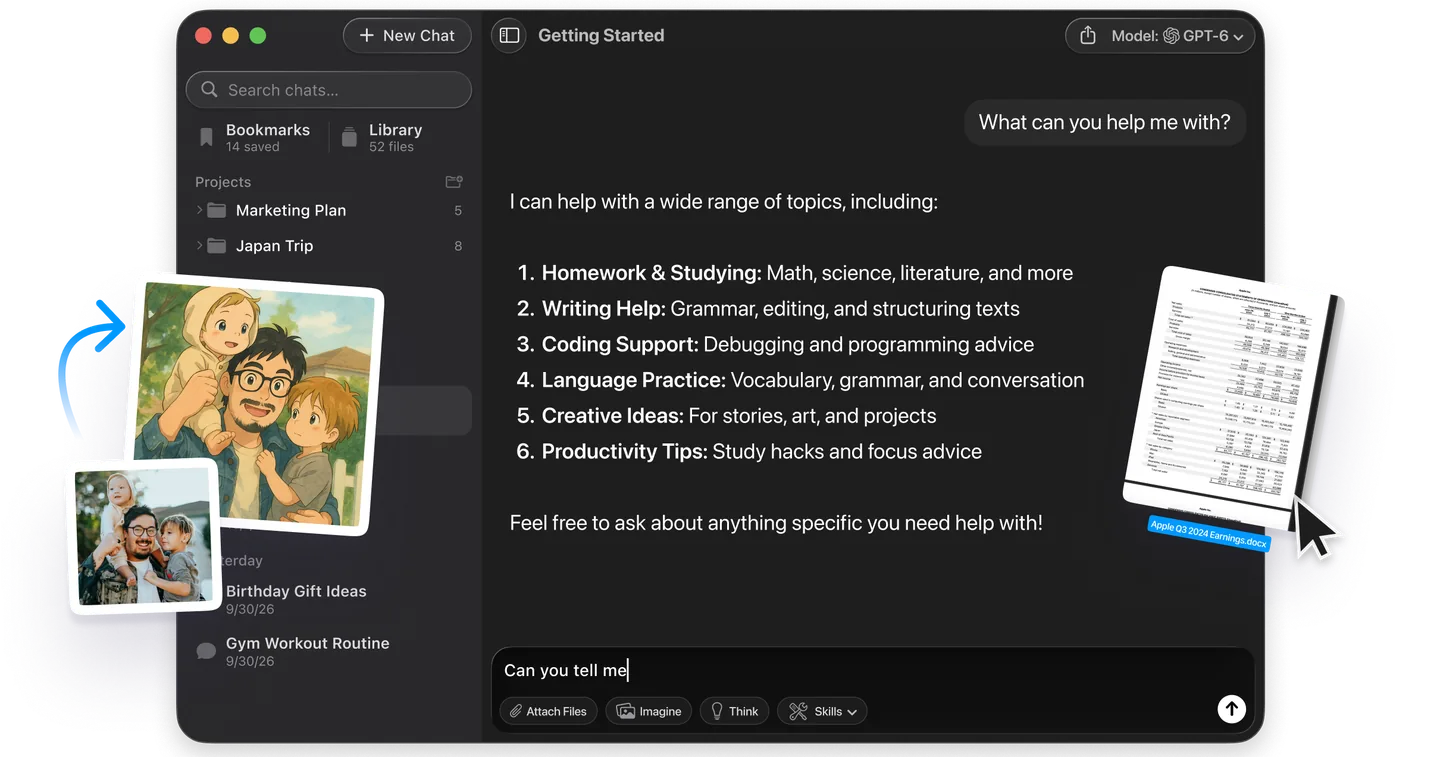
If you want the “think step-by-step” benefits without switching apps, Fello AI bundles all the top models (OpenAI, Anthropic, Google, xAI/Grok, DeepSeek, Perplexity, more) in one place and adds a single-tap Reasoning Mode (“Think”). Recent release notes explicitly say “Added Reasoning Mode to all major models,” and the composer puts Imagine and Think right next to the input bar for quick toggling. That means you can turn on deeper reasoning for GPT, Claude, Gemini, Grok, etc., without changing your prompt style. Web search is no longer a switch you manage: since version 6.8.0, Adaptive Search decides per message whether an answer needs live data, and the Online Search and Deep Research skills stay in the skills dropdown as manual overrides.
Under the hood, Fello AI also keeps up with the newest reasoning-centric models—its April update added OpenAI’s o3-mini and DeepSeek R1, plus LaTeX for math. So if your use case leans on careful multi-step logic, you can pair the app’s one-click “Think” switch with models purpose-built for reasoning. Fello runs on Mac, iPhone, and iPad, so you can keep the same workflow across devices.
Conclusion
AI is making a huge leap from being a simple text generator to becoming a genuine “thinking” partner. We’ve seen how human reasoning, our ability to use deductive, inductive, and abductive logic, is now being simulated by AI.
Models like OpenAI’s o3, Google’s Gemini, and open-source options like DeepSeek R1 aren’t just predicting the next word. They are running internal “chains of thought,” verifying their own work, and even using tools to get you a more accurate answer.
This shift isn’t just a technical upgrade; it changes how we can use these tools every day. By understanding that AI can “reason,” you can move beyond asking it for simple facts. The next time you’re stuck on a complex problem, whether you’re planning a budget, trying to understand a scientific concept, or comparing two difficult choices, challenge your AI assistant.
Give it a prompt that asks it to “think step-by-step,” “compare the pros and cons,” or “check its own work.” You’re no longer just talking to an autocomplete; you’re using a powerful reasoning tool.
Frequently Asked Questions (FAQ)
What’s the difference between critical thinking and reasoning?
Think of reasoning as the tool and critical thinking as the skill. Reasoning is the process of drawing conclusions (like using deduction or induction). Critical thinking is the larger skill of using those tools to analyze facts, spot biases, and form a sound judgment.
Can you give simple examples of deductive vs. inductive vs. abductive reasoning?
- Deductive (Rule to Case): “The company manual says all employees get Friday off. I am an employee. Therefore, I get Friday off.”
- Inductive (Case to Pattern): “The last four times I ordered from this shop, it arrived in 2 days. My new order will probably arrive in 2 days.”
- Abductive (Best Guess): “My phone is dead and the power is out in the whole house. The most likely reason is a storm knocked out the power grid.”
What is a reasoning model in AI?
A reasoning model is an AI (like o3, o4-mini, or DeepSeek R1) that is specifically built to “think” step-by-step before it answers. Instead of just predicting the next word, it works through the problem on a hidden “scratchpad” to give you a more logical and accurate solution.
What are “reasoning tokens” in AI? Do I see them?
A “token” is a piece of a word. A reasoning model uses extra tokens (and extra compute time) to “think” internally on its hidden scratchpad. You, the user, do not see these hidden “thinking” tokens. You only see the final answer, which is why a hard question might take an AI a few seconds longer to answer.
Chain of Thought (CoT) vs. Tree of Thoughts (ToT): Which works better?
- Chain of Thought (CoT) is like following a simple recipe. The AI does one step, then the next, then the next, in a single line. It’s best for problems with a clear path, like a math equation.
- Tree of Thoughts (ToT) is like brainstorming. The AI explores multiple “what if?” paths all at once. It’s better for complex problems where there’s no single right answer, like planning a big project or coming up with new ideas.