The Key Takeaways
Use ChatGPT to understand, plan, and improve your homework. Never to copy-paste a finished answer. Always follow your school’s AI rules and keep your own brain in charge.
- Helper, not ghostwriter: You can use ChatGPT in 2026 to explain concepts, brainstorm, and edit, but not to submit its text as your own.
- Which model you get: in chat, Free and Go run GPT-5.6 Luna and Plus adds GPT-5.6 Sol, which is where the heavier reasoning lives. GPT-6 Astra, OpenAI’s newest flagship, reaches the chat window only as GPT-6 Pro on the Pro plans.
- Safe workflow: Clarify task → Learn concept → Outline → Draft (yourself) → Feedback → Check facts.
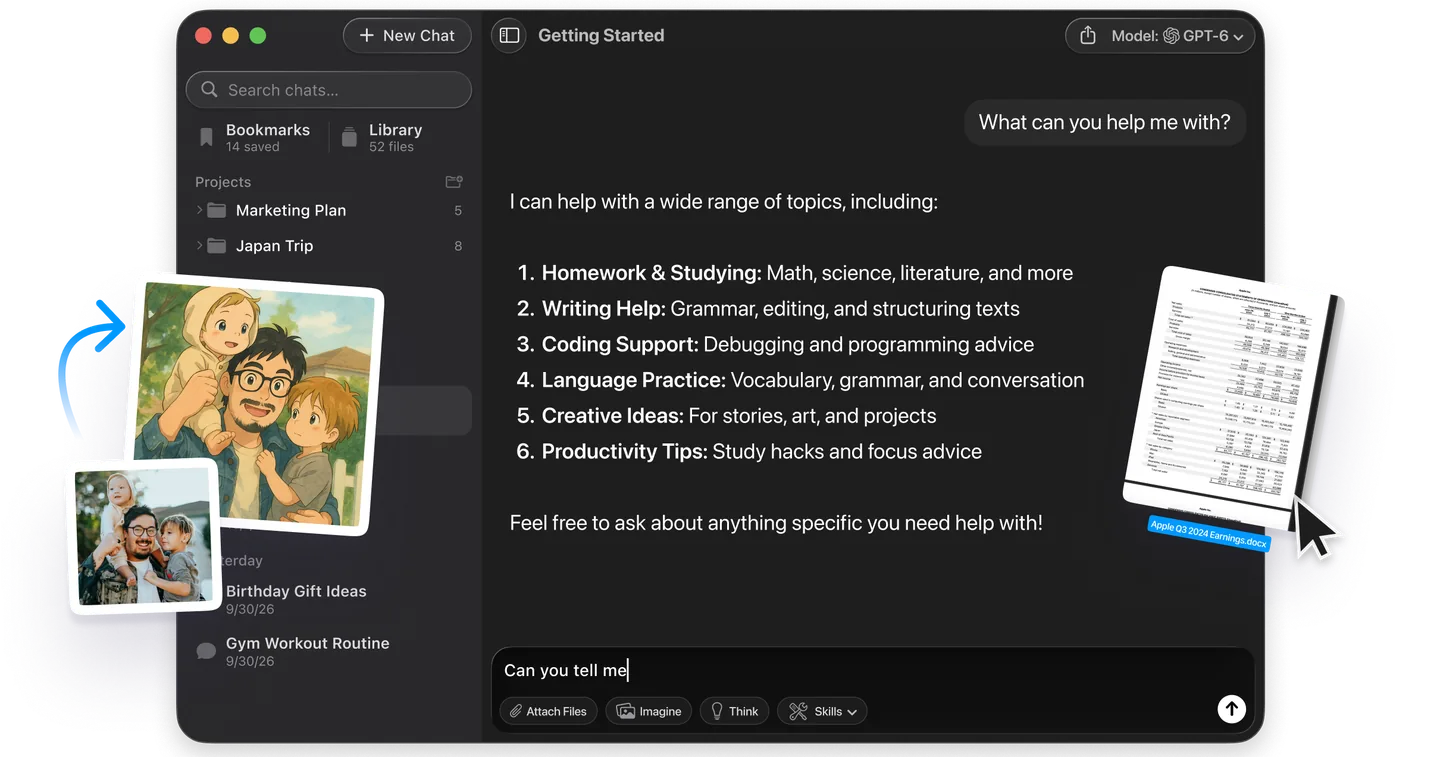
- Fello AI advantage: On Mac, iPhone, and iPad, Fello AI lets you switch between models (ChatGPT, Claude, Gemini) and chat with PDFs in one place.
- Academic integrity: Always follow your school’s policy, acknowledge AI use, and never rely on AI alone for facts.
Mini steps table for using ChatGPT on homework
| Step | What you ask ChatGPT | What you do yourself |
|---|---|---|
| 1. Clarify | “Here is my assignment. What are the key tasks and constraints?” | Read your instructions, highlight key requirements. |
| 2. Learn | “Explain this topic in simple words with 2–3 examples.” | Take notes, compare with textbook/lecture. |
| 3. Plan | “Help me brainstorm ideas and an outline for this assignment.” | Pick ideas you like, reorder them, add your own. |
| 4. Draft | “Here is my outline. What should each paragraph cover?” | Write the draft in your own words, offline if needed. |
| 5. Improve | “Review my draft for clarity and logic. Where can I improve?” | Edit based on feedback, keep your own voice. |
| 6. Check ethics | “My school’s policy says X. Is my use of ChatGPT okay?” | Follow school rules; mention AI help if required. |
Why this is worth getting right
ChatGPT is now one of the most widely used study tools on the planet, with hundreds of millions of people using it every week for everything from coding to creative writing. For students, that means you now have a powerful on-demand tutor that never sleeps and usually answers in seconds. We cover the dedicated study setting in our ChatGPT Study Mode guide.
At the same time, schools and universities are loudly talking about academic integrity, AI-generated plagiarism, and what counts as cheating. Research since 2024 keeps finding the same pattern: ChatGPT can boost learning and motivation, but only when it is used as an aid, not a replacement for thinking. Before submitting, you can check your essay with an AI detector to see what teachers might flag.
This guide walks you through how to use ChatGPT (and Fello AI) for homework in 2026 safely and effectively: to understand harder topics, plan essays, practice math and coding, and still stay on the right side of your teacher, your school’s policy, and your future self.
How does ChatGPT work?
ChatGPT is a conversational AI built by OpenAI that can understand and generate human-like text, and more recently, work with images, code, and even voice. Since its launch in 2022, it has gone through several generations of GPT models, each bringing better reasoning, language fluency, and safety. ChatGPT operates based on a language model architecture developed by OpenAI, known as the Generative Pre-trained Transformer (GPT). That is GPT with a P, not the “ChatGBT” spelling that tops the list of most misspelled AI names.
As of September 2026, on OpenAI’s own plan comparison:
- Free plan: you get GPT-5.6 Luna, which is fast, handles everyday schoolwork, and costs nothing, with unlimited everyday text chats. The Go plan runs the same model, and on both a Think button gives Luna more time on a hard question. Both plans can also try the newer GPT-6 Luna in the desktop app, though not in chat yet.
- Paid plans: Plus unlocks GPT-5.6 Sol, with the Medium and High thinking levels for heavy reasoning and coding, and adds GPT-6 Astra inside ChatGPT Work and Codex, not in the chat window. Pro adds Extra High and a Pro option that runs GPT-5.6 Sol Pro or GPT-6 Pro, the chat version of Astra, on a weekly allowance.
- Multimodal: ChatGPT handles text, images, and long documents, which mirrors the complexity of modern homework assignments.
For you as a student, the important part is not the exact version number, it is that the models are now strong enough to explain most school topics clearly, spot mistakes, and help you plan complex work.
Is it okay to use ChatGPT for homework
Short answer: it can be okay if you use it like a tutor, not like a ghostwriter. Most recent academic papers and university guidelines roughly agree on three main points.
Use AI as an aid. You are expected to still learn the material and be able to explain your work. It is a substitute for a tutor, not a substitute for your own understanding.
Be transparent and follow rules. Some teachers allow AI for brainstorming and language help, while others only permit it for proofreading. Always check the syllabus, because where the line sits on homework is set by your instructor rather than by your school. If you are unsure, ask yourself: Would I feel comfortable showing my teacher the exact ChatGPT conversation? If the answer is “no,” you are likely in risky territory.
Avoid plagiarism and misrepresentation. Passing AI-written text off as fully your own, or fabricating citations suggested by AI, is academic misconduct.
What other AI tools can help with homework
Beyond the standard free versions, several major platforms offer special grants, extended trials, and student-specific tiers to make advanced AI accessible for education. Here is a breakdown of the best current deals:
| AI Tool | Best For | Student Perks & Deals | Link |
|---|---|---|---|
| Google Gemini | College Students | 12 months free: eligible US college students get a year of Google AI Pro, normally $19.99/month, with Gemini 3.1 Pro and 5 TB of storage. Students in 140+ other markets get a year of AI Plus. Both windows close 31 December 2026. | Claim Student Offer |
| Microsoft & GitHub Copilot | Coding & Writing | Free access: GitHub Copilot is free for verified students, teachers and open-source maintainers. Microsoft Copilot Chat is free to higher-education students, faculty and staff on a school Microsoft 365 A1, A3 or A5 licence. | Get Student Pack |
| Perplexity Pro | Research & Citations | Half price, plus a free month: Education Pro is $10/month for verified students and teachers, and SheerID verification gets you one free month of Pro. Carrier and device bundles rotate, and most of the old free-year windows have closed. | Check The Free Offer |
| ChatGPT Plus | College Students (US) | 4 months free: verified US college and graduate students get four free monthly billing periods of ChatGPT Plus, normally $20/month, if they claim by 31 October 2026. A payment method is required, and Plus billed through the App Store or Google Play does not qualify. | Claim Student Offer |
| ChatGPT | Teachers (US K-12) | Free licence: OpenAI gives verified US K-12 educators a free education-grade workspace with unlimited messages and FERPA-aligned privacy through June 2028. | Claim Your Teacher Offer |
Securing access to these tools is just the first step. Once you have these powerful assistants at your fingertips, the immediate benefit isn’t just about getting answers it’s about having a study partner that can adapt to your learning style, check your code, or help you organize your research notes.

How Can Chat GPT Help Students
ChatGPT is excellent at taking a confusing topic and rephrasing it in simple words with examples then gradually raising the level back up.
- Ask for explanations “like I’m 12” and then “like I’m in grade 11 physics.”
- Request multiple analogies until one clicks.
- Compare definitions from your textbook with AI explanations to see connections.
Use Search and Thinking modes strategically
Modern ChatGPT tools often have specialized modes that are crucial for accuracy:
Thinking Mode (Reasoning): Give ChatGPT more thinking time for math, physics, and coding. On Plus, pick Medium or High on the Thinking slider; since 14 September 2026 Instant no longer steps up on its own, so you have to choose. On Free and Go, tap Think. These take longer to reply because they “think” through the problem step-by-step, drastically reducing simple logic errors. The gap between models is widest here, so it is worth knowing which math-specific AI tools actually get the answer right before you copy anything down. Physics shows the effect most clearly: in our guide to the best AI for physics, GPT-6 Sol scores 4% on research-level problems with reasoning off and about 31% at its highest setting.
Search (Web Browsing): Always enable this for history, current events, or finding real sources. Without it, the AI relies on its training memory, which can be outdated or hallucinate fake citations.
Better outlines and study plans
AI is very good at structuring messy thoughts. You can turn assignment instructions into a checklist, turn scattered ideas into a logical outline, or turn a test date into a mini study schedule. You stay in control by choosing what to keep or remove. Since 22 September 2026 ChatGPT can also turn your notes into interactive flashcards on every plan, saved to your library for the next session, and it can quiz you inside the conversation, which beats rereading as a revision loop.
Writing feedback and language practice
For essays and reports, ChatGPT can suggest clearer topic sentences, point out gaps in arguments, and help with grammar. Always keep your own tone and avoid “accept all” on big rewrites to prevent your text from sounding generic or “AI-ish.”
Practice problems for math and coding
Models are now much better at step-by-step reasoning.
- Math: Ask for practice problems with detailed solutions, or paste your solution and ask, “Check my reasoning, but do not give the answer unless there is a mistake.”
- Coding: Ask “What is wrong with this code?” rather than “Write the whole program.”
Fello AI Tip for Mac and iPhone
In Fello AI, you can pin your “Homework helper” chats and switch between the current OpenAI, Anthropic and Google models inside one app. This is handy when you want to compare explanations or code suggestions from different AIs without switching tabs.

Step by step to use ChatGPT for homework
Using AI effectively requires a structured approach. Instead of jumping straight to the answer, follow this six-step process to ensure you actually learn the material while keeping your work original and ethically sound.
1. Prepare your assignment and rules
Before opening ChatGPT, read the assignment sheet carefully. Note the format, deadline, and allowed sources. Check your school’s AI policy regarding brainstorming or debugging. You can paste the instructions into ChatGPT and ask it to “Summarize the key tasks and constraints in 5 bullet points,” but always double-check this against the original sheet.
Always keep in mind that the better prompt you write, the better result you get.
2. Learn the concepts with ChatGPT
Use ChatGPT as a concept explainer. Ask for simple language explanations of complex topics (e.g., photosynthesis) or request examples of thesis statements. Take notes in your own words and compare them to your textbook to ensure you aren’t relying solely on AI.
3. Plan the homework with an outline
Ask ChatGPT to help structure the work based on your notes and assignment constraints. Ask for a clear outline including an intro, body sections, and conclusion. You must then edit the outline, adding your own examples and removing parts that don’t match your teacher’s requirements.
4. Draft in your own words offline
Close ChatGPT or stop asking for generation. Write the draft using your outline as a roadmap. Write in your own style and phrasing. This step is crucial for learning and avoiding AI-style writing patterns that teachers might flag.
5. Ask for feedback and improvements
Once you have a full draft, paste it into ChatGPT with a focused request like, “Check this essay for clarity and structure. List the 5 biggest issues.” Apply suggestions selectively. If ChatGPT adds new facts, verify them before keeping them.
Some people think that being rude to ChatGPT brings better results. You can try it.
6. Final checks and ethical sanity check
Before submission, fact-check all dates, formulas, and statistics. Never copy AI-invented references, only cite sources you have verified exist. If required, add a note in your methodology stating, “I used ChatGPT for brainstorming and language editing.”

ChatGPT Homework Examples
Let’s see how ChatGPT or Fello AI handles homework. First, we tried a basic physics question from high school. If you want the single tutor-role prompt that sets this up, rather than the six-step workflow above, it is broken down in our guide to the ChatGPT homework prompt that actually works.
A physics problem
Question: “A box pushes down on a table with a force of 100N. The pressure it causes is 15 N/m². How big is the bottom of the box touching the table?”
ChatGPT’s Answer: “You can find out by dividing the force by the pressure. So, 100 N divided by 15 N/m² gives 6.67 m².” ChatGPT got it right and even showed how it figured it out, which teachers usually want to see.
A maths explanation
Question: Explain me pythagoras theorem please
ChatGPT’s Answer: Pythagoras theorem is a fundamental concept in geometry that relates to the relationship between the sides of a right-angled triangle. In a right-angled triangle, which is a triangle with one angle measuring 90 degrees, the theorem states that the square of the length of the hypotenuse (the side opposite the right angle) is equal to the sum of the squares of the lengths of the other two sides.
Mathematically, the theorem can be expressed as:
a² + b² = c
Where:
- c is the length of the hypotenuse
- a and b are the lengths of the other two sides (the legs of the triangle)

An essay outline
Next, we asked ChatGPT to write a short essay.
Prompt: “I need a help with writing an essay about life of Winston Churchill.”
ChatGPT’s Answer: “Certainly! I’ll be happy to assist you with writing an essay about the life of Winston Churchill. Here is an outline that you can use as a starting point:
1. Introduction
- Provide a brief overview of Winston Churchill and his significance.
- Hook the reader with an interesting fact or quote related to Churchill.
2. Early Life and Background
- Describe Churchill’s birth, date of birth, and place of birth.
- Discuss his family background, including his parents and any notable influences.
- Highlight any key events or experiences from his early years that shaped his character. ”
We’ve shortened the answer here, but you see where it’s going.

Ethical Concerns with ChatGPT
How is AI affecting schools and students?
Bias in Data: Chat GPT learns from vast amounts of text. If this data has biases, Chat GPT might show those biases too. This can be unfair, especially for certain groups. Using varied and unbiased data is key.
Misuse: Since Chat GPT creates human-like text, some might use it wrongly, like spreading false info or pretending to be someone else. It’s essential to guard against this and hold wrongdoers accountable.
Privacy & Security: There’s a risk that Chat GPT might share sensitive info by mistake. Plus, its outputs could help track people. Strong privacy measures are a must to keep user data safe.
Everyone’s Role: Developers should train Chat GPT responsibly and add safety features. Users need to use it wisely. Society should think about the tech’s impact and maybe make rules about how it’s used.
Conclusion
As we delve deeper into the age of AI, tools like ChatGPT and Fello AI stand as testaments to the limitless possibilities of technology. They undeniably revolutionize our approach to learning, communication, and problem-solving. The brilliance of such platforms offers boundless potential, but, as with all revolutionary tech, it does bring to light certain ethical conundrums. Can we truly eradicate biases from these systems? How will the lines between human and machine blur in the coming years?
In the end, the future of ChatGPT and similar AI tools rests not just on technological advancements but on the wisdom with which we wield them. As we integrate these tools more into our daily lives, it begs the question: How will we balance the vast benefits they offer with the responsibilities they entail? Only time, and our collective decisions, will tell. If you study on a Mac, our guide to the ChatGPT desktop client for Mac covers keeping ChatGPT one shortcut away from your notes.
FAQ
Is using ChatGPT for homework cheating?
It can be cheating if you copy-paste AI-generated work and submit it as your own, especially if forbidden by your school. It is usually acceptable to use it for clarifying concepts or brainstorming, provided you do the real thinking.
Can teachers tell if I used ChatGPT?
Detection tools are imperfect, but teachers can often spot a mismatch between your usual writing level and the submitted work, or catch fabricated references. The safest path is ethical use and transparency.
Should I mention ChatGPT in my assignment?
If your institution asks, briefly describe how you used AI (e.g., “for brainstorming”). If unspecified, follow general citation rules. When in doubt, be transparent.
Can I use ChatGPT during online exams?
Usually no, unless explicitly allowed. Most exams treat AI tools as outside help.
Is ChatGPT safe for my personal data?
OpenAI and apps like Fello AI provide privacy settings. However, you should avoid sharing full names, student IDs, or sensitive data in homework chats. You can ban AI from training on your data.
Methodology and sources
This update is based on:
- OpenAI documentation: the published plan comparison for the GPT-5.6 and GPT-6 model families and the ChatGPT release notes, read 25 September 2026.
- Usage Statistics: Reports from Business Insider regarding weekly active users and multimodal feature rollouts.
- Academic Research: Peer-reviewed research (Frontiers) on AI in education, focusing on ethical use and plagiarism risks.
- Fello AI Data: Official specifications regarding supported models, platforms, and features like multi-file analysis.
The recommendations are designed to hold through the 2026–2027 school year, focusing on workflows (aid-not-substitute) rather than specific model versions.