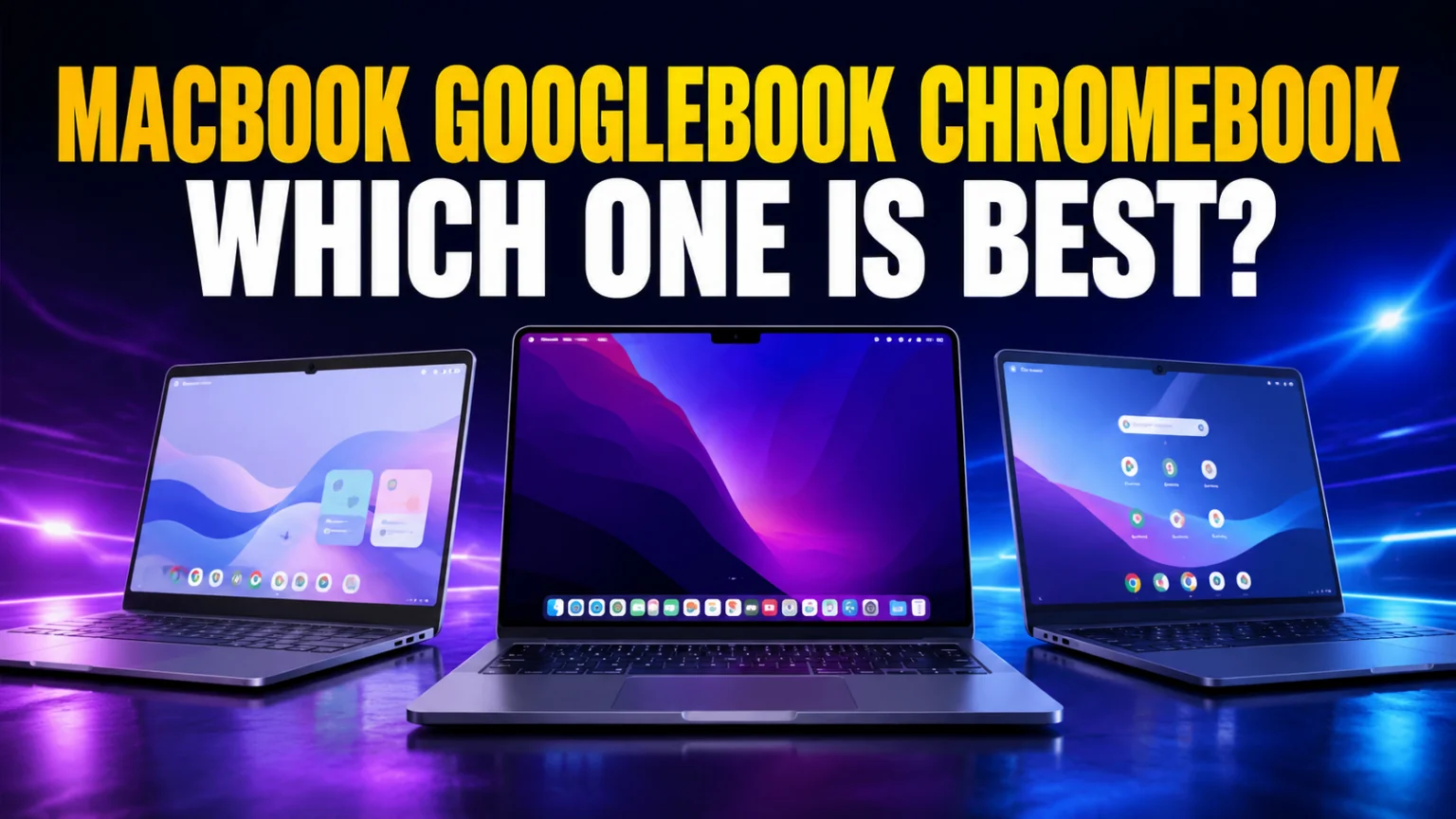
The MacBook vs Googlebook vs Chromebook question changed twice in 2026, and both changes went against what this comparison first said. Apple raised the price of every Mac on 25 June 2026 because of the AI memory shortage. The MacBook Air M5 now starts at $1,299 instead of $1,099, and the MacBook Neo costs $699 instead of $599. Google’s Googlebook is still not on sale; its official site says only “Coming fall 2026” and still lists no price.
The second change matters more than the money. Apple and Google confirmed that the next generation of Apple Foundation Models will be built on Google’s Gemini. The old “Apple AI versus Google AI” choice this article was built around no longer describes reality. Below we compare what each laptop costs today, what AI you actually get on each one, and exactly which Siri features the memory bar does and does not gate. We also correct several figures this article previously got wrong.
The Key Takeaways
- MacBook Air M5 starts at $1,299 (13-inch) and $1,499 (15-inch), both with 16GB unified memory and a 512GB SSD. Education pricing is $1,199 and $1,399.
- MacBook Neo is $699, not $599, and education pricing is $599, not $499. The $499 figure was wrong and we have removed it.
- The MacBook Neo does run the new Siri. Apple lists MacBook Neo (A18 Pro) among the supported devices. Its 8GB costs it only two extras, expressive Siri voice and advanced dictation, which need M3 or later and 12GB.
- Googlebook is still unreleased and unpriced, shipping fall 2026 through Acer, Asus, Dell, HP and Lenovo. Google has never named which Gemini model powers it.
- Chromebooks run $179 to $799 on Google’s own shop, so the cheapest Chromebook still undercuts the cheapest Mac by about $520.
What Is a Googlebook?
A Googlebook is Google’s new line of premium AI-native laptops, announced on 12 May 2026 and still not on sale. It is built around Gemini Intelligence, an operating-system-level AI layer, and hardware comes from Acer, Asus, Dell, HP and Lenovo. Google has not disclosed pricing or detailed specs, and Googlebook’s official site remains an email signup form rather than a store.
The headline feature is the Magic Pointer, a cursor that turns whatever you point at into a Gemini query. Google describes it as select anything to ask, compare, or create with Gemini. Two other features are confirmed on Google’s own site, Create My Widget, which builds a custom widget from a plain-English request, and Cast My Apps, which mirrors your Android phone apps onto the laptop.
Is the Googlebook a Chromebook?
No. Googlebook is positioned as the premium AI-first successor to Chromebook, not a rename. Chromebook continues as the budget line and Google still sells and promotes it. Googlebook sits above it as Google’s MacBook competitor, with premium hardware and Gemini built into the system layer rather than bolted onto the browser.
When Does the Googlebook Launch and How Much Will It Cost?
Googlebook ships in fall 2026, and that is all Google has committed to. As of 29 July 2026 there is no announced price, no chip, no memory figure and no battery rating for any partner device. Several sites are circulating a “starts above $999” number; Google has not published it, so we are not repeating it as fact.
That silence is itself useful information. A laptop line launching in roughly two months with no published pricing is not a device you can plan a purchase around today.
Treat the autumn window as the only firm fact Google has given you.
What Is Aluminium OS?
Aluminium OS is the reported name for Google’s new desktop operating system, built on the Android stack with a real window manager, a taskbar and Gemini integrated throughout. Worth flagging honestly, Google does not use the name “Aluminium OS” anywhere on the Googlebook site or in its announcement post. The name comes from reporting around the Android Show, so treat it as a working codename rather than a confirmed product name.
Which Gemini Model Actually Powers It?
This article previously said Googlebook runs on Gemini 3.5. That was wrong on two counts and we are correcting it. First, Google has never named a Gemini version for Googlebook. Second, the model we named does not exist in the form we implied, because Gemini 3.5 Pro was never released and remains in limited partner testing.
Google’s Pro track is frozen at Gemini 3.1 Pro, while the Flash track has moved on to Gemini 3.6 Flash, released on 21 July 2026. If you want the current state of the line, our full Gemini model comparison tracks every shipped version.
What Is the MacBook in 2026?
The MacBook in 2026 means one of two Apple laptops. The MacBook Air M5 launched in March 2026, and the MacBook Neo, Apple’s entry-level Mac, shipped on 11 March 2026. Both run macOS Tahoe today, and both will move to macOS 27 Golden Gate when it ships this autumn.
MacBook Air M5
Apple’s mainstream laptop, now starting at $1,299 for the 13-inch and $1,499 for the 15-inch. The M5 pairs a 10-core CPU with a GPU that carries a Neural Accelerator in every core, which Apple says delivers up to 4x faster on-device AI than the M4. Both sizes ship with 16GB of unified memory and a 512GB SSD as standard, double the M4 storage baseline.
Battery is rated at 18 hours of video streaming and 15 hours of wireless web, which is the honest number to plan around. Memory upgrades run $200 per 8GB, so 24GB on the 15-inch costs $1,699. For a full breakdown of which configuration suits local AI work, see our best MacBook for AI buyer’s guide.
The Air is the safest default in the range.
MacBook Neo
The MacBook Neo is Apple’s cheapest Mac at $699 for 256GB and $799 for 512GB. It is the first Mac since the Apple Silicon transition to ship with an A-series chip, the A18 Pro, rather than an M-series. Base configuration is 8GB unified memory with a 6-core CPU and 5-core GPU, and battery is rated at 16 hours of video streaming and 11 hours of wireless web.
That 8GB figure is not a footnote. It is the spec that decides whether this machine gets Apple’s newest AI features, and as the next section explains, it does not.
Read the memory line, not the price line.
Should You Wait for the M6?
For the Air, waiting is reasonable. Apple’s roadmap puts the M6 MacBook Air in early 2027 and an M6 14-inch MacBook Pro in autumn 2026, and no M6 Mac is on sale today. If your current laptop still works, the entry-level tier is the one worth holding out on.
For the high end the answer inverts. Apple is reported to be skipping the M6 Pro and M6 Max tiers entirely, with the next high-end parts arriving as M7 Pro and M7 Max in late 2027 or 2028. Anyone shopping at the top of the range is not waiting a few months, they are waiting closer to eighteen.
MacBook vs Googlebook vs Chromebook: The 2026 Comparison
Here is the full side-by-side, with MacBook Neo as a fourth column because most people asking this question are price-shopping. Every Apple figure below was checked against Apple’s store on 29 July 2026.
| Feature | MacBook Air M5 | MacBook Neo | Googlebook (fall 2026) | Chromebook |
|---|---|---|---|---|
| Starting price | $1,299 (13in) / $1,499 (15in) | $699 | Not announced | $179 to $799 |
| Education price | $1,199 / $1,399 | $599 | Not announced | Varies by reseller |
| OS | macOS Tahoe | macOS Tahoe | Android-based desktop OS | ChromeOS |
| Chip | Apple M5 (10-core CPU, Neural Accelerator per GPU core) | Apple A18 Pro (6-core CPU, 5-core GPU) | Not announced | Low-power x86 or ARM |
| RAM (base) | 16GB unified | 8GB unified | Not announced | 4GB to 8GB |
| Storage (base) | 512GB | 256GB | Not announced | 32GB to 256GB |
| Runs the new Siri | Yes | Yes, minus expressive voice and advanced dictation (needs 12GB) | Not applicable | Not applicable |
| AI assistant | Apple Intelligence | Apple Intelligence (base tier) | Gemini Intelligence | Gemini in Chrome |
| Signature AI feature | On-device writing tools plus the full new Siri | On-device writing tools plus the new Siri | Magic Pointer, Create My Widget | Web-based Gemini |
| Battery (video) | 18 hours | 16 hours | Not announced | 10 to 12 hours |
| Multi-model AI access | Yes via Fello AI | Yes via Fello AI | Gemini only at launch | Limited |
| Available | Now | Now | Fall 2026 | Now |
Apple Intelligence vs Gemini Intelligence
This is where the comparison has changed most, and where this article needs to correct itself. The original version framed the choice as privacy-first Apple on one side against cloud-first Google on the other. That framing is no longer accurate.
The two companies settled it themselves. In a joint statement from Google and Apple published on 12 January 2026, they confirmed that the next generation of Apple Foundation Models will be based on Google’s Gemini models and cloud technology. Those models power future Apple Intelligence features, including a more personalised Siri. Reporting from CNBC and Bloomberg puts the deal at roughly $1 billion a year, though that figure is not in the joint statement itself.
So the real 2026 question is not whether you want Apple’s AI or Google’s AI. It is which company’s hardware and privacy handling you prefer wrapped around what is increasingly the same underlying model family.
What Apple Intelligence Gives You
Apple Intelligence still runs on-device where it can, routing heavier work to Private Cloud Compute, and Apple maintains that no one including Apple can read what you send. You get Writing Tools across apps, Image Playground, Genmoji, notification summaries and the rebuilt Siri. Our is Apple Intelligence worth it guide covers whether the feature set justifies the hardware.
The next-generation Siri arrived with macOS 27 Golden Gate, whose public beta opened on 13 July 2026 ahead of a full release this autumn. Our macOS 27 Golden Gate guide covers what is testable now.
What the 12GB Memory Bar Actually Gates
This line gets misreported more than any other spec in the lineup, including by an earlier version of this article. Apple does publish a requirement of a Mac with M3 or later and at least 12GB of unified memory, and the MacBook Neo has an A18 Pro chip and 8GB, so it does not meet it.
That requirement does not gate Siri AI as a whole. Apple’s own device list names MacBook Neo (A18 Pro) among the machines that run the current Apple Intelligence and Siri generation, alongside every Mac with M1 or later. The Neo gets the rebuilt assistant, personal context, onscreen awareness, web answers, the standalone Siri app and Writing Tools.
What the 12GB bar restricts is a narrower pair of features. Those are the ability to customise the expressiveness and pace of Siri’s voice and higher-accuracy on-device dictation that handles punctuation and formatting as you speak. The same bar excludes the standard iPhone 17 for the same 8GB reason.
Two corrections, then. Our earlier table listed on-device Siri 2.0 as a Neo feature, which was the wrong label. A later version of this article then said the Neo cannot run the new Siri at all, which overstated it in the other direction and pushed the entry price of an AI Mac to $1,299. Neither was right.
The entry point for a Mac that runs the new Siri is the $699 MacBook Neo, not $1,299.
What Gemini Intelligence Gives You
Gemini Intelligence on Googlebook is proactive and agentic by design. It reads what is on screen, takes context from your apps and completes multi-step tasks, with Magic Pointer turning the cursor itself into a query. Most of this runs against Google’s servers, with the privacy trade-off that implies.
The catch at launch is model choice. Googlebook ships with Gemini and only Gemini, and Google has not said which version. On a Mac you can run several competing models side by side today.
What Chromebook Gives You
Chromebook in 2026 is the laptop where AI is bolted on rather than built in. You get Gemini in Chrome and some Workspace AI features, but no system-level AI layer, no on-device model and no agentic tooling. For cloud-only schoolwork and casual browsing that is fine, and the price reflects it.
Price Compared: What You Actually Pay
Prices below were checked on 29 July 2026. Apple’s are from its own store; Chromebook figures are the devices listed on Google’s Chromebook shop that day, and retailer pricing moves.
| Tier | Best pick | Price |
|---|---|---|
| Budget | Chromebook (entry) | $179 |
| Budget Mac (education) | MacBook Neo | $599 |
| Budget Mac (standard) | MacBook Neo | $699 |
| Premium ChromeOS | Chromebook Plus | $369 to $799 |
| Mainstream AI laptop (education) | MacBook Air M5 13-inch | $1,199 |
| Mainstream AI laptop | MacBook Air M5 13-inch | $1,299 |
| Premium AI laptop (fall 2026) | Googlebook | Not announced |
The honest read has shifted. At $599 against $499 we argued the Neo had erased the price argument for buying a Chromebook; at $699 against a $179 Chromebook that is no longer true. The gap is now about $520, and for a student who only needs a browser, that is a real amount of money.
What you get for the difference is macOS, the Mac app ecosystem, a far better display and a machine that stays useful for five years. That is a strong case. It is just no longer a case that the price alone makes for you. Apple’s lease route is the other way to soften the price, and our breakdown of what the Apple Upgrade Program really costs covers which Macs are eligible and which are not.
A Note on the Prices We Previously Published
Two figures in the earlier version of this article were wrong, and we would rather name them than quietly swap them out. The $1,099 MacBook Air and $599 Neo were correct when written but went stale when Apple raised Mac prices on 25 June 2026 during the memory shortage. The $499 Neo education price was never correct; Apple’s education store returns $599. Any recommendation you made on the strength of that $499 figure deserves a second look.
Get Gemini on Your MacBook Today: Fello AI
You do not have to wait for fall 2026 to run Gemini on a Mac. The Fello AI app for macOS gives you Gemini, ChatGPT, Claude, Grok and DeepSeek in one native app for $9.99 a month, on hardware you already own.
That covers the Gemini-class capability Googlebook is selling, plus four other frontier models you could not run on a Googlebook at launch even if you wanted to. Fello AI holds a 4.7-star rating across 27,000+ reviews. For a Mac-specific breakdown of how the assistants differ, see our ChatGPT vs Claude vs Gemini on Mac comparison.
Verdict: Which Laptop Wins in 2026?
The answer depends on who you are, and for one group it changed this year.
Students and College Users
The MacBook Neo at $599 with education pricing is still the best all-round pick, and it does run the new Siri. What its 8GB costs you is expressive voice and advanced dictation, which matters only if you dictate long documents. If you want those, the education-priced MacBook Air at $1,199 is the cheapest machine that qualifies. A $179 Chromebook remains the right call for cloud-only coursework and managed school fleets.
Creators and AI Power Users
The MacBook Air M5 wins today. It handles AI tasks up to four times faster than the M4, runs 18 hours on video playback, and pairing it with a multi-model app gives you every flagship model on one machine. Googlebook is worth watching, but you cannot evaluate a laptop with no published price or specs.
Professionals and Business Users
MacBook Air M5 or MacBook Pro. The ecosystem, build quality and management tooling still make the case. For security-conscious fleets, researchers demonstrated a Claude Mythos exploit targeting Apple’s M5 chip, which is worth understanding before a large rollout without changing the recommendation. Googlebook is too new to bring into a fleet on day one.
Casual Users and Home Laptops
A MacBook Neo or an entry Chromebook. If you live in Google Workspace and never install an app, a Chromebook does the job for $179. If you want a machine that is still pleasant to use in five years, the Neo is worth the extra $520.
Neither choice is wrong here. The budget is what decides it.
Anyone Curious About Gemini Intelligence
Do not buy a Googlebook at launch. Wait for pricing, real reviews and a stable first-generation OS. Until then you can run Gemini on the Mac you already own, and our best AI models for Mac in 2026 guide has the current rankings.
Conclusion
The MacBook is still the right default in 2026, but the reasoning has changed. Apple’s price rises narrowed its value advantage and Apple’s own AI now runs on Google’s models. The good news for buyers is that the cheapest Mac still runs the new Siri, so the AI entry point remains $699.
Buy the MacBook Air M5 if you want every Siri feature including expressive voice and advanced dictation. Buy the MacBook Neo if you want macOS and the new Siri at the lowest price. Buy a Chromebook if you only need a browser. Googlebook stays on the watchlist until Google publishes a price.
FAQ
Is a Googlebook the same as a Chromebook?
No. Googlebook is the premium AI-first successor to Chromebook, while Chromebook continues as the budget ChromeOS line. Googlebook is built around Gemini Intelligence at the system level and ships in fall 2026.
How much does the Googlebook cost?
Google has not announced pricing. As of 29 July 2026 the official Googlebook site is an email signup that says only “Coming fall 2026”, with no price, chip or memory figures for any partner device.
Is the MacBook better than a Chromebook in 2026?
For most people yes, but it costs more than it used to. The MacBook Neo is $699, or $599 with education pricing, against $179 for an entry Chromebook. You get macOS and a five-year machine for the difference.
Can the MacBook Neo run the new Siri?
Yes. Apple lists MacBook Neo (A18 Pro) among the devices that run the current Apple Intelligence and Siri generation, so you get the rebuilt assistant, personal context, onscreen awareness and the Siri app. Its 8GB does exclude two extras that need M3 or later with 12GB of memory, namely customising the expressiveness and pace of Siri’s voice and higher-accuracy on-device dictation.
How much does the MacBook Air M5 cost now?
The 13-inch starts at $1,299 and the 15-inch at $1,499, with education pricing at $1,199 and $1,399. Both include 16GB of unified memory and a 512GB SSD. Apple raised Mac prices across the line on 25 June 2026.
Which Gemini model powers the Googlebook?
Google has never said. Earlier reporting including our own pointed to Gemini 3.5, but Gemini 3.5 Pro was never released and remains in partner testing. Google’s shipped Flash model is Gemini 3.6 Flash, released on 21 July 2026.
Is Apple Intelligence powered by Google Gemini?
In part, yes. Apple and Google confirmed on 12 January 2026 that the next generation of Apple Foundation Models will be based on Google’s Gemini models and cloud technology. Apple Intelligence still runs on Apple devices and Private Cloud Compute.
Should I wait for the M6 MacBook?
For an Air, waiting is reasonable since the M6 MacBook Air is expected in early 2027. For high-end machines it is not, because Apple is reported to be skipping the M6 Pro and M6 Max tiers entirely, with M7 Pro and M7 Max not due until late 2027 or 2028.