Meta’s AI image generator finally has a name of its own, and it is Muse Image. Meta launched it on July 7, 2026, and it is the first image model Meta Superintelligence Labs built entirely in-house, with no outside technology underneath it. It is free to use inside the Meta AI app, Instagram Stories and WhatsApp, and it landed near the top of the public leaderboards within days.
That last point is where things get interesting, because Meta’s own announcement and the current leaderboard no longer agree. Below you get what Muse Image actually does, how free it really is, and the steps to use it on each Meta app. We also cover how it scores against GPT Image 2 and Nano Banana 2, plus the Instagram privacy setting worth checking today.
The Key Takeaways
- Muse Image launched July 7, 2026, the first image model built fully in-house by Meta Superintelligence Labs.
- It is free for everyday creation, and Meta has published no daily limit, no per-image quota and no tier name for it.
- Meta claimed No. 2 on Arena as of July 5. On the board through July 10 it sits #3 for text-to-image at 1280.4 and #2 for image editing at 1402.4.
- The Instagram @-mention feature was pulled three days after launch after CAA and SAG-AFTRA objected.
- Images made in the Meta AI app and on meta.ai carry Content Seal, a hidden provenance signal Meta says survives cropping, compression, resizing and screenshotting.
What is the Meta AI image generator?
The Meta AI image generator is Muse Image, a model that both creates and edits images from plain text prompts. Earlier Meta AI image features leaned on technology from other companies, and this one does not. TechCrunch reports it was internally code-named Mango during development.
It does not work alone. Muse Image pairs with Meta’s Muse Spark model, Meta’s multimodal reasoning model, which handles the interpretation of long or complicated prompts before any pixels get generated. The newer Muse Spark 1.1 pushed that reasoning layer considerably further.
According to Meta’s newsroom announcement, the model blends multiple photos into a single composition and renders readable text inside an image. It restores old photos and applies style transfers. It also accepts markup, so you can scribble directly on a picture to point at what should change.
What Muse Image does differently
Most image models generate once and stop. Muse Image behaves more like an agent, and the Meta Superintelligence Labs research blog describes three behaviours that set it apart.
First, it searches the web. The model grounds its images in real-time information, which Meta says improves factual accuracy on prompts involving current events. Second, it writes and runs code, which is how it produces accurate plots, charts and working QR codes rather than drawing something that merely resembles one.
Third, it self-corrects. It can make a local edit to its own draft, regenerate the image entirely, or switch to a different tactic such as tool use. Meta notes this behaviour emerged during reinforcement learning rather than being designed in.
That agentic loop is the real story here. Meta reports an approximately log-linear improvement as it spends more compute on deliberate reasoning, and says that scales considerably better than simply generating many candidates and picking the best one.
Is the Meta AI image generator free?
Yes. Meta AI with Muse Image is free for everyday creation across the Meta AI app, meta.ai, Instagram Stories and WhatsApp. Meta says heavier use falls under its subscription plans, but it has not published a per-image quota, a daily limit or a tier name for Muse Image specifically.
Meta’s exact wording: “Using Meta AI with Muse Image is free for everyday creation” and “for people who want to create even more, it’s available as part of Meta’s subscription plans.”
What Meta has not told us
This matters, because plenty of pages currently quote a specific number of free images per day. No such figure exists in any Meta source. Neither the newsroom post nor the research blog names a threshold, and neither does any of the launch-day reporting.
If you see a hard number quoted anywhere, someone invented it.
So treat the free tier the way you would treat any uncapped-but-rate-limited product. It is comfortable for normal use, and if you generate dozens in one sitting you may hit a wall that Meta has chosen not to document. If you need a documented ceiling, you need a different tool.
Meta One, the subscription that does exist
Meta does have a paid AI tier, and it is worth separating clearly from Muse Image. In May 2026 Meta announced Meta One, its subscription umbrella, and began testing two AI plans in Singapore, Guatemala and Bolivia from June 2026.
| Plan | Price | Status | What it adds |
|---|---|---|---|
| Meta One Plus | $7.99/mo | Limited test | More capacity for image and video generation, extended reasoning |
| Meta One Premium | $19.99/mo | Limited test | The same features, with more capacity on higher-compute queries |
Two warnings on that table. These are test markets, not a global rollout, so the prices may not be what you eventually see. And Meta has never stated that these tiers are what governs Muse Image’s limits, so do not read the table as the price of the image generator.
How good is Muse Image? What the leaderboards actually say
Meta’s research blog claims Muse Image took the No. 2 spot on Arena for text-to-image, single-image editing and multi-image editing, measured by human preference Elo, as of July 5, 2026. That claim was accurate when written. It has since slipped.
We pulled the Arena text-to-image leaderboard directly. On the board covering votes through July 10, 2026, Muse Image sits third for text-to-image, with Reve 2.1 ahead of it in second.
| Model | Maker | Text-to-image Elo | Image-edit Elo | Where you use it |
|---|---|---|---|---|
| GPT Image 2 | OpenAI | 1384.8 (#1) | 1465.3 (#1) | ChatGPT |
| Reve 2.1 | Reve | 1302.1 (#2) | 1383.2 (#10) | Reve |
| Muse Image | Meta | 1280.4 (#3) | 1402.4 (#2) | Meta AI, Instagram, WhatsApp |
| Nano Banana 2 | 1260.8 (#5) | 1384.8 (#9) | Gemini app | |
| MAI Image 2.5 | Microsoft AI | 1256.6 (#6) | 1401.4 (#3) | Microsoft Copilot |
Two caveats worth keeping in mind. Elo boards move as votes accumulate, and Muse Image had 8,384 votes on the text-to-image board against 60,382 for GPT Image 2, so its rating is less settled. Arena also publishes a vote cutoff per board, and a model released after that cutoff is missing because it has no votes, not because it lost.
Where Muse Image genuinely leads
Editing, not generation.
At 1402.4 on single-image editing, Muse Image is the strongest model on that board after GPT Image 2, and it beats MAI Image 2.5, Seedream 5.0 Pro and both Nano Banana Pro variants. If your work is fixing and restyling photos you already have rather than conjuring new ones, that ranking is the one that matters. For a wider view of what else is free right now, see our roundup of free AI photo generators and editors.
How to use the Meta AI image generator
There is no separate Muse Image app. The model runs inside products you probably already have, and the entry point differs on each one.
In the Meta AI app or on meta.ai
- Open the Meta AI app, or go to meta.ai in a browser.
- Type what you want in plain language, for example “make me a poster for a jazz night with readable text”.
- To edit instead of create, upload a photo first, then describe the change.
- Use the markup tool to draw on the image and point at the exact region you want altered.
Instagram Stories
- Open the Stories camera and take or select a photo.
- Look through the effects tray. Meta says Muse Image powers more than 30 new AI-powered effects for Stories.
- Tap one to restyle the photo or add generated elements before you post.
- Instagram Stories access launched in the United States first.
- Start a chat with Meta AI in WhatsApp.
- Ask for an image directly, for example “make me an image of a lighthouse at dusk”.
- Send a photo into the thread first if you want an edit, then say what to change.
- WhatsApp access rolled out in a limited set of countries, so it may not be live for you yet.
If nothing appears, country availability is usually the cause rather than a bug. Meta has said Facebook and Messenger are coming, and advertisers get access through Advantage+ creative later.
The Instagram photo problem, and the setting to check
Muse Image launched with a feature that let you @-mention a public Instagram account in a prompt and generate new images using that person’s public photos. The backlash was immediate and it was not confined to social media. Talent agency CAA and the actors’ union SAG-AFTRA both objected.
Meta pulled it on Friday, July 10, three days after launch, saying the feature “missed the mark”. That specific capability is gone.
The broader settings question did not leave with it. Meta’s own language is blunt. The company says that “people may be able to create content with your Instagram content using AI features at Meta”. It also says “you will not be notified about content created using AI features at Meta”.
So if you have a public account, open Instagram settings and look under Sharing and reuse. It takes a minute.
Worth noting that the commercial half of the launch was untouched by the reversal. The Advantage+ integration, which lets advertisers auto-generate creative variations, is proceeding as planned.
Can you tell an image came from Muse Image?
Often, yes, and this is an area where Meta is ahead of several rivals. Meta says images created by Muse Image in the Meta AI app and on meta.ai carry a hidden provenance signal called Content Seal. The mark is designed to stay intact even when an image is cropped, compressed, resized or screenshotted.
Note the scope. Meta describes that coverage for the Meta AI app and meta.ai specifically, so do not assume every image from every surface is marked.
You can check an image against it using Meta’s detection tool at meta.ai/identification. Meta has said it plans to extend Content Seal to video.
What about Muse Video?
Muse Video was announced on the same day, and it is important to be precise about its status. It was previewed, not launched. Meta describes it as coming soon to creators and Meta AI, and as of today it is not something you can open and use.
It is already rated, though.
On Arena’s text-to-video board, with votes through July 5, 2026, Muse Video ranks third at 1458.6, behind Gemini Omni Flash at 1527.5 and Dreamina Seedance 2.0 at 1481.9. Meta acknowledges gaps in audio-video synchronisation and in physically accurate fast motion. Our guide to the Meta AI video generator covers where this fits in Meta’s wider video plans.
Should you use it?
If you are already inside Meta’s apps, yes, especially for editing. It costs nothing, the editing quality sits near the top of the field, and the text rendering and QR code generation are useful in a way most free generators are not.
The reservations are about control rather than quality. You cannot see your remaining quota because Meta has not published one, Meta has not announced individual API access, output is tied to accounts on social platforms, and the privacy defaults deserve a look. If you want a clearer instead, our comparison of the ChatGPT image generator and our breakdown of whether Nano Banana is free both lay out what you actually get.
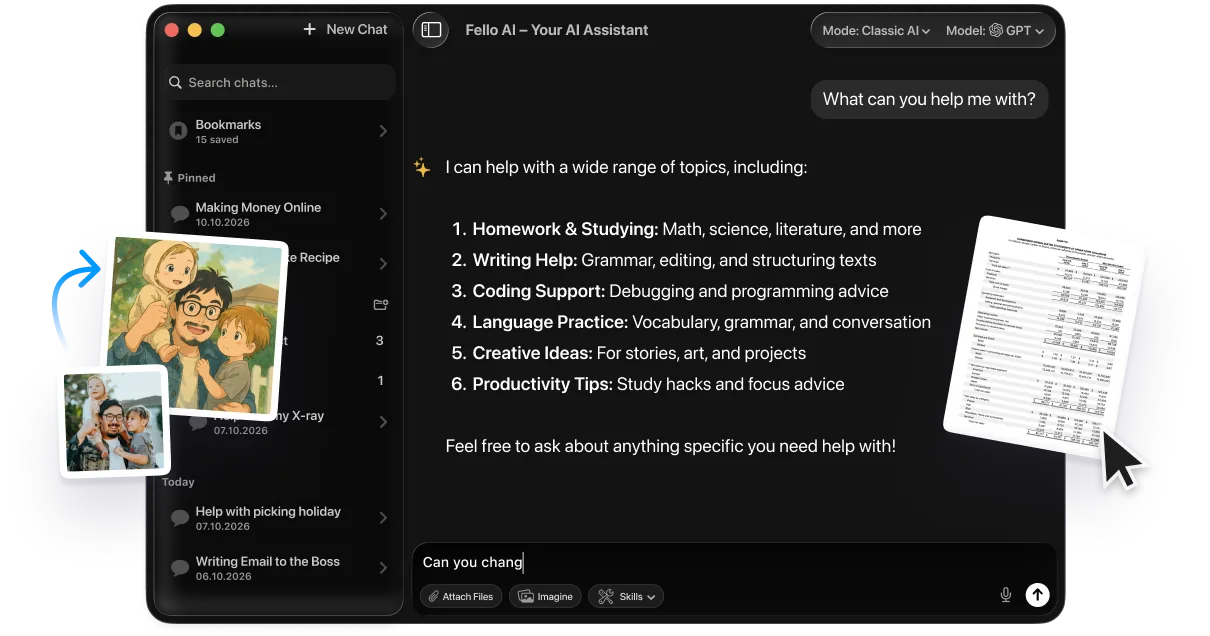
For anyone who would rather keep image generation separate from their social accounts, a desktop app like Fello AI works as a reasonable complement. It puts several leading image and text models behind one interface, with no Facebook or Instagram login attached to your work.
The bottom line
Muse Image is a strong first showing from Meta Superintelligence Labs and the most capable free image editor now sitting inside apps most people already use. Just hold Meta’s marketing loosely, since the No. 2 claim was already No. 3 for text-to-image five days later, and the free tier has no published ceiling.
Your next step takes about a minute. Open Instagram, check Sharing and reuse in your settings, then try one edit on a photo you already have rather than a prompt from scratch. That is where this model is strongest.
FAQ
Is the Meta AI image generator free?
Yes. Meta AI with Muse Image is free for everyday creation in the Meta AI app, on meta.ai, in Instagram Stories and in WhatsApp. Meta says heavier use falls under its subscription plans, but it has not published a daily limit, a per-image quota or a tier name for Muse Image.
What is the Meta AI image generator called?
It is called Muse Image. Meta launched it on July 7, 2026, and it is the first image generation model built entirely in-house by Meta Superintelligence Labs, internally code-named Mango during development.
Is Muse Image better than the ChatGPT image generator?
Not overall. On Arena’s boards covering votes through July 10, 2026, OpenAI’s GPT Image 2 leads both text-to-image at 1384.8 and image editing at 1465.3. Muse Image ranks third for text-to-image at 1280.4 and second for image editing at 1402.4.
Can people generate AI images from my Instagram photos?
The feature that let anyone @-mention a public Instagram account and generate from their photos was removed on July 10, 2026, three days after launch, after objections from CAA and SAG-AFTRA. Meta’s broader reuse settings still apply, so check Sharing and reuse in your Instagram settings.
Has Muse Video launched yet?
No. Muse Video was previewed alongside Muse Image on July 7, 2026, and Meta describes it as coming soon to creators and Meta AI. It already ranks third on Arena’s text-to-video board at 1458.6 with votes through July 5, 2026.