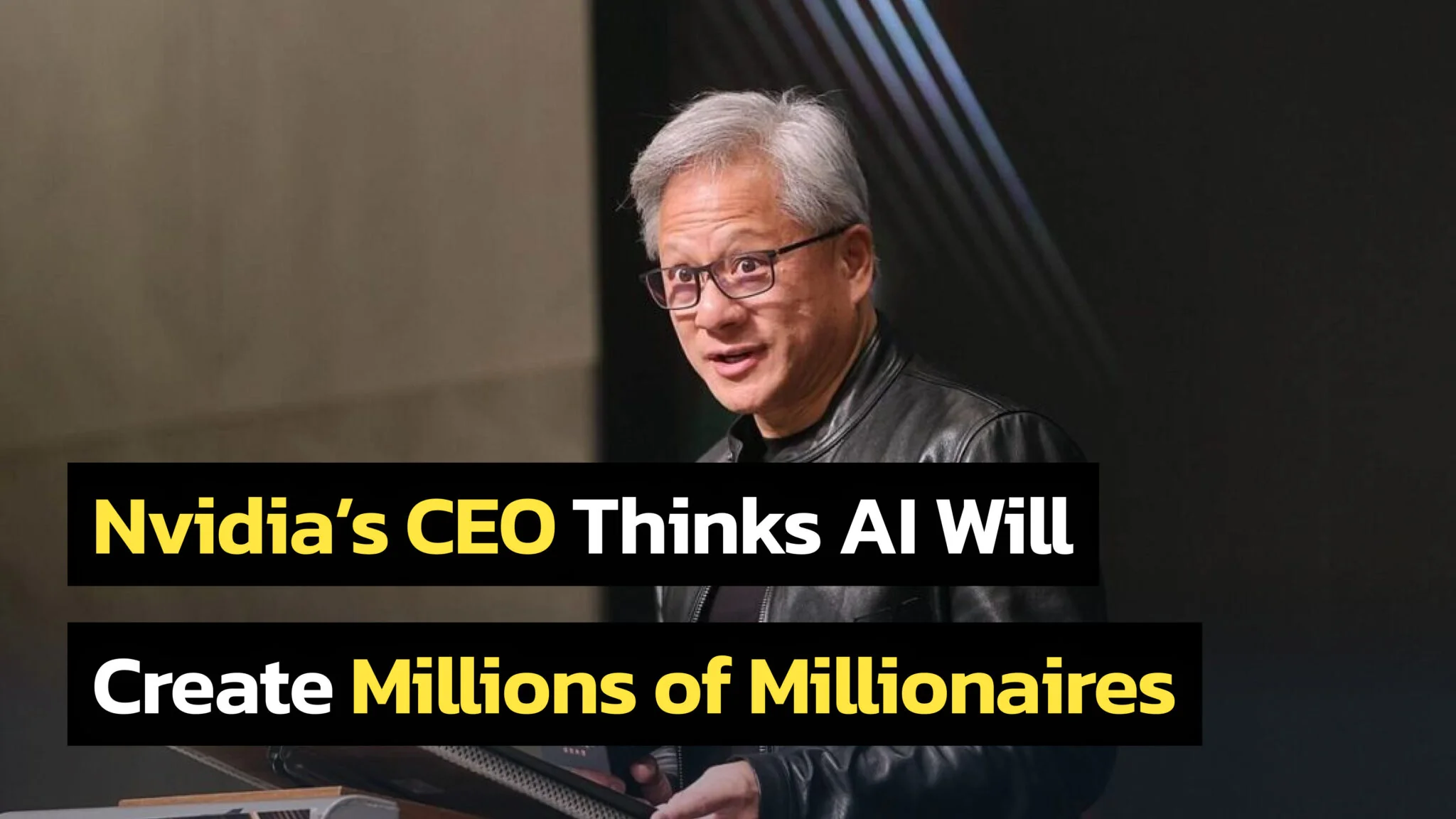
A lot of people consider the internet boom the ultimate wealth creation event in modern history. From 1995 to 2015, we watched garage startups become trillion-dollar empires and college dropouts turn into the world’s richest people. But according to Nvidia CEO Jensen Huang, we haven’t seen anything yet.
Huang recently made a prediction that stopped Silicon Valley in its tracks – “AI will create more millionaires in the next 5 years than the entire internet boom produced in 20”. This statement carries weight because Huang leads the company that powers the AI revolution, and his track record speaks for itself. We’re witnessing the biggest wealth transfer in human history unfold in front of our eyes.
The stakes couldn’t be higher. While the internet boom created unprecedented opportunities, Huang believes AI will surpass that impact in a fraction of the time. This means the window for getting involved is narrow, but the potential rewards are massive.

What Huang Said About the Future of AI
Jensen Huang’s prediction about AI creating more billionaires than the internet boom came during appearances on platforms like the All-In Podcast and the Hill & Valley Forum. These were statements made to influential tech leaders and venture capitalists who shape the industry’s direction.
Huang claims he has already created more billionaires within his own management team than any CEO in history. Which is directly correlated to the fact that under his leadership, Nvidia’s valuation skyrocketed to $4 trillion, driven by increasing demand for AI hardware and chips.
But this wasn’t Huang’s most striking claim yet. He calls AI the “greatest technology equalizer of all time,” arguing that the barrier to entry for building with AI has dropped dramatically. According to Huang, anyone can now participate in the AI economy simply by interacting with AI systems – no deep programming knowledge required.
The timeline makes his prediction quite shocking. Huang sees this massive move happening within 5 years. This compressed timeframe suggests we’re still in the early stages of something that will reshape the global economy faster than any previous technological revolution.
How AI is Creating New Millionaires
The compensation of people working in high-level AI development reveals how quickly wealth is being obtained. Elite AI researchers now command packages rivaling top athletes, with Meta reportedly offering a single AI specialist a $1 billion contract. This reflects the size of AI’s role in driving innovation across most industries.
Huang takes a hands-on approach to talent rewards, using machine learning models to evaluate all 42,000 Nvidia employees. He regularly surprises top performers with stock grants and restricted share units, understanding that keeping top-notch talent requires exceptional compensation in today’s competitive market, where the big fish poach from each other.
The opportunities extend far beyond traditional tech roles. Huang argues that “everybody’s a programmer now” because technical barriers have collapsed. You don’t need to master C++ or Python to build with AI – you just need to know how to communicate with it effectively.
This amplifies human potential across creative fields too. Huang says that “everybody’s an artist and author now” because AI tools multiply creative output by 100x. A single person with the right AI tools can produce what previously required entire teams. Ideas and creativity now matter more than technical skills, giving people who were previously locked out by educational or technical barriers the possibility to make their visions into reality.
The beauty of this democratization lies in its simplicity. Anyone can start experimenting with AI tools today and begin building valuable skills or products. The only requirement is continuous improvement and the discipline to learn how these systems work.
How AI Is Accelerating Company Growth
The most striking aspect of AI’s market opportunity lies in how small teams can generate massive value. Huang emphasizes that successful AI companies can start with mid-size teams, yet create companies worth $20-30 billion. This translates to hundreds of millions in value per person – numbers that far surpass any traditional business models.
Real examples of this are OpenAI and China’s DeepSeek. They both started with roughly 150 researchers but achieved global impact that put them at the forefront of the industry. These cases demonstrate how innovative, well-funded AI teams can quickly build projects worth tens of billions.
Companies Are Reacting
Taking all recent development into consideration, companies now face a fundamental question: why pay $20-30 billion to acquire a startup with 150 AI researchers when they could invest heavily in building such teams internally from the start?
The philosophy behind successful AI companies’ priorities focus over headcount. This creates an interesting divide in the job market. As Huang puts it: “You won’t lose your job to AI, you’ll lose your job to someone who uses AI.” The winners will be those who adapt quickly and learn to leverage AI tools effectively. The losers will be those who resist or ignore these changes.
The Impact
Huang projects the production of half a trillion dollars worth of AI supercomputers in Arizona and Texas alone within four years. This massive investment creates downstream economic opportunities across every sector as businesses need to integrate AI into their systems just to keep up.
On top of all this, Huang’s vision of every company needing “two factories” – one physical and one AI – shows the possibility of a complete restructuring of how traditional businesses operate. Tesla exemplifies this, running both automotive manufacturing and AI development operations in individual facilities.
New business models are emerging from AI integration. Companies that successfully implement AI alongside their traditional business create competitive advantages that become almost impossible to match. This new infrastructure buildout yields a massive profit for investors, developers, and service providers supporting this transition.
Conclusion
Jensen Huang’s prediction about AI creating more millionaires than the internet boom certainly grabs attention – and it should, given Nvidia’s position as the primary supplier of AI chips. His company benefits directly from AI hype, so his optimism isn’t entirely neutral.
That said, the underlying trends are real. AI is genuinely changing how small teams can create massive value, compensation for AI talent has exploded, and the technology is becoming more accessible to regular users. Whether this creates “more millionaires in 5 years than the internet in 20” remains to be seen, but the move toward AI integration across industries is undeniable.
Without betting everything on Huang’s timeline, the best thing you can do is to start learning how these tools work. The barrier to entry is low – you can experiment with AI systems today without major investment. Traditional skills aren’t becoming obsolete overnight, but understanding how to combine your existing expertise with AI capabilities is definitely becoming increasingly valuable.