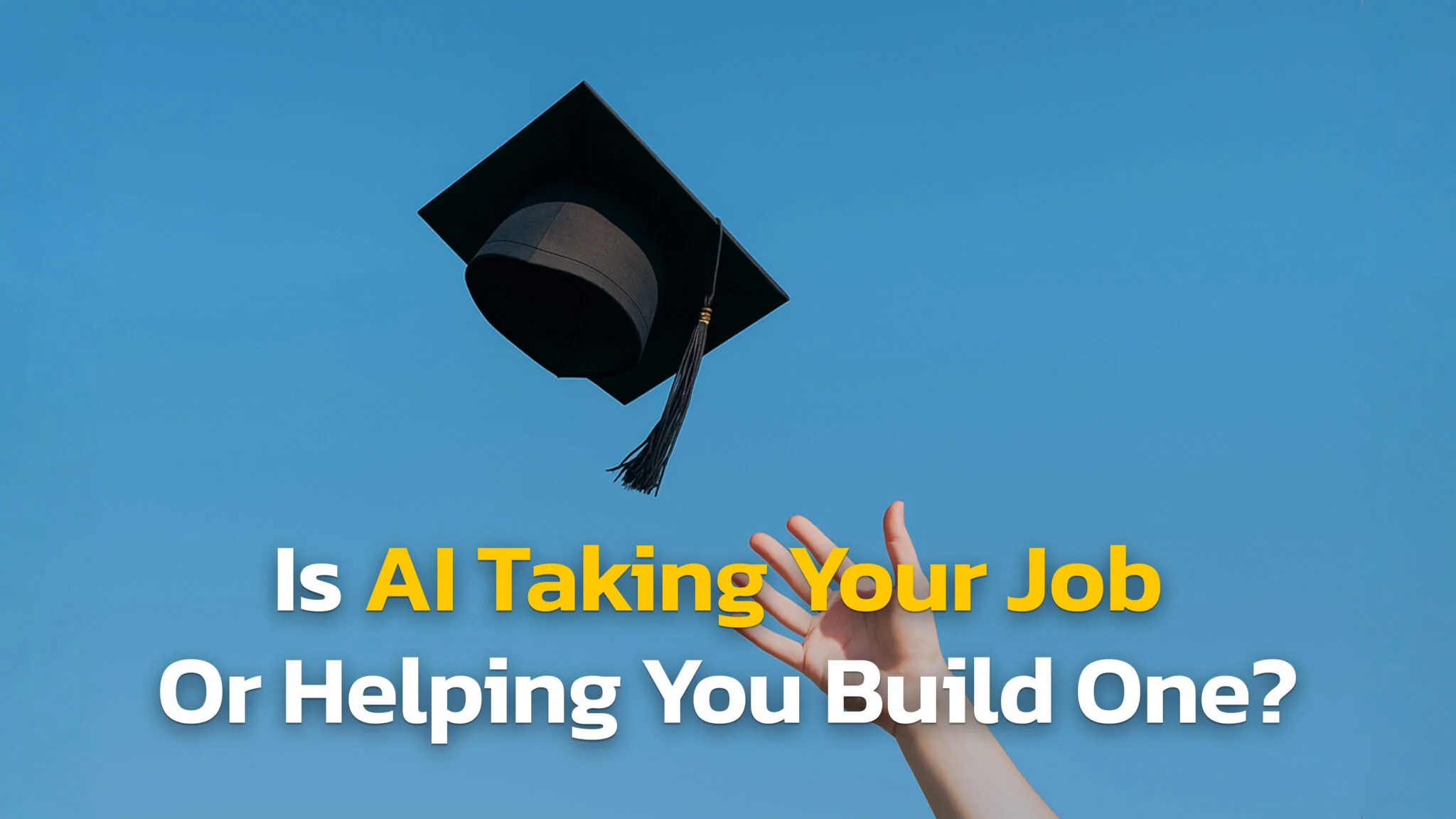
If you’re graduating college in the next few years, you’re entering a job market that’s changing faster than anyone can predict. Half of entry-level white collar jobs could be automated within five years according to some AI leaders, while others argue this generation has access to tools that could help them build billion-dollar companies as solo entrepreneurs. The gap between these predictions reveals just how uncertain the future of work has become.
Major companies are already making moves – Salesforce recently cut 4,000 jobs specifically because of AI capabilities, and other corporations are also eliminating certain roles where artificial intelligence can handle the work. Meanwhile, young entrepreneurs are using these same AI tools to build companies and create content that would have required entire teams just a few years ago. For Gen Z, this creates a unique situation where traditional career paths are disappearing while entirely new possibilities emerge.
The reality is more complex than either the negative predictions or the tech industry hype suggests. While some jobs will disappear, others are evolving from “doing the work” to “directing AI to do the work correctly.” Understanding how this change might actually play out – and how Gen Z is already responding to it – reveals whether artificial intelligence represents a threat to be feared or an opportunity to embrace.
How Is AI Changing The Job Market?
The warnings about AI wiping out entry-level jobs aren’t nonsense – companies are already making these moves. Salesforce CEO Marc Benioff recently announced cutting 4,000 jobs specifically because of AI capabilities, and he’s not alone in this decision. Other major companies are quietly eliminating roles where AI can handle the work, creating real unemployment for people who thought their jobs were secure just a few years ago.
But the reality is more nuanced than the headlines suggest. Most jobs aren’t disappearing entirely – they’re transforming from “doing the work” to “directing AI to do the work correctly.” In many cases this change will require human oversight because AI still needs guidance, quality control, and decision-making input. The challenge is that this transition period creates uncertainty about which roles will survive and which won’t, leaving many workers still trying to figure out where they fit.
The bigger issue is how this changes the skills that actually matter in the workplace. Traditional abilities that took years to develop are becoming less valuable when AI can produce similar results in minutes. Meanwhile, new skills around AI management, prompt engineering, and knowing how to get quality output from these tools are becoming essential. The companies making these transitions successfully are finding that a hybrid approach – humans directing AI rather than replacing humans entirely – often works better than pure automation.
What remains unclear is whether the performance trade-offs will push companies back toward human workers for certain tasks. Early adopters are still figuring out where AI works well and where human judgment remains irreplaceable. The key insight for workers is that adaptation isn’t optional anymore – the question is whether you’ll learn to work with AI tools or get replaced by someone who already has.
The Economy in Transition
The AI boom is creating unprecedented opportunities alongside the job displacement concerns. Individual entrepreneurs now have the potential to build companies worth hundreds of millions with just AI tools and good ideas, fundamentally changing what’s possible for small teams. This is a big change from traditional business models that required massive upfront investment and large workforces to achieve significant scale.
Massive Infrastructure Investment
Jensen Huang’s projection of half a trillion dollars worth of AI supercomputers being built in Arizona and Texas alone within four years shows the scale of economic transformation happening. This investment creates ripple effects across every sector as businesses rush to integrate AI just to remain competitive. His vision of every company needing “two factories” – one physical and one AI – is already playing out with companies like Tesla running both automotive manufacturing and AI development operations.
The infrastructure buildout is generating massive profits for investors, developers, and service providers supporting this transition. New business models are emerging where companies that successfully implement AI alongside traditional operations create competitive advantages that become nearly impossible for competitors to match. However, this concentration of investment in AI is creating economic imbalances where other industries suffer from lack of capital and attention.
We’re currently going through a chaotic economic period where traditional business models are being disrupted faster than new ones can stabilize. The speed of change makes it difficult to predict which investments, skills, or business strategies will succeed long-term. While the AI economy offers enormous potential, the uneven distribution of benefits and the rapid pace of change creates uncertainty that affects everything from individual career planning to broader economic stability.
Sam Altman’s Vision for Gen Z’s Future
Sam Altman paints an optimistic picture for young people entering the job market, even as he acknowledges that “some classes of jobs will totally go away.” In a recent interview with Cleo Abram, he argued that if he were 22 and graduating college today, he’d “feel like the luckiest kid in all of history”. His reason is because of the unprecedented opportunity to create something from nothing using AI tools. This can apparently allow a person to do what previously required teams of hundreds of people.
Altman believes we’re entering an era where a single person could build a billion-dollar company – not just in terms of valuation, but in actually delivering amazing products and services to the world. This, once again, points at a move from traditional business models that required massive teams and capital investment. The key, according to him, is learning how to use these AI tools effectively and coming up with great ideas to apply them.
While he admits that predicting 10 years out is nearly impossible given the current rate of change, Altman’s 5-year outlook suggests the biggest challenges won’t be for 22-year-olds who adapt quickly to new technology. Instead, he’s more concerned about older workers who may struggle with retraining and reskilling. His perspective frames AI not as a threat to young people, but as the greatest opportunity in history for those willing to learn and adapt.
The underlying message is that Gen Z’s natural comfort with technology positions them perfectly for this transition. Rather than competing against AI, Altman sees young people leveraging these tools to build things that were previously impossible for individuals or small teams alone.

How Gen Z Is Already Adapting
Gen Z’s natural comfort with technology is playing out exactly as Sam Altman predicted – they’re not panicking about AI, they’re experimenting with it. Many young people are already integrating AI tools into their studies, jobs, and side projects. They are figuring out what these systems can actually do and how to make their work faster and better. Rather than seeing AI as competition, they’re treating it as another digital tool to master, much like they did with social media, smartphones, and earlier tech innovations.
The smartest adaptation strategy involves focusing on uniquely human skills that AI can’t replicate. Creative thinking, ideation, and problem-solving remain firmly in human territory – AI can execute ideas brilliantly, but it typically won’t generate the original concepts worth executing. This creates a powerful combination where young people can:
- Come up with innovative ideas and creative solutions
- Use AI to handle the technical execution and mundane tasks
- Focus their time on strategy, creativity, and relationship-building
- Build businesses or careers around directing AI rather than competing with it
Perhaps the most encouraging trend is how many young people view this transition as an opportunity rather than a threat. If AI can handle typing data into spreadsheets or generating first drafts, that frees up mental energy for more valuable creative work. Instead of spending hours on routine tasks, they can focus on the parts of work they actually enjoy and find meaningful. This could lead to more fulfilling careers where human creativity and strategic thinking become the primary value drivers.
Conclusion
While AI will certainly eliminate some jobs, it’s also creating entirely new opportunities and business models that didn’t exist before. Gen Z is starting to recognize this and many are actively positioning themselves to take advantage of it. The economic disruption is real – companies are restructuring, some roles are disappearing, and traditional career paths are changing – but the action that matters most is adaptation rather than resistance.
Gen Z’s approach of learning to use AI tools and applying them to make their work more effective seems to be the winning strategy. Instead of viewing AI as a threat to compete against, they’re treating it as a powerful collaborator that can handle routine tasks while they focus on creativity, strategy, and problem-solving. This mindset difference could be what determines who thrives in this transition versus who gets left behind.
So should Gen Z be afraid of AI replacing them? The evidence suggests excitement might be more appropriate than fear. While certain changes will be uncomfortable and some traditional entry-level paths may disappear, the overall trend points toward more opportunities for those willing to adapt. The key is learning to work with AI rather than against it, which Gen Z seems naturally positioned to do.