You’ve finished your degree, thrown your cap in the air, and are ready to take on the world. But as you start scrolling through job sites, you notice a new, invisible competitor lurking in the background: Artificial Intelligence. The headlines are everywhere, sparking a mix of excitement about the future and real anxiety about your place in it.
It leaves every graduate asking the same crucial questions: Will I struggle to find a job because of AI? Where are the real opportunities, and which fields are the safest bets for a long and successful career? And most importantly, what can I do right now to stand out and build a future-proof career?
This guide cuts through the noise. We’ll use the latest data from leading global institutions to show you what’s really changing and where to focus your job search. If you are already at the application stage, start with practising job interviews with AI.
The Key Takeaways
- The Job Market Is Shifting, Not Shrinking: While AI is automating routine administrative tasks and creating an “entry-level bottleneck” in some fields, it’s also fueling massive growth in others. The net effect is a change in the type of jobs available, not a total loss of opportunity.
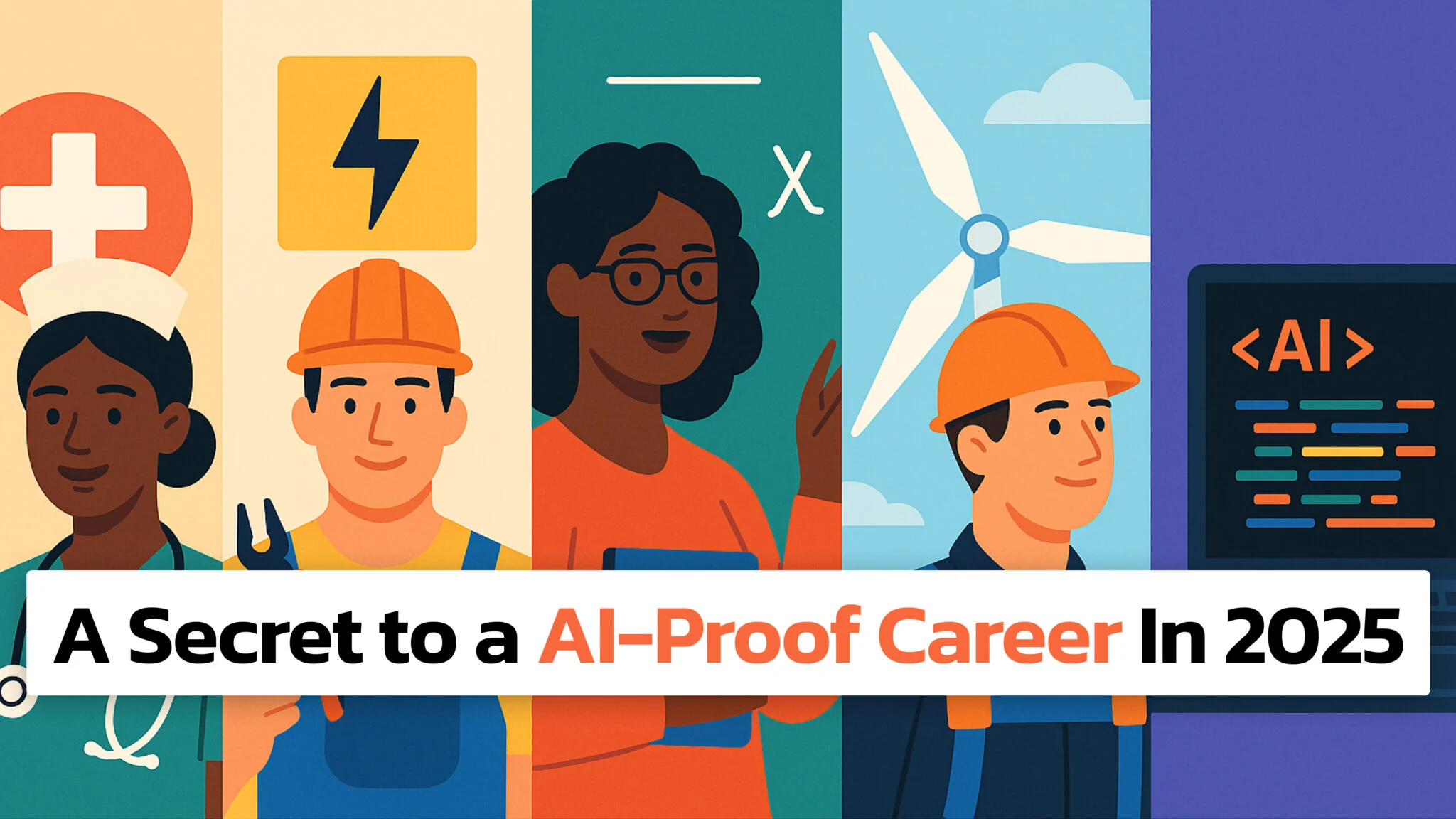
- Human Skills Are Your Best Defense: The safest and fastest-growing careers are those that require skills AI can’t replicate: physical presence, hands-on expertise, critical thinking, creativity, and empathy. Think healthcare, skilled trades, and clean energy.
- Become the Pilot, Not the Passenger: The most successful graduates won’t be those who avoid AI, but those who master it. Proving you can use AI tools to be more productive and solve problems is now a critical advantage that can put you ahead of more experienced candidates.
The New Reality for Graduates
It’s true that the AI impact on jobs is being felt most sharply at the entry level. Many traditional “first jobs” involved tasks like data entry, scheduling, and writing basic reports—tasks that Generative AI can now perform in seconds. The International Labour Organization (ILO) found that clerical and administrative work is by far the most exposed to automation.
This has created what some experts call an “entry-level bottleneck.” Companies can now use AI to handle routine work, which explains why fewer junior roles are being advertised in certain fields. So, are graduates struggling to find jobs? In some sectors that rely on routine office tasks, yes, the competition is tougher. But this is not the whole story. While some doors are closing, many new ones are opening in fields where human skills are more valuable than ever.
Future-Proof Fields: Where to Find Opportunity
So, where are the safe zones? Research points to several AI-resistant jobs that are not only secure but actively growing. These are often human-centric jobs, where technology assists rather than replaces people.
- Healthcare and the Care Economy: AI can assist with diagnostics, but it can’t provide the hands-on care or empathy required in roles like nursing and physiotherapy. These jobs rely on a physical, human presence, making them highly resilient.
- Skilled Trades and Construction: You can’t automate fixing a leaky pipe or rewiring a house. Skilled trades like electricians and HVAC technicians are booming due to infrastructure needs and worker shortages, relying on manual, non-routine work.
- Clean Energy and Climate Tech: The green transition is creating a massive number of hands-on jobs. Roles like wind turbine technicians and solar installers require physical, on-site work that is far beyond the scope of current automation.
- Cybersecurity: As AI tools advance, so do security threats, creating an urgent need for human experts. Cybersecurity is a fast-growing field where creative problem-solving is essential to protect digital systems.
- Education: AI can be a powerful classroom tool, but it cannot replace the human connection and mentorship of a great teacher. Widespread teacher shortages mean opportunities in this field remain strong.
These fields show that opportunity is plentiful, but it requires a strategic approach. Targeting the right sector is the first step; the next is equipping yourself with the skills to thrive there.
By the Numbers: The AI Job Market Today
- ~40% of global jobs are exposed to AI, with that number rising to ~60% in advanced economies. Exposure can mean automation or augmentation (IMF, 2024).
- Clerical and administrative work is the most exposed broad occupation group to Generative AI (ILO, 2025).
- Globally, employers expect tech to create ~11 million jobs and displace ~9 million by 2030 (World Economic Forum).
- The UK graduate market saw hiring fall 8% last cycle, with another 7% drop expected, leading to up to 140 applicants per role (ISE, 2025).
- Fastest-growing roles (US, 2024–34): Wind Turbine Technician (+50%), Solar Installer (+42%), Nurse Practitioner (+40%), Data Scientist (+34%), Information Security Analyst (+29%) (BLS).

How to Compete and Win in the AI Era
Knowing the safe fields is half the battle. The key isn’t to fear technology but to leverage it. Here’s how to be competitive by focusing on what makes you uniquely human and strategically smart.
You don’t need to be a coder. But leaders now say 66% wouldn’t hire someone without AI skills. You need AI literacy: learn to use tools like ChatGPT or Copilot to make your work better and faster. On your CV, show how you used AI to get real results:
- Automated a monthly operations dashboard using ChatGPT + Power Query; cut prep time by 60% and reduced manual errors to near zero.
- Built a Python script to QA chatbot outputs against company policy; lowered hallucination rate from 11% to 3% on sampled tickets.
- Prompt-engineered SQL snippets to speed ad-hoc analysis; trimmed stakeholder turnaround for data requests from 2 days to 6 hours.
These examples show how you can demonstrate immediate value. But the real power comes when you combine this new AI fluency with a solid foundation in your chosen field.
The best degrees for an AI future combine a core discipline with modern tech skills. Pair a business degree with data analysis for beginners. Learn SQL for business analysts. This combination makes you far more valuable than someone with just one specialty.
Focus on developing abilities that AI can’t replicate: critical thinking, creativity, and complex problem-solving. Mastering project management skills (Agile, Scrum), for instance, shows you can coordinate teams and projects, a fundamentally human task.
Fast Lanes into Resilient Fields
Here’s a quick map from role to the skills, certifications, and employers to target.
- SOC Analyst (Tier 1): Start with CompTIA Security+, Linux CLI, and SIEM basics. Target Managed Security Service Providers (MSSPs), banks, and telcos.
- Solar PV Installer: Get certified in working at heights and basic PV installation. Look for jobs with renewable energy contractors and local installers.
- Wind Turbine Technician: Begin with a GWO Basic Safety Training certificate. Apply to original equipment manufacturers (OEMs) and wind farm operators.
- Nursing Associate / RN: Focus on achieving national licensure and proficiency with Electronic Health Records (EHR). Hospitals and private clinics are your primary targets.
These entry points provide clear paths into high-demand sectors. To turn these opportunities into job offers, a structured, proactive plan can make all the difference.
Your 30-60-90 Day AI Career Sprint
Ready to get started? A structured plan can make the job hunt feel less overwhelming. Here’s a detailed sprint you can follow to build momentum and land a great role in the next three months.
1–30 Days: Focus and Build
The first month is about clarity and creation. Pick a target field. Don’t just browse; commit to one of the resilient fields mentioned above. Align it with your interests and studies. Identify 5-10 target companies. Research who is hiring for entry-level roles in your chosen sector.
Build one portfolio project that uses AI. This is your proof of skill. Examples include using ChatGPT to draft a detailed lesson plan for an education role, creating a mock cybersecurity incident report based on a public data set, or using an AI tool to help visualize data for a business analyst project. Document your process and the outcome.
31–60 Days: Certify and Connect
This month is about validation and visibility. Earn one “gate-opening” certification. This helps your CV get past automated screening, and our test of which AI is best for resume writing covers how the models compare on the document itself. For cybersecurity, CompTIA Security+ is a standard. For tech-adjacent roles, an AWS Certified Cloud Practitioner certificate is valuable. If you are interested in trades, get a specific safety or installation certificate like a PV installer course.
Complete a final project you can demonstrate. This should be a capstone for your new certification that you can talk about confidently in an interview, explaining the problem you solved and the skills you applied. Start networking. Connect with recruiters and professionals at your target companies on LinkedIn. Don’t ask for a job directly; ask for a 15-minute “virtual coffee” to learn about their work.
61–90 Days: Apply and Interview
The final month is about execution. Send out 20 tailored applications. Quality over quantity. Customize your CV and cover letter for each role, using keywords from the job description and highlighting your new portfolio project and certification. If you use AI to draft them, the best AI for a cover letter covers which model to pick and how much editing the research says it needs.
Rehearse your stories. Prepare to talk about how you’ve used AI, solved problems, and worked in a team. Use the STAR method (Situation, Task, Action, Result) to structure your answers. Prepare for AI-specific questions. Be ready to discuss responsible AI use. For roles in Europe, mentioning your awareness of the EU AI Act and the importance of human oversight and transparency will make you stand out.
This proactive, 90-day plan shifts you from a passive job seeker to an active candidate with tangible proof of your skills. By focusing on learning, building, and connecting, you demonstrate not only your technical abilities but also the drive and strategic thinking that employers are looking for in an AI-driven world.
Overview
The rise of AI is undeniably changing the job landscape for new graduates. While it presents real challenges for those targeting routine white-collar work, it opens up a world of opportunity in resilient, human-centric fields. The narrative isn’t about humans versus machines; it’s about humans with machines. The graduates who will thrive are not those who fear technology, but those who embrace it as a powerful tool to amplify their own skills.
Your degree has given you a strong foundation, but the modern job market demands more. It requires a proactive mindset and a commitment to continuous learning. By focusing on the growth sectors identified in this guide, intentionally building a complementary skill set, and demonstrating your ability to use AI as a productive partner, you can navigate this new reality with confidence. Your future career won’t just be “AI-proof”, it will be AI-powered.
FAQ: The Evidence Edition
Which jobs are safest from AI for new graduates?
Jobs requiring a physical presence, complex hands-on skills, and high levels of human empathy are the safest. This includes healthcare (nursing), skilled trades (plumbing, electrical), hands-on green energy roles (solar/wind technicians), and education.
What degrees are future proof against AI?
There’s no single “future-proof” degree. The strongest approach is to combine a core discipline with modern tech skills, for example, a business degree paired with data analysis skills. Degrees emphasizing critical thinking, creativity, and problem-solving will always be valuable.
Does AI reduce entry-level hiring?
In some exposed functions, yes. UK graduate hiring has fallen, and early US evidence shows young workers lost ground in AI-exposed jobs. However, aggregate employment hasn’t fallen due to AI so far across the OECD.
Is customer support being automated?
First-line triage is scaling up with AI, but humans are still essential for complex issues. A major study found that AI actually raised human support-agent productivity by nearly 15%, making the remaining agents more valuable.