Muse Spark on Mac

The best way to use
Muse Spark on your Mac

Meta ships Muse Spark through a terminal agent and an API key, so today there is nothing to open unless you are a developer. Fello AI is a native Mac app that gives you Muse Spark 1.3 in a normal chat window, next to every other frontier model.

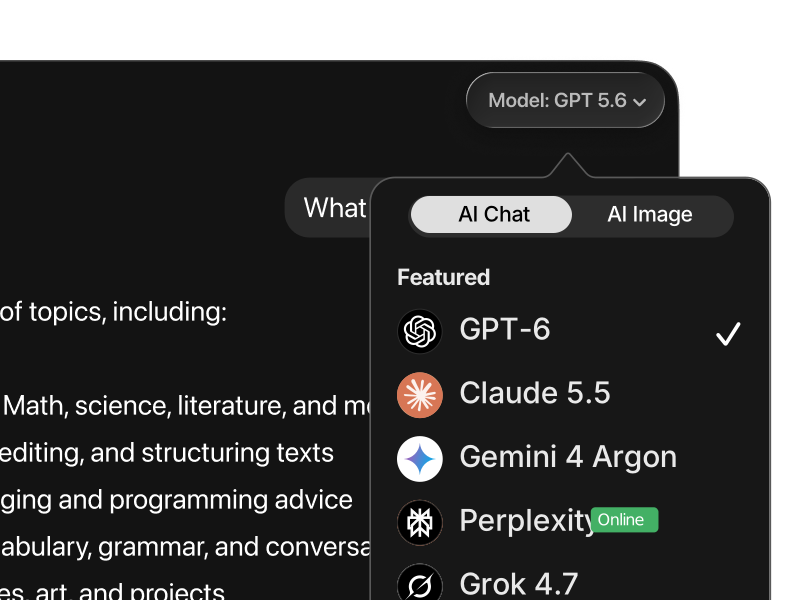
Fello AI on macOS with the model picker open, showing 10 AI models
What is Muse Spark

What Muse Spark actually is

Muse Spark is the frontier model family from Meta Superintelligence Labs, the research division Meta built to close the gap with OpenAI, Anthropic and Google. The line launched in April 2026 and has moved faster than anyone else's since: Muse Spark 1.1 in July, 1.2 in August, and Muse Spark 1.3 on September 2, 2026, its fourth release in five months. On the Artificial Analysis Intelligence Index it went from 41 to 52 in two months, eleven points on a scale where the current leader, Claude Fable 5.1, sits at 57.

What Muse Spark is built for is coding and long-context work. On Meta's own launch scorecard, 1.3 takes or ties every coding row it published, winning DeepSWE v1.1 at 75.4 against Claude Opus 5's 74.0 and SWEAtlas CodeBase QnA at 59.4 against 53.5 and 52.7, tying GPT-5.6 Sol on Terminal-Bench 2.1 at 88.8, and taking both MRCR long-context bands by a wide margin, 98.1 in the 512K to 1M band. It also loses all six of the rows Meta files under Agent, four to Opus 5 and two to GPT-5.6 Sol, which is the half of the chart most coverage skipped.

The catch is access. Meta's launch post lists exactly two places the model runs, Muse Code and the Meta Model API, and Bloomberg reported that a rollout to Facebook, Instagram and the Meta AI app is planned for the coming days. Until that lands, a developer API key is the only way in. That is the gap Fello AI fills, and it is why this page exists.

Muse Spark vs Muse Code vs Muse Glimmer: Muse Spark is the model, currently at version 1.3. Muse Code is Meta's terminal coding agent, the tool that runs the model for developers. Muse Glimmer is a separate 30-billion-parameter model distilled from Muse Spark and released under Apache 2.0 in August 2026, the only Meta weights you can download today. Muse Spark itself is closed, and Meta's promise to publish its weights has slipped once already.

52
Artificial Analysis Intelligence Index v4.2
1M tokens
Context window
$1.25 / $4.25
Meta's API rate per 1M tokens
API and terminal
The only surfaces Meta shipped it on

Getting started

3 ways to use Muse Spark on Mac

02
Muse Code

Meta's terminal coding agent, launched alongside Muse Spark 1.2 in August 2026 and updated to 1.3 underneath. It runs in a terminal window, needs an API key and metered billing, and is built for developers working inside a repository. Excellent at what it does, and of no use at all if you wanted to ask the model a question over coffee.

03
The Meta Model API

Muse Spark 1.3 is public and paid through the Meta Model API at $1.25 per 1M input tokens, $0.15 cached, and $4.25 output. A Contributor tier drops that to $0.10 and $0.20, and Meta's own rate card marks the difference plainly: the contributor model is "Used to improve our products" and the standard one is "Not used to improve our products". There are no open weights: Muse Spark is a closed model, and only the distilled Muse Glimmer is downloadable.


Why Fello AI

Muse Spark, done right

Muse Spark is one of the strongest coding models on the market and one of the cheapest ways to buy near-frontier performance. It is also the only model in that class with no app attached to it. Fello AI gives you Muse Spark in a simple native Mac window, next to Claude, ChatGPT, and Gemini, with image generation and real PowerPoint, Excel, and Word export that Meta gives you no way to do.

An app, where Meta ships none
Meta's launch post shipped Muse Spark 1.3 to Muse Code and the Meta Model API, and a consumer rollout to Facebook, Instagram and the Meta AI app has been reported as coming. Neither is a Mac app. Fello AI is a real native Mac app that launches instantly and runs Muse Spark in a normal chat window.
No API key, no metered bill
The developer path means exporting an API key, wiring up billing, and watching a token meter. Fello AI is one flat $9.99 a month for Muse Spark and every other model in the app, so the cost of a long session is a number you already know before you start it.
Muse Spark plus the frontier stack
Muse Spark 1.3 wins coding rows and loses agent rows on Meta's own chart. Claude 5 writes better, GPT-5.6 handles computer-use tasks best, and Gemini leads on multimodal input. Fello AI gives you all of them in one app with instant switching, so you can move a task to the model that suits it.

Side by side

Fello AI vs Muse Code and the Meta API

Feature Fello AI Muse Code / Meta Model API
Price Free tier + $9.99/mo or $79.99/yr Metered: $1.25 / $4.25 per 1M tokens
Access to Muse Spark 1.3 Yes Yes, with an API key
Native Mac app macOS 12+, Intel + Apple silicon Terminal and API only
Setup required Download and sign in API key, billing, command line
Models available Muse Spark 1.3, Claude 5, GPT-5.6, Gemini 3.6 Flash, Grok 4.5 and more Meta models only
Image generation GPT Image 2, Nano Banana 2, Seedream 5, FLUX.2 No
PDF support Up to 16 PDFs at once Build it yourself
iPhone and iPad Yes, same app No

In depth

A closer look at Muse Spark 1.3

The fastest climb on the index this year

On Artificial Analysis's current model pages, Muse Spark 1.1 scores 41, 1.2 scores 47 and 1.3 scores 52 at the xhigh setting it ships with, or 53 at max. That is eleven points in two months while the price did not move once, and it puts 1.3 (max) tenth on Artificial Analysis's leaderboard, one point behind Claude Opus 5 (max) and two ahead of GPT-5.6 Sol (max). Meta has shipped four Muse Spark models in five months to get there, and our best AI models ranking tracks where that leaves the field.

It wins coding and long context on Meta's own chart

On the scorecard Meta published with the launch, 1.3 takes DeepSWE v1.1 at 75.4 against Claude Opus 5's 74.0, SWEAtlas CodeBase QnA at 59.4, and ties GPT-5.6 Sol on Terminal-Bench 2.1 at 88.8. The long-context result is the most striking number of the release: 98.1 on MRCR in the 512K to 1M band, against 55.5 for Muse Spark 1.2.

It loses every agent row, and that went unreported

The same chart has six rows filed under Agent, and Muse Spark 1.3 loses all six, four to Claude Opus 5 and two to GPT-5.6 Sol. If the work you have in mind is a model driving tools through a long autonomous run rather than writing and reasoning over code, this is not the model to reach for, and in Fello AI you are one click from the ones that are.

The benchmark numbers ran on max, which shipped two days late

Every number on Meta's launch chart comes from a column labelled Muse Spark 1.3 (max), a setting that was not part of the September 2 release: Meta held it back for further safety testing and shipped the model at xhigh. Max landed two days later, on September 4, 2026, and now runs on Muse Code and the Meta Model API alongside xhigh. On Artificial Analysis the two settings score 53 and 52, so the gap is one point, but it is still worth knowing which setting a benchmark ran on. Our full Muse Spark 1.3 breakdown reads the chart row by row.


Model comparison

How does Muse Spark compare to other AIs?

The AI landscape in 2026 is competitive at the frontier level. ChatGPT leads in computer-use automation, Claude 5 excels at writing and complex analysis, and Gemini holds the context-length record. Where does Muse Spark 1.3 actually stand?

Muse Spark 1.3 is Meta's frontier model and the strongest coding model Meta has shipped, at $1.25 and $4.25 per 1M tokens against Claude Opus 5's $5 and $25. It wins coding and long context on Meta's own scorecard and loses agentic work outright. Treat it as a very cheap, very capable coding and long-document model rather than an all-rounder, and pair it with a model that handles the rest.

Muse Spark VS ChatGPT

Muse Spark vs ChatGPT

ChatGPT is the established standard. Muse Spark is the cheap coder.

ChatGPT powered by GPT-5.6 is the strongest model for computer-use tasks. It can operate software, navigate interfaces, and complete multi-step desktop workflows autonomously, and it beats Muse Spark on two of the six agent rows Meta itself published. It also has the ecosystem, the reliability, and an app on every platform.

Muse Spark 1.3 ties GPT-5.6 Sol on Terminal-Bench 2.1 at 88.8 and beats it on Meta's coding and long-context rows, at roughly a fraction of the token cost. What it has no answer to is availability: OpenAI ships apps to everyone, Meta ships an API key.

Use ChatGPT for computer use, integrations, and production reliability. Use Muse Spark for cheap, heavy coding and very long documents.

Muse Spark VS Claude

Muse Spark vs Claude

Claude is the quality benchmark. Muse Spark is a quarter of the price.

Claude 5 is the best model available for writing quality and following complex instructions, it produces the most natural and well-structured output of any major model, and Claude Opus 5 wins four of the six agent benchmarks on Meta's own chart. It also scores a point higher on the Artificial Analysis Intelligence Index, 54 against Muse Spark 1.3's 53 at the same max reasoning setting.

Muse Spark 1.3 beats Opus 5 on all three coding benchmarks Meta published and on both long-context bands, and it costs $1.25 and $4.25 per 1M tokens against Opus 5's $5 and $25. For code review, refactors, and reading very large repositories, that price difference is the argument.

Use Claude 5 for writing, structured analysis, and long autonomous runs. Use Muse Spark for volume coding at a quarter of the cost.

Muse Spark VS Gemini

Muse Spark vs Gemini

Gemini sees more. Muse Spark remembers better.

Gemini 3.6 Flash pairs a context window over 1 million tokens with native Google Search grounding and native understanding of audio as well as images and video. It is also woven through the Google ecosystem, which matters if your documents already live in Drive.

Both models take a 1M token context window, but Muse Spark 1.3 is the one with a published long-context recall figure to point at: 98.1 on MRCR in the 512K to 1M band. A large window and reliable recall across it are different claims, and long-document work is where Muse Spark earns its place.

Use Gemini for multimodal input, Google integration, and grounded search. Use Muse Spark when you need the model to actually find things deep in a very long context.

Muse Spark VS Grok

Muse Spark vs Grok

Grok is real-time. Muse Spark is heads-down.

Grok is built around live information. It indexes X and the broader web in real time, which makes it the model to ask about breaking news, current sentiment, and anything time-sensitive, and it is more willing to engage with controversial topics than most.

Muse Spark 1.3 can reach the web too, through a search grounding tool Meta exposes in its API, but live discussion is not what it is built around. What it is built around is coding and long-context work at a price that makes running it over a whole codebase reasonable. These are not really competing tools, which is the argument for having both open in the same window.

Use Grok for live information and brainstorming. Use Muse Spark for the deep technical work that follows.

Muse Spark VS Perplexity

Muse Spark vs Perplexity

Perplexity retrieves. Muse Spark builds.

Perplexity is a search-first tool. It retrieves and summarizes information from the web with citations, which makes it the fastest route to a sourced answer when you do not want to do the research by hand.

Muse Spark 1.3 is a reasoning and coding model first. Meta does offer a search grounding tool that gives it live web access, but citation-first research is Perplexity's whole design, not a side feature. Muse Spark is far better at writing code, working through a long repository, and turning information into something finished.

Use Perplexity to find and verify facts. Use Muse Spark to reason, code, and build with them.

Muse Spark VS DeepSeek GLM Kimi

Muse Spark vs other models

No single model wins every task.

Fello AI also gives you DeepSeek as a powerful low-cost model, GLM and Kimi as the strongest open-weight coders, and Qwen as the multilingual all-rounder. Each is a click away, right beside Muse Spark.

Use all of them in one app

No single model is best at everything. Muse Spark leads on cheap coding and long-context recall, but Claude writes better and wins the agent rows, ChatGPT handles computer use, and Grok has live data. The most capable AI setups route each task to the model that suits it. Fello AI puts Muse Spark, ChatGPT, Claude, Gemini, Grok, and Perplexity in one native app, and reaches Muse Spark without an API key or a terminal.

Metric Muse Spark 1.3 GPT-5.6 Claude 5 Gemini 3.6 Flash
Coding Top tier Top tier Top tier Very good
Long-context recall Best in class Very good Very good Very good
Agentic work Behind the field Excellent Excellent Very good
Context window 1M tokens 1M tokens 1M tokens 1M tokens
App from the vendor None yet, API and terminal Yes Yes Yes
Best for Cheap heavy coding, very long documents All-round work, operators Long-form writing, docs Speed, large docs, research

What Fello AI offers

What you can actually do in Fello AI

Switching between AI models in Fello AI
Use the right model for the task

Different models are better at different kinds of work. In Fello AI, you switch between ChatGPT, Claude, Gemini, Grok, and more without leaving the app or rebuilding your workflow. Compare outputs, move faster, and use the model that fits instead of forcing everything through one tool.

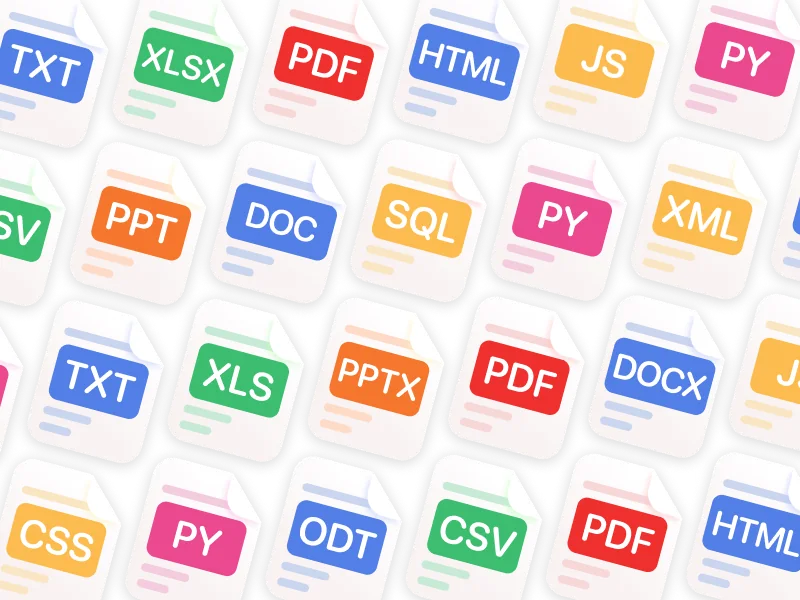
Fello AI supports PDF, Word, Excel, PowerPoint, images, and many more file formats
Chat with PDFs, images, and Office files

Upload PDFs, images, Excel sheets, slide decks, and documents, then ask for summaries, explanations, rewrites, or extracted insights. This makes Fello AI much more useful for study, research, reporting, and day-to-day professional tasks than a plain text chatbot.

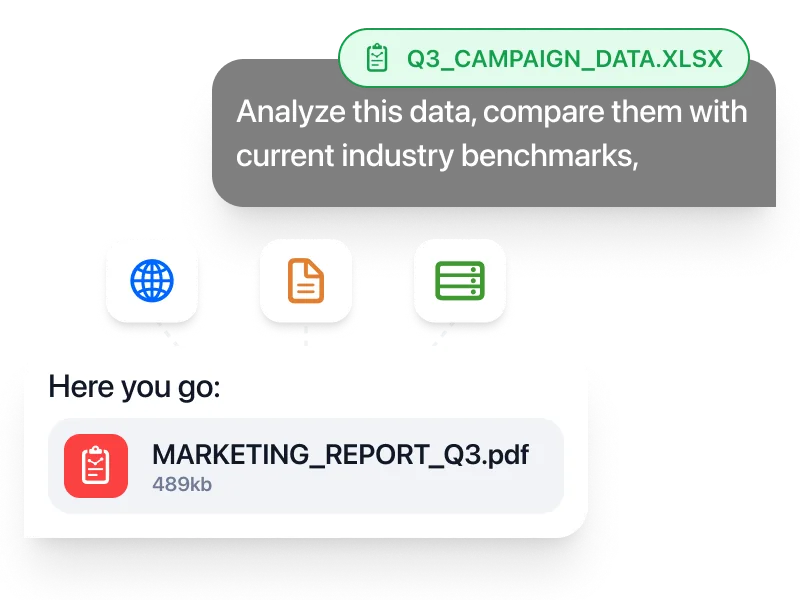
Fello AI generating a downloadable PDF report from a spreadsheet
Create real documents you can download

Generate PowerPoint presentations, Excel spreadsheets with formulas, Word documents, and PDFs, then download and use them immediately. That turns AI from a brainstorming tool into something much closer to a real productivity workspace.

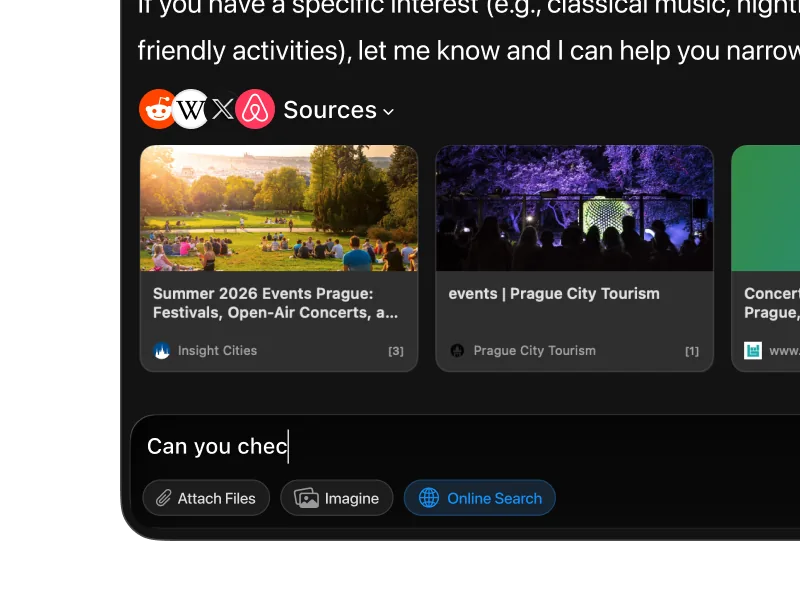
Fello AI web search results with cited sources
Search the web and keep working in one place

When you need current information, Fello AI searches the web with cited sources instead of forcing you to leave the app and manually piece things together. Especially useful when researching a topic, checking facts, or turning fresh information into a finished document.

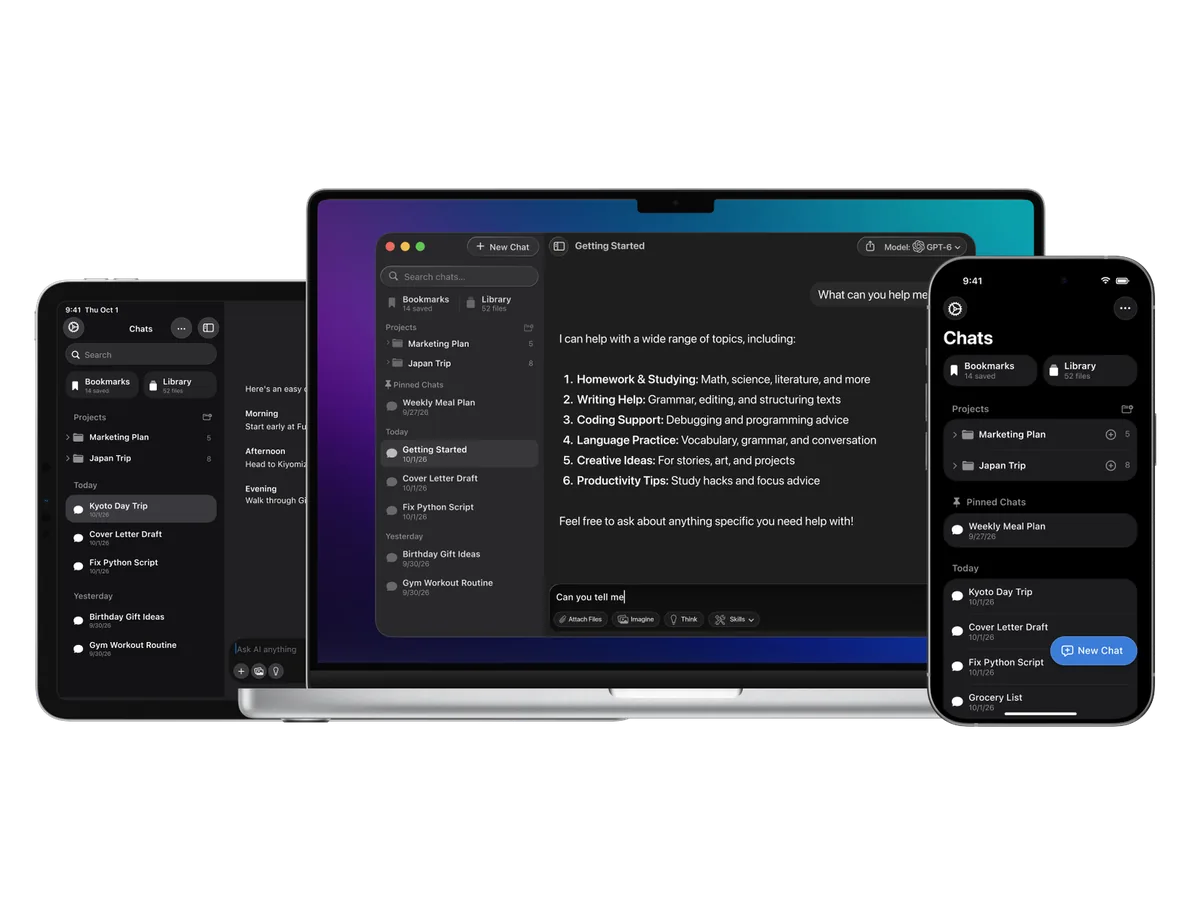
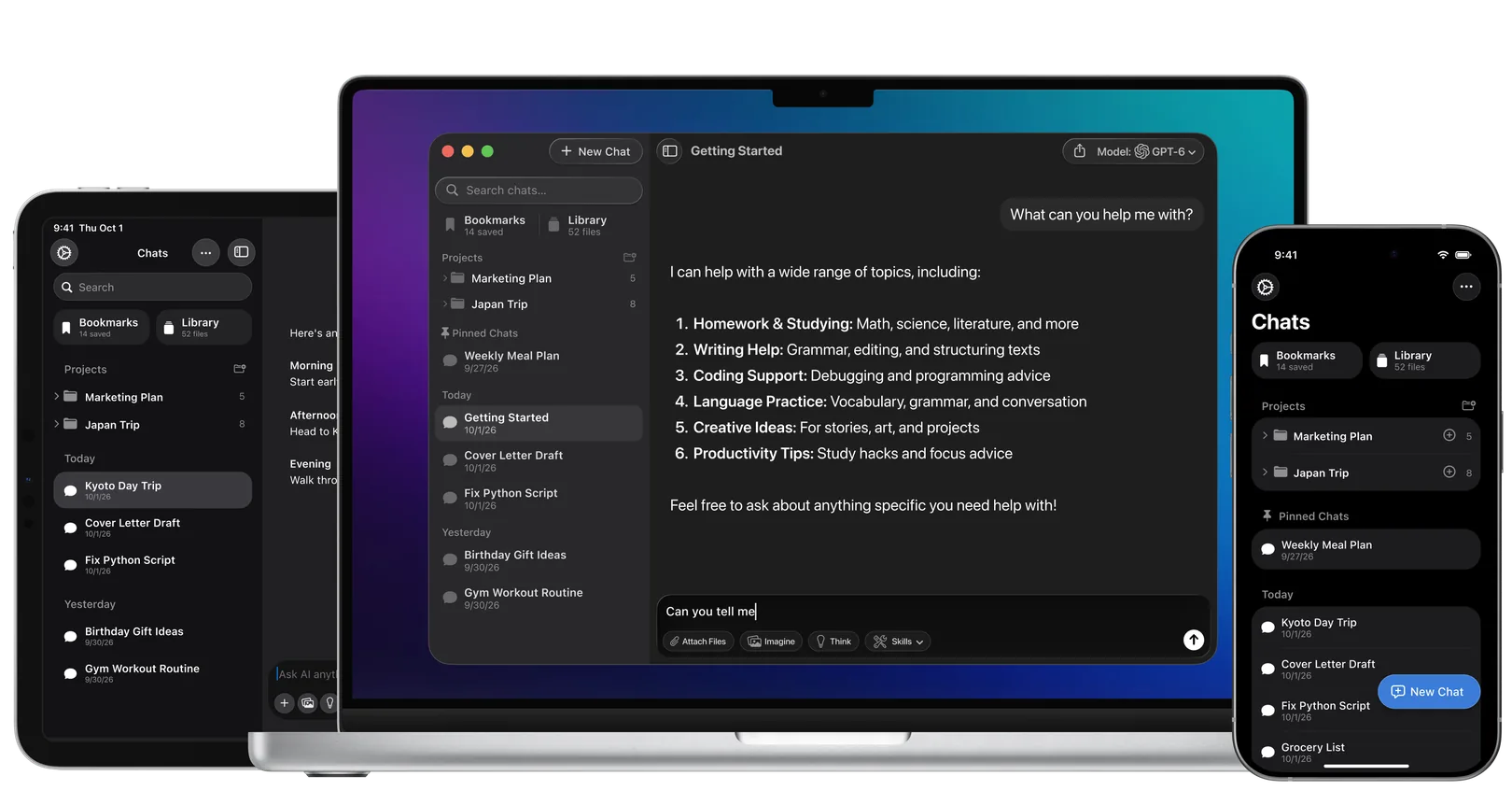
Fello AI on Mac, iPhone, and iPad
One workflow across Mac, iPhone, and iPad

Fello AI is native on all Apple devices, so you keep the same app, the same models, and the same workflow whether you're on your Mac at a desk or on your phone on the go. No separate setup, no switching tools, no restarting the context.

For professionals

Fello AI gives professionals a practical way to use ChatGPT, Claude, Gemini, Grok, and other top models across Mac, iPhone, and iPad as part of one consistent workflow. Analyze PDFs, Word files, Excel sheets, presentations, and images, then turn the result into real downloadable documents for client work, internal workflows, and day-to-day execution.

For students

Fello AI helps students handle everyday academic work more efficiently. Summarize readings, explain difficult topics, compare answers across models, and work with PDFs, slides, notes, and study materials in one place. Instead of relying on a single AI answer, use the model that fits the task and move from quick explanations to deeper research without jumping between apps.


Common questions

Frequently asked questions

No. Meta's Muse Spark 1.3 announcement names exactly two places the model runs: Muse Code, a terminal coding agent, and the Meta Model API. Neither is a desktop app, and Meta has not announced one. Meta does ship a separate Meta AI Mac app, but that runs its consumer assistant, not Muse Spark 1.3. If you want Muse Spark in a real Mac window without a terminal or an API key, Fello AI is the way to do it.
Not yet, as of early September 2026. Meta's launch post shipped Muse Spark 1.3 to Muse Code and the Meta Model API only, and Bloomberg reported that Meta plans to roll it out to Facebook, Instagram and the Meta AI app in the coming days. That is a change of shape from the original April 2026 release, which powered the Meta AI app and website on day one. Until the rollout actually lands, treat any claim that 1.3 is already live in WhatsApp or Instagram with care. Our guide to the Meta AI Mac app covers what the consumer app does run.
Meta's standard API rate is $1.25 per 1M input tokens, $0.15 per 1M cached input tokens, and $4.25 per 1M output tokens, unchanged since Muse Spark 1.1 launched the paid API in July 2026 despite three capability upgrades since. That makes it roughly a quarter the price of Claude Opus 5 at $5 and $25. Through Fello AI you pay one flat $9.99 a month for Muse Spark alongside Claude, GPT-5.6, Gemini, Grok, and more, with no API key and no token meter to watch.
That depends on which tier a developer chooses when they export their own API key. Meta's standard tier carries no such condition. Its Contributor tier drops the price to $0.10 and $0.20 per 1M tokens, roughly 92% cheaper, and Meta's rate card labels that model "Used to improve our products" against "Not used to improve our products" for the standard one. On a terminal coding agent, your prompts and completions are your codebase, so that trade is worth reading carefully before you take it, particularly under an employment contract or a client NDA. Meta's AI chief Alexandr Wang has said a meaningful double-digit percentage of developers are choosing it.
No. Muse Spark 1.3 is a closed model. Meta has promised open weights twice and shipped them neither time: on August 10, 2026 Mark Zuckerberg wrote that Meta would soon release the weights for Muse Spark 1.2, and by September 2 that had become an undated line about Muse Spark open weights coming soon, with no version named. What is open is Muse Glimmer, a 30-billion-parameter dense model distilled from Muse Spark and released under Apache 2.0 in August 2026, sized to run locally. It is not the frontier model, and Meta has never said it was. Our best open source AI models roundup sets it against the field.
It is the best coding model Meta has shipped, and on Meta's own launch scorecard it wins or ties every coding row: DeepSWE v1.1 at 75.4 against Claude Opus 5's 74.0, SWEAtlas CodeBase QnA at 59.4 against 52.7, and a tie with GPT-5.6 Sol on Terminal-Bench 2.1 at 88.8. Those are the vendor's own numbers on the vendor's own chart, which is worth remembering, but the price makes it an easy model to evaluate for yourself. In Fello AI you can run the same task through Claude 5 or GPT-5.6 for a second opinion without leaving the window.
This is its weakest area. Meta's own benchmark chart has six rows filed under Agent, and Muse Spark 1.3 loses all six, four to Claude Opus 5 and two to GPT-5.6 Sol. Meta did improve the behaviour around long tasks in 1.3: it says the model now asks clarifying questions when a prompt is ambiguous, confirms before consequential actions, and tracks more than one thread inside a single conversation. But if your work is a model driving tools autonomously for a long stretch, Claude Opus 5 is the better pick, and it is one click away in the same app.
Muse Code is Meta's terminal coding agent, launched alongside Muse Spark 1.2 in August 2026 and now running 1.3 underneath. It works inside a repository from the command line, in the same shape as other terminal coding agents, and it needs an API key and metered billing. It is a developer tool, not a chat app: it is excellent for driving changes through a codebase and no use at all if you simply wanted to ask the model a question.
Fello AI gives you Muse Spark 1.3, Meta's current flagship, released on September 2, 2026. Note that Meta ships 1.3 in more than one reasoning configuration: it launched at the xhigh setting, which scores 52 on the Artificial Analysis Intelligence Index v4.2, and the max setting behind every number on Meta's launch chart followed on September 4 after extra safety testing, scoring 53. Fello AI keeps model access updated as new versions ship, so you are not locked to an older one.
Yes. Fello AI works on any Mac running macOS 12 Monterey or later, including Intel-based Macs. Because Fello AI uses cloud-based AI, your local hardware does not affect the quality or speed of the responses. That matters more than usual with Muse Spark: it is a closed model with no downloadable weights, so running it locally is not an option on any hardware.

All the AI you need.
One beautiful app.

Download Fello AI for Mac, iPhone, and iPad. Free to start.

Fello AI running on Mac, iPad, and iPhone

4.7 rating·27,000+ reviews·Free to start