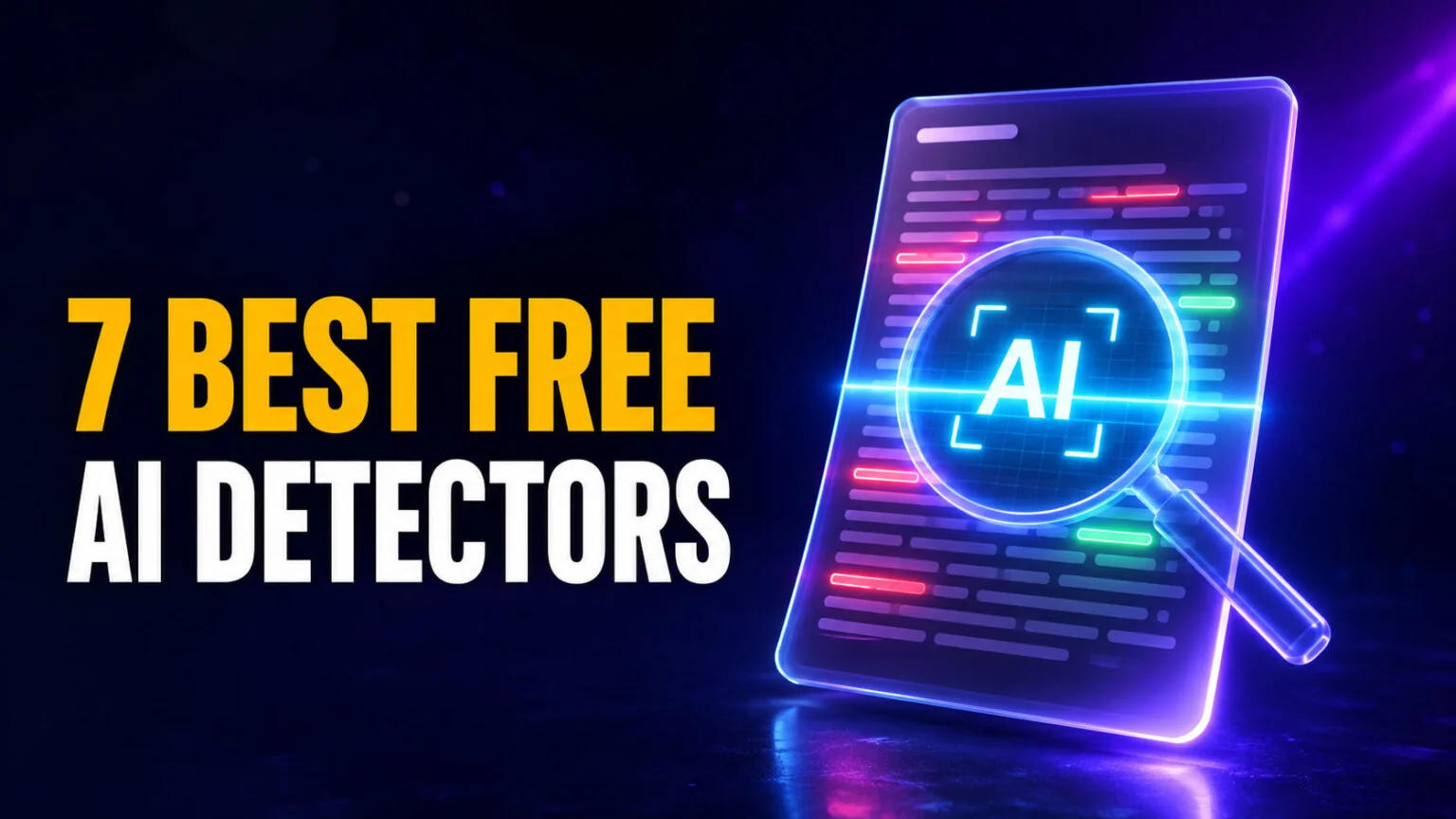
You can check whether a piece of text was written by AI in seconds, for free, without spending a cent. Yet a widely cited Stanford study on AI detector bias found the leading detectors wrongly flagged 61.22% of essays written by non-native English speakers as AI-generated. The tool you pick, and how you read its score, matters a lot.
This guide ranks the best free AI detector options in 2026 on the things that actually decide which one you should paste your text into. We compare the real free-tier limits, whether you need to sign up, how accurate each tool honestly is, and which ones work best for essays, teachers, and quick everyday checks. We sell no detector of our own, so these picks are neutral.
The Key Takeaways
- GPTZero scans 10,000 characters per scan for free with no account needed, and claims 99% accuracy on modern AI text.
- A Stanford study found leading detectors wrongly flagged 61.22% of non-native English essays as AI while staying near-perfect on native writers, so no free tool is proof.
- QuillBot and ZeroGPT run free checks with no signup and no hard word cap, the best fit for a fast paste-and-check.
- Turnitin’s real AI detector is not publicly free; sites advertising a “free Turnitin checker” are third-party lookalikes, not the official tool.
- For essays and grading, run two or three detectors and treat the score as a signal, never a verdict.
The Best Free AI Detectors in 2026 (Compared)
The short answer is that GPTZero is the best all-round free AI detector for most people, thanks to a generous no-signup scan, sentence-level highlighting, and a long track record. If you want zero friction, QuillBot and ZeroGPT are the easiest free checkers to use on a quick paste. For blended human and AI text, Copyleaks is the strongest free option.
The table below compares the genuinely free tiers, not the paid plans these companies want you to buy. Accuracy figures marked “claims” are the vendor’s own numbers, which independent tests often rate lower, so read them with healthy skepticism.
| Tool | Free limit | Signup needed? | Best for | Accuracy |
|---|---|---|---|---|
| GPTZero | 10,000 characters per scan | No (account for larger) | All-round use, sentence detail | Claims 99% |
| QuillBot | No hard cap (80-word minimum) | No | Fast free checks | Moderate |
| ZeroGPT | Generous free scans | No | Quick unlimited pastes | Moderate |
| Copyleaks | About 25,000 characters | No to scan | Blended human and AI text | Claims 99%+ |
| Scribbr | About 1,200 words per check | No | Students and essays | Moderate |
| Grammarly | Free checker | No | Writers already in Grammarly | Basic |
| Pangram | Limited free checks | Account | Highest independent accuracy | Strong in tests |
GPTZero
GPTZero is the detector most people land on first, and for good reason. You can paste up to 10,000 characters per scan without an account, and a free account lets you check longer documents. It returns an overall AI probability plus sentence-by-sentence highlighting, which helps you see exactly which passages triggered the flag.
GPTZero claims 99% accuracy on text from modern models like GPT-5 and Gemini, and roughly 96.5% on mixed human-AI documents. Those are the company’s own figures, so treat them as a ceiling rather than a promise. As an everyday free tool it is hard to beat on transparency. We compare those claims against independent testing in how accurate GPTZero really is.
QuillBot
QuillBot runs its AI detector fully free with no signup and no hard word cap, needing only an 80-word minimum to return a result. It checks text from ChatGPT, Claude, GPT-5, and Gemini, and gives an AI score with sentence-level highlights. For students and writers who just want a fast gut check before submitting, it is one of the lowest-friction options available.
ZeroGPT
ZeroGPT is a long-standing free checker built around unlimited quick scans and no login. It highlights the sentences it believes are AI-written and gives a percentage score. Accuracy is middling compared with the strongest tools, so ZeroGPT works best as a first pass you confirm elsewhere rather than a final word. We ran it against a full set of human and AI essays in our full ZeroGPT review.
Copyleaks
Copyleaks lets you scan a large block of text, around 25,000 characters, without logging in, and it is built to catch AI writing that has been lightly edited or blended with human text. The company claims accuracy above 99%, and it is a favorite in professional and enterprise settings. If your worry is content that mixes human and AI passages, this is the free tool to reach for.
Scribbr
Scribbr’s free AI detector is aimed squarely at students, checking about 1,200 words per submission with no signup and unlimited checks. It is a clear, student-friendly option that pairs naturally with its plagiarism tools, though its own testing puts the free tier’s accuracy around 78%, so it is a helpful first read rather than the last word. The word limit means you will split a long essay into sections.
Grammarly
Grammarly added a free AI detector that identifies content from ChatGPT, GPT-5, and Gemini with no sign-up required. It is basic compared with dedicated detectors, but if you already write inside Grammarly, having a quick AI check in the same place is convenient. Use it as a convenience layer, not your only source of truth.
Pangram
Pangram is the accuracy standout, scoring 99.98% on the RAID benchmark with a roughly 1-in-10,000 false-positive rate in testing validated by University of Chicago researchers. Its free access is more limited and points you toward a paid plan for volume. It fits best when you need the most trustworthy read on a single important document and are willing to create an account. For high-stakes checks, it earns its place next to the free workhorses.
Are Free AI Detectors Accurate?
Free AI detectors are useful signals, not proof. The most-cited warning comes from that Stanford study, which tested seven detectors on TOEFL essays written by real non-native English students with no AI involved. The tools wrongly labeled an average of 61.22% of those essays as AI-generated, while staying near-perfect on essays written by native English writers.
The reason is baked into how detection works. Most tools score two things, perplexity, which measures how predictable your word choices are, and burstiness, which measures how much your sentence lengths vary. AI text is smooth and even, and so is the writing of many non-native speakers and people writing on tightly structured topics, so their work gets caught in the same net.
That is why every honest guide, including our deeper explainer on whether AI detectors are accurate, lands on the same rule. A high AI score is a reason to look closer, ask questions, or request a draft history, not a reason to accuse someone. Free tools are perfectly good for that first look, as long as you never treat the number as a verdict.
Which Free AI Detector Is Closest to Turnitin?
This is the most misunderstood question in the whole category. Turnitin’s actual AI detector is not available as a free public tool. It lives inside Turnitin’s institutional platform, which schools and universities license, and there is no legitimate way to run the official Turnitin AI check for free from a website.
Many sites use the Turnitin name in their titles to capture that search traffic, but those are third-party detectors, not the real thing. If you want a free result that behaves like an academic-grade checker, your closest options are GPTZero, Copyleaks, and Scribbr, all of which are built to handle essays and give a defensible score. None of them will match Turnitin’s exact output, so if your school uses Turnitin, use a free tool to self-check and expect some variance.
Best Free AI Detector for Essays, Students, and Teachers
For essays, Scribbr and GPTZero are the strongest free picks because both are tuned for longer, structured writing and explain their results clearly. Students checking their own drafts before submission get the most value here, since a quick scan shows which passages read as machine-written so you can rework them in your own voice. Pairing a detector with the right free AI tools for students keeps the whole workflow honest and cheap.
For teachers, the honest advice is to lean on detectors gently. Given the 61.22% false-positive finding for non-native writers, a single free scan should never decide a grade or an academic-integrity case. The better approach is to run two or three detectors, look for agreement, and use the result to open a conversation, not to close one. Our AI for teachers guide covers the rest of the classroom toolkit.
Free AI Detectors With No Signup or Word Limit
If your priority is speed and privacy, a handful of tools let you check text with no account at all. QuillBot and ZeroGPT are the standouts for no-signup, no-hard-cap checks, so you can paste and score in a couple of seconds. GPTZero gives you 10,000 characters per scan before it asks for a free account, and Grammarly’s checker also skips the signup wall.
The trade-off is that the most frictionless tools are not always the most accurate, so match the tool to the stakes. For a quick “does this read as AI” gut check, a no-signup option is fine. For anything that affects a grade, a client, or a job, run the same text through a second detector and compare, the way you would sanity-check any free AI chatbot answer before trusting it.
How to Use a Free AI Detector Without Getting Burned
The smartest way to use these tools is to flip the question. Instead of asking “will this pass a detector,” ask “is this really my own thinking, in my words.” When the answer is yes, an occasional false flag is annoying but survivable, because you can show your drafts, your sources, and your reasoning.
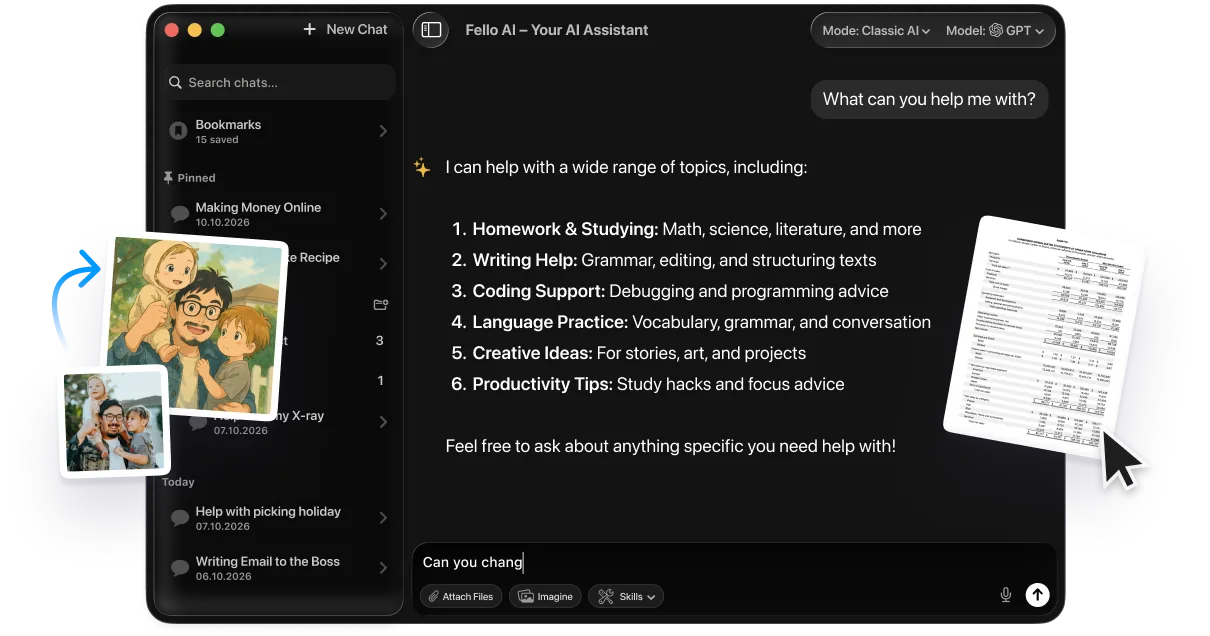
This is also where using AI well beats trying to hide it. If you draft with a model and then rewrite in your own voice, add your own examples, and check facts, the work becomes yours in substance, not just in phrasing. An app like Fello AI, which puts multiple frontier models in one place from $9.99 a month and carries more than 27,000 reviews, is handy for that kind of real drafting and editing across models. It is a writing companion, not an “undetectable text” button, and that distinction is the whole point.
Before you rely on any single score, sanity-check the tool itself. Many detectors offer paid upgrades, and you can weigh them against other AI free trials if you decide you need more volume or higher accuracy than the free tiers give.
The Bottom Line on Free AI Detectors
For most people, GPTZero is the best free AI detector to start with, backed up by Copyleaks for blended text and Scribbr for essays. Keep QuillBot or ZeroGPT bookmarked for no-signup speed, and reach for Pangram when accuracy on one important document really matters.
Whichever you choose, remember the one rule that never changes. A detector score is a signal, not a sentence, so pair it with judgment, run more than one tool on anything important, and compare your options on our best AI models hub when you want to understand the systems these detectors are trying to catch.
FAQ
What is the best free AI detector?
GPTZero is the best all-round free AI detector for most people, offering 10,000 characters per scan with no account, sentence-level highlighting, and a strong track record. Copyleaks is the best free choice for blended human and AI text, and Scribbr suits students checking essays. No free tool is perfectly accurate, so confirm important results with a second detector.
Are free AI detectors accurate?
They are useful but far from perfect. A Stanford study found leading detectors wrongly flagged 61.22% of essays by non-native English writers as AI while staying near-perfect on native writers. Treat any score as a signal to look closer, not as proof, and never let a single free scan decide a grade or a job.
Is there a free AI detector with no signup?
Yes. QuillBot and ZeroGPT let you check text with no account and no hard word limit, and Grammarly’s checker also skips signup. GPTZero gives you 10,000 characters per scan before asking for a free account. These are ideal for quick checks, though the fastest tools are not always the most accurate.
Can I use Turnitin’s AI detector for free?
Not directly. Turnitin’s real AI detector is only available inside the institutional platform that schools license, so there is no official free public version. Websites advertising a free Turnitin checker are third-party tools, not the genuine article. GPTZero, Copyleaks, and Scribbr are the closest free stand-ins for academic self-checks.
Why did a free AI detector flag my own writing?
Detectors score how predictable and how uniform your writing is, and clear, structured, or non-native English prose often looks like AI to them. That is why false positives are common. If your work was flagged unfairly, keep your drafts and notes, run the text through another detector, and use the evidence of your process to back yourself up.