91% of marketing professionals now actively use AI tools in their daily work, up from just 63% the year before, according to Jasper’s 2026 State of AI in Marketing report surveying 1,400 marketers. The shift is no longer about whether to use AI. It is about using it well, and most marketers are not there yet.
The typical marketing team in 2026 pays for ChatGPT Plus for copywriting, Jasper for long-form content, Canva for visuals, a presentation tool for decks, and an analytics platform for reports. That is four or five subscriptions, four or five logins, and a lot of context-switching between apps that do not talk to each other. This guide shows you how to handle the three tasks that eat the most marketing hours, content creation, presentation decks, and performance reports, using AI tools that actually speed things up. We will also show you how Fello AI lets you do most of this from a single app.
The Key Takeaways
- 91% of marketers actively use AI in 2026, but most still juggle multiple tools and subscriptions for different tasks
- Fello AI gives you GPT-5.4, Claude, Gemini, Perplexity, and DeepSeek in one app for $9.99/month, replacing several separate subscriptions
- AI significantly cuts content production time for marketing teams when used with the right prompts and workflows
- This guide includes copy-paste prompts for blog posts, ad copy, pitch decks, campaign recaps, and monthly reports
- The biggest gaps in most marketers’ AI use are presentations and reporting, two tasks where AI saves the most time
How AI Is Changing Marketing Work in 2026
The numbers behind AI adoption in marketing are hard to ignore. Beyond the 91% adoption rate, Salesforce’s 2026 State of Marketing report found that 75% of marketers have adopted AI but most still use it for basic tasks like drafting emails or generating social captions. The report’s headline says it plainly: marketers have the tools but are still sending “one-way, generic campaigns.”
That gap between having AI and using it effectively is where real competitive advantage sits right now. According to HubSpot’s 2026 State of Marketing report, 61% of marketers believe the industry is experiencing its biggest disruption in 20 years. Companies that build AI into their actual workflows, not just their toolbars, are consistently outperforming teams still relying on traditional methods alone. The marketers pulling ahead are not the ones with the most subscriptions. They are the ones who know which model to use for which task and have repeatable prompts that produce consistent output.
Here is what the data from Jasper’s 2026 report says marketers actually use AI for most:
- 57% use AI for content creation (blog posts, emails, social copy)
- 56% use it for idea generation and brainstorming
- 51% use it for multi-asset campaign creation across formats and channels
- 50% say AI helps them get work to market faster
- 19% are already using AI agents to automate marketing workflows end-to-end, with that number growing fast (HubSpot, 2026)
The three biggest time-sinks, content, presentations, and reports, are exactly where AI delivers the most value. Let’s walk through each one.
Why Fello AI Is the Best AI App for Marketers
Most “best AI tools for marketers” lists give you 30 different apps to evaluate. One for writing, another for presentations, a third for analytics, plus a handful of niche tools for social media, email, and SEO. That is helpful if you have unlimited budget and time to learn new interfaces. For everyone else, it is overwhelming.
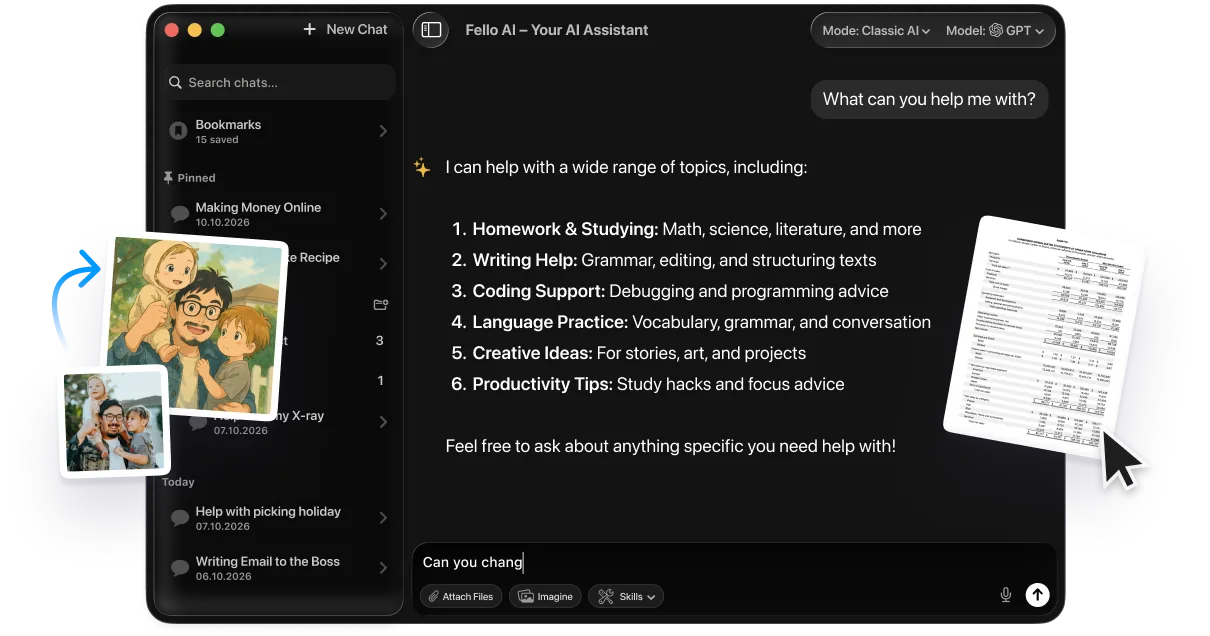
Fello AI takes a different approach. It puts GPT-5.4, Claude, Gemini, Perplexity, and DeepSeek into one clean app on your Mac, iPhone, or iPad. Instead of switching between tools, you pick the best model for each task and work from a single interface. Marketing teams running on Claude should also look at Claude Cowork, which builds reports and decks autonomously with a dedicated Marketing plugin.
Here is what that means for your marketing workflow:
- Write a blog post using GPT-5.4’s strong content generation, then switch to Claude for a tighter edit
- Research competitors with Perplexity’s real-time search capabilities without leaving the app
- Draft ad copy in three different styles by running the same prompt through GPT-5.4, Claude, and Gemini
- Build a pitch deck outline using Gemini’s analytical strengths, then flesh it out with GPT-5.4
- Summarize a 40-page campaign report by dragging the PDF into Fello AI and asking for key insights
- Generate social media posts tailored to LinkedIn, Twitter, and Instagram from a single brief
All of this for $9.99/month. Compare that to paying for ChatGPT Plus ($20/month), Jasper (from $39/month), and Canva Pro ($18/month) separately. That is $77/month or more for three tools when one app handles all three use cases and gives you access to more AI models. For a deeper look at how different models compare, check our ChatGPT vs Gemini comparison.
How to Use AI for Marketing Content with Fello AI
Content is still the backbone of marketing, and it is the task where AI has the most mature tooling. The problem is not a lack of AI writing tools. The problem is that most marketers use AI like a slot machine, type a vague prompt, hope for something usable, then spend 30 minutes editing a mediocre draft. The right workflow changes that completely.
Step 1: Research and Brief
Start with research, not writing. Open Fello AI and use Perplexity or Gemini for research-heavy tasks since both are strong at pulling current information:
Prompt: “I’m writing a blog post about [topic] for our [industry] audience. Give me 5 unique angles we could take, with supporting data points for each. Focus on angles that haven’t been covered extensively by [top 3 competitors].”
This alone saves you 30-45 minutes of manual research. Try the same prompt in both Perplexity and GPT-5.4 to compare depth versus creativity.
Step 2: Create a Content Brief
Once you choose your angle, build a full brief before writing a single word:
Prompt: “Create a detailed content brief for a 1,500-word blog post on [your chosen angle]. Include a working headline, target keyword, 5-7 H2 sections with bullet points for each, 3 data points to include, and a clear CTA. Our tone is professional but conversational.”
This brief becomes your roadmap. You are still making every strategic decision, but AI handles the structural heavy lifting.
Step 3: Draft Section by Section
Do not ask AI to write the entire post at once. Work through each section:
Prompt: “Write the introduction for this blog post. The main argument is: [thesis]. Open with a surprising stat or counterintuitive finding. Keep it under 120 words. Tone: confident, direct, no fluff.”
Then move through each H2 section the same way. If a section comes back too generic, push back: “This reads like every other marketing blog. Add a specific example from [industry] and a data point that supports the claim.” Section-by-section drafting gives you more control over voice and lets you rewrite one weak section without regenerating the entire post.
Step 4: Edit and Polish
After you have a complete draft, switch to Claude for editing. Claude is particularly strong at catching logical gaps and tightening language:
Prompt: “Review this blog post for clarity, argument strength, and brand voice. Our voice is [describe your brand voice]. Highlight any weak arguments, cut unnecessary words, and fix grammatical errors. Keep the original structure: [paste your draft]”
For more prompt ideas for your writing workflow, our prompt engineering guide covers advanced techniques that work across all models.
Quick-Reference Prompts for Marketing Content
Blog posts:
- “Write 5 headline options for a blog post about [topic]. Each should include the keyword [keyword] and be under 60 characters.”
- “Rewrite this paragraph to be more specific and data-driven. Replace any vague claims with concrete examples: [paragraph]”
Ad copy:
- “Write 3 variations of a Facebook ad for [product/service]. Each should be under 125 characters, include a clear benefit, and end with a CTA. Target audience: [audience].”
- “Write a Google Ads headline (max 30 characters) and description (max 90 characters) for [product]. Focus on [key benefit].”
For more ad copy prompts, see our guides on Gemini prompts for ad copy and ChatGPT prompts for sales copy.
Email marketing:
- “Write a 3-email nurture sequence for [product/service]. Email 1: introduce the problem. Email 2: present the solution with social proof. Email 3: time-sensitive offer. Each email under 200 words.”
- “Write 5 subject lines for a promotional email about [offer]. A/B test style, mix curiosity and urgency.”
Social media:
- “Turn this 800-word blog post into 5 social media posts: 1 LinkedIn (professional tone, 150 words), 1 Twitter thread (5 tweets), 1 Instagram caption (casual, with hashtags), 1 Facebook post, and 1 short-form hook for TikTok/Reels: [paste post]”
If you write LinkedIn content regularly, our guide on LinkedIn posts that don’t sound like AI has prompts specifically designed to avoid that robotic AI tone.
How to Use AI for Marketing Decks with Fello AI
Presentations are one of the biggest time-sinks in marketing. Pitch decks, campaign proposals, quarterly reviews, client presentations, every marketer builds them, and most spend 60-70% of the time on formatting and layout rather than the actual message. AI cannot design your slides for you, but it can handle the content side, turning hours of work into minutes.
Almost no AI marketing guides cover this, which is surprising given how many decks marketers produce every week.
Step 1: Turn Your Brief into a Slide Outline
Start with whatever you have, a campaign brief, meeting notes, performance data, or just a rough idea. Paste it into Fello AI:
Prompt: “Turn this campaign brief into a 12-slide pitch deck outline. Include title slide, problem statement, our solution, 3 key benefits with data, competitive positioning, timeline, budget, team, and next steps. For each slide, write a headline, 3-4 bullet points, and a speaker note: [paste your brief]”
GPT-5.4 tends to produce punchier headlines and tighter bullet points. Gemini is stronger for slides that need data interpretation. Try both and cherry-pick the best parts.
Step 2: Write Speaker Notes That Sound Natural
Speaker notes are where most marketers either wing it or write full scripts. The sweet spot is conversational notes with just enough detail to keep you on track:
Prompt: “Write speaker notes for each of these slides. Each note should be 60-80 words, conversational in tone, and include one specific data point I can reference. Write them as if I am presenting to a CMO, not reading a research paper: [paste slide outline]”
Step 3: Plan Your Visuals
AI cannot build your slides, but it can tell you exactly what visual belongs on each one:
Prompt: “For each slide in this deck, suggest a specific visual element: chart type with axis labels, diagram description, or icon. Be specific. Instead of ‘add a chart,’ tell me ‘bar chart comparing Q1 vs Q2 conversion rates with Q2 highlighted in brand blue.’ Include what data source I need for each visual.”
Step 4: Build the Deck
Take your AI-generated content into your preferred tool, whether that is PowerPoint, Google Slides, Keynote, or a dedicated AI presentation tool like Beautiful.ai (from $12/month) or Gamma (from $8/month). The hard part, figuring out what to say on each slide, is already done. For a deeper walkthrough of using AI in PowerPoint specifically, see our AI-powered presentations guide.
Quick-Reference Prompts for Marketing Decks
- “Turn this 2,000-word strategy document into a 10-slide executive summary with one key takeaway per slide”
- “Write a 90-second opening for my presentation on [topic] that starts with a surprising stat and sets up the problem we solve”
- “Create a competitive positioning slide comparing our product to [Competitor A] and [Competitor B]. Include columns for feature, us, them, them. Use checkmarks and X marks.”
- “Write transition sentences between these slides so the deck flows naturally: [slide list]”
How to Use AI for Marketing Reports with Fello AI
Reporting is the marketing task nobody enjoys but everyone needs. Monthly performance reports, campaign post-mortems, board-level summaries, these take hours to compile and most of the time goes into formatting data into something readable. AI handles this faster than almost any other marketing task.
Step 1: Summarize Raw Data
Export your data from Google Analytics, HubSpot, or whatever platform you use, then drop the file into Fello AI:
Prompt: “Summarize this marketing performance data into a monthly report. Include top-level KPIs with month-over-month change, 3 wins, 3 areas that need attention, and recommended next steps. Format it for a marketing director who has 5 minutes to read it: [paste or attach data]”
Fello AI can analyze PDFs and documents directly, so you can drag in exported reports without copying and pasting raw numbers.
Step 2: Generate Insights, Not Just Numbers
The difference between a good report and a great one is interpretation. Numbers without context are just noise:
Prompt: “Look at this campaign data and tell me: what is working, what is not, and why. Don’t just describe the numbers. Explain the likely causes behind any significant changes and suggest 3 specific actions we should take next month: [paste data]”
DeepSeek is particularly strong for analytical tasks like this. Try it alongside GPT-5.4 and compare the depth of analysis.
Step 3: Create Executive Summaries
For board meetings or leadership updates, you need a different format, shorter, higher-level, focused on business impact:
Prompt: “Turn this detailed marketing report into a one-page executive summary for the CEO. Lead with revenue impact, then customer acquisition costs, then pipeline contribution. Use bullet points, bold the key numbers, and keep it under 300 words: [paste report]”
Quick-Reference Prompts for Marketing Reports
- “Compare these two months of campaign data and highlight the 5 most significant changes with likely explanations: [paste both months]”
- “Turn this raw data export into a formatted table with columns for metric, this month, last month, % change, and status (green/yellow/red): [paste data]”
- “Write a post-mortem analysis for this campaign. Include objective, results vs. target, what worked, what didn’t, and 3 recommendations for the next campaign: [paste results]”
- “Summarize this quarterly marketing data into 5 slides worth of talking points for a board presentation. Each point should be one sentence with one bold number.”
For tips on working with data in spreadsheets, our guide on AI for Excel and data analysis covers formulas, pivot tables, and visualization prompts.
Fello AI vs. Separate Subscriptions: What You Actually Get
| Feature | Fello AI ($9.99/mo) | ChatGPT Plus ($20/mo) | Jasper (from $39/mo) | Canva Pro ($18/mo) |
|---|---|---|---|---|
| Blog posts and long-form content | Yes (GPT-5.4, Claude, Gemini) | Yes (GPT only) | Yes (Jasper models) | No |
| Ad copy and social media posts | Yes (multiple models) | Yes (GPT only) | Yes | Basic templates |
| Presentation outlines and speaker notes | Yes | Limited | No | Templates only |
| Report summaries and data analysis | Yes | Yes (GPT only) | No | No |
| PDF and document analysis | Yes | Yes (paid tier) | No | No |
| Real-time research | Yes (Perplexity, Gemini) | Browsing mode | No | No |
| Multiple AI models | GPT-5.4, Claude, Gemini, Perplexity, DeepSeek | GPT only | Jasper models only | Canva AI only |
| Mac, iPhone, iPad app | Yes | Web + mobile app | Web only | Web + mobile app |
| Total monthly cost | $9.99 | $20 | $39+ | $15 |
Paying for ChatGPT Plus, Jasper, and Canva Pro separately costs $77+ per month. Fello AI gives you access to more models across all three use cases for $9.99/month. The difference is not just price. It is the ability to switch between models for different tasks without switching between apps.
Other AI Tools Marketers Use
While Fello AI covers the full marketing workflow in one app, here are a few specialized tools worth knowing about.
Jasper focuses on marketing-specific content generation with built-in brand voice training and campaign workflows. It is popular with enterprise teams that need consistent output across large content operations. The Creator plan starts at $39/month, which makes sense for teams producing high volumes of content. If you already use Fello AI, its multiple models handle the same tasks for a fraction of the cost.
Canva Magic Studio adds AI-powered design features to Canva’s template library. It is strong for marketers who need visual assets, social media graphics, and basic presentation templates. Canva Pro costs $18/month per user; see our Canva pricing guide for the full plan breakdown. Our explainer on what Canva AI can do covers its full toolset. Fello AI does not create visual designs, but it generates the copy, outlines, and briefs that feed into any design tool.
HubSpot Breeze is HubSpot’s built-in AI layer for CRM, email automation, and lead scoring. If you already use HubSpot for your marketing stack, Breeze adds AI-powered features directly in your existing workflow. It is bundled with HubSpot’s paid plans rather than sold separately.
Beautiful.ai and Gamma are dedicated AI presentation tools. Beautiful.ai (from $12/month) auto-formats your slides as you type. Gamma (from $8/month) generates full presentations from prompts. Both are strong for teams that build dozens of decks a month. For content-first marketers, Fello AI’s outline and speaker note generation pairs well with either tool.
Best AI Prompts for Marketers: Quick Reference
Here are the most useful prompts you can copy directly into Fello AI. Replace the bracketed placeholders with your specific details. The more context you give, the better the output.
Content strategy:
- “Analyze these 3 competitor blog posts and identify content gaps we can fill. What topics do they cover weakly or skip entirely? [paste URLs or content]”
- “Create a 4-week content calendar for [product/brand]. Include 2 blog posts, 8 social media posts, 2 emails, and 1 case study per week. Map each piece to a funnel stage.”
Copywriting:
- “Write 3 value propositions for [product]. Each should be one sentence, lead with the customer benefit, and avoid jargon.”
- “Rewrite this landing page copy to be more conversion-focused. Current conversion rate is [X%]. Focus on the headline, subhead, and CTA: [paste copy]”
Analysis:
- “Review this marketing funnel data and identify where the biggest drop-off is happening. Suggest 3 hypotheses for why and 3 tests we could run: [paste funnel data]”
- “Compare our last 3 months of email marketing metrics and identify trends. What should we test next? [paste data]”
Pro tip: If any AI response feels generic, follow up with “Be more specific to [your industry/audience]” or “Give me a concrete example using real numbers.” The second response is almost always better. For a complete library of marketing prompts, check our 400+ AI prompts for marketing.
Conclusion
AI tools for marketers are no longer optional, 91% of marketing professionals use them daily. The question is whether you are getting real value from them or just adding more subscriptions to your expense report. Instead of juggling ChatGPT, Jasper, Canva, and a handful of niche tools, Fello AI gives you GPT-5.4, Claude, Gemini, Perplexity, and DeepSeek in one app for $9.99/month.
Start with one workflow from this guide. Pick the task that takes you the most time, whether that is content, decks, or reports, run through the prompts, and see how much faster it gets. You can download Fello AI on Mac, iPhone, or iPad with a free trial to test it yourself.
FAQ
What are the best AI tools for marketers in 2026?
The most versatile option is Fello AI, which gives you access to GPT-5.4, Claude, Gemini, Perplexity, and DeepSeek in one app for $9.99/month. For specialized needs, Jasper handles enterprise content workflows, Canva Magic Studio covers visual design, and HubSpot Breeze adds AI to your CRM.
Can AI write marketing copy that actually converts?
Yes, but it works best as a drafting partner, not a replacement for human strategy. AI excels at generating variations, A/B test options, and first drafts. The marketer’s job is to provide the strategy, brand voice, and audience context that turns a decent draft into high-converting copy.
How much time does AI save marketers?
Marketing teams using structured AI workflows report saving 60-70% of their content production time. The biggest savings come from first drafts, where AI can produce a solid starting point in minutes instead of hours. Editing and refinement still require human judgment.
Will AI replace marketers?
No. AI replaces tasks, not roles. The marketers at risk are those doing purely repetitive work like basic copywriting or manual data entry. Marketers who use AI to handle those tasks and focus on strategy, creativity, and relationship building are more valuable than ever.
What is the cheapest way to access multiple AI models for marketing?
Fello AI at $9.99/month gives you GPT-5.4, Claude, Gemini, Perplexity, and DeepSeek in one app. Subscribing to ChatGPT Plus ($20/month) and Jasper (from $39/month) separately would cost $59+ per month for fewer models and more app-switching.