Do you know the feeling of spending hours writing what you think is persuasive sales copy, only to watch potential customers read it and walk away without buying? Every business owner and sales professional has felt this frustration – stuck knowing their product can solve real problems, but struggling to communicate that value in a way that makes people reach for their wallets.
The difference between copy that converts and copy that flops often comes down to understanding exactly which psychological triggers to pull and how. In this matter, specific ChatGPT prompts for sales copy become invaluable – they help you tap into proven sales psychology while adapting the message to your specific audience and offer. However, you have to know exactly how to structure your requests to get the results you need.
Lucky for you, we’ve analyzed over a hundred high-converting sales campaigns and distilled the patterns into seven prompt templates that consistently produce copy that sells. What makes these prompts different is how they guide the AI to create copy that feels personal and transparent while following the psychological principles that drive purchasing decisions. Below you can find The best 7 ChatGPT prompts for sales copy.
The Key takeaways
- Context is king: ICP, offer, proof points, and objections drive quality.
- Iterate, don’t generate: draft → refine → variants → test.
- Constraint-based prompting wins: reading level, word count, banned phrases.
- Proof guardrails reduce risk: “Do not invent results or testimonials.”
- Testing is mandatory: headlines, hooks, CTAs, and openers should be variant-ready.
- Save a reusable system: use the prompt brief checklist below as your default workflow.
Build the prompt brief first
Every prompt below works far better when you hand ChatGPT the same eight inputs up front. Fill this brief once, keep it in a note, and paste it above any of the seven prompts. For the reusable framework behind it, use our guide to how to make the best prompt and the checklist in how to ask ChatGPT a question.
| Step | What to provide | Why it matters | Copy-paste example |
|---|---|---|---|
| 1 | Role | Forces the right “writer brain” | “Act as a senior conversion copywriter.” |
| 2 | ICP | Prevents generic copy | “Target: busy agency owners doing client reporting weekly.” |
| 3 | Offer + USP | Creates differentiation | “Unique mechanism: real-time dashboard + auto insights.” |
| 4 | Proof | Stops invented claims | “Only use these proof points: 4.8⭐ (312 reviews), 1,200 users.” |
| 5 | Objections | Improves conversion readiness | “Top objections: price, setup time, trust.” |
| 6 | Constraints | Reduces fluff and hallucinations | “8th-grade reading level, no hype words, max 120-word hero.” |
| 7 | Output format | Makes drafts shippable | “Return: headline, subhead, bullets, CTA variants, FAQ.” |
| 8 | Refinement loop | Gets from draft → final | “Give 5 headline variants, then rewrite for calmer tone.” |
1 Landing page copy prompt
Use this when you need a sales-focused landing page for product launches, lead gen, or a single-offer page.
Act as a senior conversion copywriter specializing in direct response.
I need high-converting landing page copy for [product/service] targeting [specific audience]. Business: [business description] Goal: [generate leads / drive sales / book demos] Primary value proposition: [main benefit] Key differentiator (USP): [unique selling point] Proof points (use only what’s real): [reviews, metrics, logos, testimonials you can verify] Top objections: [objection 1], [objection 2], [objection 3]
Write landing page copy that includes:
- Pre-headline
- Headline (max 12 words)
- Subheadline
- 3–5 benefit bullets
- Social proof section (placeholders allowed; do NOT invent facts)
- Offer + pricing explanation (clear, simple)
- Risk reversal / guarantee section (match our real policy)
- 3 CTA button variations
Constraints:
- 8th-grade reading level
- short sentences
- avoid hype words (game-changer, revolutionize, unlock, unleash, etc.)
- do not make unverified performance claims
Output format: Return in sections with labels. End with 5 headline variants and 5 CTA variants for A/B testing.
Tip: If your landing copy still sounds generic, run the prompt through the structure in 10 Secret Prompting Techniques That Guarantee Near-Perfect Accuracy and add “write 3 versions: calm, bold, and playful.”
2 Email sales sequence prompt
Use this for automated funnels, onboarding, and product launches when one email won’t convert the lead.
Write a [number]-email sales sequence for [product/service] targeting [audience] who [current situation].
Lead source: [lead magnet / webinar / free trial / newsletter] Timeframe: [e.g., 7 days] Goal: convert to [purchase / booked call / paid plan] Tone: [helpful / authoritative / conversational]
Sequence requirements:
- Email 1: welcome + deliver promised value + open loop
- Email 2: problem story + empathy
- Email 3: unique mechanism + why it works when others fail
- Email 4: social proof story (use only real proof; placeholders ok)
- Email 5: close + urgency only if true + clear CTA
Rules:
- Subject lines under 40 characters
- Each email under 250 words
- One CTA per email
- Include PS in every email
- Do not invent results, numbers, awards, reviews
Output format: Return each email with: subject line, preview line, body, CTA, PS. End with 10 alternative subject lines for Email 5.
If you’re building more email workflows beyond this sequence, the template patterns in Reply to Your Emails 10x Faster with ChatGPT are a useful add-on for internal team replies, objections, and follow-ups.
3 Product description copy prompt
Use this for ecommerce listings, PDPs, catalogs, and marketplaces.
Create a compelling product description for [product name] targeting [customer demographic] at [price point].
Key features: [list features] Customer problem: [problem] Desired outcome: [solution/outcome] Proof points (only real): [reviews, certifications, guarantees, materials, tests] SEO keywords to include: [keyword 1], [keyword 2], [keyword 3] Platform: [Shopify / Amazon / Etsy / website]
Write:
- Benefit-led headline
- 1 sensory paragraph (help them visualize)
- 5–8 scannable benefit bullets (feature → benefit)
- Technical specs list
- Objection handling for: [common objection]
- CTA line
Constraints:
- No medical/performance claims unless substantiated
- No invented reviews, awards, or certifications
- Keep it crisp, skimmable, and human
4 VSL video sales letter prompt
Use this for YouTube ads, paid social, webinar intros, and sales page videos.
Create a [duration] VSL script for [product/service] targeting [audience] in [current situation]. Goal: [conversion objective] Offer: [what they get + price if relevant] Main pain point: [problem] They have tried: [previous solutions]
Script must include:
- 0:00–0:05 pattern interrupt
- 0:05–0:15 qualify the viewer
- 0:15–0:35 old way vs new way
- 0:35–0:50 offer and what they get
- 0:50–1:00 CTA with exact next step
Formatting:
- Two-column table: Visuals (left) and Dialogue (right) Rules:
- Use only verified proof points (or placeholders)
- No guaranteed outcomes unless legally substantiated
End with 5 alternative hooks for the first 5 seconds.
5 Sales pitch prompt
Use this for enterprise sales, investors, partnerships, and high-stakes decks.
Create a sales pitch for [product/service] to [audience type] for [context] worth [deal size]. Company: [company description] Traction: [real metrics only] Market problem: [problem] Target market: [who] Competitive advantage: [differentiators] Business model: [pricing / revenue streams] Ask: [amount / next step]
Build:
- Hook (market opportunity)
- Problem with examples
- Solution with unique mechanism
- Proof + traction (no invented claims)
- Competitive landscape (high-level)
- Offer / proposal structure
- Objection prep (top 5 hard questions + strong answers)
- Close with next steps
Tone: [confident, direct, not hype] Output: structured talk track + slide-by-slide outline.
6 Sales funnel copy prompt
Use this to build consistent messaging across awareness → consideration → decision.
Build complete sales funnel copy for [product/service] targeting [customer avatar]. Traffic source: [organic / paid / referrals / partners] Stages: [e.g., 3 stages] Goal: [purchase / demo / call / trial]
For each stage, write: 1 Awareness
- lead magnet headline options (10)
- opt-in page hero copy
- 5 hooks for ads/posts
2 Consideration
- 3-email educational sequence
- objection-handling bullets
- proof and trust elements (placeholders ok, no invented results)
3 Decision
- offer section copy
- pricing framing
- risk reversal (match real policy)
- FAQ (7 questions)
- 5 CTA variants
Constraints:
- Keep tone consistent with [brand voice]
- No fake urgency or scarcity
- Identify any claims that require proof in a “Claims to Verify” list at the end.
7 Sales script prompt
Use this for calls, demos, discovery sessions, and consultative selling.
Create a sales call script for [context] selling [product/service] to [prospect type]. Call length: [duration] Prospects are: [current situation] Common objections: [list] Competitive advantages: [differentiators] Proof: [real case studies, metrics, testimonials]
Script must include:
- Opening and framing statement
- Discovery questions (needs, timeline, budget, decision process)
- Positioning + value explanation (simple, no jargon)
- Objection handling (price, timing, trust, competition)
- Close options (soft close + direct close)
- Follow-up email template
Output: Return a conversation tree (If they say X → you say Y). End with coaching notes (tone, pacing, personalization).
Create Your Own ChatGPT Prompts for Sales Copy
Creating effective sales copy prompts requires giving ChatGPT specific context about your business, target audience, and sales objectives. The more detailed information you provide about your market position and customer psychology, the more persuasive and targeted your generated copy will be.
Step-by-Step Process:
- Define your sales context – Specify the format (email, landing page, script) and where it will be used.
- Describe your business and offer – Include what you sell, pricing, and key differentiators from competitors.
- Identify your target audience – Be specific about demographics, current situation, and pain points.
- State your conversion goal – Clarify whether you want leads, sales, bookings, or other specific actions.
- Provide market context – Include competitor information, objections you face, and your unique advantages/responses.
- Set tone and constraints – Specify brand voice, length requirements, and any other constraints you have.
- Request structured output – Ask for organized sections, alternatives, and implementation guidance.
Example Prompt Using These Steps:
Create a sales script for phone calls selling premium business coaching priced at $10,000 to business owners. Calls last 45 minutes, prospects are entrepreneurs generating $500K-$2M annually struggling with team management and scaling, common objections are price concerns and time commitment, competitive advantages are 15+ years experience and 200+ client transformations. Use these client success stories: [insert specific case studies/testimonials]. Create a script that: opens with rapport building around scaling challenges, uses discovery questions uncovering operational bottlenecks and revenue goals, presents solutions connecting to potential discovered needs, handles objections with ROI calculations and success stories, demonstrates value through client case studies and assessment process, guides to commitment with assumptive closing techniques, and follows up on implementation timeline. Include conversation flows for different responses, objection scripts for price and time concerns, and coaching notes for maintaining a consultative tone.
Prompt packs people also like
| Prompt pack | Best for | What you’ll get |
|---|---|---|
| 400+ Best AI Prompts for Marketing | Full-funnel marketing teams | Copy, email, SEO, promos, brand |
| 7 Effective Gemini Prompts for Ad Copy | Paid traffic testing | Ad angles, hooks, CTA variants |
| 6 Gemini Prompts for LinkedIn Posts | Organic demand gen | Human-sounding posts + edit pass |
| 7 Best Gemini Prompts for YouTube Scripts | Video teams | Hooks, outlines, chapters, metadata |
| 7 Secret ChatGPT Prompts for Business Strategy | Positioning + offers | Competitor angles, strategy prompts |
| Top 200 ChatGPT Prompts for E-commerce | Ecommerce operators | Product research + PDP + ads |
| Top 10 ChatGPT Hacks You Need to Know | Power users | Higher-quality outputs + workflows |
Where to run these prompts
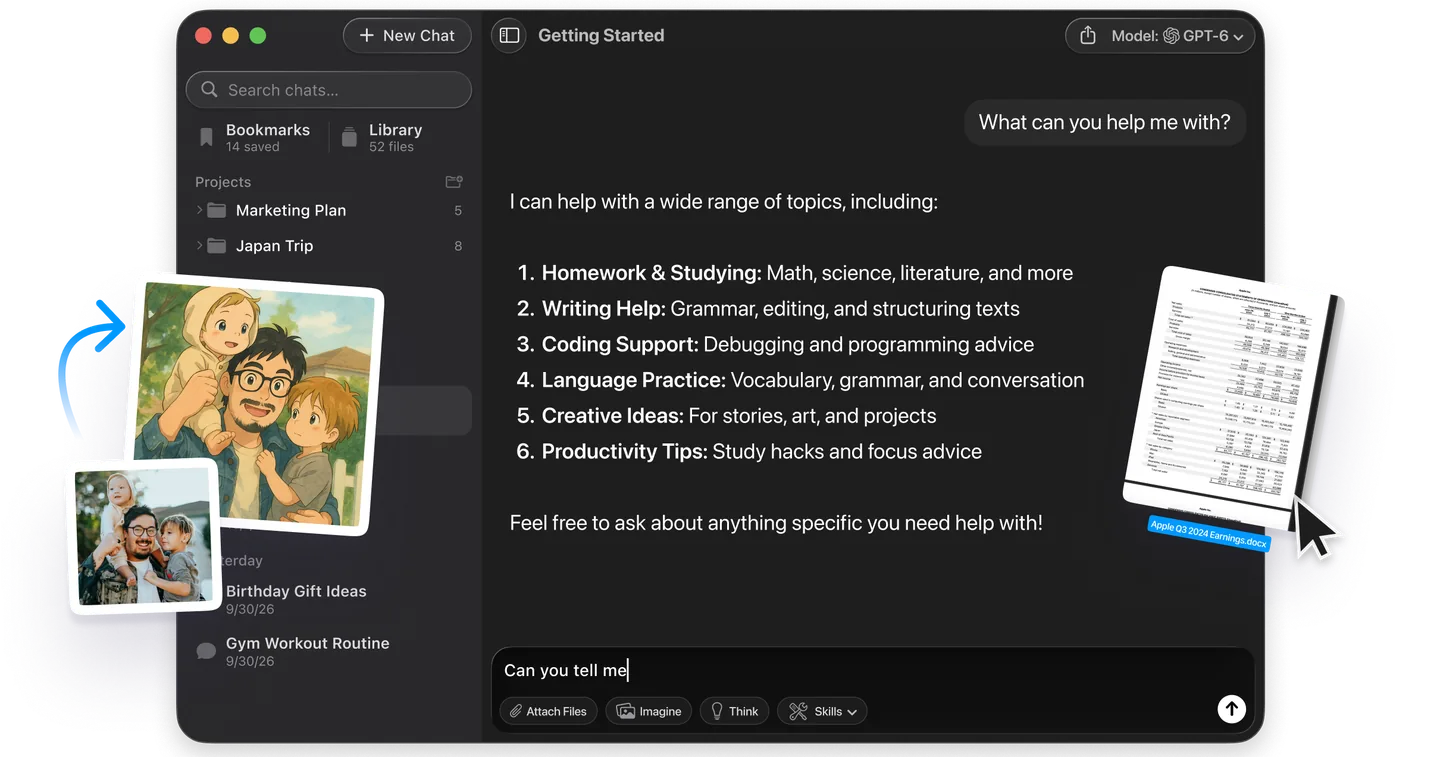
All seven prompts are written for a chat window, and ChatGPT handles every one of them well. The friction is what comes next, because you still copy the output into a document, a deck, or a landing page builder yourself. Fello AI removes that step by running every major model, including Claude, ChatGPT, Gemini, Grok, and DeepSeek, in one app for $9.99 a month, and by generating the finished artifact straight from the prompt: documents, PDFs, slide decks, and spreadsheets. For the email sequence or the VSL script above, that means the draft arrives as a document instead of a wall of chat text. If you would rather keep ChatGPT itself in a window beside your doc, our guide to the ChatGPT desktop client for Mac covers the install.
It will not replace a design tool for final polish and it will not run your CRM, so treat it as the drafting layer rather than the whole stack. If sales copy is one piece of a wider push, our guide to AI for small business covers where the rest of the budget tends to go.
Conclusion
ChatGPT excels at understanding psychological triggers, sales patterns, and proven copywriting structures that drive conversions because it has been trained on billions of data points and human behavioral patterns. Its ability to analyze successful sales frameworks and apply persuasion principles makes it a handy tool for generating compelling copy that taps into human psychology.
However, the generated copy should always be your starting point, not your final product. You’ll need to refine the content to match your brand voice, add industry-specific language, and incorporate unique phrases that set your business apart from the crowd.
Start by testing a couple of these ready-made prompts for your current sales materials, then experiment with your own prompts once you become more familiar with the process. Keep track of which copy performs best so you can refine your approach over time and maintain the signature that makes your business unique.
FAQ
What are the best ChatGPT prompts for sales copy?
Structured “mega prompts” with ICP, offer, proof, objections, constraints, and output format beat generic “write me an ad” prompts.
Can ChatGPT write sales copy that converts?
It can produce strong drafts fast, but you still need real proof points, compliance checks, and testing.
How do I stop ChatGPT from sounding like a robot?
Define voice rules (contractions, short sentences, no jargon), provide a style sample, and run a refinement loop (“make it warmer and simpler”).
What inputs matter most for conversion?
ICP pain, USP, proof, and top objections. If those are missing, the model fills gaps with generic patterns.
How do I reduce hallucinations in sales copy?
Use “proof-only” constraints, require a “Claims to Verify” list, and ban invented testimonials or numbers.