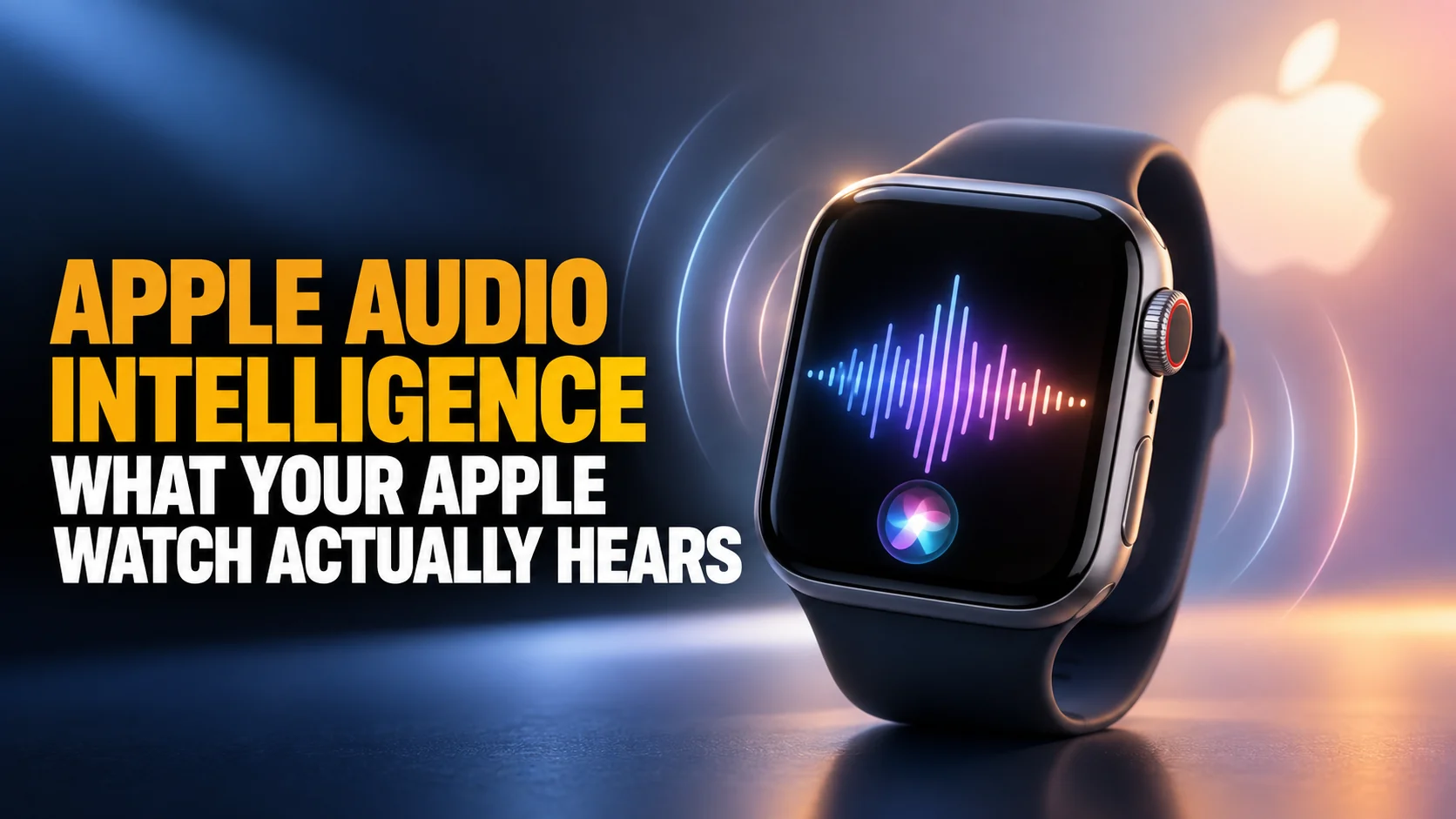
Apple announced Apple Audio Intelligence on 9 September 2026. Within hours, the coverage had settled on one phrase: your Apple Watch is now always listening. The feature that earned that headline is Siri Recap, which quietly takes notes on the conversations you have during the day and writes them up as summaries you can read later. Apple published an eleven-page privacy paper on the same day arguing, in some detail, that the headline is wrong. The same event brought the iPhone 18 Pro and Apple’s first foldable, and we cover every AI feature in the iPhone Duo separately.
Both descriptions hold at once, and the gap between them is where the interesting part lives. This article works from Apple's two primary documents rather than the press coverage: the support page for Audio Intelligence and the privacy overview PDF. It covers what the four features do, what leaves your wrist and what never does, and how to switch each feature on or off. It also covers the two hardware gates that will disqualify most people reading this, and the one question Apple answered in a way you may not find satisfying.
The Key Takeaways
- Four features, not one: Sound Recognition, Music Recognition with Shazam, Live Rewind and Siri Recap. Only the first two work today.
- Not in the 14 September release: Live Rewind and Siri Recap arrive in beta later this year, in English only. They are not part of the 14 September iOS 27 release.
- Two hardware gates: you need an Apple Watch Series 12 or Ultra 4 and a specific recent iPhone. Most current owners will not qualify.
- No recording is made: Apple's wording is that there is no recording to produce if requested by any party, "because no recording exists".
- Live Rewind chimes. Siri Recap does not. The feature that summarises your conversations gives the people in them no signal at all, and Apple explains why.
What Apple Audio Intelligence Actually Is
Apple Audio Intelligence is a named bundle of four Apple Intelligence features that run on the microphones of the Apple Watch Series 12 and Apple Watch Ultra 4. Apple describes it as a brand-new class of Apple Intelligence features. All four depend on the new S11 chip and a piece of it called the Secure Exclave, which matters enormously and which we come back to below. Apple's support page for Audio Intelligence is the reference for everything in this section.
Sound Recognition detects sirens, alarms, doorbells and similar sounds and notifies you, even when your iPhone is not with you. Apple positions it explicitly for people who are deaf or hard of hearing, and it is the feature most likely to change someone's day rather than mildly improve it.
Music Recognition uses Shazam to identify whatever is playing nearby and drops the title and artist into the Smart Stack without you tapping anything.
Live Rewind shows you the last 15 seconds of a conversation as text when you double-press the Digital Crown. It is aimed at the moment when someone says a book title, a set of cooking instructions or an unfamiliar term and it slides past you.
Siri Recap is the contentious one. It takes ambient notes on your conversations through the day and produces high-level summaries in the Siri app. Apple is careful to say these are summaries and not transcripts, comparable to notes a person might write after a conversation.
Is Your Apple Watch Always Listening?
Not in the way the phrase implies, and the distinction is worth getting right because it is the entire basis of Apple's privacy argument.
What the chip is actually doing
According to Apple's Audio Intelligence Privacy Overview, the S11 chip runs a lightweight AI model whose only job is to work out whether speech is happening nearby. Apple's wording is that this model "doesn't transcribe or record anything. It simply detects whether a conversation has started." Only once a conversation is detected does audio flow into a protected buffer inside the Secure Exclave.
So the microphone is active in the sense that something is always sampling it. What is not happening is continuous transcription, continuous recording, or a continuous stream of your speech going anywhere. The same on-device approach drives Live Captions on a Mac. The honest summary is that the watch is always detecting and only sometimes processing.
The Secure Exclave, and why it carries the argument
The Secure Exclave is a hardware-isolated compartment built into the silicon that handles sensor data separately from everything else. Apple states that data processed inside it cannot be reached by watchOS, by apps, by you, or by Apple. Audio sits there in a buffer that is continuously overwritten, so it never accumulates and never becomes a file.
That leads to the sentence Apple clearly wants quoted, and which appears identically in both primary documents: there is no recording to share, forward, or produce if requested by any party, "because no recording exists". That is a strong claim, because it describes what anyone could subpoena, leak or hand over, not just what Apple promises not to look at. If you want the broader context for how Apple handles this kind of processing, our guide on using AI without giving up your privacy covers the general principles.
What You Need for Apple Audio Intelligence
This is where most readers will stop, and Apple has not made it easy to find. There are two separate requirement sets, and the second one is strict.
| Feature | Watch required | iPhone required | Available now? |
|---|---|---|---|
| Sound Recognition | Series 12 or Ultra 4 | iPhone 11 or later, or SE 2nd gen or later, on iOS 27 | Yes |
| Music Recognition (Shazam) | Series 12 or Ultra 4 | iPhone 11 or later, or SE 2nd gen or later, on iOS 27 | Yes |
| Live Rewind | Series 12 or Ultra 4 | iPhone 16, 16 Plus, 16 Pro, 16 Pro Max, 17, 17e, 17 Pro, 17 Pro Max, Air, 18 Pro, 18 Pro Max or Duo | No, beta later this year |
| Siri Recap | Series 12 or Ultra 4 | Same list as Live Rewind | No, beta later this year |
The gates most coverage missed
Note what that iPhone list does and does not contain. The iPhone 16e is absent while the 17e is present, so the common shorthand "iPhone 16 or later" is wrong and would mislead 16e owners. The two AI features also require Apple Intelligence and Siri AI in beta, so an eligible phone alone is not enough. Our rundown of which iPhones, iPads and Macs support Apple Intelligence is the place to check the wider device picture.
There are age limits too, which almost nobody reported. Live Rewind and Siri Recap are not available to users under 13 at all, and for users under 18 on a Child Account a parent or guardian has to switch access on.
The EU problem
Apple's support page states that Live Rewind and Siri Recap require Siri AI in beta. The same page's footnote states that Siri AI "will not initially be available in the EU on iOS, iPadOS, and watchOS". Read together, those two statements mean EU users should not expect Live Rewind or Siri Recap on Apple Watch at launch, since watchOS is named directly in the exclusion.
Apple has not published a sentence saying Audio Intelligence is unavailable in the EU, so treat this as the consequence of two stated requirements rather than an announcement. It is consistent with the Digital Markets Act delay Apple has already described for Siri AI, which we cover alongside the rest of the release in our iOS 27 guide.
How to Turn Apple Audio Intelligence On
Every Audio Intelligence feature is opt-in, and each one lives in a different place. Apple's own instructions are as follows.
Sound Recognition and Shazam
For Sound Recognition, open Settings on iPhone, tap Accessibility, then Sound & Name Recognition, then Sound Recognition, then turn on "Detect using Apple Watch". If it is already on for your iPhone, it switches on for the watch automatically. You can enable or disable individual sound categories separately.
For Shazam, open Settings on the Apple Watch itself, tap Smart Stack, then turn on "Music Detection". You can also tap the Enable Music Detection widget when it appears in your Smart Stack.
Live Rewind and Siri Recap
You can opt into both during Apple Watch setup, or change them later. For Live Rewind, open the Watch app on iPhone, tap Siri, tap Live Rewind, then turn on "Double Click Digital Crown". Activation then requires a deliberate double-press every single time.
Siri Recap is also switched on in the Watch app on iPhone, and it is the only feature with scheduling. You can set it by time, by location, or both, so it runs only at work or never at night, and you can always override it from Control Center. If you would rather have none of this, our guide to turning off Apple Intelligence covers the broader switches.
What Happens to Your Data
The four features handle data differently, and only one of them sends anything to Apple's servers.
The Siri Recap pipeline
Once a conversation is detected, audio enters the Secure Exclave on the watch, is encrypted, and is transmitted to the Secure Exclave on your paired iPhone. Apple says a new audio-verified pairing mechanism, working alongside Bluetooth, ensures that data can only reach that one phone and no other device. On the iPhone, the audio is decrypted inside the Secure Exclave, transcribed on-device, and condensed to text that Apple designs to be "less than half the length of the original transcript". The raw audio is then deleted permanently from both Secure Exclaves.
Only that condensed text, plus some contextual information, is encrypted and sent to Private Cloud Compute, where Apple Foundation Models write the final summary. Apple says data there is never stored or accessible to anyone including itself, a claim it invites researchers to audit and documents in its Private Cloud Compute write-up. The result comes back encrypted to your iPhone and watch. Apple notes that this processing is subject to daily usage limits, without saying what they are. The same caps now cover Siri AI and the photo tools, which we set out alongside every AI feature on the iPhone 18 Pro. If your watch cannot reach your phone in time, the encryption keys expire and the audio is deleted.
Everything else mostly stays put
Sound Recognition runs entirely on the watch, with no audio transcribed or transmitted. Live Rewind is processed on your devices only, unless you tap Ask Siri or save the snippet, at which point the text alone goes to Private Cloud Compute. Shazam is the one exception that touches a non-Apple service, and it sends an acoustic signature rather than audio, which Apple describes as a compact representation that cannot be reversed into the original sound.
Anything you save syncs end-to-end encrypted through iCloud if you use two-factor authentication and a passcode, and Apple states plainly that it does not hold the encryption keys. Siri Recaps auto-delete after seven days unless you save or export them. Live Rewind snippets vanish roughly 30 seconds after the display dims.
The People Around You
Most of the coverage framed this as a question about your privacy. The sharper question is about everyone else's, and it is the one place where Apple's answer deserves scrutiny rather than repetition.
One feature announces itself, the other does not
Live Rewind is loud about what it is doing. Apple states that an audible chime plays from the watch speaker when it activates, even if the watch is on silent or you have headphones connected, accompanied by a full-display animation and a microphone indicator. That is a deliberate design choice to alert nearby people.
Siri Recap does none of this. The privacy paper explains why in a single sentence: "There is no audible signal because no raw audio is retained." In other words, Apple's position is that there is nothing to disclose, because nothing is being captured that could be shared.
How good is that argument?
On the forensic question, it is strong. If no recording exists, there is nothing to leak, subpoena or hand over. Apple reinforces this by not attributing speakers, by omitting flagged sensitive content such as financial data and government-assigned identifiers, and by keeping raw audio inside hardware neither you nor Apple can open.
On the social question, it is weaker. The person talking to you still has no way to know that a summary of their words is being generated and stored on your phone for the next seven days. A summary is not a recording, but it is not nothing either, and consent is usually about whether someone knew, not about the file format. Apple gets close to conceding this in its own advice, which asks you to "consider those around you where conversations might be private or sensitive". That places the judgement on you, which is probably the right place for it, but it is a different thing from the feature handling it.
Two more limits are worth knowing before you rely on any of this. Apple warns that summaries "may be incomplete or inaccurate" and that important details may be omitted or misunderstood, so it advises confirming anything that matters with the people involved. It also warns that its automated filtering "may not remove all sensitive information".
Should You Switch It On?
For most people the question is academic for now, because the hardware gates rule them out and the two interesting features are months away in beta and English only.
If you do qualify, the answer splits cleanly. Sound Recognition is an easy yes, particularly if you are deaf or hard of hearing, and it costs you nothing in exposure because it never leaves the watch. Shazam is harmless. Live Rewind is the better-designed of the two AI features: it only runs when you deliberately double-press, it announces itself audibly, and it forgets in about 30 seconds. It is hard to object to.
Siri Recap is the one to think about, and the deciding factor is not really the technology, which is more careful than the headlines suggest. It is whether you are comfortable being the person in the room generating notes that nobody else knows about. Apple gives you good tools to draw that line, including location and time scheduling, so a reasonable middle path is to allow it somewhere specific like your own workplace and leave it off everywhere else. If Apple's assistant is not the one you want doing this kind of work anyway, our roundup of Apple Intelligence alternatives for Mac covers what else is available, and our explainer on Siri AI sets out what the rebuilt assistant can and cannot do.
Whatever you decide, decide it deliberately rather than during watch setup, which is the moment Apple asks and the moment you are least likely to be paying attention.
Frequently Asked Questions
Does the Apple Watch record my conversations?
No. Apple states that Audio Intelligence features do not create audio recordings, and that there is no recording to share, forward or produce if requested by any party, because none exists. Audio is processed inside a hardware-isolated Secure Exclave on the S11 chip and deleted immediately afterwards.
Is Apple Audio Intelligence available now?
Partly. Sound Recognition and Music Recognition with Shazam work now on Apple Watch Series 12 and Ultra 4. Live Rewind and Siri Recap will be available in beta later this year, starting with English. They are not part of the iOS 27 release on 14 September.
Do I need to tell people my watch is summarising?
Apple does not require it and Siri Recap gives no signal to anyone nearby, unlike Live Rewind, which chimes audibly. Apple's own guidance asks you to consider those around you where conversations might be private or sensitive, so the judgement is left to you.
How long are Siri Recap summaries kept?
Siri Recaps auto-delete after seven days unless you save or export them. Saved Live Rewind snippets persist, while unsaved ones disappear roughly 30 seconds after your watch display dims. You can view, edit and delete anything in the Siri app at any time.
Will Apple Audio Intelligence work in the EU?
Sound Recognition and Shazam should. Live Rewind and Siri Recap require Siri AI, and Apple states Siri AI will not initially be available in the EU on iOS, iPadOS and watchOS, so EU users should not expect those two at launch. Apple has given no timeline.