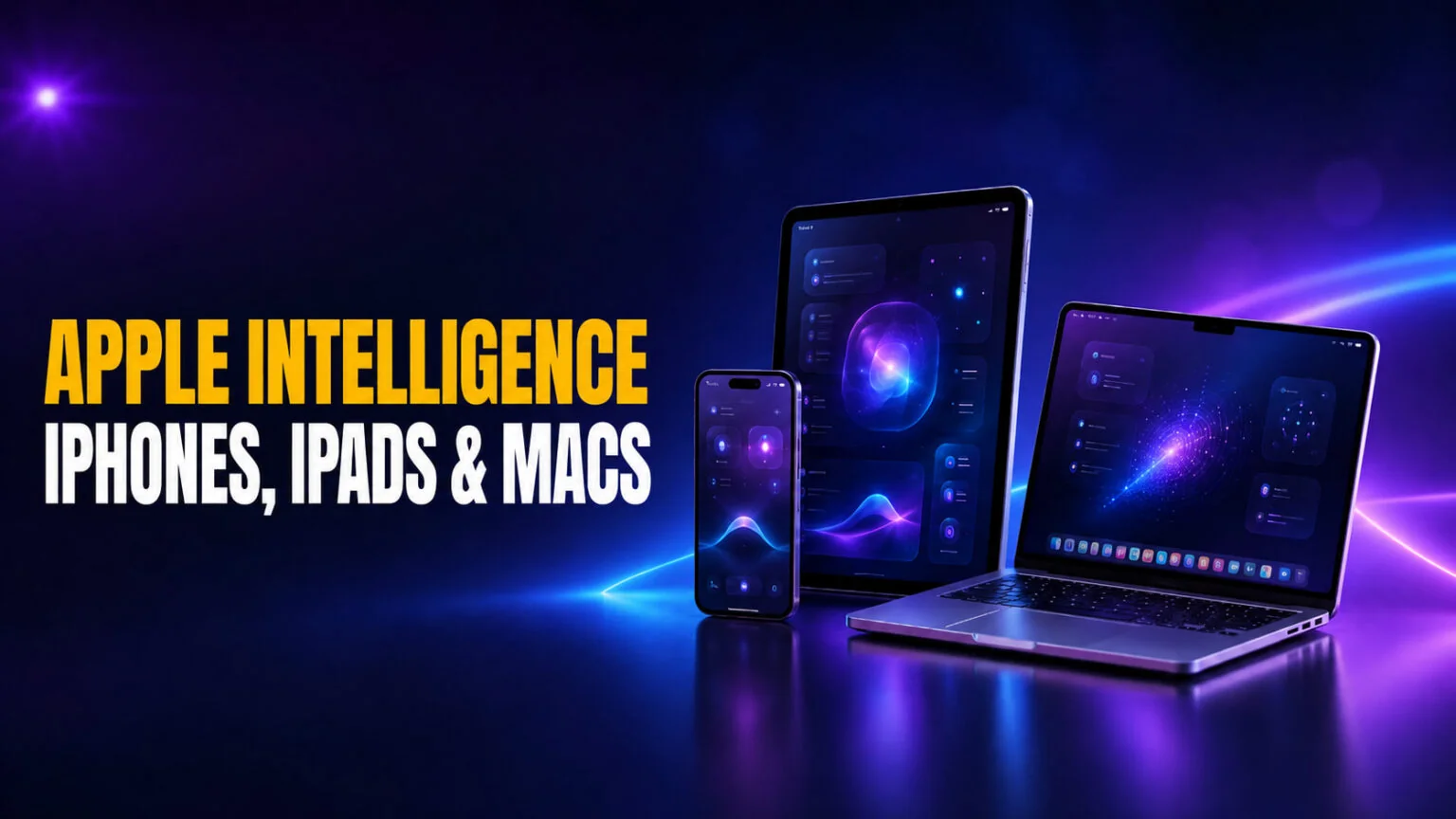
Apple Intelligence runs on iPhone 15 Pro and later, every iPhone 16 and 17 model, iPads with an M1 chip or the A17 Pro, and any Apple silicon Mac. That means the dividing line is hardware, not software, and the standard iPhone 15, iPhone 15 Plus, and every iPhone 14 or older are locked out no matter which iOS version they run. The floor is the A17 Pro chip on iPhone and the M1 on iPad and Mac.
This guide lists every supported device by category, names the exact chips and RAM each one needs, and flags the models that look eligible but are not. It also covers the new 2026 twist most lists miss, the 12GB RAM tier that splits Apple Intelligence into a standard experience and a more advanced one, so you know whether your device gets the full feature set or just part of it. If your Mac misses the cut, our guide to Apple Intelligence alternatives for Mac covers what to run instead. If you are deciding which iPhone to actually buy, our iPhone buying guide for 2026 takes the decision from there.
The Key Takeaways
- iPhone: Apple Intelligence works on iPhone 15 Pro, 15 Pro Max, and all iPhone 16 and 17 models, including iPhone Air, 16e, and 17e.
- iPad and Mac: any iPad with M1 or later (plus iPad mini with A17 Pro) and any Apple silicon Mac (M1 or newer) qualify.
- The 12GB rule: the most advanced on-device model needs 12GB of RAM, so only iPhone Air, iPhone 17 Pro, and 17 Pro Max unlock every Siri AI feature.
- Left out: the standard iPhone 15, iPhone 15 Plus, iPhone 14 and older, and all Intel Macs cannot run Apple Intelligence.
- Rollout: Apple Intelligence is free. iOS 27, iPadOS 27, and macOS 27 all arrive on Monday, September 14, 2026. Siri AI lands as an English-only beta behind a waitlist, and not on EU iPhones, iPads, or Apple Watches.
Apple Intelligence Supported Devices at a Glance
Here is the full eligibility list across every product line, matching Apple’s own device requirements. The minimum chip is what matters, so if your device meets or beats it, you are covered.
| Device category | Supported models | Minimum chip | Minimum OS | Advanced 12GB model? |
|---|---|---|---|---|
| iPhone | iPhone 15 Pro and later, all iPhone 16 and 17 | A17 Pro | iOS 27 | Only Air, 17 Pro, 17 Pro Max |
| iPad | iPad mini (A17 Pro), iPad Air and Pro with M1+ | A17 Pro / M1 | iPadOS 27 | iPad Air and Pro with M4 + 12GB |
| Mac | Every Apple silicon Mac, plus MacBook Neo | M1 / A18 Pro | macOS 27 | M3 or faster with 12GB |
| Apple Watch | Series 10+, Ultra 2+, SE 3 (via paired iPhone) | n/a (relays to iPhone) | watchOS | No (uses iPhone) |
| Apple Vision Pro | Apple Vision Pro | M2 | visionOS | Yes |
Every device on this list runs Siri AI and the core Apple Intelligence features. The last column is the part that trips people up, and it is the subject of its own section below. If Siri AI stops responding on a supported device, see why Siri is not working.
Which iPhones Support Apple Intelligence?
Apple Intelligence runs on iPhone 15 Pro, iPhone 15 Pro Max, and every single iPhone 16 and iPhone 17 model. That includes the budget iPhone 16e and 17e, the thin iPhone Air, and both Pro tiers. The shared requirement is the A17 Pro chip or newer, which is why the lineup splits the way it does within the iPhone 15 generation.
The standard iPhone 15 and iPhone 15 Plus do not support Apple Intelligence, even though they launched the same year as the 15 Pro. They shipped with the older A16 Bionic, which lacks the Neural Engine headroom Apple requires. Every iPhone 14, iPhone 13, and earlier model is also excluded for the same reason, and no software update changes that.
| iPhone generation | Models | Chip | Apple Intelligence | Full 12GB tier |
|---|---|---|---|---|
| iPhone 17 | 17 Pro Max, 17 Pro, Air, 17, 17e | A19 / A19 Pro | Yes | Air, 17 Pro, 17 Pro Max only |
| iPhone 16 | 16 Pro Max, 16 Pro, 16 Plus, 16, 16e | A18 / A18 Pro | Yes | No |
| iPhone 15 | 15 Pro Max, 15 Pro | A17 Pro | Yes | No |
| iPhone 15 | 15 Plus, 15 | A16 Bionic | No | No |
| iPhone 14 and older | all models | A16 and earlier | No | No |
If you want the cheapest route to Apple Intelligence, the iPhone 15 Pro is the entry point, and the iPhone 16e is the most affordable current model that qualifies.
The 12GB RAM Tier, Explained
In 2026 Apple drew a new line inside Apple Intelligence itself, and it is the detail most device lists skip. Similar cutoffs apply elsewhere in macOS, where Live Captions needs Apple silicon and will not run on an Intel Mac at all. The platform’s most advanced on-device model requires 12GB of unified memory to run, because the larger model has to fit in RAM alongside the operating system and your active apps. Devices with 8GB get the standard experience, and that covers the vast majority of Siri AI.
On the 8GB tier, you still get Siri AI’s conversational depth, onscreen awareness, and personal context understanding, so the everyday experience feels complete. What the 12GB tier adds on top are two on-device-only perks, more expressive Siri voices and more advanced dictation, which run locally on the bigger model. Among iPhones, only the iPhone Air, iPhone 17 Pro, and iPhone 17 Pro Max clear the 12GB bar. If those extra Siri touches are not for you, you can always turn Siri off completely.
The base iPhone 17 and 17e ship with 8GB, so they miss those two on-device extras at launch. The rest of Apple Intelligence still works in full, and heavier requests on 8GB devices route to Private Cloud Compute, Apple’s private server-side fallback, rather than running locally. On Mac the advanced model needs an M3 chip or faster with 12GB, and on iPad it needs an iPad Air or Pro with M4 and 12GB.
Which iPads Support Apple Intelligence?
On iPad the rule is simple, you need an M1 chip or later. That covers every recent iPad Pro and iPad Air, going back to the 2021 models. The one exception that breaks the M-series pattern is the iPad mini (A17 Pro), which qualifies on Apple’s phone-class chip rather than an M-series one.
Older iPads with A-series chips below the A17 Pro do not support Apple Intelligence, and neither do the base entry-level iPad models that still ship with older silicon. If you are unsure, check Settings for your chip; anything with M1, M2, M3, or M4 is in, and the only A-series iPad that makes the cut is the current iPad mini. If you are choosing a new tablet, our guide to the best iPad for AI breaks down which model to buy.
Which Macs Support Apple Intelligence?
The Mac story is the most generous of the three. Every Apple silicon Mac supports Apple Intelligence, from the original M1 MacBook Air all the way up to the Mac Pro and Mac Studio, plus the new MacBook Neo with the A18 Pro chip. If your Mac has any M-series chip, it is eligible for the standard experience. If you are choosing between a MacBook Neo and an iPad, our iPad vs MacBook comparison shows which one gets more out of Apple Intelligence.
The only Macs left out are Intel-based models, which have no Apple silicon Neural Engine and cannot run the on-device models. For the advanced 12GB on-device tier, you need an M3 or faster chip paired with at least 12GB of RAM, though every Apple silicon Mac still gets the broader Apple Intelligence feature set either locally or through Private Cloud Compute. For a full buyer’s rundown, see our picks for the best MacBook for AI, or read why a Mac mini for AI is often overkill.
Apple Watch and Vision Pro
The Apple Watch does not run Apple Intelligence on its own. Instead, Apple Watch Series 10 or later, Apple Watch Ultra 2 or later, and Apple Watch SE 3 can use Siri AI features when paired with an Apple Intelligence-enabled iPhone nearby. The heavy lifting happens on the phone, and the watch acts as a relay, which is why it has no chip or RAM requirement of its own. Notably, the Apple Watch Series 9 is not on Apple’s list, so it cannot run the new Siri even alongside a compatible iPhone.
Apple Vision Pro supports Apple Intelligence natively on its M2 chip, making it the one headset in the lineup with full access. If you want a deeper look at how Apple’s spatial and assistant ambitions compare to rivals, our breakdown of Android XR glasses versus Apple’s AI glasses covers where the platforms are heading.
Requirements, Cost, and Rollout
Beyond the chip, Apple lists a few baseline requirements on its Apple Intelligence support page. You need about 7GB of free storage on device, the device language and Siri set to a supported language (English first, with more to follow), and the latest OS. Apple Intelligence and Siri AI ship with iOS 27, iPadOS 27, and macOS 27, and iOS 27 reaches the public free on Monday, September 14, 2026, a date Apple confirmed at its September 9 event, with iPadOS 27 and macOS 27 shipping the same day. Siri AI arrives as an English-only beta behind a waitlist, and Apple is not releasing it on EU iPhones, iPads, or Apple Watches.
Region matters too. Apple Intelligence is unavailable in mainland China while Apple works through local regulatory requirements, and in the European Union the new Siri AI is limited to Mac and Apple Vision Pro at launch rather than iPhone. The same EU block keeps Apple’s new HomeView smart display off sale there entirely. For the full feature rundown and the background on Siri AI and the Google deal behind it, see our Apple Intelligence explainer and our deeper dive into what Siri AI actually is.
Should You Upgrade for Apple Intelligence?
If your device already meets the A17 Pro or M1 floor, you have no reason to upgrade; the standard experience covers nearly everything Apple announced. The two on-device extras tied to 12GB of RAM are nice but minor, and they still function through Private Cloud Compute on 8GB devices. Most people are better off keeping a compatible phone than spending to chase expressive voices and faster dictation.
If you are on an excluded device like the standard iPhone 15, an iPhone 14, or an Intel Mac, the calculus changes, and the iPhone 16e or a 15 Pro is the cheapest way in. If you would rather spread that cost, our guide to the Apple Upgrade Program covers what leasing an iPhone or Mac from Apple involves. Either way, your AI options are not limited to what Apple bakes into your hardware, and our comparison of Apple Intelligence and ChatGPT covers what you gain by adding one. Apps like Fello AI run Claude, ChatGPT, Gemini, Grok, and DeepSeek on any Apple silicon Mac for one monthly price, so you can use the latest models regardless of whether your device made Apple’s eligibility list. If your device did make the list, our guide to replacing Siri with ChatGPT, Claude, or Gemini shows what that unlocks in Settings. For more context on the platform itself, our WWDC 2026 recap captures everything Apple announced.
Conclusion
The rule of thumb is short, A17 Pro or newer on iPhone, M1 or newer on iPad and Mac, with the standard iPhone 15, iPhone 15 Plus, iPhone 14 and older, and all Intel Macs left out. The only modern nuance is the 12GB RAM tier, which gives iPhone Air and the 17 Pro models a slightly fuller on-device experience while everyone else gets the same features through the cloud. Check your chip, confirm you have the storage and a supported language, then update to iOS 27 on September 14, 2026 to switch Apple Intelligence on. If you decide it is not for you, our guide shows how to turn off Apple Intelligence again in seconds.
FAQ
Does the iPhone 15 support Apple Intelligence?
Only the iPhone 15 Pro and 15 Pro Max support it, thanks to the A17 Pro chip. The standard iPhone 15 and iPhone 15 Plus use the older A16 Bionic and are not compatible.
Which iPhone gets the full Apple Intelligence experience?
Only the iPhone Air, iPhone 17 Pro, and iPhone 17 Pro Max have the 12GB of RAM needed for the most advanced on-device model. Other supported iPhones run Siri AI and nearly all features, missing only expressive voices and advanced dictation locally.
Do all M1 Macs and iPads support Apple Intelligence?
Yes. Any Mac or iPad with an M1 chip or later qualifies, and the iPad mini (A17 Pro) is the one A-series iPad that also makes the cut. Intel Macs are not supported.
Is Apple Intelligence free?
Yes. Apple Intelligence and Siri AI are free, with no subscription required for the core features. iOS 27 arrives on Monday, September 14, 2026, with iPadOS 27 and macOS 27 the same day, and Siri AI comes as an English-only beta behind a waitlist that skips EU iPhones, iPads, and Apple Watches. For the full iPhone list, see our iOS 27 supported devices guide. For the Mac side, see our breakdown of which Macs run macOS 27 Golden Gate.
Why doesn’t my iPhone have Apple Intelligence?
It almost certainly lacks the required chip. Apple Intelligence needs an A17 Pro or newer on iPhone, so any model below the iPhone 15 Pro, including the standard iPhone 15 and every iPhone 14 or older, cannot run it.