A tabela de preços do GPT-6 da OpenAI, em vigor desde 22 de setembro de 2026, encerrou o argumento que esta comparação costumava resolver. A resposta da DeepSeek ao GPT-5.6 chegou a 31 de julho como V4-Flash-0731 e foi substituída a 10 de setembro pelo DeepSeek-V4.1-Flash, que fatura por pico e fora de pico desde 16 de agosto de 2026 e hoje custa $0.15 / $0.60 por milhão de tokens fora de pico e $0.30 / $1.20 em pico. Face ao nível de topo da OpenAI a diferença continua enorme: o GPT-6 Sol, a $2.00 / $10.00, é 13x mais caro na entrada e 17x na saída do que a DeepSeek fora de pico, ou 7x e 8x em pico. Face ao nível mais barato da OpenAI, porém, a comparação inverteu-se por completo. O GPT-6 Luna custa $0.10 / $0.50, o que fica abaixo do DeepSeek V4.1 Flash em ambos os eixos a qualquer hora da semana, fora de pico incluído. O modelo credível mais barato desta comparação é agora o da OpenAI.
Ambas as metades são reais, e a maioria das comparações continua a imprimir apenas a primeira. Este guia compara os dois lado a lado em desempenho, preços, funcionalidades, privacidade e casos de uso reais, e mantém separadas as duas superfícies da OpenAI, porque estão desfasadas uma geração. Na API, a OpenAI vende o GPT-6 Sol a $2.00 / $10.00 e o GPT-6 Luna a $0.10 / $0.50, com o GPT-6 Astra acima deles a $10.00 / $50.00, e os três têm uma janela de contexto de 1M tokens. No ChatGPT, a caixa de chat continua a responder com o GPT-5.6: o Astra chega ao chat como GPT-6 Pro nos planos Pro, Business e Enterprise, o Plus recebe-o no ChatGPT Work e no Codex, não no chat, e o Free e o Go ficam no chat com o GPT-5.6 Luna. Os níveis antigos do GPT-5.6 continuam à venda, o Sol a $4.00 / $20.00 com um preço promocional que, segundo a OpenAI, se mantém pelo menos até 21 de novembro de 2026, e o Terra a $2.00 / $12.00. A OpenAI não republicou os benchmarks isolados de programação para o Sol, por isso os números diretos e detalhados abaixo usam os seus dados publicados mais completos, os resultados do GPT-5.5 medidos contra o DeepSeek V4, e cada um está identificado com a casa que o realizou. Vai ver os números de benchmark canónicos, cenários de custo mensal a diferentes escalas, a realidade de privacidade e censura de cada plataforma, e um veredito claro sobre qual deve realmente usar. A DeepSeek, fundada por Liang Wenfeng, é a startup de Hangzhou por trás dos modelos V4, e o ChatGPT é o produto da OpenAI que a maioria das pessoas já conhece.
Os Pontos Principais
- O GPT-5.6 atingiu a disponibilidade geral a 9 de julho de 2026, e a tabela de preços GPT-6 da OpenAI entrou em vigor a 22 de setembro de 2026. O DeepSeek V4-Flash-0731 foi lançado a 31 de julho de 2026 e a 10 de setembro de 2026 foi substituído pelo DeepSeek-V4.1-Flash, que serve agora todas as chamadas a
deepseek-flashe ao nome antigodeepseek-v4-flash.- O preço da API do DeepSeek V4.1 Flash é $0.15 na entrada / $0.60 na saída por 1M tokens fora de pico, duplicando para $0.30 / $1.20 em horas de pico. Isso é 13x a 17x mais barato do que o GPT-6 Sol ($2.00 / $10.00) fora de pico, ou 7x a 8x em pico, mas o GPT-6 Luna, a $0.10 / $0.50, é mais barato do que a DeepSeek em ambos os eixos a qualquer hora da semana, fora de pico incluído.
- O DeepSeek V4 Pro pontua ~91,2% no SWE-Bench Verified e ~96,4% no HumanEval (relatório de abril do V4 da DeepSeek), mas no Intelligence Index v4.3.2 do Artificial Analysis é o mais fraco dos dois modelos da DeepSeek, 36,0 contra os 45,1 do V4.1 Flash. No Terminal-Bench 2.1, as casas discordam: o próprio cartão da DeepSeek coloca o V4-Flash-0731 em 82,7, a corrida independente do Artificial Analysis obtém 78,7, e a classificação oficial do tbench.ai não lista qualquer modelo DeepSeek.
- O chat web da DeepSeek é gratuito, sem níveis de subscrição. O ChatGPT Plus custa $20/mês, o Pro custa $100, $200 ou $500/mês.
- A DeepSeek não tem aplicação nativa para Mac ou Windows. O ChatGPT tem.
- O contexto de 1M da DeepSeek já não é uma vantagem. Os modelos GPT-6 têm também uma janela de 1M tokens, e o GPT-6 Luna fica abaixo dos dois modelos da DeepSeek em ambos os eixos ($0.10 / $0.50 contra os $0.15 / $0.60 do V4.1 Flash fora de pico e os $0.66 / $1.98 do V4 Pro).
DeepSeek vs ChatGPT num relance
Antes de entrarmos nos benchmarks, aqui está o confronto direto em todas as dimensões que importam em 2026. A coluna do ChatGPT indica o preço do GPT-6 Sol, o modelo que a OpenAI vende na API; a caixa de chat no Plus continua a responder com o GPT-5.6.
| ChatGPT (GPT-6 Sol) | DeepSeek (V4 Pro) | |
|---|---|---|
| Lançamento | 22 de setembro de 2026 | 24 de abril de 2026 |
| Arquitetura | Não divulgada | Mixture-of-Experts, 1,6T total / 49B ativos |
| Janela de contexto | 1M (API) | 1M tokens |
| Nível gratuito | Acesso limitado ao porta-estandarte | Chat web ilimitado |
| Planos pagos | Plus $20, Pro de $100 a $500 | Nenhum para chat (apenas API) |
| Preço de entrada da API (por 1M) | $2.00 | $0.66 fora de pico, $1.32 em pico |
| Preço de saída da API (por 1M) | $10.00 | $1.98 fora de pico, $3.96 em pico |
| Aplicação nativa para Mac | Sim | Não |
| Geração de imagens | Sim | Não |
| Modo de voz | Sim | Não |
| Open source | Não | Sim (licença MIT) |
| Privacidade/encaminhamento de dados | EUA (OpenAI) | China |
O ChatGPT vence em polimento, ecossistema e amplitude de funcionalidades. A DeepSeek vence em abertura, e em preço face a tudo o que está acima do nível barato da OpenAI. A janela de contexto está agora empatada. Tudo o que se segue explora por que motivo esses compromissos importam.
O que há de novo em 2026: GPT-5.6 e DeepSeek V4
Ambos os produtos avançaram uma geração na mesma semana, por isso qualquer comparação escrita antes do final de abril de 2026 já está desatualizada.
O GPT-5.5 foi lançado a 23 de abril de 2026, como o novo modelo predefinido para os subscritores ChatGPT Plus, Pro, Business e Enterprise. A OpenAI descreve-o como mais rápido, mais eficiente em tokens, e melhor em programação, investigação e análise de dados do que o GPT-5.4, no anúncio oficial do GPT-5.5. O maior salto é no raciocínio de contexto longo: o MRCR v2 a um milhão de tokens passou de 36,6% no GPT-5.4 para 74,0% no GPT-5.5.
O DeepSeek V4 saiu um dia depois, a 24 de abril de 2026, como um lançamento de pré-visualização open source. É lançado em duas variantes. O V4 Flash tem 284B de parâmetros totais com 13B ativos por consulta e é o modelo de chat predefinido. O V4 Pro tem 1,6T de parâmetros totais com 49B ativos e é o modelo de raciocínio. Ambos suportam uma janela de contexto de um milhão de tokens, com um máximo de saída de 384K, e ambos são lançados sob a licença MIT, com os pesos completos disponíveis no Hugging Face. Para a análise completa do lançamento, veja a nossa cobertura do lançamento do DeepSeek V4.
V4-Flash-0731 e depois V4.1-Flash: as atualizações que mudaram o argumento
A 31 de julho de 2026 a DeepSeek lançou o V4-Flash-0731, e esta é a mudança mais relevante nesta comparação desde abril. É um novo pós-treino, não uma nova arquitetura, com os mesmos parâmetros 284B total / 13B ativos, o mesmo contexto de 1M e máximo de saída de 384K, a mesma licença MIT, e no lançamento o mesmo preço de $0.14 / $0.28, que a DeepSeek substituiu por faturação de pico/fora de pico a 16 de agosto de 2026. Substituiu a pré-visualização por completo e a 10 de setembro de 2026 foi ele próprio substituído pelo DeepSeek-V4.1-Flash, o modelo mais pequeno de uma nova família de arquitetura com visão multimodal nativa. A documentação da DeepSeek trata agora deepseek-v4-flash como um nome antigo encaminhado para o V4.1-Flash e faturado à tarifa Flash; o nome atual do modelo é deepseek-flash.
O que mudou foi o desempenho agêntico. Na própria tabela de benchmarks da DeepSeek, o pequeno modelo Flash agora vence a muito maior pré-visualização do V4 Pro em todos os testes agênticos listados: Terminal Bench 2.1, 82,7 contra 72,1, NL2Repo, 54,2 contra 38,5, DeepSWE, 54,4 contra 12,8, Toolathlon-Verified, 70,3 contra 55,9. Um novo pós-treino moveu estes números mais do que um modelo com quase quatro vezes mais parâmetros ativos, e é por isso que o nível barato é agora a escolha sensata predefinida, e não o compromisso.
A conclusão: o ChatGPT e a DeepSeek estão agora mais próximos do que nunca em capacidade bruta, e a pergunta prática mudou de «qual é mais inteligente?» para «que compromisso faz sentido para si?»
Desempenho e benchmarks
Nos benchmarks, os dois porta-estandartes trocam golpes. O DeepSeek V4 Pro lidera em alguns testes de programação e matemática; o GPT-5.5 lidera em testes agênticos e de uso de ferramentas.
| Benchmark | GPT-5.5 | DeepSeek V4 Pro | Vencedor |
|---|---|---|---|
| SWE-Bench Verified | (não publicado oficialmente) | ~91,2% | DeepSeek (equivale ao nível do Claude Opus 4.8) |
| SWE-Bench Pro | 58,6% | 55,4% | GPT-5.5 |
| HumanEval | ~95% | ~96,4% | Empate |
| MATH-500 | ~89% | ~88,3% | Empate |
| Terminal-Bench 2.0 (agêntico, relatório de abril da DeepSeek) | 82,7% | 67,9% | GPT-5.5 |
| MRCR v2 @ 1M tokens | 74,0% | (contexto de 1M suportado) | GPT-5.5 |
Para números independentes e lado a lado, o Artificial Analysis mantém uma comparação ao vivo que se atualiza à medida que ambos os fornecedores lançam novos checkpoints.
O Terminal-Bench é onde deve ter mais cuidado, porque três casas publicam três números diferentes e nenhum deles está errado. O próprio cartão do modelo da DeepSeek coloca o V4-Flash-0731 em 82,7 no Terminal Bench 2.1, à frente do GLM-5.2 com 81,0 e atrás do Claude Opus 4.8 com 85,0, correndo no próprio harness da DeepSeek com o esforço de raciocínio máximo. O Artificial Analysis, a correr o benchmark de forma independente, obtém 78,7. A classificação oficial no tbench.ai não lista qualquer modelo DeepSeek; a sua tabela 2.1 é liderada pelo Claude Fable 5, com 83,8%, com o GPT-5.5 via Codex em 83,1% e o GPT-5.6 Terra em 78,4% (classificação lida a 1 de agosto de 2026). Trate qualquer valor isolado e não atribuído do Terminal-Bench com desconfiança.
O padrão é consistente. Em tarefas isoladas de programação e matemática, o DeepSeek V4 Pro é competitivo ou fica ligeiramente à frente. Em fluxos agênticos de uso de ferramentas com vários passos, em que o modelo tem de encadear chamadas, decidir quando parar e manter o estado ao longo de contextos longos, o GPT-5.5 continua a ter vantagem. Se está a entregar ao modelo um único problema difícil, a DeepSeek vence no preço por resposta correta. Se está a correr um agente que tem de conduzir o Cursor ou operar um navegador durante uma hora, o polimento do GPT-5.5 nota-se.
DeepSeek vs ChatGPT para programação
Esta é a comparação mais pesquisada do conjunto, e a resposta honesta é que ambos são excelentes. A distância é menor do que o marketing de qualquer um dos lados sugere.
O DeepSeek V4 Pro pontua cerca de 91,2% no SWE-Bench Verified, o que o coloca no mesmo nível do Claude Opus 4.8 e ligeiramente atrás do GPT-5.5 no SWE-Bench Pro (58,6% contra 55,4%). No HumanEval, situa-se por volta dos 96,4%, ligeiramente à frente do GPT-5.5. Em correção pura de geração de código em problemas isolados, o V4 Pro está essencialmente em paridade com os melhores modelos fechados. A nossa comparação completa DeepSeek vs Claude coloca os dois lado a lado.
Onde realmente divergem é no estilo. O GPT-5.5 escreve código mais limpo e idiomático, que parece ter sido escrito por um programador sénior. Preenche requisitos vagos com predefinições sensatas. O DeepSeek V4 Pro é mais defensivo: acrescenta verificações de nulos, verificações de limites e tratamento de casos-limite sem lhe ser pedido, o que é ótimo para código de produção mas verboso para protótipos rápidos. A DeepSeek também segue instruções específicas de forma mais literal, ao passo que o ChatGPT por vezes «melhora» o seu prompt antes de responder.
Para programação agêntica em ferramentas como o Cursor ou o Cline, o panorama de abril tinha o GPT-5.5 bem à frente no Terminal-Bench 2.0 (82,7% contra 67,9% no próprio relatório da DeepSeek), o que se traduzia em menos descarrilamentos em refatorizações longas com vários ficheiros. O V4-Flash-0731 reduziu essa distância de forma acentuada, e no harness da DeepSeek pontua agora 82,7 no Terminal Bench 2.1, embora nenhuma classificação independente tenha ainda corrido os dois modelos nas mesmas condições. Para geração de código num só passo ao mais baixo custo possível, a escolha barata é agora o GPT-6 Luna a $0.10 / $0.50, e não a DeepSeek: a geração de código é intensiva em saída, e o Luna é mais barato na saída além da entrada, tanto fora de pico como em pico. O DeepSeek V4.1 Flash a $0.15 / $0.60 por milhão de tokens fora de pico só é melhor compra se quiser pesos abertos ou a pontuação mais alta do Intelligence Index. Também lidera o nosso balanço da melhor IA gratuita para programação.
Custo do DeepSeek vs ChatGPT: a matemática real
É aqui que a comparação deixa de ser académica. A diferença de custo entre a DeepSeek e o ChatGPT é suficientemente grande para, por si só, inverter decisões de API.
Os preços para consumidor são simples. O chat web da DeepSeek em chat.deepseek.com é completamente gratuito, sem níveis de subscrição. O nível gratuito do ChatGPT existe, mas limita o acesso ao modelo porta-estandarte. Para saber como ambos se posicionam entre as opções sem custo, veja o nosso guia sobre o melhor chatbot de IA grátis. O ChatGPT Plus custa $20/mês e dá acesso total ao GPT-5.6 Sol no chat, e ainda ao GPT-6 Sol e Luna no ChatGPT Work e no Codex; os níveis superiores (Pro, Business, Enterprise) acrescentam o GPT-6 Pro, impulsionado pelo Astra, no próprio chat, contexto mais longo e controlos de equipa. Há também um nível Go a $8/mês para utilizadores casuais. Para a análise atual dos planos, veja o nosso guia de preços do ChatGPT.
Os preços da API eram onde a DeepSeek fazia a sua argumentação sem réplica, e dois movimentos reduziram-na: o próprio aumento da DeepSeek a 16 de agosto de 2026 e a tabela de preços GPT-6 da OpenAI a 22 de setembro. Aqui estão as tarifas por milhão de tokens, com o valor fora de pico primeiro:
| Modelo | Entrada (por 1M) | Saída (por 1M) |
|---|---|---|
| GPT-6 Luna | $0.10 | $0.50 |
| DeepSeek V4.1 Flash | $0.15 / $0.30 | $0.60 / $1.20 |
| DeepSeek V4 Pro | $0.66 / $1.32 | $1.98 / $3.96 |
| GPT-6 Sol | $2.00 | $10.00 |
| GPT-5.6 Sol (antigo, promoção) | $4.00 | $20.00 |
| GPT-6 Astra | $10.00 | $50.00 |
Já não há uma única tarifa fixa a citar. Cada célula da DeepSeek acima mostra primeiro o valor fora de pico e depois o de pico. O pico decorre entre as 01:00-04:00 e as 06:00-10:00 UTC, de segunda a sexta-feira (09:00-12:00 e 14:00-18:00, hora de Pequim), e todas as outras horas faturam a exatamente metade. As leituras de entrada em cache são ainda mais baratas, $0.003 por milhão fora de pico para o V4.1 Flash e $0.022 para o V4 Pro.
A DeepSeek já tinha assinalado isto na sua documentação há meses, dizendo apenas que a API «vai em breve adotar uma política de preços de pico/fora de pico», sem data associada. Chegou a 16 de agosto de 2026 exatamente como descrito: uma sobretaxa, e não um desconto fora de pico revivido, com preços em horas de pico ao dobro das tarifas normais em todos os itens de faturação. O desconto de lançamento anterior do V4 Pro, que em tempos estava previsto expirar a 31 de maio de 2026 e fazer o modelo voltar a $1.74 / $3.48, nunca chegou a expirar; foi a mudança para pico/fora de pico que finalmente alterou o preço. A 10 de setembro de 2026 a tarifa Flash voltou a mexer-se, para $0.15 / $0.60 fora de pico, com o lançamento do DeepSeek-V4.1-Flash.
Agora o exemplo prático. Imagine que está a correr um fluxo de trabalho que processa 100 milhões de tokens por mês, divididos igualmente entre entrada e saída (50M cada). Eis quanto isso custa.
| Modelo | Custo mensal (50M entrada + 50M saída) |
|---|---|
| GPT-6 Luna | $30 |
| DeepSeek V4.1 Flash | $38 fora de pico, $75 em pico |
| DeepSeek V4 Pro | $132 fora de pico, $264 em pico |
| GPT-6 Sol | $600 |
| GPT-5.6 Sol (antigo, promoção) | $1,200 |
| GPT-6 Astra | $3,000 |
Esta tabela é o argumento completo, e já não se lê como há um mês. A linha mais barata é a da OpenAI. O GPT-6 Luna, a $30 por mês, fica abaixo dos $38 do DeepSeek V4.1 Flash mesmo fora de pico, e em pico é 2,5 vezes mais barato. Face aos níveis acima dele, a vantagem da DeepSeek continua real e grande: fora de pico, o V4.1 Flash é 16 vezes mais barato do que o GPT-6 Sol e 80 vezes mais barato do que o Astra; corra a mesma carga de trabalho em horas de pico e esses valores caem para 8x e 40x. O V4 Pro não compete com nada nesta tabela, porque a $132 fora de pico custa mais de quatro vezes o GPT-6 Luna e pontua abaixo dele. Se foi convencido a favor da DeepSeek por um título que dizia «100 vezes mais barato do que o ChatGPT», esse número foi medido contra o nível mais caro da OpenAI, e deixou de ser a história completa quando a OpenAI cortou o Luna em 80% a 30 de julho de 2026, a DeepSeek subiu as suas próprias tarifas a 16 de agosto de 2026 e voltou a cortá-las a 10 de setembro, e a OpenAI substituiu o Luna a 22 de setembro pelo GPT-6 Luna a $0.10 / $0.50, metade da tarifa anterior na entrada e menos 58% na saída. Para uma análise mais aprofundada, veja o guia completo de preços do DeepSeek.
O senão: os preços da DeepSeek são tão baixos, em parte, porque a empresa opera sobre infraestrutura chinesa, sem sobretaxa por residência de dados nos EUA ou conformidade empresarial. Se essas restrições não se aplicam a si, a poupança é real. O Qwen alimenta agora também a Apple Intelligence na China. Para uma alternativa chinesa de gama mais alta com benchmarks mais próximos da fronteira, veja a nossa análise do Qwen3.7-Max. Se se aplicam, está a pagar os preços do GPT-6 por um motivo.
Funcionalidades e capacidades
A inteligência pura do modelo é uma coisa; o produto construído à sua volta é outra. O ChatGPT é um produto de consumo polido. A DeepSeek é um invólucro de chatbot à volta de um modelo de nível de investigação.
O ChatGPT vem com geração de imagens, modo de voz, pesquisa web avançada, carregamento de ficheiros, interpretador de código, GPTs personalizados, memória entre conversas, aplicações nativas para Mac e Windows, aplicações móveis, extensões de navegador, e uma proposta de conformidade empresarial. A gama completa do ChatGPT, do GPT-5.0 ao GPT-6, está mapeada na nossa comparação definitiva de modelos ChatGPT.
A DeepSeek é, por design, muito mais leve. O chat web faz entrada e saída de texto, com um interruptor «DeepThink» para o modelo de raciocínio V4 Pro e um botão básico de pesquisa web. Não há geração de imagens, não há modo de voz, não há interpretador de código, não há aplicação nativa para computador, nem ecossistema de aplicações. A aplicação móvel existe, mas não tem o polimento da do ChatGPT. Em troca, o que a DeepSeek oferece são pesos totalmente abertos sob licença MIT, o que significa que a pode correr localmente, ajustá-la, incorporá-la no seu próprio produto, ou alojá-la atrás da sua própria fronteira de privacidade.
Para a maioria dos casos de uso de consumo, a vantagem de funcionalidades do ChatGPT é decisiva. Para programadores que querem um modelo de classe de fronteira sem restrições de licenciamento ou de preço, a DeepSeek é a melhor peça de construção.
Privacidade, censura e segurança
Esta é a secção que todas as comparações subestimam, e é onde as duas plataformas diferem em género, não apenas em grau.
A DeepSeek encaminha os dados dos utilizadores para servidores na China, onde ficam sujeitos à Lei de Inteligência Nacional de 2017, que exige que as empresas chinesas cooperem, a pedido, com o trabalho de inteligência do Estado. Investigadores de segurança também assinalaram que a DeepSeek transmite dados para infraestrutura de cloud afiliada à ByteDance. A ByteDance tem as suas próprias ambições de modelo de fronteira; o seu Seed 2.1 Pro é uma entrada classificada na tabela de programação WebDev da Arena.
O modelo aplica regras chinesas de moderação de conteúdo. Pergunte à DeepSeek sobre a Praça de Tiananmen, o estatuto político de Taiwan, ou críticas a Xi Jinping, e vai obter uma recusa ou um enquadramento alinhado com o Estado. A 30 de janeiro de 2025, o Garante italiano ordenou à DeepSeek que bloqueasse o seu chatbot em Itália, depois de a empresa não ter respondido às preocupações de privacidade do regulador. Vários outros reguladores abriram entretanto inquéritos semelhantes. Cobrimos o panorama completo no nosso guia sobre se a DeepSeek é segura para utilizadores dos EUA e da UE.
O ChatGPT tem os seus próprios problemas de privacidade, incluindo processos judiciais sobre dados de treino, janelas de retenção opacas, e um longo historial de escrutínio regulatório na UE. Mas a OpenAI é uma empresa sediada nos EUA, sujeita à lei dos EUA e da UE, e o ChatGPT não aplica regras de conteúdo de um Estado-nação sobre temas políticos. As entradas do nível gratuito são usadas para treino, a menos que opte por não participar; os níveis Plus, Pro, Business e Enterprise oferecem controlos de dados mais fortes.
A orientação prática: se é um utilizador dos EUA ou da UE a introduzir material relacionado com trabalho num chatbot, o perfil de risco do ChatGPT é substancialmente mais baixo do que o da DeepSeek. Se precisa de pesos abertos que possa correr em hardware que controla, a DeepSeek vence por defeito, porque não há alternativa de código fechado neste nível de preço-desempenho.
DeepSeek vs ChatGPT no Mac e no computador
O ChatGPT tem uma aplicação nativa polida para Mac, com atalhos globais, arrastar e largar de ficheiros, e integração com o Spotlight do macOS. A DeepSeek não tem nada disso. A experiência oficial da DeepSeek é um separador web e uma aplicação móvel. O nosso guia sobre o cliente de computador do ChatGPT para Mac aborda o que essa aplicação consegue fazer.
Se quer a DeepSeek no seu Mac, está a escolher entre três opções. Pode usar o chat web num navegador, o que funciona mas fica desarrumado. Pode correr os pesos abertos localmente num Mac topo de gama com memória unificada suficiente, o que é tecnicamente possível para o V4 Flash mas exige hardware significativo. Ou pode usar um invólucro de computador de terceiros. Abordámos as opções específicas para Mac no nosso guia do cliente de computador da DeepSeek para macOS.
A terceira opção, uma única aplicação nativa que traz ambos os modelos e elimina por completo a questão do invólucro, é abordada mais abaixo. Para uma comparação lado a lado das principais aplicações de chat nativas no macOS, veja a nossa comparação ChatGPT vs Claude vs Gemini no Mac.
Onde entram o Gemini e o Grok
Muitas pesquisas associam a DeepSeek e o ChatGPT ao Gemini ou ao Grok, por isso aqui está a resposta curta.
O Gemini 3.1 Pro continua a ser o modelo Pro da Google, e no Intelligence Index v4.3.2 do Artificial Analysis pontua 29,7 contra os 47,6 do GPT-6 Sol. A melhor pontuação da Google é agora a do Gemini 4 Argon, com 52,6, acima do GPT-6 Sol, e desde 13 de outubro podem usá-lo os assinantes do Google AI Pro e do Ultra e os clientes pagos da API. Entre os modelos Gemini que pode realmente usar, a melhor pontuação não está na linha Pro, mas no Gemini 3.8 Flash, com 40,9. O que o Gemini oferece, em contrapartida, é uma proposta multimodal mais forte (imagem, vídeo, áudio) e integração estreita com o Google Workspace. Se vive no Gmail e no Docs, o Gemini é a escolha de maior alavancagem. Comparamo-los diretamente no nosso guia ChatGPT vs Gemini. O Grok 4.7 é o modelo mais capaz da xAI, com 46,4, é competitivo em programação e raciocínio, tem a melhor geração de imagens da categoria através do Grok Imagine, e vem incluído no X Premium+. Colocámo-lo frente a frente com o porta-estandarte da OpenAI na nossa comparação Grok vs ChatGPT, e frente ao DeepSeek na nossa comparação DeepSeek vs Grok. O DeepSeek V4.1 Flash vence os dois em preço por uma margem ampla e é o único dos quatro com pesos totalmente abertos.
Para a maioria dos leitores que comparam diretamente a DeepSeek e o ChatGPT, o Gemini e o Grok são alternativas na categoria de «assistente polido de código fechado» que o ChatGPT define, não na categoria de «modelo de fronteira barato e open-weight» que a DeepSeek define. Estão a resolver problemas diferentes. O Kimi, o outro desafiante chinês open-weight, também está na segunda categoria, e comparamo-lo com o ChatGPT em Kimi vs ChatGPT.
Qual deve usar?
A resposta honesta depende do que está a otimizar. Eis os veredictos por caso de uso.
Escolha o ChatGPT se quer o assistente de consumo mais polido, precisa de geração de imagens ou de modo de voz, trabalha num Mac e quer uma aplicação nativa, está numa indústria regulada que exige tratamento de dados baseado nos EUA, ou constrói agentes que encadeiam muitas chamadas a ferramentas. O plano Plus a $20/mês chega para quase todos os casos de uso pessoal.
Escolha a DeepSeek se quer um chatbot gratuito e capaz, sem subscrição, precisa de uma janela de contexto de 1M tokens para trabalho com documentos longos, quer pesos abertos que possa correr ou ajustar localmente, ou quer a pontuação mais alta disponível na gama barata, que é o V4.1 Flash com 45,1. Se o único que importa é o custo bruto da API, calcule primeiro o GPT-6 Luna.
Use ambos se for um utilizador avançado. Muitos programadores usam o ChatGPT para tarefas diárias e chamam a API da DeepSeek para trabalhos de fundo de grande volume, onde a diferença de custo importa. Os dois complementam-se melhor do que se substituem.
Como usar ambos numa só aplicação
Usar ambos é a resposta sensata, e o atrito não é o dinheiro. O ChatGPT Plus custa $20 por mês e o chat web da DeepSeek não custa nada, por isso a fatura não é o problema. O problema é que a DeepSeek não lança nenhuma aplicação nativa de computador, o que significa que correr o par corretamente o deixa com uma aplicação Mac polida para um modelo e um separador de navegador para o outro.
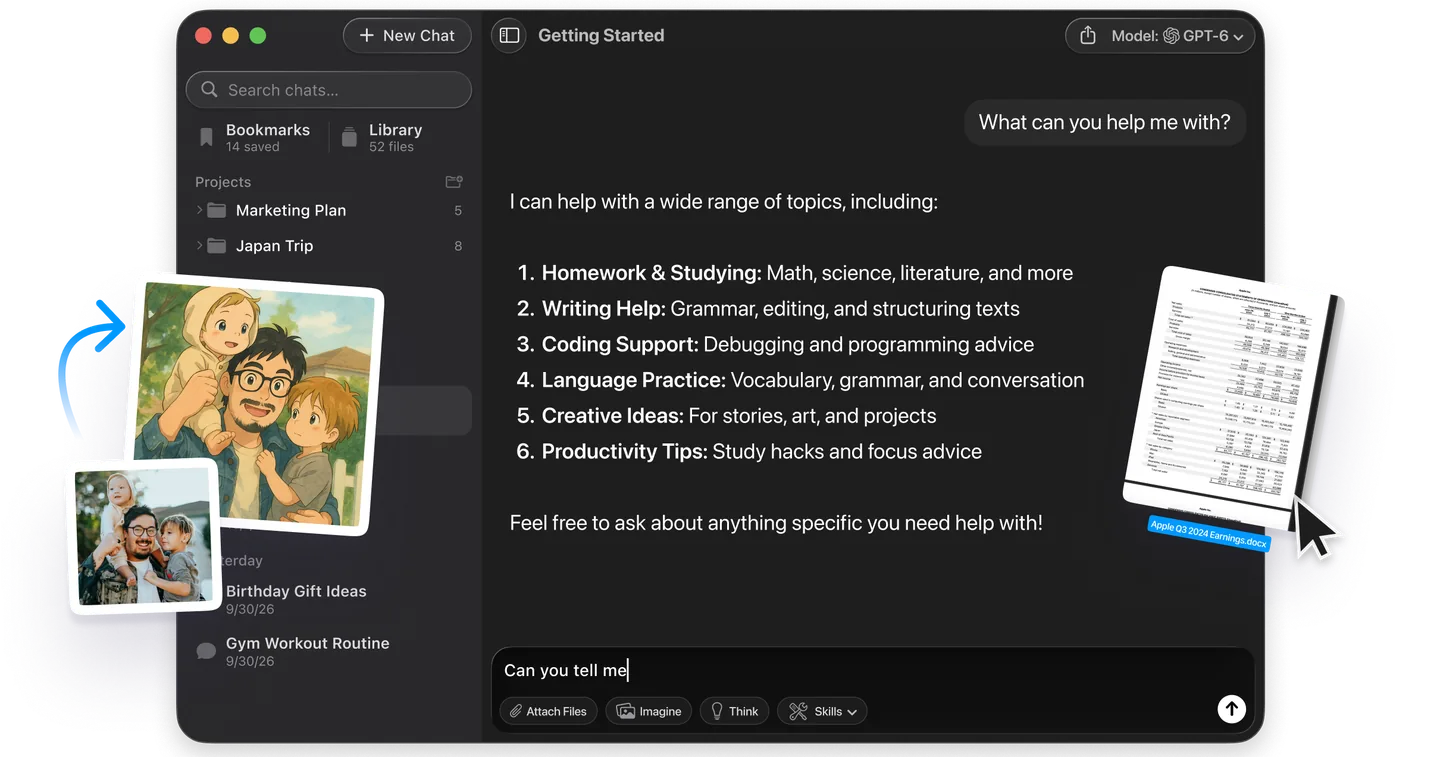
Fello AI é uma aplicação nativa para Mac, iPhone e iPad que reúne a DeepSeek e o ChatGPT numa única subscrição, juntamente com o Claude, o Gemini, o Grok, o Perplexity, o Kimi, o GLM e o Qwen. Começa em $9.99 por mês, metade do ChatGPT Plus sozinho, com um nível gratuito para experimentar primeiro e uma classificação de 4,7 estrelas em mais de 27.000 avaliações. Muda de modelo dentro de uma única conversa, que é exatamente o que o veredito «use ambos» acima lhe pede para fazer, sem um segundo início de sessão ou uma segunda janela.
O veredito final
O DeepSeek V4 fechou a distância de capacidade ao ponto de, na maioria dos benchmarks isolados, os dois ficarem dentro de um par de pontos percentuais, e o V4-Flash-0731 reduziu a distância agêntica que era a vantagem remanescente mais clara do ChatGPT. O ChatGPT continua a vencer em polimento, ecossistema e residência de dados ocidental. A DeepSeek vence sem discussão em abertura (pesos totalmente licenciados sob MIT contra nenhum). Em preço vence agora apenas na faixa intermédia da OpenAI: 16x mais barato do que o GPT-6 Sol e 80x mais barato do que o Astra fora de pico, mas mais caro do que o GPT-6 Luna a qualquer hora da semana. A vantagem da janela de contexto desapareceu: os modelos GPT-6 têm uma janela de 1M tokens, igualando a da DeepSeek.
Para um chatbot de consumo do dia a dia nos EUA ou na UE, o ChatGPT Plus a $20/mês é a escolha certa por defeito. Para uma carga de trabalho de API de grande volume em que o custo importa mais do que o polimento, calcule primeiro o GPT-6 Luna: a $0.10 / $0.50 é mais barato do que o DeepSeek V4.1 Flash a qualquer hora, e no Intelligence Index v4.3.2 pontua 38,1 contra os 36,0 do V4 Pro. O DeepSeek V4.1 Flash é a escolha quando quer pesos abertos ou a pontuação mais alta, 45,1. O que já não faz sentido é recorrer ao DeepSeek V4 Pro para o máximo de raciocínio: a $0.66 / $1.98 por milhão de tokens fora de pico custa mais de quatro vezes o V4.1 Flash e pontua abaixo, 36,0 contra 45,1.
A era em que o ChatGPT não tinha concorrência real acabou. Também acabou a era em que «a opção barata» significava um modelo pior.
FAQ
A DeepSeek é melhor do que o ChatGPT?
Em benchmarks, o DeepSeek V4 Pro é competitivo com o GPT-5.5 e fica ligeiramente à frente em alguns testes de programação e matemática. Como produto, o ChatGPT é melhor: mais funcionalidades, melhor polimento, aplicações nativas de computador, e um ecossistema mais profundo. A resposta certa depende de valorizar mais a capacidade por dólar ou a capacidade por minuto de atrito.
A DeepSeek é gratuita de usar?
Sim. O chat web da DeepSeek em chat.deepseek.com é completamente gratuito, sem níveis nem limites de utilização. A API é paga, faturada por token contra um saldo que carrega. O ChatGPT também tem um nível gratuito, mas limita o acesso ao modelo porta-estandarte; o GPT-5.6 Sol no chat exige o plano Plus a $20/mês ou superior, e o GPT-6 Pro, impulsionado pelo Astra, exige Pro, Business ou Enterprise.
A DeepSeek é segura de usar nos EUA e na UE?
A DeepSeek encaminha os dados dos utilizadores através de servidores na China e está sujeita às leis chinesas de inteligência. O Garante italiano ordenou o bloqueio da aplicação a 30 de janeiro de 2025, e vários outros reguladores abriram inquéritos. Para uso pessoal não sensível, é adequado para muitas pessoas. Para dados de trabalho, indústrias reguladas, ou qualquer coisa que não queira que um governo estrangeiro possa potencialmente ver, o perfil de risco do ChatGPT é substancialmente mais baixo.
A DeepSeek é melhor do que o ChatGPT para programação?
Estão próximos. O DeepSeek V4 Pro atinge cerca de 91% no SWE-Bench Verified e 96% no HumanEval; o GPT-5.5 liderou em programação agêntica no próprio relatório de abril da DeepSeek, com o Terminal-Bench 2.0 em 82,7% contra 67,9% do V4 Pro. O V4-Flash-0731 fechou a maior parte dessa distância em julho, pontuando 82,7 no Terminal Bench 2.1 no harness da DeepSeek e 78,7 na corrida independente do Artificial Analysis. Para geração de código num só passo, o DeepSeek V4.1 Flash é o que mais pontua entre as opções baratas, 45,1 no Intelligence Index v4.3.2, mas o GPT-6 Luna, a $0.10 / $0.50, é mais barato tanto na entrada como na saída.
A DeepSeek pode substituir o ChatGPT?
Para alguns fluxos de trabalho, sim. Para outros, não. A DeepSeek pode substituir o ChatGPT para chat apenas de texto, trabalho técnico, matemática, e cargas de trabalho de API de grande volume. Não pode substituir o ChatGPT para geração de imagens, modo de voz, integração com aplicação nativa para Mac, ou qualquer coisa que exija o ecossistema mais alargado de produtos do ChatGPT. A maioria dos utilizadores que se preocupam com o custo acaba por usar ambos.