OpenAI’s GPT-6 rate card, live since September 22, 2026, ended the argument this comparison used to settle. DeepSeek’s answer to GPT-5.6 landed on July 31 as V4-Flash-0731 and was replaced on September 10 by DeepSeek-V4.1-Flash, which has billed peak and off-peak since August 16, 2026 and now costs $0.15 / $0.60 per million tokens off-peak and $0.30 / $1.20 at peak. Against OpenAI’s flagship tier the gap is still enormous: GPT-6 Sol at $2.00 / $10.00 is 13x DeepSeek’s input rate and 17x its output rate off-peak, or 7x and 8x at peak. Against OpenAI’s cheapest tier it has reversed outright. GPT-6 Luna costs $0.10 / $0.50, which undercuts DeepSeek V4.1 Flash on both axes at every hour of the week, off-peak included. The cheapest credible model in this comparison is now OpenAI’s.
Both halves of that are real, and most comparisons still print only the first. This guide compares the two head to head across performance, pricing, features, privacy and real-world use cases, and it keeps OpenAI’s two surfaces apart, because they are a generation out of step. In the API, OpenAI sells GPT-6 Sol at $2.00 / $10.00 and GPT-6 Luna at $0.10 / $0.50, with GPT-6 Astra above them at $10.00 / $50.00, and all three carry a 1M-token context window. In ChatGPT, the Chat box still answers on GPT-5.6: Astra reaches Chat as GPT-6 Pro on the Pro, Business and Enterprise plans, Plus gets it in ChatGPT Work and Codex rather than Chat, and Free and Go stay on GPT-5.6 Luna in Chat. The legacy GPT-5.6 tiers are still on sale, Sol at $4.00 / $20.00 on promotional pricing OpenAI says holds at least through November 21, 2026, and Terra at $2.00 / $12.00. OpenAI has not republished the isolated coding benchmarks for Sol, so the detailed head-to-head numbers below use its most complete published figures, the GPT-5.5 results measured against DeepSeek V4, and each one is labelled with the house that ran it. You’ll see the canonical benchmark numbers, monthly cost scenarios at different scales, the privacy and censorship reality of each platform, and a clear verdict on which one you should actually use. DeepSeek, founded by Liang Wenfeng, is the Hangzhou startup behind the V4 models, and ChatGPT is the OpenAI product most people already know.
The Key Takeaways
- GPT-5.6 reached general availability July 9, 2026, and OpenAI’s GPT-6 rate card went live September 22, 2026. DeepSeek V4-Flash-0731 shipped July 31, 2026 and was superseded on September 10, 2026 by DeepSeek-V4.1-Flash, which now serves every
deepseek-flashcall and the legacydeepseek-v4-flashname.- DeepSeek V4.1 Flash API pricing is $0.15 input / $0.60 output per 1M tokens off-peak, doubling to $0.30 / $1.20 in peak hours. That is 13x to 17x cheaper than GPT-6 Sol ($2.00 / $10.00) off-peak, or 7x to 8x at peak, but GPT-6 Luna at $0.10 / $0.50 is cheaper than DeepSeek on both axes at every hour of the week, off-peak included.
- DeepSeek V4 Pro scores ~91.2% on SWE-Bench Verified and ~96.4% on HumanEval (DeepSeek’s April V4 report), but on Artificial Analysis’s Intelligence Index v4.3.2 it is the weaker of DeepSeek’s two models, 36.0 against V4.1 Flash’s 39.5. On Terminal-Bench 2.1 the houses disagree: DeepSeek’s own card puts V4-Flash-0731 at 82.7, Artificial Analysis’s independent run gets 78.7, and the official tbench.ai board lists no DeepSeek model at all.
- DeepSeek’s web chat is free with no subscription tiers. ChatGPT Plus is $20/month, Pro is $100, $200 or $500/month.
- DeepSeek has no native Mac or Windows app. ChatGPT does.
- DeepSeek’s 1M context is no longer an edge. The GPT-6 models carry a 1M-token window too, and GPT-6 Luna undercuts both DeepSeek models on both axes ($0.10 / $0.50 against V4.1 Flash’s $0.15 / $0.60 off-peak and V4 Pro’s $0.66 / $1.98).
DeepSeek vs ChatGPT at a Glance
Before we get into benchmarks, here’s the head-to-head on every dimension that matters in 2026. The ChatGPT column prices GPT-6 Sol, the model OpenAI sells in the API; the Chat box on Plus still answers on GPT-5.6.
| ChatGPT (GPT-6 Sol) | DeepSeek (V4 Pro) | |
|---|---|---|
| Released | September 22, 2026 | April 24, 2026 |
| Architecture | Not disclosed | Mixture-of-Experts, 1.6T total / 49B active |
| Context window | 1M (API) | 1M tokens |
| Free tier | Limited flagship access | Unlimited web chat |
| Paid plans | Plus $20, Pro $100 to $500 | None for chat (API only) |
| API input price (per 1M) | $2.00 | $0.66 off-peak, $1.32 peak |
| API output price (per 1M) | $10.00 | $1.98 off-peak, $3.96 peak |
| Native Mac app | Yes | No |
| Image generation | Yes | No |
| Voice mode | Yes | No |
| Open source | No | Yes (MIT license) |
| Privacy/data routing | US (OpenAI) | China |
ChatGPT wins on polish, ecosystem, and feature breadth. DeepSeek wins on openness, and on price against everything above OpenAI’s cheap tier. The context window is now a tie. Everything below explores why those tradeoffs matter.
What’s New in 2026: GPT-5.6 and DeepSeek V4
Both products jumped a generation in the same week, so any comparison written before late April 2026 is already out of date.
GPT-5.5 launched on April 23, 2026, as the new default model for ChatGPT Plus, Pro, Business, and Enterprise subscribers. OpenAI describes it as faster, more token-efficient, and better at coding, research, and data analysis than GPT-5.4 in the official GPT-5.5 announcement. The biggest jump is in long-context reasoning: MRCR v2 at 1 million tokens went from 36.6% on GPT-5.4 to 74.0% on GPT-5.5.
DeepSeek V4 dropped one day later, on April 24, 2026, as an open-source preview release. It ships in two variants. V4 Flash has 284B total parameters with 13B active per query and is the default chat model. V4 Pro has 1.6T total parameters with 49B active and is the reasoning model. Both support a 1 million token context window with 384K max output, and both are released under the MIT license with full weights available on Hugging Face. For the full launch breakdown, see our DeepSeek V4 launch coverage.
V4-Flash-0731, then V4.1-Flash: the updates that changed the argument
On July 31, 2026 DeepSeek shipped V4-Flash-0731, and it is the most consequential change to this comparison since April. It is a re-post-train rather than a new architecture, same 284B total / 13B active parameters, same 1M context and 384K max output, same MIT licence, and at launch the same $0.14 / $0.28 price, which DeepSeek replaced with peak/off-peak billing on August 16, 2026. It superseded the preview outright, and was itself superseded on September 10, 2026 by DeepSeek-V4.1-Flash, the first model in a new architecture family with native multimodal vision. DeepSeek’s docs now treat deepseek-v4-flash as a legacy name routed to V4.1-Flash and billed at the Flash price; the current model name is deepseek-flash.
What moved is agentic performance. On DeepSeek’s own benchmark table the small Flash model now beats the far larger V4 Pro preview on every agentic test listed: Terminal Bench 2.1 82.7 vs 72.1, NL2Repo 54.2 vs 38.5, DeepSWE 54.4 vs 12.8, Toolathlon-Verified 70.3 vs 55.9. A re-post-train moved those numbers further than a model with nearly four times the active parameters did, which is why the cheap tier is now the sensible default rather than the compromise.
The takeaway: ChatGPT and DeepSeek are now closer than they’ve ever been on raw capability, and the practical question has shifted from “which is smarter?” to “what tradeoff makes sense for you?”
Performance and Benchmarks
On benchmarks, the two flagships trade blows. DeepSeek V4 Pro leads on some coding and math tests; GPT-5.5 leads on agentic and tool-use tests.
| Benchmark | GPT-5.5 | DeepSeek V4 Pro | Winner |
|---|---|---|---|
| SWE-Bench Verified | (not officially published) | ~91.2% | DeepSeek (matches the Claude Opus 4.8 tier) |
| SWE-Bench Pro | 58.6% | 55.4% | GPT-5.5 |
| HumanEval | ~95% | ~96.4% | Tie |
| MATH-500 | ~89% | ~88.3% | Tie |
| Terminal-Bench 2.0 (agentic, DeepSeek’s April report) | 82.7% | 67.9% | GPT-5.5 |
| MRCR v2 @ 1M tokens | 74.0% | (1M context supported) | GPT-5.5 |
For independent, side-by-side numbers, Artificial Analysis maintains a live comparison that updates as both vendors release new checkpoints.
Terminal-Bench is where you should be most careful, because three houses publish three different numbers and none of them is wrong. DeepSeek’s own model card puts V4-Flash-0731 at 82.7 on Terminal Bench 2.1, ahead of GLM-5.2 at 81.0 and behind Claude Opus 4.8 at 85.0, run with DeepSeek’s own harness at max reasoning effort. Artificial Analysis, running the benchmark independently, gets 78.7. The official board at tbench.ai lists no DeepSeek model at all; its 2.1 table is led by Claude Fable 5 at 83.8%, with GPT-5.5 via Codex at 83.1% and GPT-5.6 Terra at 78.4% (board read August 1, 2026). Treat any single unattributed Terminal-Bench figure with suspicion.
The pattern is consistent. On isolated coding and math tasks, DeepSeek V4 Pro is competitive or slightly ahead. On agentic, multi-step tool-use workflows where the model has to chain calls, decide when to stop, and keep state across long contexts, GPT-5.5 still has the edge. If you’re handing the model a single hard problem, DeepSeek wins on price-per-correct-answer. If you’re running an agent that has to drive Cursor or operate a browser for an hour, GPT-5.5’s polish shows up.
DeepSeek vs ChatGPT for Coding
This is the most-searched comparison in the cluster, and the honest answer is that both are excellent. The gap is smaller than the marketing on either side suggests.
DeepSeek V4 Pro scores around 91.2% on SWE-Bench Verified, putting it in the same tier as Claude Opus 4.8 and slightly behind GPT-5.5 on SWE-Bench Pro (58.6% vs 55.4%). On HumanEval it sits at roughly 96.4%, a hair ahead of GPT-5.5. For pure code-generation correctness on isolated problems, V4 Pro is essentially at parity with the top closed models. Our full DeepSeek vs Claude comparison puts the two side by side.
Where they actually diverge is style. GPT-5.5 writes cleaner, more idiomatic code that reads like a senior developer wrote it. It fills in vague requirements with sensible defaults. DeepSeek V4 Pro is more defensive: it adds null checks, bounds checks, and edge-case handling without being asked, which is great for production code but verbose for quick prototypes. DeepSeek also follows specific instructions more literally, where ChatGPT will sometimes “improve” your prompt before answering.
For agentic coding in tools like Cursor or Cline, the April picture had GPT-5.5 well ahead on Terminal-Bench 2.0 (82.7% vs 67.9% in DeepSeek’s own report), which showed up as fewer derailments on long multi-file refactors. V4-Flash-0731 narrowed that gap sharply, and on DeepSeek’s harness it now scores 82.7 on Terminal Bench 2.1, though no independent board has yet run both models under the same conditions. For one-shot code generation at the lowest possible cost, the cheap pick is now GPT-6 Luna at $0.10 / $0.50 rather than DeepSeek: code generation is output-heavy, and Luna is cheaper on output as well as input, off-peak and at peak alike. DeepSeek V4.1 Flash at $0.15 / $0.60 per million tokens off-peak is the better buy only if you want open weights or the higher Intelligence Index score. It also tops our roundup of the best free AI for coding.
DeepSeek vs ChatGPT Cost: The Real Math
This is where the comparison stops being academic. The cost gap between DeepSeek and ChatGPT is large enough to flip API decisions on its own.
Consumer pricing is straightforward. DeepSeek’s web chat at chat.deepseek.com is completely free with no subscription tiers. ChatGPT’s free tier exists but caps access to the flagship model. For how both rank among no-cost options, see our guide to the best free AI chatbot. ChatGPT Plus is $20/month and gives full access to GPT-5.6 Sol in Chat, plus GPT-6 Sol and Luna in ChatGPT Work and Codex; higher tiers (Pro, Business, Enterprise) add the Astra-powered GPT-6 Pro in Chat itself, longer context, and team controls. There’s also an $8/month Go tier for casual users. For the current plan breakdown, see our ChatGPT pricing guide.
API pricing is where DeepSeek used to make its case unanswerably, and two moves narrowed it: DeepSeek’s own increase on August 16, 2026 and OpenAI’s GPT-6 rate card on September 22. Here are the per-million-token rates, off-peak first:
| Model | Input (per 1M) | Output (per 1M) |
|---|---|---|
| GPT-6 Luna | $0.10 | $0.50 |
| DeepSeek V4.1 Flash | $0.15 / $0.30 | $0.60 / $1.20 |
| DeepSeek V4 Pro | $0.66 / $1.32 | $1.98 / $3.96 |
| GPT-6 Sol | $2.00 | $10.00 |
| GPT-5.6 Sol (legacy, promo) | $4.00 | $20.00 |
| GPT-6 Astra | $10.00 | $50.00 |
There is no single flat rate to quote any more. Each DeepSeek cell above shows off-peak first and peak second. Peak runs 01:00-04:00 and 06:00-10:00 UTC, Monday to Friday (09:00-12:00 and 14:00-18:00 Beijing time), and every other hour bills at exactly half. Cached input reads are cheaper again, $0.003 per million off-peak for V4.1 Flash and $0.022 for V4 Pro.
DeepSeek had flagged this in its docs for months, saying only that the API “will soon adopt a peak/off-peak pricing policy” with no date attached. It landed on August 16, 2026 exactly as described: a surcharge rather than a revived off-peak discount, with peak-hour prices at 2x the regular rates across all billing items. The earlier V4 Pro launch discount, once scheduled to expire on May 31, 2026 and return the model to $1.74 / $3.48, never did expire; the peak/off-peak switch is what finally moved the price. On September 10, 2026 the Flash card moved again, down to $0.15 / $0.60 off-peak with the release of DeepSeek-V4.1-Flash.
Now the worked example. Imagine you’re running a workflow that processes 100 million tokens per month, split evenly between input and output (50M each). Here’s what that costs.
| Model | Monthly cost (50M input + 50M output) |
|---|---|
| GPT-6 Luna | $30 |
| DeepSeek V4.1 Flash | $38 off-peak, $75 peak |
| DeepSeek V4 Pro | $132 off-peak, $264 peak |
| GPT-6 Sol | $600 |
| GPT-5.6 Sol (legacy, promo) | $1,200 |
| GPT-6 Astra | $3,000 |
This table is the whole argument, and it no longer reads the way it did a month ago. The cheapest row is OpenAI’s. GPT-6 Luna at $30 a month undercuts DeepSeek V4.1 Flash’s $38 even off-peak, and at peak it is 2.5 times cheaper. Against the tiers above it DeepSeek’s lead is still real and large: off-peak, V4.1 Flash is 16 times cheaper than GPT-6 Sol and 80 times cheaper than Astra; run the same workload at peak and those fall to 8x and 40x. V4 Pro competes with nothing on this table, because at $132 off-peak it costs more than four times GPT-6 Luna and scores below it. If you were sold on DeepSeek by a headline that said “100 times cheaper than ChatGPT,” that number was measured against OpenAI’s most expensive tier, and it stopped being the whole story when OpenAI cut Luna by 80% on July 30, 2026, DeepSeek raised its own rates on August 16, 2026 and cut them again on September 10, and OpenAI replaced Luna on September 22 with GPT-6 Luna at $0.10 / $0.50, half the old input rate and 58% less on output. For a deeper breakdown, see the full DeepSeek pricing guide.
The catch: DeepSeek’s pricing is so low partly because the company runs on Chinese infrastructure with no premium for US data residency or enterprise compliance. If those constraints don’t apply to you, the savings are real. Qwen now also powers Apple Intelligence in China. For a higher-end Chinese alternative with closer-to-frontier benchmarks, see our Qwen3.7-Max review. If they do, you’re paying GPT-6 prices for a reason.
Features and Capabilities
Pure model intelligence is one thing; the product wrapped around it is another. ChatGPT is a polished consumer product. DeepSeek is a chatbot wrapper around a research-grade model.
ChatGPT ships with image generation, voice mode, advanced web search, file uploads, code interpreter, custom GPTs, memory across conversations, native Mac and Windows apps, mobile apps, browser extensions, and an enterprise compliance story. The full ChatGPT lineup, from GPT-5.0 through GPT-6, is mapped in our ultimate ChatGPT model comparison.
DeepSeek is, by design, much thinner. The web chat does text input and text output with a “DeepThink” toggle for the V4 Pro reasoning model and a basic web search button. There’s no image generation, no voice mode, no code interpreter, no native desktop app, and no app ecosystem. The mobile app exists but lacks the polish of ChatGPT’s. What DeepSeek offers in exchange is full open weights under MIT license, meaning you can run it locally, fine-tune it, embed it in your own product, or host it behind your own privacy boundary.
For most consumer use cases, ChatGPT’s feature lead is decisive. For developers who want a frontier-class model without licensing or pricing constraints, DeepSeek is the better building block.
Privacy, Censorship, and Safety
This is the section every comparison underplays, and it’s where the two platforms differ in kind, not just degree.
DeepSeek routes user data to servers in China, where it falls under the 2017 National Intelligence Law that requires Chinese companies to cooperate with state intelligence work on request. Security researchers have also flagged that DeepSeek transmits data to cloud infrastructure affiliated with ByteDance. ByteDance has frontier-model ambitions of its own; its Seed 2.1 Pro is a ranked entry on Arena’s WebDev coding board.
The model enforces Chinese content moderation rules. Ask DeepSeek about Tiananmen Square, Taiwan’s political status, or Xi Jinping criticism, and you’ll get either a refusal or state-aligned framing. On January 30, 2025, the Italian Garante ordered DeepSeek to block its chatbot in Italy after the company failed to address the regulator’s privacy concerns. Several other regulators have since opened similar inquiries. We covered the full picture in our guide to whether DeepSeek is safe for US and EU users.
ChatGPT has its own privacy issues, including training-data lawsuits, opaque retention windows, and a long history of regulatory scrutiny in the EU. But OpenAI is a US-headquartered company subject to US and EU law, and ChatGPT does not enforce nation-state content rules on political topics. Free-tier inputs are used for training unless you opt out; Plus, Pro, Business, and Enterprise tiers offer stronger data controls.
The practical guidance: if you’re a US or EU user putting work-related material into a chatbot, ChatGPT’s risk profile is materially lower than DeepSeek’s. If you need open weights you can run on hardware you control, DeepSeek wins by default because there’s no closed-source alternative at this price-performance tier.
DeepSeek vs ChatGPT on Mac and Desktop
ChatGPT has a polished native Mac app with global hotkeys, file drag-and-drop, and integration with macOS Spotlight. DeepSeek has none of that. The official DeepSeek experience is a web tab and a mobile app. Our guide to the ChatGPT desktop client for Mac covers what that app can do.
If you want DeepSeek on your Mac, you’re picking between three options. You can use the web chat in a browser, which is fine but cluttered. You can run the open weights locally on a high-end Mac with enough unified memory, which is technically possible for V4 Flash but requires significant hardware. Or you can use a third-party desktop wrapper. We covered Mac-specific options in our DeepSeek desktop client guide for macOS.
The third option, a single native app that carries both models and drops the wrapper question entirely, is covered further down. For a side-by-side of the main native chat apps on macOS, see our ChatGPT vs Claude vs Gemini on Mac comparison.
Where Gemini and Grok Fit In
A lot of searches pair DeepSeek and ChatGPT with Gemini or Grok, so here’s the short answer.
Gemini 3.1 Pro is still Google’s Pro model, and on Artificial Analysis’s Intelligence Index v4.3.2 it scores 29.7 against GPT-6 Sol’s 47.5. Google’s strongest scorer is now Gemini 4 Argon at 52.6, ahead of GPT-6 Sol, and since October 13 Google AI Pro and Ultra subscribers and paid API customers can use it. Among the Gemini models you can actually use, the top scorer is not the Pro line at all but Gemini 3.8 Flash at 40.9. What Gemini offers instead is a stronger multimodal story (image, video, audio) and tight integration into Google Workspace. If you live in Gmail and Docs, Gemini is the highest-leverage choice. We compare them directly in our ChatGPT vs Gemini guide. Grok 4.7 is xAI’s most capable model at 46.4, is competitive on coding and reasoning, has the best-in-class image generation via Grok Imagine, and is bundled with X Premium+. We put it head-to-head with OpenAI’s flagship in our Grok vs ChatGPT comparison, and against DeepSeek in our DeepSeek vs Grok comparison. DeepSeek V4.1 Flash undercuts both of them by a wide margin on price and is the only one of the four with fully open weights.
For most readers comparing DeepSeek and ChatGPT directly, Gemini and Grok are alternatives in the “polished closed-source assistant” category that ChatGPT defines, not in the “cheap open-weights frontier model” category that DeepSeek defines. They’re solving different problems. Kimi, the other open-weight Chinese challenger, sits in the second category too, and we compare it with ChatGPT in Kimi vs ChatGPT.
Which Should You Use?
The honest answer depends on what you’re optimizing for. Here are the verdicts by use case.
Pick ChatGPT if you want the most polished consumer assistant, you need image generation or voice mode, you work on a Mac and want a native app, you’re in a regulated industry that needs US-based data handling, or you build agents that chain many tool calls. The $20/month Plus plan is enough for almost every personal use case.
Pick DeepSeek if you want a free, capable chatbot with no subscription, you need a 1M-token context window for long-document work, you want open weights you can run or fine-tune locally, or you want the strongest score available at the cheap end, which is V4.1 Flash at 39.5. If raw API cost is the only thing that matters, price GPT-6 Luna first.
Use both if you’re a power user. Many developers run ChatGPT for daily tasks and call DeepSeek’s API for high-volume background jobs where the cost gap matters. The two complement each other better than they replace each other.
How to Use Both in One App
Using both is the sensible answer, and the friction is not the money. ChatGPT Plus is $20 a month and DeepSeek’s web chat costs nothing, so the bill is not the problem. The problem is that DeepSeek ships no native desktop app at all, which means running the pair properly leaves you with a polished Mac app for one model and a browser tab for the other.
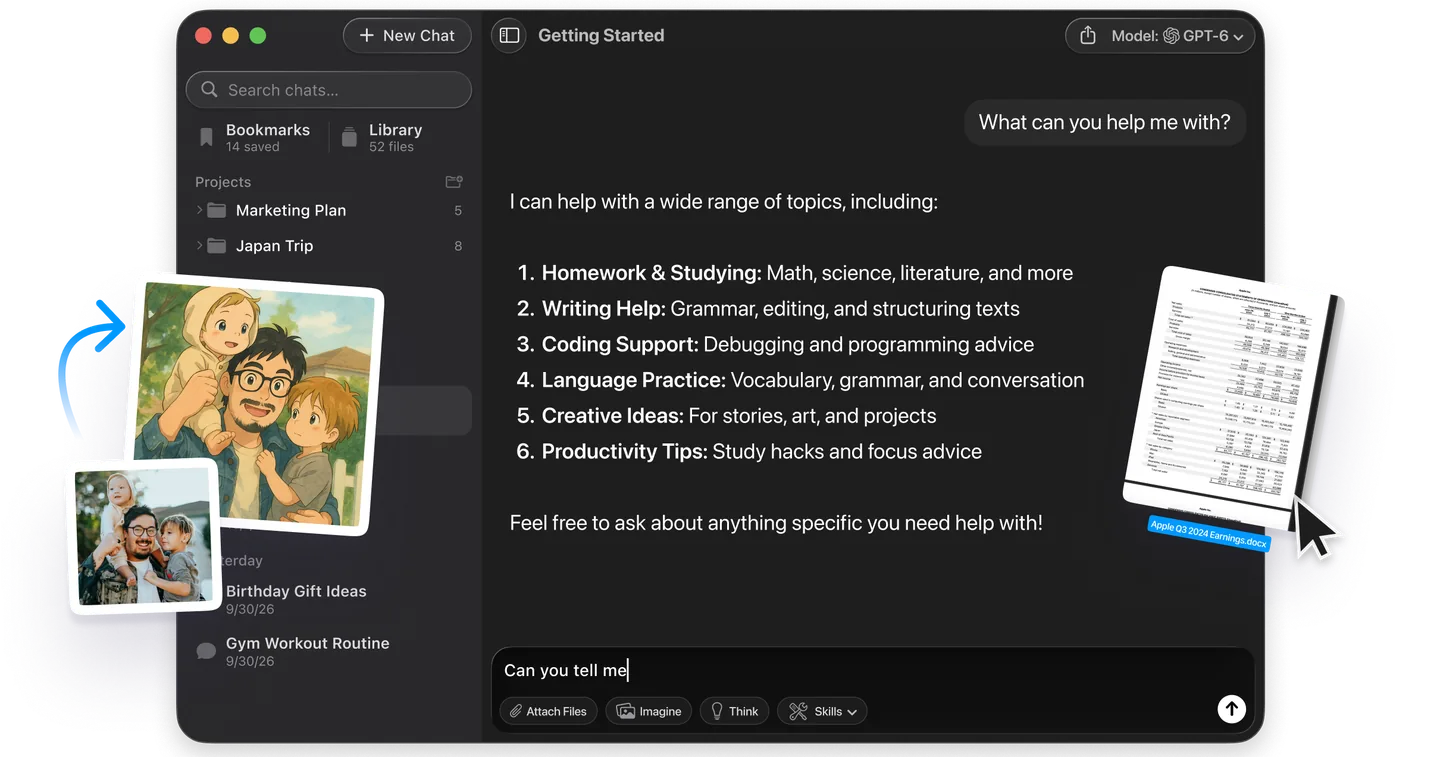
Fello AI is a native Mac, iPhone and iPad app that puts DeepSeek and ChatGPT behind one subscription, along with Claude, Gemini, Grok, Perplexity, Kimi, GLM and Qwen. It starts at $9.99 a month, half of ChatGPT Plus on its own, with a free tier to try first and a 4.7-star rating across 27,000+ reviews. You switch models inside a single conversation, which is what the “use both” verdict above actually asks you to do, without a second login or a second window.
The Final Verdict
DeepSeek V4 closed the capability gap to the point where, on most isolated benchmarks, the two are within a couple of percentage points, and V4-Flash-0731 narrowed the agentic gap that was ChatGPT’s clearest remaining lead. ChatGPT still wins on polish, ecosystem, and Western data residency. DeepSeek wins outright on openness (full MIT-licensed weights vs none). On price it now wins only in the middle of OpenAI’s range: 16x cheaper than GPT-6 Sol and 80x cheaper than Astra off-peak, but more expensive than GPT-6 Luna at every hour of the week. The context-window advantage is gone: the GPT-6 models carry a 1M-token window, matching DeepSeek’s.
For an everyday consumer chatbot in the US or EU, ChatGPT Plus at $20/month is the right default. For a high-volume API workload where cost matters more than polish, price GPT-6 Luna first: at $0.10 / $0.50 it is cheaper than DeepSeek V4.1 Flash around the clock, and on Intelligence Index v4.3.2 it scores 37.3 against V4 Pro’s 36.0. DeepSeek V4.1 Flash is the pick when you want open weights or the higher score, at 39.5. What no longer makes sense is reaching for DeepSeek V4 Pro for maximum reasoning: at $0.66 / $1.98 per million tokens off-peak it costs more than four times V4.1 Flash and scores lower, 36.0 against 39.5.
The era when ChatGPT had no real competition is over. So is the era when “the cheap option” meant a worse model.
FAQ
Is DeepSeek better than ChatGPT?
On benchmarks, DeepSeek V4 Pro is competitive with GPT-5.5 and slightly ahead on some coding and math tests. As a product, ChatGPT is better: more features, better polish, native desktop apps, and a deeper ecosystem. The right answer depends on whether you value capability per dollar or capability per minute of friction.
Is DeepSeek free to use?
Yes. DeepSeek’s web chat at chat.deepseek.com is completely free with no tiers and no usage caps. The API is paid, billed per token against a balance you top up. ChatGPT also has a free tier, but it caps access to the flagship model; GPT-5.6 Sol in Chat requires the $20/month Plus plan or higher, and the Astra-powered GPT-6 Pro requires Pro, Business or Enterprise.
Is DeepSeek safe to use in the US and EU?
DeepSeek routes user data through servers in China and is subject to Chinese intelligence laws. The Italian Garante ordered the app blocked on January 30, 2025, and several other regulators have opened inquiries. For non-sensitive personal use it’s fine for many people. For work data, regulated industries, or anything you wouldn’t want a foreign government to potentially see, ChatGPT’s risk profile is materially lower.
Is DeepSeek better than ChatGPT for coding?
They’re close. DeepSeek V4 Pro hits about 91% on SWE-Bench Verified and 96% on HumanEval; GPT-5.5 led on agentic coding in DeepSeek’s own April report, Terminal-Bench 2.0 at 82.7% against V4 Pro’s 67.9%. V4-Flash-0731 closed most of that gap in July, scoring 82.7 on Terminal Bench 2.1 on DeepSeek’s harness and 78.7 on Artificial Analysis’s independent run. For one-shot code generation, DeepSeek V4.1 Flash is the higher scorer of the cheap options at 39.5 on Intelligence Index v4.3.2, but GPT-6 Luna at $0.10 / $0.50 is cheaper on both input and output.
Can DeepSeek replace ChatGPT?
For some workflows, yes. For others, no. DeepSeek can replace ChatGPT for text-only chat, technical work, math, and high-volume API workloads. It can’t replace ChatGPT for image generation, voice mode, native Mac app integration, or anything that requires the broader ChatGPT product ecosystem. Most users who care about cost end up using both.