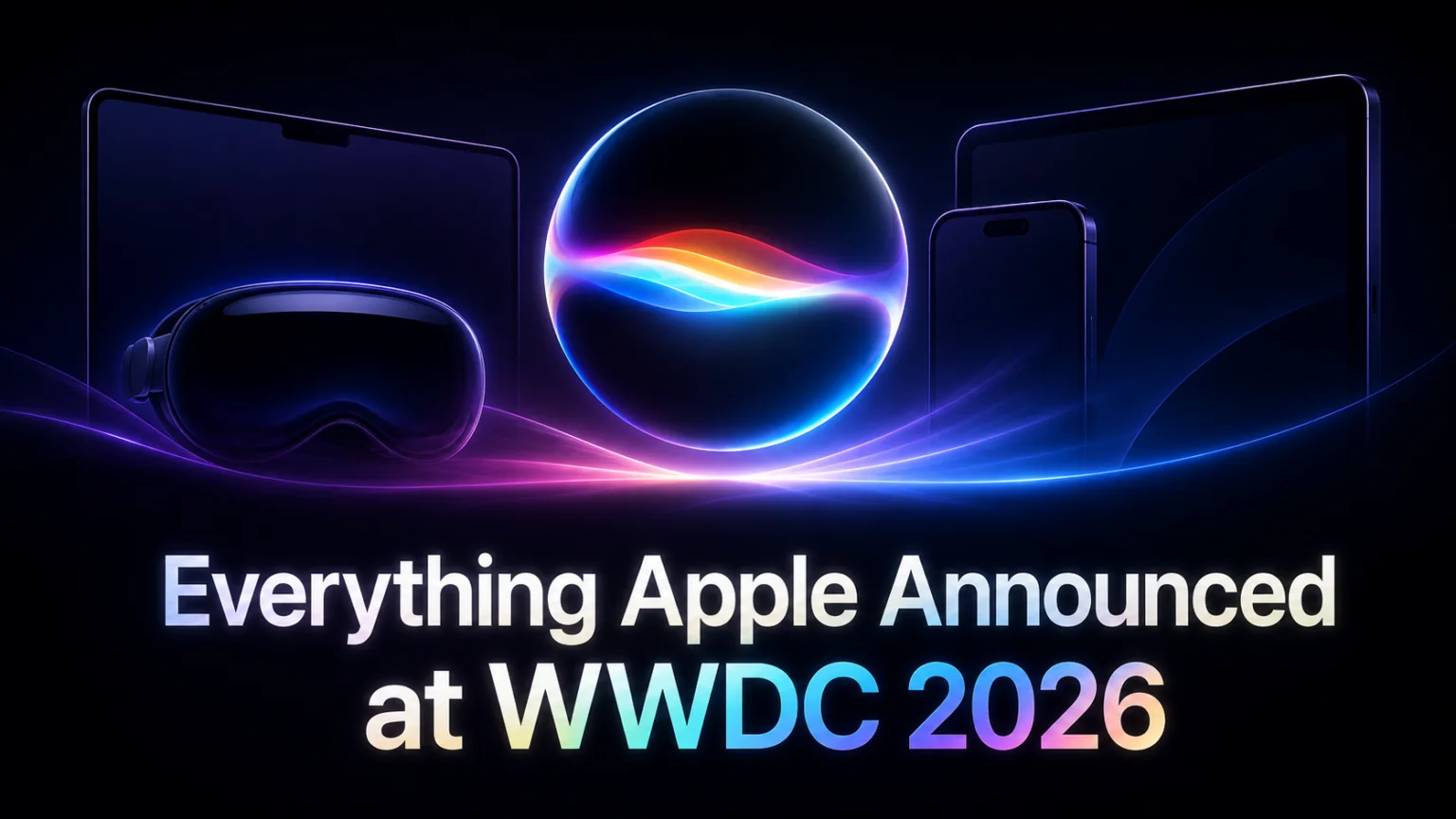
Apple reset its entire AI strategy at WWDC 2026. In a keynote on June 8, the company rebranded Siri as Siri AI, built it on a new generation of Apple Foundation Models developed with Google Gemini, shipped iOS 27 and macOS 27 “Golden Gate,” and rebuilt Apple Intelligence around the pair. The one thing it did not announce is the feature most recaps led with, an Extensions framework that would let you set Claude, ChatGPT or Gemini as your default AI. That has been reported, never confirmed, and it is still not a switch you can flip. It was also Tim Cook’s final keynote as CEO before John Ternus takes over on September 1, capping it as the biggest AI shift in Apple’s history. If the rebuilt assistant ever stops responding, see why Siri is not working.
The headlines focused on Siri and the Google deal, and then a great deal of coverage, this article included, went on to report a default-AI setting that Apple never put on stage. This recap covers what Apple actually announced, what the Gemini partnership means, and where third-party model choice really stands. If you are on a Mac, our guide to Apple Intelligence alternatives for Mac rounds up the assistants worth pairing with it.
The Key Takeaways
- Siri AI is a full redesign, built on Apple Foundation Models developed with Google Gemini under a multi-year deal reported to be worth roughly $1 billion per year.
- Apple did not announce third-party Extensions. A framework that would let you set Claude, ChatGPT or Gemini as your default AI was reported by Bloomberg and found in beta strings, but it appears in neither June 2026 newsroom release.
- New software ships as iOS 27, iPadOS 27, and macOS 27 “Golden Gate,” with developer betas from WWDC week, public betas in July, and iOS 27 and macOS 27 reaching the public on Monday, 14 September 2026.
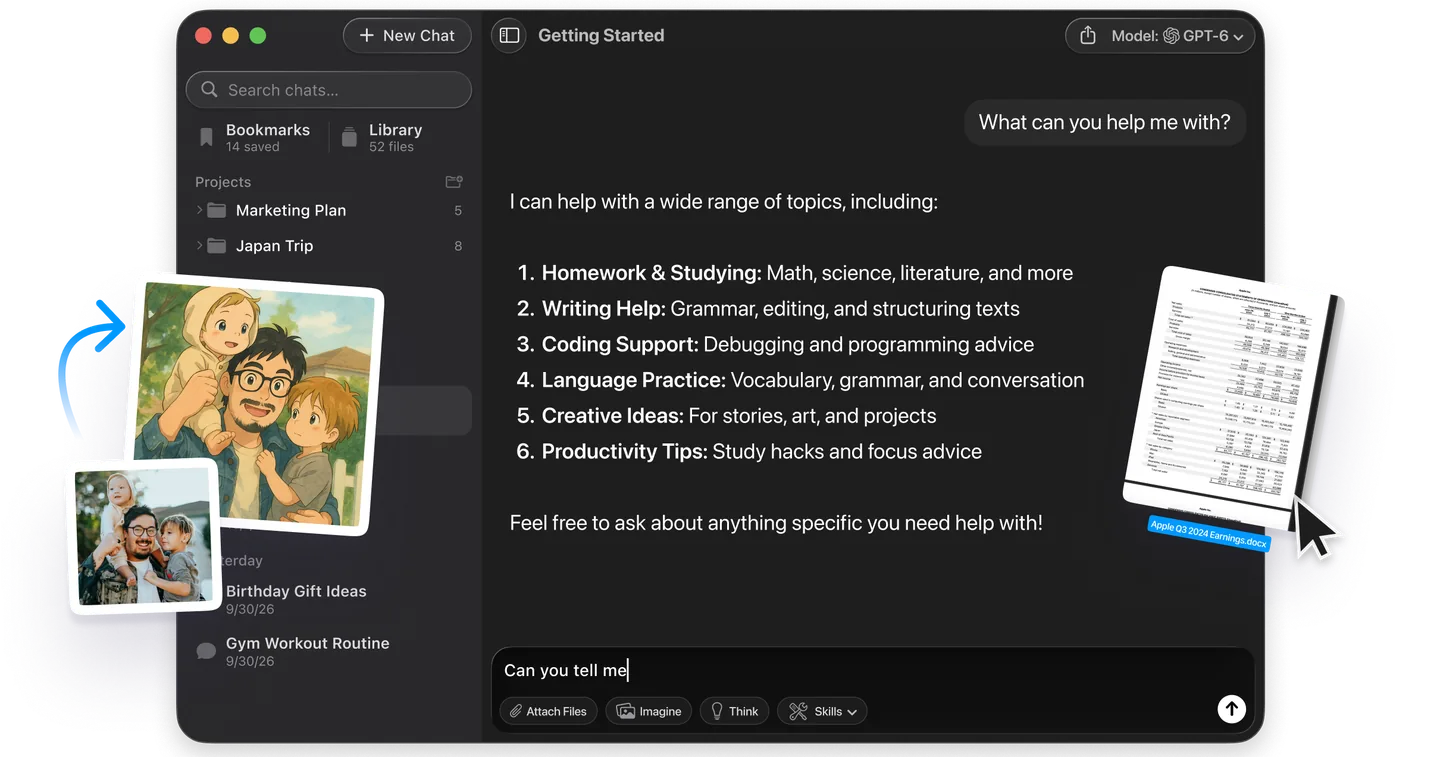
- ChatGPT is still the only extension Apple has ever shipped. A multi-model app like Fello AI runs Claude, ChatGPT, Gemini, Grok, and DeepSeek in one place today.
- iOS 27 supports every iPhone that runs iOS 26, from the iPhone 11 onward, making it Apple’s most widely supported release yet.
Everything Apple Announced at WWDC 2026
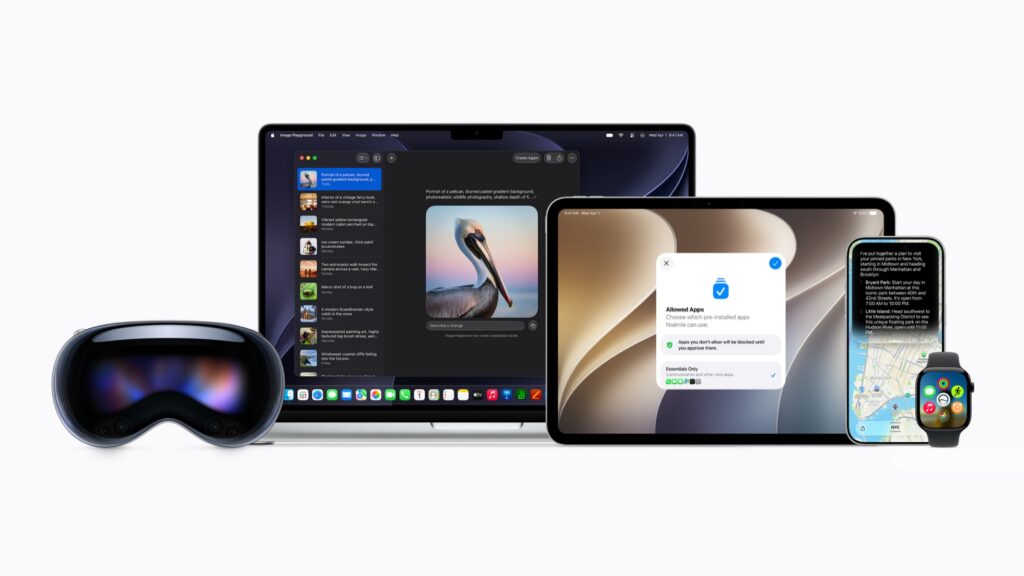
Apple packed the keynote, but five announcements carry the weight, as TechCrunch’s full rundown laid out. Siri became Siri AI, a redesigned assistant built on a new generation of Apple Foundation Models that Apple developed with Google Gemini. The operating systems were renamed iOS 27, iPadOS 27, and macOS 27 “Golden Gate.” Apple Intelligence gained new generative photo tools. The Photos app picked up Clean Up, Extend, and Spatial Reframe. And child-safety controls expanded across Safari and Apple accounts.
Everything sits on Apple’s foundation models plus the Google partnership, tied together by what Craig Federighi described as a new orchestration layer that coordinates AI tasks across your apps. The rollout follows Apple’s usual cadence, with developer betas starting this week and a public launch in the fall. Apple’s decision to build on Google rather than OpenAI looks more pointed now that Apple has sued OpenAI over alleged trade secret theft.
The Default-AI Switch Apple Never Announced
Almost every recap of this keynote, this one included, told you that iOS 27 Extensions would let you choose which AI provider powers Apple Intelligence. Go back to the source material and the claim does not hold. Apple did not demonstrate Extensions at WWDC, and third-party model choice appears in neither of its June 2026 newsroom releases, including the one announcing Siri AI.
What does exist is reporting. Bloomberg described the framework in March 2026, and on May 5, 2026 MacRumors and 9to5Mac found strings for it inside iOS 27 test builds, naming ChatGPT, Gemini and Claude as the expected providers. Strings in a beta show that someone is building something. They are not a shipping feature, and Grok was never part of that reporting. For the feature-level view, see our comparison of Apple Intelligence and ChatGPT. If the rebuilt assistant is not for you, our guide on how to turn off Siri covers switching it off across every device.
Here is where it stands today. The framework is switched off in the public beta, no third-party assistant registers as a Siri extension on any device, and ChatGPT remains the only extension Apple has ever shipped. Our guide to replacing Siri with ChatGPT, Claude or Gemini walks through the Settings path that does work and separates it from the menus other guides invent. If you want several models right now, you need a separate app, which is exactly the gap a tool like Fello AI fills.
Siri AI: What Actually Changed
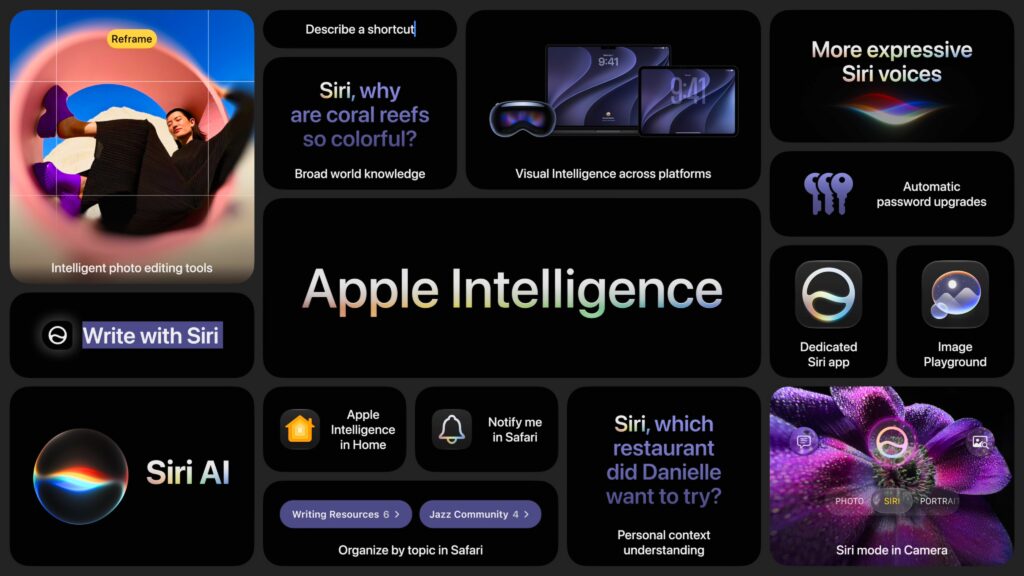
Apple rebuilt Siri from the ground up and renamed it Siri AI. The assistant now holds multi-turn conversations, draws on real-time world knowledge, and reads on-screen context so it can act on what you are looking at. It can create reminders from an ongoing conversation and pull personal information across your apps when you ask.
The interface changed too. Siri AI now lives in the Dynamic Island, accessible by swiping down from it, pressing the side button, or saying “Hey Siri.” A revamped voice engine makes it sound more expressive, and a new standalone Siri app stores your conversation history, synced through iCloud so sessions follow you between devices. If you have wondered whether Siri is really AI, this is the year the answer stops being complicated.
On the Mac, Siri AI reaches into Spotlight and shows up in right-click menus on any file or window, so you can summarize, rewrite, or ask about something without leaving your workflow. There are four separate places Siri AI lives on a Mac, and we cover each of them. On Vision Pro, it gains a 3D visualization you can place anywhere in your space.
The Google Gemini Deal
The most surprising reveal was the engine. On stage, Apple said it collaborated with Google and the Gemini family of models to build the next generation of Apple Foundation Models that power Siri AI. Reporting goes further, describing a custom Google Gemini model running the assistant rather than Apple’s own large models or OpenAI’s. According to Gene Munster of Deepwater Asset Management, the multi-year agreement is worth roughly $1 billion per year, with a total value estimated up to $5 billion. AI analyst Kim Isenberg reported the custom model carries about 1.2 trillion parameters, far larger than Apple’s existing cloud models. Apple pushed back on that framing the next day. Craig Federighi said Apple uses “none of the models that Google deploys to their customers,” as MacRumors reported: the models Siri AI runs on are Apple’s own, trained on Apple’s data and refined using outputs from Gemini. Apple has published no parameter count for any of them.
The model reportedly uses a mixture-of-experts design, which activates only part of its parameters per query to keep costs in check. Apple’s on-device models still handle quick, private requests; harder queries route to Apple’s largest cloud model inside Private Cloud Compute, which runs on NVIDIA GPUs that Google hosts. Apple framed privacy as a hard line, saying queries are processed without being retained and that the contract bars Google from training future Gemini versions on Apple user data.
It is a notable pivot. Apple already ships ChatGPT integration, and the Gemini deal now puts a second outside partner at the centre of the system, this time shaping the models Apple runs itself rather than a handoff you switch on. If you are weighing the models themselves, our breakdown of Gemini 3.5 and our Anthropic vs OpenAI comparison cover how the frontier labs stack up.
iOS 27, macOS 27 Golden Gate, and Apple Intelligence
The operating systems got new numbers and, for the Mac, a new name. macOS 27 “Golden Gate” focuses on performance and a design refresh, adjusting the Liquid Glass look introduced last year with a global opacity slider and updated window shapes. Our full guide to macOS 27 Golden Gate breaks down which Macs make the cut and the new Siri AI requirements. Apple said it improved macOS performance and dozens of underlying technologies, with a wide release on 14 September 2026.
Apple Intelligence picked up the most visible upgrades. Image Playground can now generate images in nearly any style, including far more realistic ones, at almost any size, and it spans more apps. The Photos app added three generative tools, with Clean Up removing distractions, Extend widening a shot and changing its aspect ratio, and Spatial Reframe letting you pan around an image and fill the gaps using on-device spatial models. The Home app also got smarter security-camera notifications.
There is good news on hardware too. iOS 27 runs on every iPhone that supports iOS 26, going back to the iPhone 11, which makes it the most widely supported iOS release Apple has shipped. Child-safety controls expanded as well, with an “Ask to Browse” prompt turned on by default for users under 13.
Siri AI vs Old Siri vs a Multi-Model App
Apple closed a big gap this year, but the new system is still one assistant, and that assistant is Apple’s own with an optional ChatGPT handoff. Here is how the old Siri, the new Siri AI, and a dedicated multi-model app compare for someone who wants real choice today.
| Feature | Old Siri | Siri AI (2026) | Fello AI |
|---|---|---|---|
| Underlying model | Narrow, rule-based | Apple Foundation Models, refined using Gemini | Claude, ChatGPT, Gemini, Grok, DeepSeek |
| Switch between models | No | No, ChatGPT handoff only | Yes, anytime in one app |
| Available now | Yes | With iOS 27 on 14 September 2026 | Yes |
| Platform | Apple devices | Apple devices | Mac and iOS |
| Multi-turn chat | Limited | Yes | Yes |
| Image generation | No | Image Playground | Yes, across models |
| Price | Free | Free, with paid model tiers | $9.99/month, all models |
The point is not that Apple got it wrong. Siri AI is a real upgrade. But model choice on Apple’s terms is still reporting rather than a setting, and even the reported version would give you one provider at a time.
How to Get Every AI Model on Your Mac Today
If WWDC convinced you that the future is multi-model, you do not have to wait for Apple to confirm anything. Fello AI is a native Mac and iOS app that runs Claude, ChatGPT, Gemini, Grok, and DeepSeek behind a single subscription, so you can send the same question to several models and compare answers in seconds.
That flexibility matters because no single model wins everything. You might lean on one model for careful writing, another for coding, and a third for fast research, and switching is a click rather than a separate app and a separate bill. For $9.99 a month you get the major models, image generation, and regular updates as new versions land, without juggling five logins. You can start from the Fello AI App Store page or the getting started guide, and if you are comparing options, our roundup of the best AI models is a good next read.
Conclusion
WWDC 2026 was a real leap for Siri, and a lesson in how fast a reported feature becomes a reported fact. Siri AI shipped, on Apple’s own foundation models rather than on a Gemini model. The default-AI switch did not, and Apple has still never said it will. Until that changes, the fastest way to put Claude, ChatGPT, Gemini, Grok, and DeepSeek in one place is a multi-model app like Fello AI. For the full timeline and device list, see our iOS 27 release date and supported devices guide.
FAQ
What did Apple announce at WWDC 2026?
Apple announced Siri AI, a redesigned assistant running on a new generation of Apple Foundation Models developed with Google Gemini; iOS 27, iPadOS 27, and macOS 27 “Golden Gate”; new Apple Intelligence photo tools; and expanded child-safety controls. It did not announce third-party Extensions, despite widespread reporting to the contrary.
Is Siri AI now?
Yes. Apple rebranded the assistant as Siri AI and rebuilt it on a new generation of Apple Foundation Models, which it refined using outputs from Google Gemini rather than running a Gemini model, adding multi-turn conversation, on-screen awareness, a Dynamic Island interface, and a standalone app with synced history.
Can I set ChatGPT or Claude as my default AI on iPhone?
Not today, and Apple has never said you will. You can turn on the ChatGPT extension in Settings, under Apple Intelligence and Siri, and Siri will hand the hard questions to it. Claude and Gemini cannot be set as the assistant behind Siri on any device, in any beta. The Extensions framework that would allow it was reported by Bloomberg and found in beta strings, but Apple has never announced it.
How much is Apple paying Google for Gemini?
Apple has not confirmed a figure. Analyst Gene Munster of Deepwater Asset Management estimated the multi-year deal at roughly $1 billion per year, with a total value up to $5 billion.
When do iOS 27 and macOS 27 come out?
Developer betas started during WWDC week and public betas followed in July. iOS 27 reaches the public free on Monday, 14 September 2026, a date Apple confirmed at its 9 September event. iPadOS 27 and macOS 27 arrive the same day.
Where can I watch WWDC 2026?
The full WWDC 2026 video is available on Apple’s website and official youtube channel.