TL;DR: We tested four frontier models to see which one writes the best “I’m late for work” email. In our test, Claude Sonnet 4.5 felt like the most balanced, human-like option, while Grok 4.1 wins on humor and Gemini 3 Pro is safest for corporate contexts.
| Model | Best For | Vibe |
|---|---|---|
| Claude Sonnet 4.5 | Nuance & Tone | Considerate & detailed |
| GPT-5.1 | Consistency | Polished & standard |
| Gemini 3 Pro | Workspace Integration | Direct & professional |
| Grok 4.1 | Personality | Witty & casual |
Opening
Imagine spilling hot coffee on your laptop right as you are leaving for work. You are stressed, messy, and running 20 minutes late. You need to email your boss, but you don’t have the brainpower to be professional. This is the perfect setup for a “human writing” test. We pitted four top AI models against each other to answer three questions: Which AI sounds most human? Can a robot make a joke without it being awkward? And who writes the best excuse?
- Claude Sonnet 4.5 excels at following strict style instructions and avoiding clichés.
- Grok 4.1 is the best choice if you want genuine humor or a “witty coworker” vibe.
- GPT-5.1 is reliable but risks sounding like a standard template.
- Specific prompts with “banned words” help any AI sound less robotic.
Our previous one prompt test: One Prompt Face-Off: Midjourney v7 ChatGPT, Stable Diffusion, Nano Banana Pro
The cat disaster prompt
To run a fair AI email writing test, we need a scenario that requires personality. Asking for a generic business meeting request is too easy; any basic model can churn out a meeting agenda. Instead, we used a prompt about a cat knocking over coffee. This specific scenario forces the AI to balance professional responsibility with a relatable, chaotic human moment.
We gave the models strict rules to ensure they didn’t just revert to their training data defaults. They had to be professional but lightly humorous. Crucially, we also banned overused AI words like “delve,” “tapestry,” and “landscape.” This negative constraint is vital because it forces the AI to think creatively rather than using its default settings. A truly human email doesn’t sound like a press release; it sounds like a person typing fast on their phone. For the full list of tells, see our 50 common AI phrases, translated.
Battle prompt:
“Write an email to my boss explaining that I’ll be about 20 minutes late because my cat knocked over my coffee right as I was leaving. – Length: 90–110 words – Tone: professional but lightly humorous (one small joke is okay; no sarcasm) – Include one specific detail about the cat or the spill so it feels real. – Avoid clichés like ‘I hope this email finds you well’, ‘due to unforeseen circumstances’, and ‘thank you for your understanding’. – Do not use the words delve, tapestry, or landscape.”
Why this specific prompt works
This prompt acts as a stress test for human-like AI writing benchmarks. By banning the standard “AI filler” phrases, we strip away the safety net. If a model relies on templates, it will struggle to fill the gap. If it has genuine semantic understanding, it will generate something fresh. The requirement for a “specific detail” tests the model’s ability to hallucinate a plausible, grounded reality rather than a generic abstraction.
Meet the frontier contenders
We used the latest chatbots available to see how they handle everyday chaos. This is a frontier AI model comparison focused on style, not just coding or math. While many benchmarks focus on Python coding or solving math Olympiad problems, most users just want an assistant that doesn’t sound like a robot.
Claude Sonnet 4.5
Anthropic’s model is often praised for its writing nuances. It has specific style controls to help tune how formal it sounds. Claude Sonnet 4.5 is effectively the “Goldilocks” model: Anthropic recommends it as the default because it balances intelligence, speed, and cost between the smaller Haiku and the heavier Opus models. In our testing, its defining trait is “character.” It tends to adopt a persona more deeply than its competitors, making it a strong candidate for tasks requiring empathy or specific voice matching.
GPT-5.1
The flagship model from OpenAI. It is the heavy hitter often seen in comparisons like Claude Sonnet 4.5 vs GPT-5.1. With the 5.1 update, OpenAI introduced GPT-5.1 Instant and GPT-5.1 Thinking. For this test, we used the default chat experience (GPT-5.1 Instant). GPT-5.1 is the “polished default”—it is what most people think of when they hear “AI writing.” It is incredibly consistent, but that consistency can sometimes be its downfall if you are looking for uniqueness.
Gemini 3 Pro
Google’s Gemini 3 Pro sits behind Gemini in Gmail and other Workspace features. Because it’s embedded directly into Gmail and Docs, Gemini tends to be tuned for brevity, safety, and utility in work emails. It expects to be used in a work environment, so its training likely prioritizes being safe, direct, and efficient. It represents the “corporate safe” option in our lineup.
Grok 4.1
The wildcard from xAI. Known for Grok 4.1 creative writing, it is pitched as emotionally intelligent and funny. Grok was originally marketed as a witty, slightly “rebellious” chatbot willing to answer spicy questions in a very X-style tone. Grok 4.1 keeps that personality while xAI now emphasizes creative, emotional, and collaborative interactions. In a test about a cat disaster, this could be a huge advantage—or a liability if it takes the joke too far.
We generated emails with all four models using the exact same prompt. Here is how the “vibes” compared when answering which AI sounds most human.
The considerate overachiever (Claude Sonnet 4.5)
Claude Sonnet 4.5 tends to write with high empathy. In our test, it focused on the “I wanted to let you know” phrasing rather than the robotic “I am writing to inform you.” It followed the negative constraints perfectly, avoiding all the banned clichés. The detail it invented about the cat often felt surprisingly specific. Like “she decided my keyboard was a heated bed” rather than just “she jumped.”
Subject: Running 20 Minutes Late This Morning
Hi [Boss’s Name],
I wanted to let you know I’ll be about 20 minutes late this morning. My cat had impeccable timing and knocked my full coffee mug directly onto my shirt just as I was heading out the door. I’m now on my second outfit attempt and currently soaking up coffee from the kitchen floor.
I’ll be in by [time] and will jump straight into my morning tasks. I’ve already checked my calendar and don’t have any meetings until [time], so this shouldn’t impact anything urgent.
See you soon, [Your name]
In this sample, notice how Claude bridges the gap between the apology and the excuse. It doesn’t just state the fact; it weaves it into a narrative. This “narrative glue” is a hallmark of Claude Sonnet 4.5 vs Gemini 3 vs Grok 4.1 comparisons.
The polished default (GPT-5.1)
GPT-5.1 produced a very clean email. It had a perfect structure: explanation, apology, reassurance, and sign-off. However, because so many people use GPT, its “voice” can feel very familiar. It is safe, but it might not surprise you. It followed the instructions, but the humor felt slightly calculated, like a dad joke told at a board meeting.
Hi [Boss’s Name],
I wanted to let you know I’ll be about 20 minutes late this morning. As I was heading out the door, my cat launched himself onto the kitchen counter and knocked my full mug of coffee directly into my open work bag. I’m cleaning everything up and making sure my laptop has survived before I leave. I should arrive by around 9:20, and I’ll catch up on anything I miss—hopefully with less help from my “assistant.” If anything urgent comes up before then, feel free to call me.
Best,
[Your Name]
While technically flawless, the best AI for writing professional emails isn’t always the one with perfect grammar. it’s the one that sounds authentic. GPT-5.1 is reliable, but in this specific creative test, it risks blending in with the millions of other AI-generated emails sent every day. GPT also forgot about subject.
The Gmail native (Gemini 3 Pro)
As the engine behind Gemini in Workspace, this model strikes a fascinating balance. It opens with a classic corporate line (“I am writing to let you know…”), making it the safest bet for a strict boss, but then pivots into genuine wit. It didn’t just report the spill; it joked about the cat “testing gravity” and the floor “enjoying the hazelnut coffee.”
Subject: Running a little behind schedule
Hi [Boss’s Name],
I am writing to let you know that I will be roughly twenty minutes late getting in this morning. I was packed and ready to leave when my cat, usually a creature of grace, decided to test gravity by swatting my full travel mug right off the counter.
My kitchen floor is currently enjoying my hazelnut coffee more than I am, but I have finally cleaned up the sticky mess and am heading out the door now. I expect to arrive by 9:20 AM and will stay later this evening to catch up on my tasks.
Best regards,
[Your Name]
For users who want a blend of formal structure and personality, Gemini is surprisingly strong. It doesn’t feel transactional; it feels like a capable employee trying to lighten the mood while maintaining professional boundaries.
The witty coworker (Grok 4.1)
In the battle of Claude Sonnet 4.5 vs Gemini 3 vs Grok 4.1, Grok stood out for personality. It made the strongest joke about the “feline barista.” If your workplace has a relaxed culture, Grok sounds the most like a real person venting to a friend. It used contractions and casual phrasing that the other models often scrub out. That gap between personality and polish is the whole story of Grok against Claude.
Subject: Running about 20 minutes late this morning
Hi [Boss’s Name],
I’m sorry—I’m going to be roughly 20 minutes late today. Just as I was grabbing my keys to leave, my cat Luna decided to launch herself at a passing fly, misjudged spectacularly, and sent my full travel mug of coffee flying across the kitchen floor. It’s now a very enthusiastic abstract painting in medium roast.
I’m cleaning it up as fast as I can and will be in as soon as possible.
Thanks,
[Your Name]
Grok’s strength is that it doesn’t sound like it’s trying to pass a corporate HR inspection. It sounds like a human being. This makes it risky for very formal environments, but perfect for startups or creative industries.
Scoring the robot factor
How do we actually judge a human-like AI writing benchmark? We looked for four specific indicators that reveal the “robot” behind the text.
- Natural Phrasing: Does it sound like a person speaking, or a press release? Humans use sentence fragments and variable pacing. Robots tend to use complete, grammatically perfect sentences every time.
- Specificity: Did it invent a detail about the coffee spill, or stay vague? “My cat knocked over a cup” is vague. “My cat swatted my mug onto my white rug” is specific.
- Humor Quality: Was the joke actually funny? Humor is the hardest Turing test. If the AI explains the joke or uses a pun that feels forced, it fails.
- Robot Tells: Did it use phrases like “I hope this email finds you well”? Even though we banned this specific phrase, did it swap it for a synonym like “I trust you are doing well”?
If an AI that sounds less robotic is your goal, look for models that use varied sentence lengths. Robots love sentences that are all the same size. Humans write in a mix of short and long bursts.
The Verdict
After reviewing the emails, scoring the “robot factor,” and laughing at the cat disasters, we have a clear hierarchy. While every model followed the instructions, the difference in “human feel” came down to which models were willing to prioritize narrative over pure utility.
| Rank | Model | Award | Why it Won |
|---|---|---|---|
| 🏆 1st | Claude Sonnet 4.5 | Most Human | It didn’t just write an email; it told a mini-story. The specific detail (“second outfit attempt”) felt exactly like a conscientious employee saving face. |
| 🥈 2nd | Grok 4.1 | Personality Hire | The “feline barista” and “abstract painting” jokes were genuinely funny. It takes risks that pay off. |
| 🥉 3rd | Gemini 3 Pro | The Safe Bet | Feels like a real person writing quickly from a phone. It lacks deep narrative flair but successfully avoids the uncanny “AI shimmer.” |
| 🏅 HM | GPT-5.1 | Reliable Standard | Followed every rule perfectly but suffered from its own popularity. It sounds like the AI we all know, polite and unnoticed. |
If you are looking for a tool that can navigate the social nuance of a mistake, Claude is the clear choice. However, if your goal is simply to communicate information without drawing attention to yourself, the “Safe Bet” or “Reliable Standard” options might actually be preferable for strict corporate environments.
Anytime you use AI, don’t forget to be safe with your personal information. Do you know how to stop AI from training on your data?
How to humanize AI text
Even the best AI for writing professional emails needs good instructions. If you want better results, try these simple steps to customize your model of choice. Everything here is prompt work rather than a paid rewriter, and we cover the AI humanizer tools that sell the same promise separately.
Explicitly tell the AI not to use words like “unforeseen circumstances,” “game-changer,” or “unlock.” These are dead giveaways that you are using an AI email writer. A simple “negative constraint” list at the end of your prompt works wonders.
Give it a persona
Tell the AI, “Write as if you are a tired employee texting a friend,” or “Write like a busy project manager who hates wasting time.” This forces the model to adopt a specific vocabulary set that is distinct from its default “helpful assistant” voice.
Use style controls
Modern models have built-in features to save your preferences, so you don’t have to type them every time.
- Claude Projects: You can create a “Project” in Claude and upload a text file with your writing samples. Name it “My Writing Style.” Claude will then use this file as context, so it can more closely match your tone, sentence length, and vocabulary in future drafts.
- Gemini Gems: You can create a custom “Gem” in Gemini (e.g., a “Work Email Gem”) and then use it inside Gmail and other Workspace apps. This pre-instructed Gem can be tuned to be concise, professional, and void of emojis.
- ChatGPT Custom Instructions: Go to your settings and fill out the “How would you like ChatGPT to respond?” box. Add a permanent instruction like: “Never use the word ‘delve’. Always keep emails under 100 words. Use casual, direct language.”
Device Tip: On mobile apps (like the ChatGPT or Claude app), use voice mode to dictate your prompt. Speaking your instructions often results in more natural humanizing AI generated text because you use casual language yourself. When you speak, you naturally add “uhs,” “ums,” and casual phrasing that the AI picks up on and mirrors in its text output.
How to Run This Test on Your Own Writing
The useful finding here is that the winner moves with the message. Claude took the apology, Grok would take the joke you send a colleague, Gemini would take the note that goes to a client. Acting on that means keeping all four within reach, and paying four subscriptions to settle the tone of an email is not a serious plan.
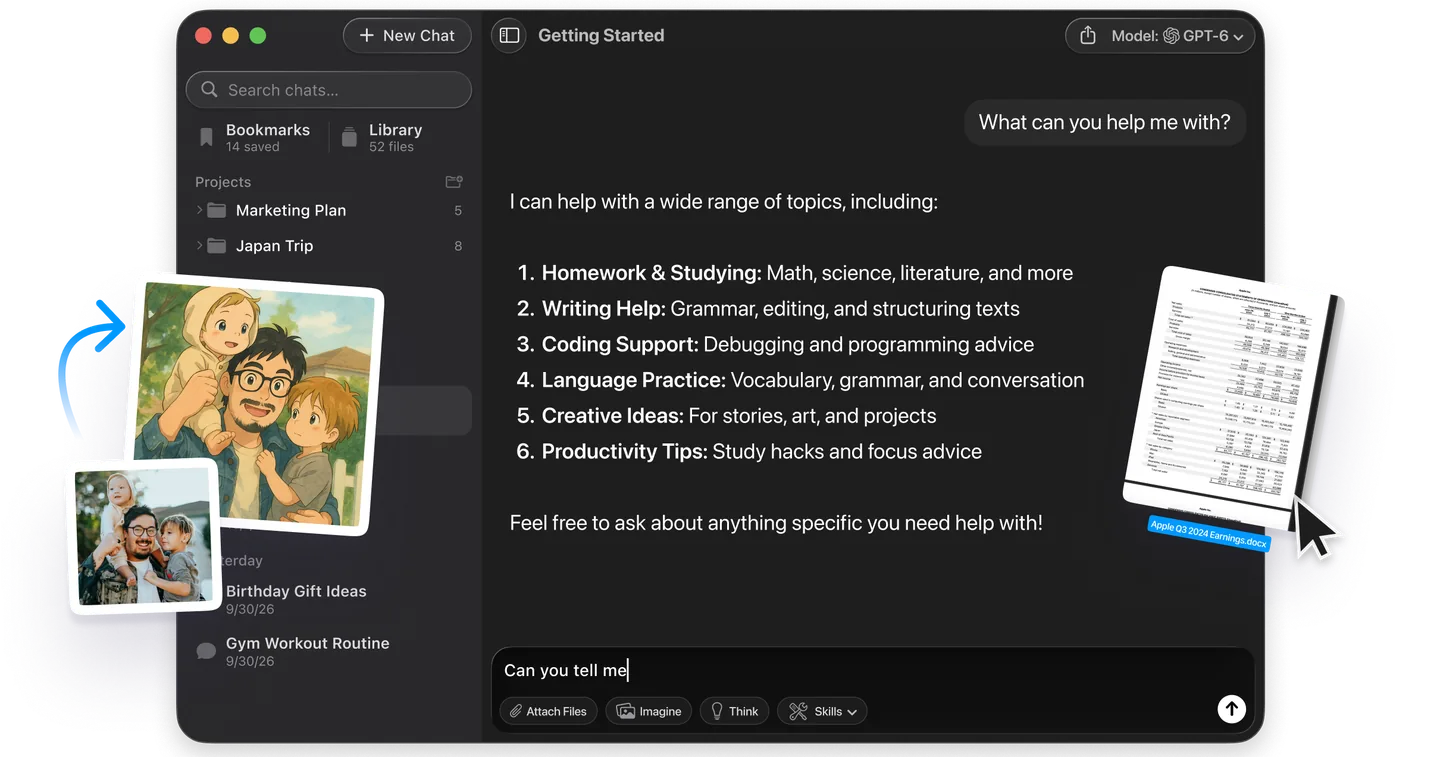
Fello AI is a native Mac, iPhone and iPad app that puts Claude, ChatGPT, Gemini and Grok behind one subscription, along with DeepSeek, Perplexity, Kimi, GLM and Qwen. It starts at $9.99 a month, with a free tier to try first and a 4.7-star rating across 27,000+ reviews. You can paste the cat prompt once, send it to each model in the same conversation, and judge the replies side by side on your own writing rather than on ours.
Conclusion
Finding the AI that sounds less robotic comes down to the vibe you need for the specific moment. For a safe, standard email to a board of directors, GPT-5.1 is fine. But for this specific “cat disaster” test, where humanity and humility were required, Claude Sonnet 4.5 and Grok 4.1 proved they can handle the human element best.
Claude wins on balance and grace, while Grok wins on humor. Sounding human is only one job, though, so for the bigger picture of when to use which AI we map every task to its best model. The next time you are running late, whether it’s a cat or a spilled coffee, try pasting the “Cat Battle Prompt” into your tool of choice. You might just save your reputation, and your morning.
Next Step: Copy the “Cat Battle Prompt” from the top of this article and paste it into your favorite AI tool to see how it handles your specific writing style.
FAQ
Which AI model sounds the most human?
In our testing, Claude Sonnet 4.5 consistently scores highest for natural, nuanced writing. Grok 4.1 is a close second if you prefer a more casual or humorous human tone, often described as the “witty coworker.”
How do Claude Sonnet 4.5, GPT-5.1, Gemini 3 Pro and Grok 4.1 compare for email writing?
In our samples, Claude was best for specific tone matching and empathy. GPT-5.1 is the most reliable for standard professional structures. Gemini 3 Pro is best for quick, functional updates in Gmail. Grok 4.1 is best for creative, internal, or informal emails where personality is a plus.
How do I make AI-generated text sound less robotic?
You can use humanizing AI generated text techniques like banning specific “AI words” (delve, tapestry, landscape), asking for variable sentence lengths, and providing a specific persona (e.g., “write like a busy project manager”). Using voice mode to dictate prompts also helps.
Is Claude Sonnet 4.5 good for writing emails?
Yes. Because it tends to adhere very closely to style guidelines and negative constraints (what not to do), it is arguably the best AI for writing professional emails that don’t sound like generic templates. It handles nuance better than most competitors.
Is Grok 4.1 better than Claude Sonnet 4.5 or GPT-5.1 for natural conversation?
Grok 4.1 is often “looser” and more willing to be edgy or funny. If “natural” to you means “witty and opinionated,” Grok may feel better. If “natural” means “polite, empathetic, and professional,” Claude is usually the better choice.
Methodology & sources
To ensure this frontier AI model comparison was fair, we adhered to a strict testing protocol.
- Testing Date: Late 2025.
- Models: Claude Sonnet 4.5, GPT-5.1 (Instant), Gemini 3 Pro, Grok 4.1.
- Process: We ran the “Cat/Coffee” prompt 3 times per model to check for consistency and chose the median response (not the best or worst) for the article.
- Scoring: Blind review by human editors to identify “robot tells” and rate “human-likeness” on a scale of 1-5.
- Sources:
- Anthropic [Model Card & Docs] for Sonnet 4.5 capabilities.
- OpenAI [Changelog] for GPT-5.1 release notes.
- Google DeepMind [Gemini Technical Report] for architecture details.
- xAI [Blog] for Grok 4.1 personality features.