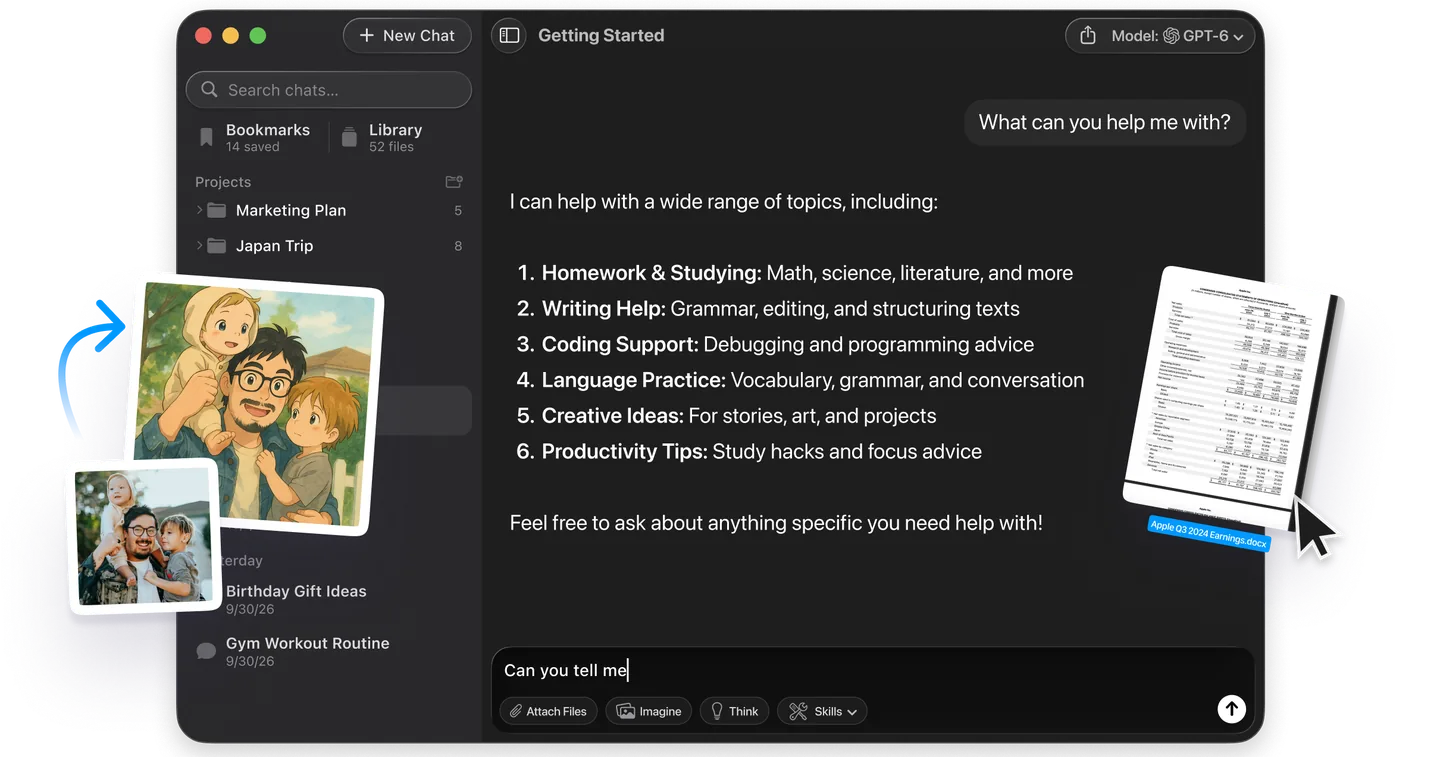
TL;DR: Stop using ChatGPT as just a chatbot and start using it as a personal operating system. By turning on features like Memory, Projects, and Scheduled Tasks – and organizing everything in a Mac hub like Fello AI – you can automate workflows, compare models, and save hours every week.
| Metric | Detail |
|---|---|
| User Base | Over 700M weekly users (based on 2025 estimates) |
| Top Features | Cross-chat Memory, Projects, Scheduled Tasks |
| Best Mac Cockpit | Fello AI (multi-model app for Mac/iOS) |
| Goal | Productivity & workflow automation |
Opening
ChatGPT is no longer just a fun toy for writing emails, drafting birthday cards, or generating jokes. Going into 2026, it has evolved into a serious productivity engine, yet most people are still only scratching the surface of what it can do. If you are tired of typing the same prompts over and over, or if you feel like you are constantly correcting the AI’s tone, you are missing out on the real power of modern AI.
This guide moves beyond basic tips to show you how to use ChatGPT effectively using the settings power users rely on. We will cover ChatGPT hacks for 2026 designed to automate tasks so they happen while you sleep, and ChatGPT tips and tricks to centralize your tools and stop browser tab fatigue.
By the end of this article, you will know:
- How to make ChatGPT remember your preferences long-term using advanced Memory settings.
- Which hidden settings control the AI’s personality and depth to stop it from sounding robotic.
- Why the tenth hack is the most important for your privacy and long-term workflow management.
The Key Takeaways
- Memory is key: Stop repeating yourself by using cross-chat Memory and “Projects” to keep context alive across weeks of work.
- Automation works: Use Scheduled Tasks to make ChatGPT work for you even when you are offline or focused on other things.
- Centralize tools: Apps like Fello AI bring ChatGPT, Gemini, and Claude into one Mac interface for better speed and model comparison.
- Audit everything: The best hack is using ChatGPT to critique its own answers and design your workflows for you.
1. ChatGPT Memory – turn it into your autopilot
Most users waste an incredible amount of time re-explaining who they are in every single conversation. They start every new chat with “I am a marketing manager…” or “Write this for a 5th-grade audience.” In 2026, ChatGPT hacks center around efficiency, and the “Memory” feature is your first line of defense against this repetition. This allows the AI to store facts about your writing style, job, or preferences and apply them automatically to future chats without being asked.
You don’t need complex settings or coding knowledge to make this work. You simply need to talk to the AI and tell it what is important. It acts like a digital sticky note that persists across interactions. If you tell it you are vegan, it won’t suggest steak recipes three months from now. If you tell it you code in Python, it won’t give you Java snippets.
Try these simple commands to train your AI:
- “Remember this: I am a content creator writing for beginners. Always use a friendly, encouraging tone and avoid jargon.”
- “Remember this: I prefer answers in bullet points with bold headers. Never give me walls of text.”
- “Show me everything you currently remember about me so I can audit it.”
Once set, you never have to type those instructions again. The AI simply “knows.” If you change your mind or your job role shifts, you can simply tell it to “forget” specific details or wipe the slate clean. This feature turns ChatGPT from a stranger you meet every day into a dedicated assistant who knows your quirks.
2. Use ChatGPT Projects for big goals
If you are managing a large initiative, standard chats can get messy and lose context very quickly. You might have five different chats about the same marketing campaign, and none of them talk to each other. The ChatGPT Projects feature solves this by letting you group specific chats, files, and instructions under one dedicated umbrella. This is different from a normal chat because the AI retains context across the entire project, effectively giving it a “long-term memory” specific to that goal.
Think of a Project as a digital binder or a workspace. You can upload your brand guidelines, past performance reports, and strategy documents once, and they stay available for every new conversation inside that folder. You don’t need to re-upload your logo or re-paste your mission statement. Our full guide to ChatGPT Projects covers the per-plan file limits and the sharing rules most write-ups still get wrong.
Best ways to use Projects:
- Client Work: Create one project per client with their specific tone of voice, assets, and past deliverables. This keeps client data strictly separated.
- Course Creation: Keep your syllabus, research notes, and draft modules in one “Course Launch” project so the AI understands the full curriculum structure.
- Travel Planning: Store all flight PDFs, hotel options, and itineraries in a “Japan Trip 2026” project. You can ask “What time is my flight?” without searching through emails.
3. Automate with Scheduled Tasks
One of the most powerful ChatGPT productivity hacks is shifting from a “pull” mindset to a “push” mindset. Historically, you had to ask the AI to do something. Now, with Scheduled Tasks, you can turn the AI into a proactive assistant that runs specific prompts at set times without you lifting a finger.
This feature is perfect for recurring administrative work that usually clutters your brain or gets forgotten in the Monday morning rush. By automating the inputs, you ensure consistent outputs.
Examples of tasks you can schedule:
- Monday Briefing: “Every Monday at 9 AM, check for 5 new articles on [your topic] and summarize them into a digest.”
- Monthly Review: “On the 1st of each month, remind me to upload my analytics sheet and then analyze the key trends, highlighting growth areas.”
- Language Learning: “Every Friday at 6 PM, give me a short Italian lesson based on our previous chats and vocabulary errors.”
This transforms the tool from a passive encyclopedia into an active employee that reports to you on a schedule.
4. Master the GPT-5.2 Auto switch
Not every question requires a genius-level answer that burns through computing credits and takes thirty seconds to generate. Sometimes you want speed; other times you need deep reasoning. The Auto model switching in GPT-5.2 handles this for you, toggling between an “Instant” mode and a “Thinking” mode based on the complexity of your request.
However, the AI isn’t perfect at guessing your intent. You can influence this behavior with your prompts to get exactly what you need, ensuring you aren’t waiting for a simple answer or getting a shallow answer for a complex problem. You can also manually override the Auto selection in many interfaces if you need total control.
How to steer the model:
- For speed: “Give me a quick, high-level answer in under 150 words. No deep reasoning needed, just the facts.”
- For depth: “Use your best deep reasoning. It is okay if this takes longer. Show me your structured thinking in steps and consider edge cases.”
By explicitly stating your constraints, you take control of how to use ChatGPT effectively, making sure the tool matches your pace.
5. Build an AI cockpit on Mac with Fello AI
Switching between browser tabs to use ChatGPT, then Gemini, then Claude is a productivity killer. It breaks your flow and makes it hard to compare results. A major trend for best AI apps for Mac in 2026 is consolidation. This is where tools like Fello AI shine. Fello acts as a “cockpit” for your desktop, giving you access to all the top models (ChatGPT, GPT-5, Claude, Gemini) in one native interface.
Using a dedicated app offers benefits that a browser cannot match. It integrates deeper into your operating system and workflow.
Why power users switch to Fello AI:
- Speed: It sits in your dock or menu bar for instant access via shortcuts, meaning help is always one keystroke away.
- Choice: You can compare answers from different models side-by-side to find the best result.
- Practical tip: Draft your email in ChatGPT, then send the same prompt to Claude inside Fello to see if it suggests punchier hooks.
- Organization: It helps you pin important conversations and organize prompts better than the default web interface, which often becomes a chaotic list of “New Chats.”
If you are serious about efficient workflows, getting AI out of the browser and into a dedicated tool is a massive upgrade.
6. Create Custom Assistants
Stop asking generic ChatGPT to do specialized work. It is a jack of all trades, but sometimes you need a master of one. Custom GPTs allow you to build mini-experts tailored to your specific needs. You can configure them with unique instructions, reference files, and even external tools.
This is invaluable for ChatGPT for business or classroom settings where consistency matters. You create the tool once, and it performs the same way every time, regardless of who on your team is using it.
Ideas for your own Custom GPTs:
- The Editor: A GPT pre-loaded with your company style guide (AP style, Oxford commas, etc.) that only critiques grammar and tone, never rewriting the substance.
- The Math Tutor: A GPT for students that generates worksheets based on specific grade-level standards and refuses to just give the answer without explaining the steps.
- The SEO Strategist: A GPT that knows your specific keyword list, your competitors, and your content strategy, helping you brainstorm titles that actually rank.
7. Prompt with examples
Many people struggle with ChatGPT prompts for content creation because they write long, vague paragraphs of instructions. They try to describe a “professional but witty” tone and get frustrated when the result sounds like a bad sitcom. Research shows that providing a concrete example is often more effective than writing a wall of text.
The “Show, Don’t Tell” method forces the AI to mimic a pattern rather than guess what you mean. It anchors the AI to a specific style.
Try this prompting structure:
- Role: “Act as a senior copywriter for a luxury brand.”
- Task: “Write a product description for these hiking boots.”
- Example: “Here is a previous description that performed well. Match this tone, sentence length, and vocabulary structure: [Paste text].”
By feeding it the output you want to emulate, you drastically reduce the need for revisions.
8. Analyze data files like a pro
ChatGPT data analysis has become a powerful assistant for the kind of day-to-day spreadsheet work that used to require either a lot of Excel skills or a junior data analyst. You can upload Excel files, PDFs, CSVs, or images directly into the chat. The AI can then clean the data, create charts, find outliers, or summarize findings in seconds.
This hack is perfect for students doing research or business owners looking for trends who don’t have time to master pivot tables or Python scripts.
Killer use cases:
- Gap Analysis: Upload your content calendar and ask, “Find dates where we have no content scheduled and suggest topics based on seasonal trends.”
- Synthesis: Upload three different research PDFs and ask, “Create a single 2-page report combining insights from all these documents, highlighting where they agree and disagree.”
- Visuals: Upload a raw sales sheet and ask, “Generate a bar chart showing Q3 growth by region.”
9. Tune personality and vibe
If you find AI outputs too robotic, stiff, or annoyingly cheerful, you can change them. You are not stuck with the default setting. New personalization settings allow you to toggle specific traits like warmth, enthusiasm, and emoji usage.
This is a great ChatGPT tip for ensuring your content sounds like you, not a machine. It saves you from having to manually edit out all the exclamation marks or “delve” words.
Adjusting for your audience:
- For Professional Reports: Set enthusiasm to “Low,” emojis to “None,” and structure to “High.” This ensures concise, boardroom-ready text.
- For Social Media: Set warmth to “High,” emojis to “Default,” and tone to “Conversational.” This creates engagement without feeling forced.
10. The self audit hack
This is the hack that most people miss, and it is arguably the most powerful. Instead of treating ChatGPT as an answer engine, treat it as a high-level consultant that audits you and itself. It has the reasoning capabilities to critique logic and improve processes.
1. The Workflow Audit
Ask ChatGPT to design your processes. Don’t just ask it to write the email; ask it how to manage your inbox. Use your “Year with ChatGPT” recap stats to see how you actually use AI, then ask ChatGPT to redesign your workflows around your real habits.
- Prompt: “Act as my productivity coach. Design a workflow for how I should use ChatGPT to manage my [project] in under 2 hours a week. Then turn it into a concise checklist.”
2. The Self-Critique
Force the AI to grade its own homework. This often triggers a higher level of reasoning because it forces the model to review its output against a set of criteria.
- Prompt: “Critique your previous answer on a scale of 1-10 for accuracy, clarity, and usefulness. Then, rewrite it to be a 10/10.”
3. The Privacy Audit
Use the memory feature to manage your data privacy. It’s vital to know what the machine knows.
- Prompt: “Explain everything you currently remember about me. Recommend what I should delete to better protect my privacy.”
Bonus Tip for Mac Users: OpenAI is discontinuing Voice Mode in the standalone Mac app starting January 15, 2026. However, voice features will still work on mobile and web. If you rely on voice dictation on your Mac, you can pair the Fello AI app or your Mac’s native dictation with ChatGPT to keep talking to your AI without interruption.
For a deeper walkthrough, see our full guide on how to use ChatGPT effectively.
Conclusion
The gap between a casual user and a power user in 2026 comes down to workflow. By setting up Projects, configuring Memory, and using a centralized tool like Fello, you stop fighting the AI and start collaborating with it. You move from being a prompt typist to an AI manager.
Next Step: Choose just one hack from this list we recommend Hack #1 (Memory) and set it up today. It takes two minutes and will save you time in every future conversation.
FAQ
Is it safe to use ChatGPT Memory?
Yes, but you should be mindful. You have full control to view and delete specific memories. For highly sensitive data (like financial info or passwords), it is best to turn Memory off or use Temporary Chats to ensure nothing is stored.
What is the difference between ChatGPT and Fello AI?
ChatGPT is the AI model and service provided by OpenAI. Fello AI is a Mac app that lets you use ChatGPT, plus other models like Claude and Gemini, all in one convenient interface. It is great if you want to access AI quickly without opening a browser or if you want to switch between models easily.
Can I use these hacks on the free version?
Some features, like advanced data analysis, large file uploads, and increased memory limits, are usually reserved for paid plans (Plus or Team). However, basic prompting hacks, personality tuning, and custom instructions often work on free tiers.
How do I stop ChatGPT from being too wordy?
Use the “Auto” hack or set your custom instructions to “Direct and concise.” You can also specifically ask it to “limit the response to 150 words” or “give me a bulleted list only.”
What are the best ChatGPT hacks for productivity in 2026?
To maximize productivity, focus on Hack #1 (Memory) to reduce repetition, Hack #3 (Scheduled Tasks) to automate recurring work, and Hack #5 (Fello AI) to centralize your tools. Finally, use Hack #10 (Self-Audit) to have the AI constantly refine these workflows for you.
Methodology & sources
We stress-tested these hacks across GPT-5.2 and GPT-4o in dozens of real-world scenarios, including memory retention limits and project context stability, to make sure they still work in the 2026 landscape. We also cross-referenced them with official documentation to ensure accuracy.
- Comparison: We compared browser-based workflows against dedicated apps like Fello AI on macOS to measure time savings.
- Sources:
- OpenAI Help Center (Memory & Projects specs)
- Fello AI (App features and privacy policy)
- TechRadar & The Verge (Trend reports for 2026)