Midjourney V8.1 rolled out to midjourney.com and Discord on April 30, 2026, two weeks after launching in alpha on April 14. It is the fastest model Midjourney has shipped, with standard jobs rendering 4 to 5 times faster than earlier versions and HD mode running 3x faster and 3x cheaper than V8.0. Native 2K images are now the headline feature, generated at 2048 by 2048 pixels without a separate upscale step.
This Midjourney V8.1 review covers what changed since V7 and V8.0, how V8.1 stacks up against GPT Image 1.5, Imagen 4, Nano Banana Pro, and Flux 2, what it costs, and how to actually use it on a Mac in 2026. Midjourney still has no native Mac app and no public API, so the access story matters as much as the model.
The Key Takeaways
- Midjourney V8.1 launched April 30, 2026 on midjourney.com and Discord, after a two-week alpha that started April 14.
- HD mode is now the default in V8.1, generating native 2048×2048 images that previously needed a separate upscale, and HD costs only about 1.33 GPU minutes per image.
- Standard jobs render 4 to 5x faster than earlier versions. SD is 50% faster and 25% cheaper than V8.0, and HD is 3x faster and 3x cheaper.
- The aesthetic returned to V7 after community pushback on V8.0. V7 personalization profiles carry over with the
--pflag.- Plans start at $10/month for the Basic tier (3.3 GPU hours), going to $120/month for Mega. There is still no public API and no native Mac app.
What’s New in Midjourney V8.1
V8.1 is a polish release on top of V8.0, which itself was the largest infrastructure rebuild in Midjourney’s history. The headline change, per Midjourney’s own V8.1 Alpha changelog, is that HD mode is now affordable enough to run as the default, after the company cut the GPU cost three-fold. You can flip between SD and HD inside the version section of midjourney.com settings, or by appending --hd to a prompt.
Beyond raw speed, V8.1 adds image prompts and image weights back into the parameter set. There is also a new prompt shortener that compresses long inputs while preserving intent, and an updated Describe function that returns more detailed prompt suggestions from a reference image. Sharpness improved noticeably for SREFs and moodboards, the two features most damaged by V8.0’s transition. A new Run as HD button re-runs any standard-resolution job at higher quality without retyping the prompt.
The aesthetic is the change most users actually feel. V8.0 launched with a colder, flatter look that pushed concept artists back to V7 in protest. V8.1 explicitly returns to the V7 spirit while keeping V8’s better hand rendering, anatomy, and short-text generation. V7 personalization profiles carry over to V8.1, so the time you spent rating images is not wasted.
Midjourney V8.1 vs V7 vs V8.0
Three model versions still matter in May 2026, and they each have a use case. V7 remains the moody, exploratory model that rewards short prompts. V8.0 is the photorealistic upgrade with broken aesthetics. V8.1 is the version most users should land on. With photorealism this convincing, it helps to know how to spot an AI-generated photo in 2026.
| Feature | Midjourney V7 | Midjourney V8.0 | Midjourney V8.1 |
|---|---|---|---|
| Released | April 2025 | March 17, 2026 | April 30, 2026 |
| Default resolution | 1024×1024 | 1024×1024 | 2048×2048 (HD default) |
| Speed vs V7 | baseline | ~3x faster | ~5x faster |
| Aesthetic | moody, painterly | flat, clinical | V7 spirit, restored |
| Hand rendering | inconsistent | strong | strong |
| Text rendering | weak | improved | best in family |
| Best for | concept art, mood pieces | product mockups | most workflows |
| Personalization | mature --p profiles | limited | inherits V7 profiles |
| HD GPU cost | upscale required | high | ~1.33 GPU minutes |
If your work is photoreal product, brand, or architectural rendering, V8.1 is a clear win. If you make moody concept art, atmospheric loose explorations, or rely heavily on small prompt edits to discover happy accidents, keep V7 in your toolkit. Most professional users now run both, switching per project.
For a deeper look at V7 against the rest of the field, our one-prompt face-off between V7, ChatGPT, Stable Diffusion, and Nano Banana Pro still holds up. It is the best baseline for understanding the V8.1 jump.
How V8.1 Compares to GPT Image 1.5, Imagen 4, Nano Banana Pro, and Flux 2
Midjourney is no longer the unquestioned leader. GPT Image 1.5 sits at the top of public arena rankings for raw quality. Imagen 4 Ultra from Google DeepMind delivers the most photorealistic API output. Nano Banana Pro is the strongest Google offering for daily creative work. Flux 2 Pro from Black Forest Labs has the best photorealism among open-weights models. V8.1 is the strongest aesthetic option, and the only one with a mature personalization system.
| Model | Default resolution | Pricing | Best for | Mac access |
|---|---|---|---|---|
| Midjourney V8.1 | 2048×2048 HD | from $10/mo | aesthetic-led work, brand, products | browser + Discord |
| GPT Image 1.5 | 1536×1536+ | bundled in ChatGPT Plus $20/mo | text rendering, prompt accuracy | native ChatGPT Mac app |
| Imagen 4 Ultra | 2048×2048 | usage-based via Google AI / Vertex | photorealism | Gemini Mac app |
| Nano Banana Pro | up to 1536×1536 | bundled in Gemini paid tier | balanced creative work | Gemini Mac app |
| Flux 2 Pro | up to 2048×2048 | API per-image or self-hosted | photoreal, open-weights | local on Apple Silicon |
The honest answer to “which is best in 2026” is that they are all strong, and the right pick depends on your workflow. If you want the cleanest text and the deepest prompt understanding, GPT Image 1.5 is hard to beat. If you want photorealism without compromise, Imagen 4 wins. In case you want the Midjourney aesthetic on a faster, cheaper, sharper engine, V8.1 is the obvious answer. Our full Nano Banana Pro vs GPT Image 1.5 comparison breaks down the Google vs OpenAI fight in detail, and the Flux 2 deep dive covers the open-weights option.
How HD Mode Works in V8.1
HD mode renders native 2048×2048 images in V8.1 with no separate upscale pass. The model generates every pixel at full resolution from the first step, which produces sharper edges, cleaner textures, and better fine detail than the old upscale pipeline. Enable HD by selecting it in the version section of midjourney.com settings, or by adding --hd to your prompt.
The cost has dropped enough to make HD practical for most users. HD costs roughly 1.33 GPU minutes per image, while SD costs under one full GPU minute, so you are paying about a third more for double the resolution and noticeably cleaner output. On the Basic plan that translates to roughly 150 HD images per month, on Standard around 670, on Pro around 1,350, and on Mega around 2,700.
A subtle catch is that during the main-site rollout Midjourney temporarily kept SD as the default to conserve compute on the new infrastructure. If your jobs look softer than you expect, check the version panel and confirm HD is selected.
Midjourney V8.1 Pricing in 2026
Midjourney still uses four pricing tiers, billed monthly or annually. Annual billing knocks 20% off every tier. Pricing has not changed for V8.1 itself, but HD’s cost reduction means you get noticeably more usable output per GPU hour than under V8.0.
| Plan | Monthly | Annual (per month) | Fast GPU hours | Relax mode | Stealth mode |
|---|---|---|---|---|---|
| Basic | $10 | $8 | 3.3 hours | no | no |
| Standard | $30 | $24 | 15 hours | yes | no |
| Pro | $60 | $48 | 30 hours | yes | yes |
| Mega | $120 | $96 | 60 hours | yes | yes |
The Basic plan is the right starting point if you only need V8.1 for occasional brand or product work. Most professionals still land on Standard, where unlimited Relax mode lets you experiment without burning fast hours. Pro and Mega only make sense if you need Stealth mode for client work or routinely batch-generate hundreds of images per day. For the latest official tiers, check Midjourney’s plan-comparison docs.
How to Use Midjourney V8.1 on a Mac in 2026
Midjourney has no native Mac app, and that is unlikely to change soon. The model lives on midjourney.com and Discord, both of which work fine on macOS but require a few setup decisions to feel native.
The cleanest option is the browser. Open Safari or Chrome, sign in at midjourney.com, and head to the Imagine page. From Safari you can run File then Add to Dock to turn the site into a Dock-pinned web app that opens in its own window without browser chrome. The result is the closest thing to a Midjourney Mac app, and it works on Apple Silicon and Intel Macs alike.
If you prefer Discord, install the official Discord Mac app and join your Midjourney server. Use /imagine followed by a prompt as you have been since V5. The Discord experience now matches midjourney.com for V8.1 features, including the Describe and prompt-shortener tools.
A third option that often gets missed is iPhone Mirroring. macOS Sequoia and Tahoe let you stream the full Midjourney iOS app from your iPhone to your Mac screen, so the iOS interface lives inside a window on your desktop. That gives you a touch-style UI for browsing the explore feed and history, while still using the Mac keyboard to type prompts.
For local image generation on Apple Silicon, Diffusion Bee, Draw Things, and Mochi Diffusion remain the best zero-config options. They run Stable Diffusion and Flux variants entirely on-device, with no cloud cost and no rate limits, but the output quality on creative work still trails V8.1 by a wide margin.
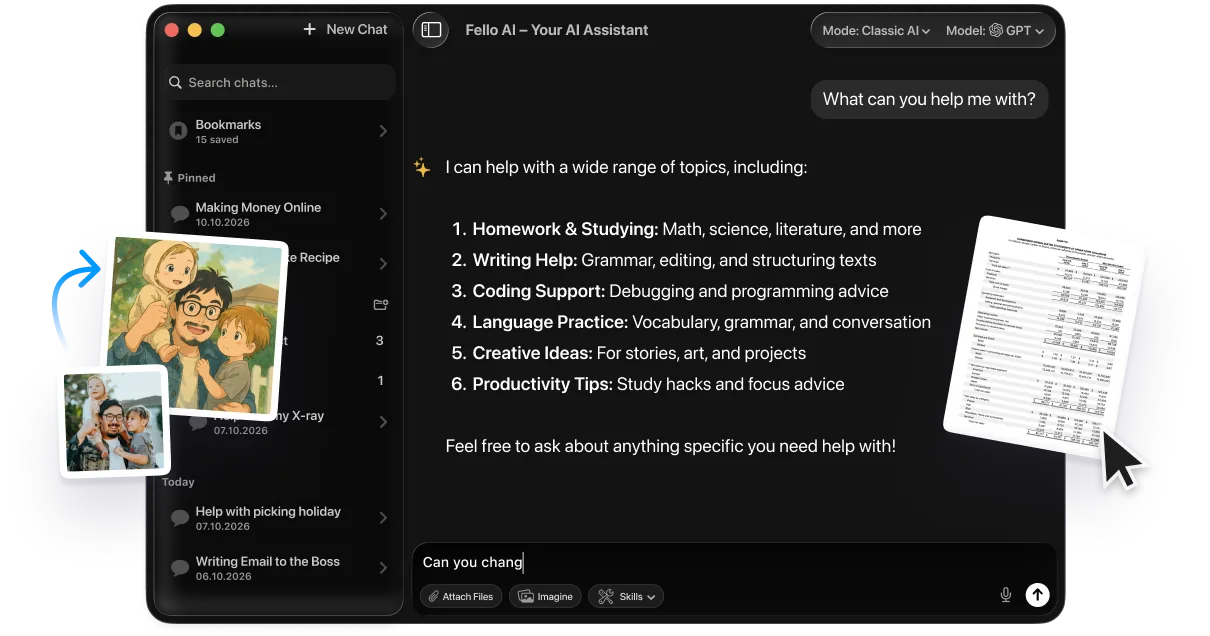
If you want Midjourney-style results without the Discord-or-browser limitation, the Fello AI Mac and iPhone app routes prompts to ChatGPT, Claude, Gemini, Grok, and DeepSeek through one $9.99/month subscription. Image generation via GPT Image and Gemini Imagen is included. It is not Midjourney, but it covers the rest of the image-gen field in one Mac-native app, and you can pair it with a Midjourney browser tab for V8.1.
Who Should Upgrade to V8.1
V8.1 is the right model for product photography, architectural rendering, and brand work where photorealism, hand rendering, and short text on labels or signs matter. It is also the right model for anyone who was loyal to V7 but felt burned by V8.0, because the aesthetic is back and the speed finally matters.
V8.1 is not the right model for purely conceptual moodboarding, atmospheric looser exploration, or anyone who relies on V7’s habit of generating happy accidents from sparse prompts. V7 still wins those workflows, and Midjourney has confirmed V7 is staying available.
The pragmatic answer is to subscribe to a plan that covers both. V7 personalization profiles carry into V8.1, so most professionals will set up both versions inside one account and switch per project.
Midjourney’s Current Limits
Two limits are worth flagging before you sign up. First, there is still no public Midjourney API as of May 2026, despite community pressure. If you need to integrate Midjourney into a product or pipeline, you will be stuck with unofficial wrappers that scrape Discord, which Midjourney explicitly does not authorize.
Second, there is no native Mac, iPhone, or iPad app. Midjourney has shipped iOS app references in the past but the current production access points are midjourney.com, Discord, and the iPhone Mirroring workaround. If a native app matters to you, the best ChatGPT alternatives on Mac roundup covers the multi-model apps that fill that gap.
Final Verdict
V8.1 is the most usable Midjourney release in two years. The 5x speed, 2K-by-default HD, and restored V7 aesthetic make it the obvious daily driver for almost every Midjourney workflow. V7 stays available for the looser creative work it is still better at. Compared to GPT Image 1.5 and Imagen 4, V8.1 holds the aesthetic crown and finally closes the gap on text rendering and photorealism, but loses on prompt understanding and platform polish.
The big asterisk is access. Midjourney is still a browser and Discord product, with no API and no Mac app. If you want one Mac-native interface that includes image generation alongside ChatGPT, Claude, Gemini, Grok, and DeepSeek under a single subscription, Fello AI is the cleanest option. If you want Midjourney specifically, the Add-to-Dock browser trick is the closest thing to a Mac app, and it works well.
For the wider 2026 picture, our best AI models hub is updated monthly and now reflects V8.1’s position in the image-generation field. Midjourney is also pushing past image generation entirely, as its new full-body body scanner shows.
FAQ
When was Midjourney V8.1 released?
Midjourney V8.1 launched in alpha at alpha.midjourney.com on April 14, 2026, and rolled out to midjourney.com and Discord on April 30, 2026.
Is Midjourney V8.1 free?
No. Midjourney has no free tier in 2026. The cheapest paid plan is Basic at $10 per month, which includes about 3.3 fast GPU hours. If a no-cost start matters more, compare the best the best free AI image generators.
How does Midjourney V8.1 compare to V7?
V8.1 is roughly 5x faster, defaults to 2K HD output, has stronger hand and text rendering, and now matches V7’s aesthetic. V7 still wins for moody concept art and rewards short prompts. V7 personalization profiles carry over to V8.1.
Is there a Midjourney Mac app?
No. As of May 2026 Midjourney does not publish a native Mac app. The best Mac access is to use midjourney.com in Safari and add the page to the Dock, or use the Discord Mac app.
Does Midjourney have an API in 2026?
No. There is no official public API for Midjourney as of May 2026. Unofficial Discord-based wrappers exist but are not authorized by Midjourney and can break at any time.
Which AI image generator is best on Mac in 2026?
Midjourney V8.1 wins on aesthetics, GPT Image 1.5 wins on text rendering and prompt accuracy, Imagen 4 wins on photorealism, and Flux 2 Pro wins on open-weights flexibility. For one Mac-native app that covers most of the field in a single subscription, Fello AI is the simplest answer.