Kimi is free to start, and that is the fastest way to summarise Moonshot AI’s pricing. The Kimi app gives you unlimited basic chat, file uploads and web search on a $0 Adagio plan, while paid memberships climb from $19 a month to $199 a month for heavy agent and coding use. If you build on the API instead, you pay per token, and the flagship Kimi K3 costs $3 per million input tokens and $15 per million output tokens.
That gap between a free chat app and a metered developer API is the whole story of Kimi pricing, and it trips up most buyers. This guide breaks down every subscription tier, the full per-model API rate card, the real limits of the free plan, and how Kimi’s cost compares against Claude, GPT and DeepSeek. Every API rate was re-checked against Moonshot’s own developer docs on September 25, 2026, and the app plans are the international prices Kimi charges in US dollars.
The Key Takeaways
- Free forever tier: the Adagio plan costs $0 with unlimited basic chat, but only about 6 agent credits and no Agent Swarm or Kimi Code.
- App plans: paid memberships run $19 (Moderato), $39 (Allegretto), $99 (Allegro) and $199 (Vivace) per month.
- Flagship API: Kimi K3 is $3 / $15 per million input/output tokens, with a cache-hit input rate of just $0.30.
- Budget API: Kimi K2.6 costs $0.95 / $4 per million tokens, a little over a quarter of K3’s output rate.
- Cheaper than the Western flagships, not than everything: K3 undercuts Claude Opus 5.5 ($4 / $20) and GPT-6 Astra ($10 / $50), but OpenAI’s GPT-6.1 Sol now costs less at $2 / $10 and scores higher.
How Much Does Kimi Cost? The Quick Answer
Kimi costs nothing to try. The Kimi app is free on the Adagio tier, and paid plans run from $19 a month up to $199 a month depending on how much agent and coding work you need. On the Moonshot API you pay per token instead of a flat fee, so the flagship Kimi K3 costs $3 per million input and $15 per million output tokens, while the cheaper K2.6 model runs at $0.95 / $4.
Which number matters depends on how you use Kimi. Casual users who chat, upload documents and search the web will mostly live on the free or $19 plan. Developers wiring Kimi into an app, an agent or a coding tool care about the per-token rate, because that is what scales with usage. The rest of this guide covers both sides in full.
Kimi Subscription Plans and Membership Pricing
Moonshot names Kimi’s five membership tiers after musical tempos, from the slow free Adagio plan up to the fast, feature-loaded Vivace tier. Every paid plan is available monthly or annually on Moonshot’s official membership page, and the annual option shaves roughly 20% off the monthly rate. Annual billing on the top plan saves you up to $480 a year. One caveat before you budget: on July 19, 2026 Moonshot paused new subscriptions because K3 demand had pushed its GPUs close to capacity, and said it would reopen spots in batches, so a tier may not be open to new sign-ups when you check.
| Plan | Monthly | Annual | Best for |
|---|---|---|---|
| Adagio | Free | Free | Casual chat and testing |
| Moderato | $19 | $180/yr | Solo users, light agent use |
| Allegretto | $39 | $372/yr | Power users, more coding |
| Allegro | $99 | $948/yr | Heavy agent and Kimi Code |
| Vivace | $199 | $1,908/yr | Teams, maximum concurrency |
Adagio (Free)
The free plan gives you unlimited basic chat, file uploads and live web access, which covers most everyday questions. It includes about 6 agent credits, a single concurrent task and 200 professional database calls. Agent Swarm, Kimi Code and Kimi Claw are locked, so serious automation is off the table until you upgrade.
Moderato ($19/mo)
The entry paid tier is the sweet spot for solo users who want real agent work. You get 60 agent credits, two concurrent tasks, 4x agent speed priority and 25 Agent Swarm runs in beta. It also adds Kimi Code at 1x and lifts your database calls to 2,000.
Allegretto ($39/mo)
Allegretto is aimed at power users who lean on Kimi for coding. It bumps you to 150 agent credits, 50 Agent Swarm runs with four concurrent subtasks and Kimi Code at 5x. This is also the first tier to include Kimi Claw, the browser-control agent.
Allegro ($99/mo)
Allegro is the heavy-workload plan, with 360 agent credits, four concurrent tasks and 120 Agent Swarm runs. Kimi Code jumps to 15x and database calls reach 12,000. Most independent developers who run agents daily will not need more than this.
Vivace ($199/mo)
Vivace is the top tier, built for teams and non-stop automation. It delivers 720 agent credits, 240 Agent Swarm runs with eight concurrent subtasks and Kimi Code at 30x. At $199 a month it sits well below what comparable enterprise AI seats cost elsewhere, which is a big part of Kimi’s appeal.
Is Kimi Free? What the Adagio Tier Really Includes
Yes, Kimi is free to use, and that has not changed in 2026. The free Adagio tier still gives you unlimited standard chat, document uploads and web browsing, powered by a capable model rather than a stripped-down one. For asking questions, summarising files and general research, you may never need to pay a cent.
The catch is agentic work. Moonshot has tightened the free tier so that autonomous multi-step tasks, Agent Swarm and Kimi Code sit behind paid plans. You get only a handful of agent credits per period on Adagio, which is fine for a quick test but not for building. If you want Kimi to run long research jobs, control a browser or write and execute code, the $19 Moderato plan is the real starting point. You can read the full model breakdown in our guide to the Kimi K2.6 model.
Kimi API Pricing Per Million Tokens
If you are a developer, the Moonshot API is where Kimi pricing gets interesting. You pay only for the tokens you send and receive, billed per million, and rates vary sharply by model. The newest and most capable model costs the most, while the previous-generation models stay far cheaper. Prompt caching can cut your input cost dramatically when you reuse the same context.
| Model | Input /1M | Output /1M | Cache hit | Context |
|---|---|---|---|---|
| Kimi K3 | $3.00 | $15.00 | $0.30 | 1M |
| Kimi K2.7 Code | $0.95 | $4.00 | $0.19 | 262K |
| Kimi K2.7 Code HighSpeed | $1.90 | $8.00 | $0.38 | 262K |
| Kimi K2.6 | $0.95 | $4.00 | $0.16 | 262K |
Kimi K3 pricing
The flagship Kimi K3 is a 2.8-trillion-parameter model that activates 104 billion parameters per token, with a 1 million token context window, and it is priced accordingly at $3 input and $15 output per million tokens. The standout number is the cache-hit input rate of just $0.30, a tenth of the miss rate, which rewards workloads that reuse long system prompts or documents. Full specs and benchmarks are in our Kimi K3 deep dive.
Kimi K2.7 Code and K2.6 pricing
K2.7 Code and K2.6 both cost $0.95 input and $4 output per million tokens, which makes them the value workhorses of the range. Both publish cache-hit rates, $0.19 for K2.7 Code and $0.16 for K2.6, and K2.7 Code is tuned for long-horizon coding and multi-agent orchestration. If speed matters more than price, K2.7 Code HighSpeed doubles every rate to $1.90 / $8 for output Moonshot puts at about 180 tokens per second. For most production apps that do not need a full million tokens of context, K2.6 or K2.7 Code is the smart default.
Kimi K2.5 and K2 are retired
If an older guide sends you to K2.5 at $0.60 / $3 or the original Kimi K2 at $0.60 / $2.50, neither can be bought any more. Moonshot retired the kimi-k2 series on May 25, 2026 and kimi-k2.5 on August 31, 2026, and calls to K2.5 now return a 404 “model not found” error, according to its model list. Moonshot points K2.5 users to K3, but on price the nearest replacement is K2.6 at $0.95 / $4, which costs more than either retired model did.
One extra cost to plan for is tooling. Web search is billed per call on top of token usage. In September 2026 Moonshot moved it to standalone endpoints at $0.002 per Web Search Basic call, $0.003 per Web Search Pro call and $0.002 per URL fetch, charged only when a call returns results. The older built-in web search tool still costs $0.005 a call, and its results count as input tokens on your next request. Moonshot publishes these fees on its web search pricing docs. They are small per call but add up at scale.
What Does Kimi Actually Cost? A Worked Example
Per-million rates are abstract, so here is a concrete job. Say you send 1 million input tokens and generate 1 million output tokens, which is a large task, roughly a book’s worth of text each way. On Kimi K3 that costs $3 plus $15, so $18 total before any caching. Run the same job on K2.6 and it drops to $0.95 plus $4, or just $4.95.
Caching changes the math again. If most of that input is a repeated document or system prompt, K3 bills the cached part at $0.30 per million instead of $3, cutting the total closer to $15. Writing to the cache is billed too, at $3 per million for the default five-minute cache or $6 for a one-hour cache, so caching pays off when the same prefix is read many times. For real chat apps, where inputs are short and outputs modest, most requests cost fractions of a cent. The takeaway is simple, pick K3 when you need its reasoning and context, and drop to K2.6 when you do not. Our guide on when to use which AI model walks through those trade-offs.
Kimi Pricing on OpenRouter, Groq and Other Hosts
Moonshot is not the only place to buy Kimi tokens. Third-party inference hosts resell the open-weight models, sometimes below Moonshot’s own list price, and they add features like unified billing and faster hardware. On OpenRouter, seven of the 19 K3 listings charged Moonshot’s own $3 / $15 on September 25, 2026, and ten sat below it, from DeepInfra at $2.85 / $14.25 down to about $0.88 / $10.53 for the cheapest four-bit listing. K2.6 starts at about $0.45 / $1.90 through the cheapest reseller.
Groq, the usual pick for high-speed inference, no longer serves Kimi at all. It shut down its last Kimi K2 model on April 15, 2026 and points users to GPT-OSS 120B instead, so for speed on Kimi itself the route is now Moonshot’s K2.7 Code HighSpeed. For jobs that can wait, Moonshot’s Batch API, open to all users since April 2026, saves 40% against real-time calls. If throughput and latency matter more than the lowest headline price, compare hosts before you commit.
Kimi Cost vs Claude, GPT and DeepSeek
Kimi’s pitch has always been frontier-class output at a fraction of Western prices, and against the Western flagships that still holds. K3 is 25% cheaper than Claude Opus 5.5 ($4 / $20) on both input and output, and 70% cheaper than GPT-6 Astra ($10 / $50). It is no longer cheaper than everything from the West, though. GPT-6.1 Sol, OpenAI’s mid-tier model, costs $2 / $10, a third less than K3, and so does Anthropic’s Claude Sonnet 5.5. DeepSeek, the other Chinese price leader, stays far cheaper, at a rate that now doubles during weekday peak hours (01:00 to 04:00 and 06:00 to 10:00 UTC). Alibaba’s Qwen 3.8 is the other Chinese multi-trillion-parameter model chasing that same value crown. How that gap plays out inside the chat apps is covered in our Kimi vs ChatGPT comparison.
| Model | Input /1M | Output /1M | Notes |
|---|---|---|---|
| Kimi K3 | $3.00 | $15.00 | Flagship, 1M context |
| Kimi K2.6 | $0.95 | $4.00 | Cheap workhorse |
| Claude Fable 5.1 | $10.00 | $50.00 | Anthropic’s dearest model |
| Claude Opus 5.5 | $4.00 | $20.00 | Anthropic flagship, tops the AA Intelligence Index |
| GPT-6 Astra | $10.00 | $50.00 | OpenAI flagship |
| GPT-6.1 Sol | $2.00 | $10.00 | OpenAI mid-tier, cheaper than K3 |
| DeepSeek V4 Pro | $0.66 (peak $1.32) | $1.98 (peak $3.96) | Cheapest here, double at peak |
The honest caveat is capability, and it now cuts against K3 on value as well. On the Artificial Analysis Intelligence Index (v4.3.2, maximum effort, read September 30, 2026), K3 scores 43.6, against 57.6 for Claude Opus 5.5, 52.7 for GPT-6 Astra and 51.8 for GPT-6.1 Sol. Among open-weight models it is third, behind Xiaomi’s MiMo-V2.6-Pro (46.3) and GLM-5.3 (44.8). So K3 is neither the strongest model nor the best value near the top any more, because GPT-6.1 Sol scores higher for less money. What K3 still offers is open weights, a 1 million token context and a price well below Opus 5.5 and Astra. For a cheaper, capable coder, K2.6 or DeepSeek may serve you better, as covered in our best AI for coding roundup.
Can You Run Kimi for Free by Self-Hosting?
This is where Kimi gets interesting for cost-conscious teams. Moonshot ships its models as open weights, and K3’s landed on July 27, 2026, so you can download it today and run it with no per-token fee at all. The catch is the hardware. The published repository is 96 safetensors shards totalling about 1.56 TB, and it already ships at roughly four bits per parameter, so there is no further quantisation trick waiting to shrink it onto a desktop card.
For most people, self-hosting only pays off at very high volume, where the fixed cost of hardware beats a metered API bill. Smaller teams are usually better off with the hosted API or a subscription. Every recent Kimi model is downloadable now, K3 included, which is why Kimi ranks so highly among the best open-source AI models for anyone who wants full control and zero usage fees. Note that K3 ships under Moonshot’s own Kimi K3 License rather than the permissive MIT terms the earlier K2 releases carried.
Which Kimi Plan Should You Choose?
Match the plan to the job. If you just want a smart chatbot for questions, files and web search, the free Adagio tier is enough. If you want Kimi to run agents, browse and code, start at $19 Moderato and climb only when you hit its limits. Developers building products should skip the app entirely and use the API, choosing K3 for hard reasoning and K2.6 for everything else.
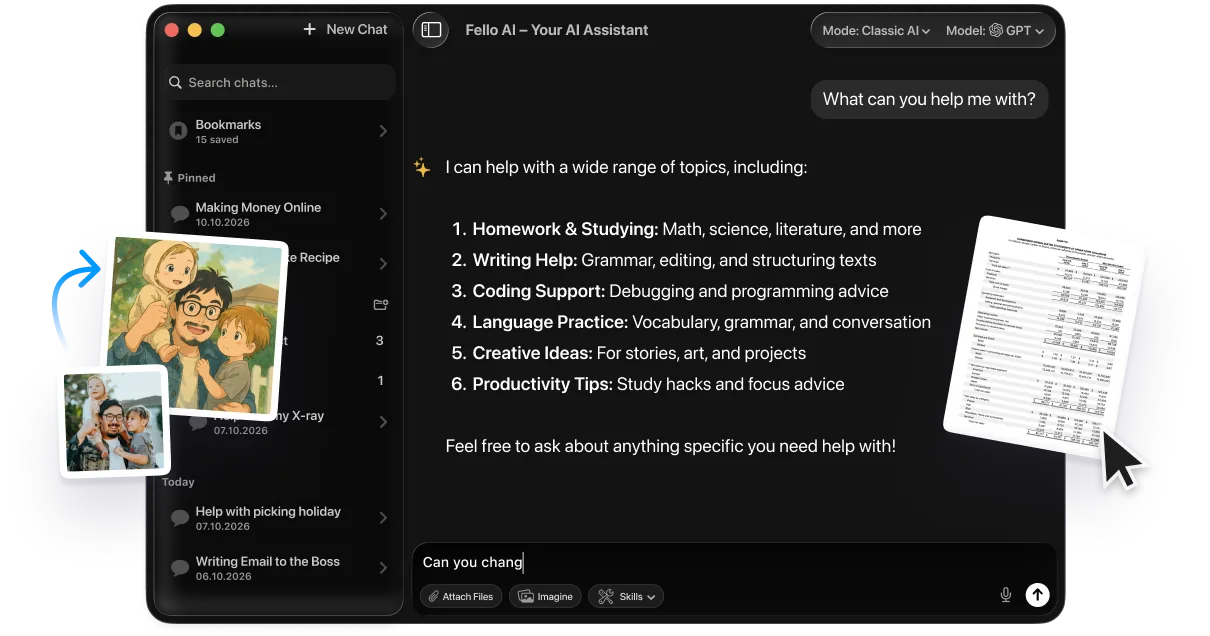
If you would rather not manage a Moonshot subscription at all, a multi-model creation app like Fello AI lets you tap Kimi models alongside other frontier models like ChatGPT, Gemini, Grok, Deepseek and more, which is handy when you want to compare outputs. Thanks to Fello AI you can pay only $9.99 a month and use multiple models at once. On a Mac it arrives as a native Kimi desktop client, with no Moonshot account to top up. Whichever route you pick, Kimi remains one of the most aggressively priced frontier options on the market, and the free tier means testing it costs nothing.
FAQ
Is Kimi free to use?
Yes. The free Adagio tier gives you unlimited basic chat, file uploads and web access at no cost. It is capped at roughly 6 agent credits and excludes Agent Swarm, Kimi Code and Kimi Claw, so heavy agent and coding work needs a paid plan starting at $19 a month.
How much does the Kimi API cost per million tokens?
It depends on the model. Flagship Kimi K3 costs $3 per million input tokens and $15 per million output tokens. The cheaper K2.6 and K2.7 Code models cost $0.95 / $4, and K2.7 Code HighSpeed costs $1.90 / $8. Cache hits cut input costs by roughly 80 to 90 percent, and the Batch API takes 40 percent off jobs that can wait.
What is Kimi K3 pricing?
Kimi K3 costs $3 per million input tokens and $15 per million output tokens, with a cache-hit input rate of just $0.30. It carries a 1 million token context window, so a large 1M-in, 1M-out job costs about $18 before caching.
Is Kimi cheaper than Claude and GPT?
Than their flagships, yes. Kimi K3 at $3 / $15 undercuts Claude Opus 5.5 ($4 / $20) and GPT-6 Astra ($10 / $50) on input and output. It is not cheaper than GPT-6.1 Sol or Claude Sonnet 5.5, which both cost $2 / $10, and both also score higher than K3 on the Artificial Analysis Intelligence Index (51.8 and 56.0 against 43.6). DeepSeek V4 Pro is cheaper than all of them at $0.66 / $1.98 off-peak.
Can I run Kimi for free by self-hosting?
Yes. Moonshot releases its models as open weights and K3’s shipped on July 27, 2026, so you can run it locally with no per-token fee. The practical barrier is size, because the K3 repository is about 1.56 TB across 96 shards. Self-hosting only pays off at high volume, and for most teams the hosted API stays cheaper.