OpenAI just dropped GPT-5, the most anticipated AI model release of 2025. After months of speculation and hype surrounding what many expected to be a revolutionary leap toward artificial general intelligence, the company has finally unveiled its latest flagship model. With ChatGPT now serving 700 million weekly users worldwide, the pressure was on OpenAI to deliver something truly groundbreaking.
GPT-5 arrives as a unified system rather than a single model, designed to automatically choose the right approach for each task. Sam Altman positioned this release as bringing “a team of PhD-level experts in your pocket,” promising significant improvements in reasoning, coding, health advice, and creative tasks. The lineup includes multiple variants optimized for different needs and computational requirements.
But does GPT-5 actually live up to the enormous hype? We’ll break down from the technical improvements to the real-world applications to see whether this represents the major breakthrough OpenAI claims or simply another incremental step in the current competitive AI space. Here’s what GPT-5 actually includes:
- GPT-5 – The full-power flagship model, built for complex reasoning, advanced problem-solving, and high-accuracy results.
- GPT-5 Mini – A lighter, faster version optimized for everyday tasks and quick responses.
- GPT-5 Nano – An ultra-efficient variant designed to run directly on devices with minimal computing power.
Technical Specifications
The context window — essentially the model’s short-term memory — determines how much text it can “see” at once when generating a response. All three GPT-5 models share the same expanded context length of 400,000 tokens, with a maximum output length of 128,000 tokens.
In practical terms, 400K tokens is the rough equivalent of over 900 pages of text, which allows the model to read and retain the contents of entire books, multi-document research datasets, or months of conversation history without forgetting earlier details. This is a substantial leap for workflows like legal discovery, academic analysis, or codebase refactoring.
In terms of knowledge, GPT-5’s main model has a cutoff date of September 30, 2024, meaning it was trained on data up until that point. The smaller GPT-5 Mini and GPT-5 Nano models have a slightly earlier cutoff date of May 30, 2024. While all three can still pull in fresh information via browsing tools (when enabled), the cutoff defines the static knowledge baked into the base model.
Pricing follows OpenAI’s per-token model, which charges separately for input (the text you send in) and output (the text the model generates). Costs are calculated per 1 million tokens, with GPT-5 positioned as the highest-priced tier due to its size and advanced reasoning capabilities, and GPT-5 Nano offering the most affordable option for lightweight or edge-deployed use cases. A discounted “cached input” rate applies when reusing context that the model has already processed.
| Model | Input / 1M tokens | Cached Input / 1M tokens | Output / 1M tokens |
|---|---|---|---|
| GPT-5 | $1.25 | $0.125 | $10.00 |
| GPT-5 Mini | $0.25 | $0.03 | $2.00 |
| GPT-5 Nano | $0.05 | $0.01 | $0.40 |
GPT-5 Benchmarks
Benchmarks are the industry’s measuring stick for evaluating a model’s reasoning, knowledge, and problem-solving abilities. GPT-5 delivers a considerable leap over its predecessor — in academic tests, and also in human-evaluated, real-world scenarios. The biggest gains are in math, coding, multimodal understanding, and health.
It scores 94.6% on AIME 2025 (without tools), setting a new state of the art in competitive math, and achieves 74.9% on SWE-bench Verified and 88% on Aider Polyglot for real-world coding. In multimodal understanding (MMMU), it reaches 84.2%, and on the most challenging medical tasks (HealthBench Hard), it scores 46.2%. On the HLE (Humanity’s Last Exam), GPT-5 records a maximum of 42%, slightly below Grok 4’s 44.4%.
On the Artificial Analysis Intelligence Index — a composite score combining results from multiple datasets across reasoning, knowledge, math, and programming — GPT-5 achieves the highest recorded result to date at 69.

With GPT-5 Pro’s extended reasoning mode, the model also sets a new high score on GPQA, achieving 88.4% without tools.
| Benchmark | GPT-5 Score | What It Measures |
|---|---|---|
| AIME 2025 | 94.6% | Advanced math competition, no tools |
| SWE-bench Verified | 74.9% | Fixing real GitHub code issues |
| Aider Polyglot | 88% | Multilingual coding & refactoring |
| MMMU | 84.2% | Multimodal text-image understanding |
| HealthBench Hard | 46.2% | Difficult clinical/medical questions |
| HLE Bench | 42% | Hard Logical Evaluation – complex logical reasoning tasks |
| Artificial Analysis Intelligence Index | 69 | Composite score across reasoning, knowledge, math, and programming |
| GPQA | 88.4% | Graduate-level reasoning, no tools |
Usage Improvements
Here are the key usability upgrades in GPT-5 that make it feel smarter, more reliable, and more human in everyday interactions.
Automatic Smart Reasoning
This is likely the most innovative feature OpenAI brought out. GPT-5 automatically decides when to think deeply about your question versus when to respond quickly. Unlike previous models where you had to manually switch between fast and reasoning modes, GPT-5 uses a smart router system that analyzes your request and chooses the appropriate approach. If you ask a simple question, it responds instantly. For complex problems like debugging code or analyzing health data, it automatically switches to deeper reasoning mode without you having to do anything.
Massive Reduction in Wrong Answers
Another one of GPT-5’s biggest improvements is dramatically fewer hallucinations – those confident-sounding but completely incorrect responses that have plagued AI models. GPT-5 produces 45% fewer factual errors than GPT-4o, and when using its thinking mode, it makes 80% fewer errors than OpenAI’s previous o3 model. This means you can trust its answers much more, especially for important questions about health, work, or research where accuracy matters.
Persistent Context Memory
Rather than forgetting everything between chats, GPT-5 can now maintain long-term memory (if enabled), remembering your preferences, ongoing projects, or past conversations across sessions. For example, if you’re building an app, it can recall your previous code snippets and design choices weeks later without you having to re-explain.
Real-Time Web Integration
GPT-5 comes with upgraded browsing capabilities that are faster and more context-aware. It can now pull the most relevant, up-to-date information from the web, summarize it, and cite sources more reliably. This makes it far more useful for tasks like market research, fact-checking, or staying on top of breaking news.
Better at Following Instructions
GPT-5 is significantly better at doing exactly what you ask rather than interpreting your request loosely. Whether you’re asking it to write in a specific format, follow particular guidelines, or maintain a certain tone throughout a long conversation, it sticks to your instructions more reliably. This improvement extends to custom instructions in your settings – the model now consistently remembers and applies your preferences across different chats.
New Safety Approach
Instead of simply refusing to help with potentially sensitive topics, GPT-5 uses a new “safe completions” approach. Rather than saying “I can’t help with that,” it tries to provide useful information while staying within safety boundaries. For example, if you ask about a dual-use topic like chemistry, it might explain general principles and safety considerations rather than just shutting down the conversation entirely.
More Natural, Less “AI-like” Personality
GPT-5 feels more like talking to a knowledgeable friend rather than an overly enthusiastic AI assistant. It uses fewer unnecessary emojis, avoids excessive agreement (a problem called “sycophancy”), and responds with more natural, conversational language. The model is also less likely to praise every single thing you say, giving you more genuine and useful feedback instead of constant validation.
Improved Use Cases
While GPT-5 brings a range of small upgrades across many areas, here we focus only on the use cases that show the most notable improvements over previous models.
Healthcare
GPT-5 performs better on medical reasoning benchmarks like HealthBench Hard, scoring 46.2% — a significant step up from earlier versions. This means it can give more accurate and nuanced explanations in health-related queries, such as clarifying symptoms, interpreting medical studies, or supporting early-stage research. It is still not a replacement for professional medical advice, but the improvement makes it a more dependable assistant for health education and preliminary information gathering.
In practice, these upgrades could be used to support government-run healthcare systems with automated patient triage, power more reliable health chatbots for public information services, or act as an assistant to doctors by quickly summarizing patient histories or highlighting relevant research during consultations.
Coding
It is better at reading existing code, identifying bugs, and making fixes that work in practice. GPT-5 is now integrated with tools like Cursor, where it can help developers write and refactor and build code more efficiently inside their existing workflow. Within the ChatGPT interface itself, it can even build functional mini-web apps from relatively brief prompts, making it useful for quickly prototyping ideas or demonstrating concepts without needing a full development environment. These improvements make it a stronger everyday tool for both individual developers and collaborative teams.
Business Integrations
Several companies are already using GPT-5 to meaningfully speed up their operations and improve productivity. Amgen applies it in drug design workflows, BBVA uses it for financial analysis, and Oscar Health employs it for clinical reasoning. These integrations are reducing real bottlenecks. For example, BBVA has reported cutting some types of analysis from weeks to just hours. With its 400k-token context window, GPT-5 can work through entire regulatory documents, or long meeting transcripts without losing track, making it well-suited for complex enterprise environments.
Pricing and Availability
GPT-5 is starting to roll out today for Plus, Pro, Team, and Free users, with Enterprise and Edu access coming in one week. The main difference between free and paid plans is usage volume. Pro subscribers get unlimited GPT-5 access and can use GPT-5 Pro. Plus users can comfortably make GPT-5 their default for everyday questions, while Team, Enterprise, and Edu customers get generous limits for organization-wide use. Free-tier users will receive the full reasoning capabilities over the coming days, but once they reach their GPT-5 limit, they’ll automatically switch to GPT-5 mini — a smaller, faster model that’s still highly capable.
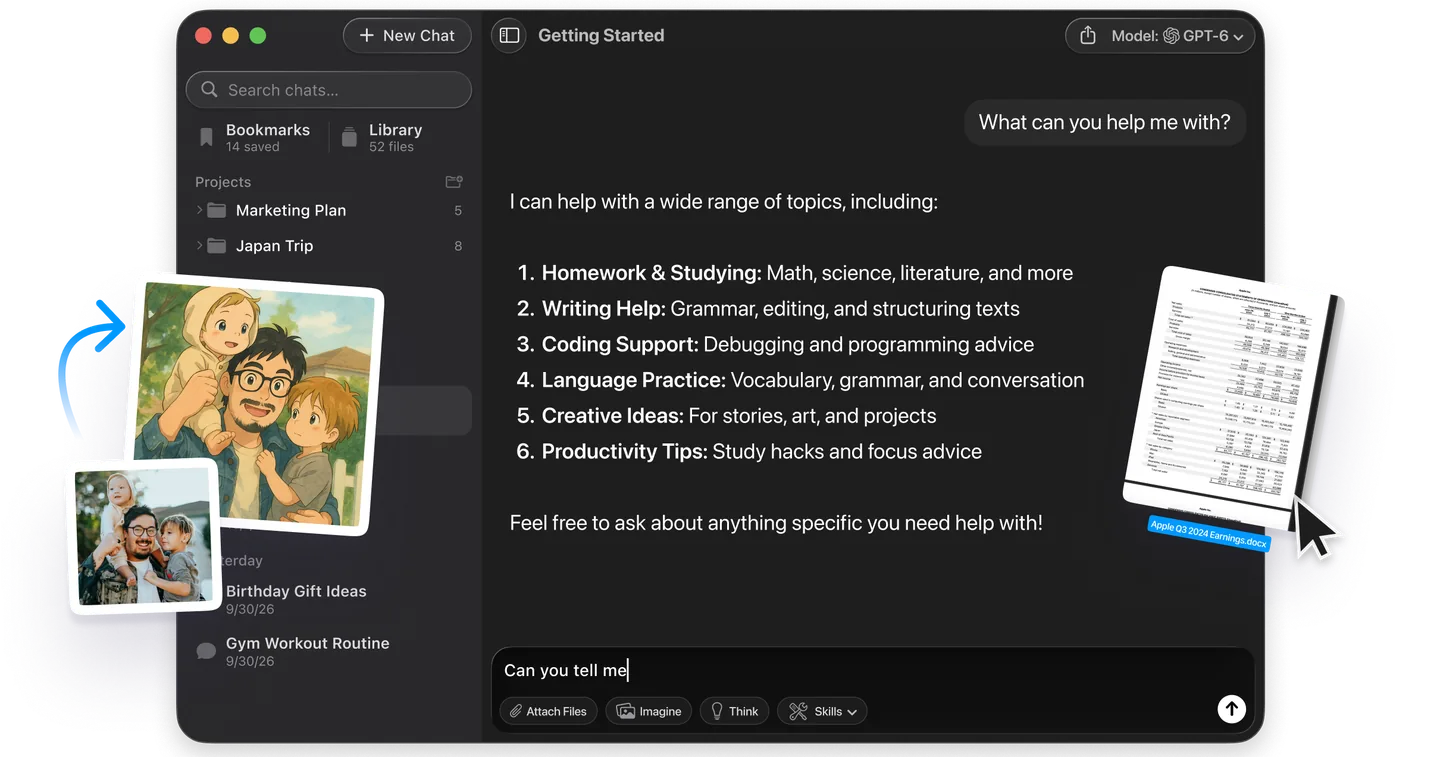
GPT-5 will also be available on Fello AI in the coming days, allowing you to use it alongside all other major AI models and switch seamlessly between them in one interface.
| Plan | Price | Key Benefits |
|---|---|---|
| Free | $0 | Limited GPT-5 access, switches to GPT-5 mini after usage cap |
| Plus | $20/month | Higher usage limits, GPT-5 as default model |
| Pro | $200/month | Unlimited GPT-5 access, includes GPT-5 Pro |
| Team | $30/user/month (monthly) $25/user/month (annually) | Generous limits for collaborative work across teams |
| Enterprise | Custom pricing | Organization-wide access, highest usage allowances |
Conclusion
Looking at GPT-5’s benchmarks and early testing, it’s clear that this release is more of a refinement than a revolution. While it edges ahead of previous leaders in many categories, the overall gap isn’t as dramatic as the hype might have suggested. In some areas, such as hard logical reasoning (HLE Bench), it even trails behind competitors like Grok 4. The improvements are there, but they don’t seem to redefine the landscape in the way many were expecting.
The most notable advances appear to be in health-related reasoning and real-world coding tasks. Scores on HealthBench Hard, SWE-bench Verified, and Aider Polyglot suggest that GPT-5 will be a more capable assistant for developers and professionals working in medical or scientific domains. In most other areas — from multimodal understanding to graduate-level reasoning — the jump feels more like an incremental upgrade than a groundbreaking leap.
The coming days will show how the wider AI community reacts, but OpenAI faces a delicate challenge. Expectations for GPT-5 were sky-high, and if the model is perceived as failing to deliver on that anticipation, a backlash is possible. Competitors are moving quickly, and unless GPT-5 can demonstrate compelling real-world advantages beyond the benchmarks, OpenAI may find itself under pressure to accelerate its next big step.