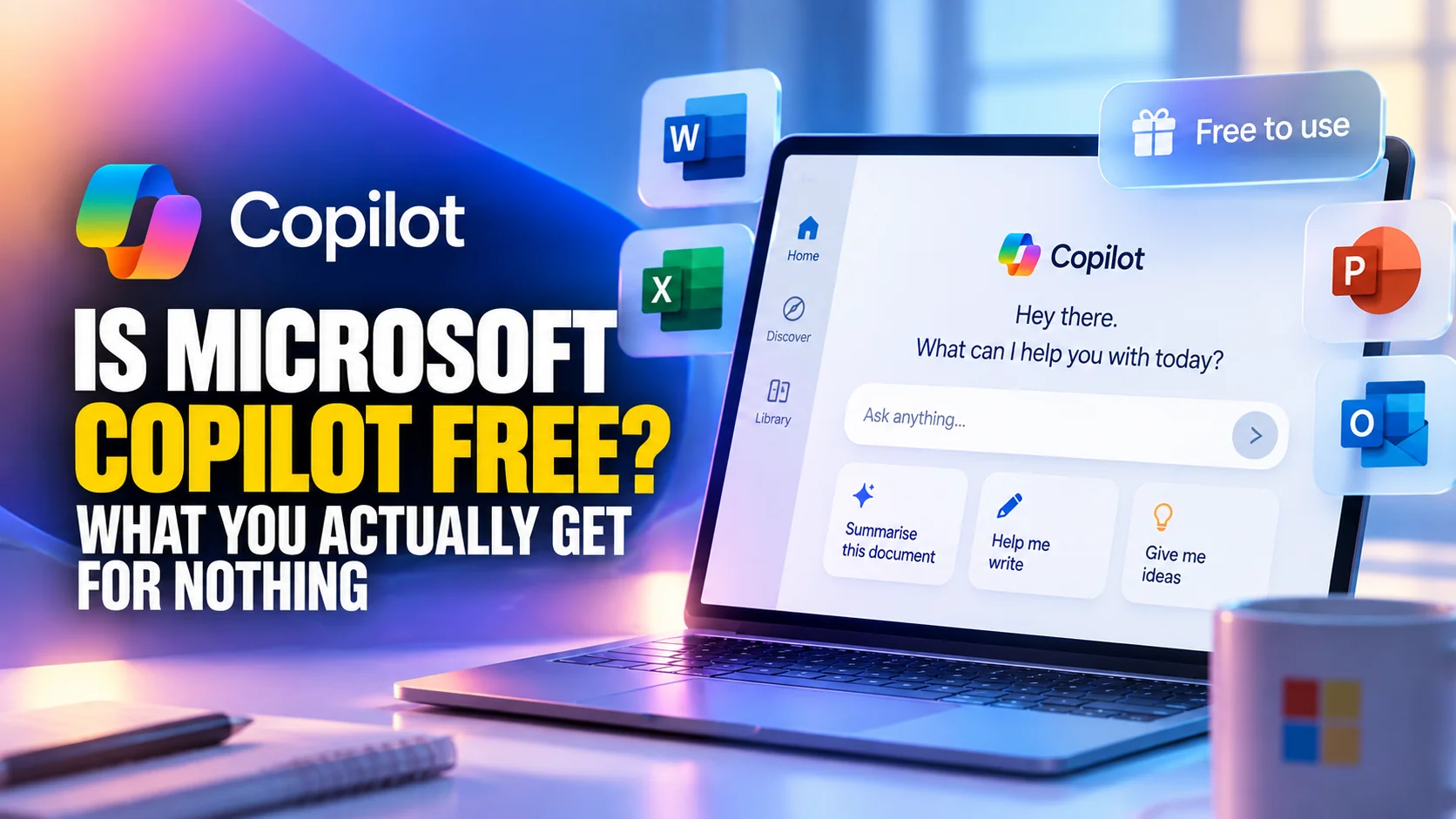
Type is Microsoft Copilot free into a search box and the top commercial result will tell you there is no free tier at all. Microsoft’s own pricing page, on the same query, opens its FAQ with the opposite: “Is Copilot free? Yes. Microsoft offers a limited free version of Copilot subject to available capacity and limits.” One of those is wrong, and the reason the internet cannot agree is that Microsoft has put the same name on five different products at five different prices.
This guide sorts out which Copilot you are actually looking at, what the free one does, and where it stops. It also covers the part every other page invents: the size of the free allowance. Microsoft does not publish it, and the numbers you see quoted have been retired from Microsoft’s own documentation. Everything below was checked against Microsoft and GitHub source pages on 20 September 2026.
The Key Takeaways
- Yes, and it is not a trial. Microsoft Copilot on the web, in Windows, in Edge and in the mobile apps costs nothing, and you do not even need to sign in to start.
- No, it is not unlimited. Microsoft calls it “subject to available capacity and limits” and never says what the limits are.
- The free tier has no row in Microsoft’s own limits table. That table covers Personal, Family, Premium and Pro in bands like “Standard usage” and “Highest usage”. Free is the yardstick everything else is measured against, and it is never measured itself.
- Copilot inside Word, Excel, PowerPoint and Outlook is the paid part, starting at $9.99 a month, and it reaches only the subscription owner.
- Microsoft 365 Basic buys you no AI whatsoever. Microsoft’s own footnote is blunt about it.
Is Microsoft Copilot Free? The Short Answer
Yes. Microsoft Copilot is free to use on the web, in Windows, in the Edge browser and in the iOS, Android and Mac apps. Microsoft calls it “a limited free version of Copilot subject to available capacity and limits”. It adds that “when you hit a limit, you can choose to upgrade to a paid option or come back later”. That is a permanent product, not a countdown.
That is the whole answer, and everything below is the fine print on it.
What is not free is Copilot inside the desktop Office apps. The moment you want Copilot to draft in Word from a file on your drive, build a deck in PowerPoint or summarise an Outlook thread, you need a paid Microsoft 365 subscription. That single boundary explains most of the confusion on this question, because both halves are advertised under the word Copilot. It is also worth knowing that Copilot is no longer the only assistant in those apps: ChatGPT’s own Office add-in installs free on every plan and puts a rival sidebar in the same ribbon.
The confusion is not the reader’s fault. Microsoft’s consumer marketing page for Copilot has no free plan card on it at all. Every button says “Try for free”, which means a one-month trial of a paid subscription, or “See plans and pricing”. The free tier is documented only in the support articles. That is exactly why a pricing directory ranking near the top of this search concluded, and still states, that Microsoft Copilot “does not offer a free plan”. It does. Microsoft just does not sell it to you.
Which Copilot Are You Actually Looking At?
Five products carry this name, and the answer to the free question is different for each one. Find your row before you read anything else about pricing, including ours.
| What you are using | What it costs | What it can reach |
|---|---|---|
| Microsoft Copilot (web, Windows, Edge, phone, Mac) | Free | The web, your chat, your screen if you point it there |
| Copilot in Microsoft 365 (Personal, Family, Premium, Pro) | From $9.99/month | Your documents and mail, inside the desktop apps, owner only |
| Microsoft Copilot Chat (at work) | Free with an eligible business licence | The web, with enterprise data protection, no company files |
| Microsoft Copilot (the work add-on licence) | Paid, per seat | Your organisation’s files, mail, chats and meetings |
| GitHub Copilot Free | Free | Your code, in your editor |
Two of those five are free outright, one is free if your employer already pays for Microsoft 365, and two cost money. A comparison that tells you Copilot costs $21 a user is quoting row four at a reader sitting in row one. If you want the basics of the product itself rather than the price, our explainer on what Microsoft Copilot actually is covers the ground this table skips.
What the Free Version Does
More than most people expect, and it starts before you have an account.
You Do Not Have to Sign In
Microsoft’s support page is explicit that “sign in isn’t required”. Open the web app and you can chat, get answers grounded in a live web search, summarise a page you are reading in Edge, and get help with writing, brainstorming and summarising. Signing in with a personal Microsoft account then adds chat history, image creation, longer conversations and voice.
Finding the thing is oddly harder than using it. Microsoft’s support articles point at three different addresses, and they are not the same product. The page that defines the free tier sends you to copilot.cloud.microsoft, which opens under the title “Copilot | AI chat for work”. The getting-started page sends you to copilot.com, which opens on a sign-in screen. The address that actually loads the free consumer assistant with a text box waiting for you, no account required, is the old one: copilot.microsoft.com.
The Windows App Gets Extras Nothing Else Does
On Windows 11 the Copilot app ships preinstalled and pinned to the taskbar. Microsoft documents a set of features for it that exist nowhere else. There is a dedicated Copilot key, or Windows+C, to open it. There is an opt-in wake word, Copilot Vision for asking about what is on your screen, and a file search that finds and reads documents stored on the device. That is a lot of assistant to hand someone for nothing.
Mac users get a thinner deal, and the fine print is worth reading twice. One Microsoft support page states that the Copilot app “requires macOS 14.0 or later and a Mac with an Apple M1 chip or later”. Microsoft’s own download page asks only for “MacOS Sonoma 14 or later”, and the App Store listing names no chip at all. Treat the Intel exclusion as one page’s word rather than a settled requirement. The same support page also says the app is “currently only available in the US, UK, and Canada”. That line has simply gone out of date: the app is listed in the Czech, German, Japanese, Indian and Brazilian storefronts among others, free, last updated on 3 September 2026. Microsoft leaving a stale sentence on a support page is a recurring theme on this topic.
Where the Free Version Stops
Free Copilot does not appear inside the desktop Office apps, and it has no standing access to your mail or your files. Two features sit behind the paywall by name rather than by volume: Researcher and Analyst, the agent tools, are marked “Not available” on both Microsoft 365 Personal and Family, and appear only from Premium upwards. Everything else is a question of how much, not whether.
Geography draws a harder line than money does. Copilot runs in “over 170 markets”, with exceptions Microsoft names as “China (excluding Hong Kong) and embargoed markets”, and its published list of text languages runs to 43. Age is the other silent gate. AI features in the Office apps are switched off for users under an age threshold that varies by region. Microsoft warns that the features simply disappear from the apps rather than asking for a birthday.
Is Microsoft Copilot Free and Unlimited?
No. The free tier is capped, and here is the finding that no other page on this question reports: no current Microsoft support or pricing page puts a number on it. Not one.
The Table With No Free Column
Microsoft’s support article on AI credits and limits, updated in September 2026, carries the only official limits table there is. It lists Chat, Deep reasoning, Pages, Audio Overview, Voice, Vision, Image gen, Researcher and Analyst down one side, and Personal, Family, Premium and Pro across the top. The free tier is not a column. It is not a footnote either.
The values in that table are not numbers. They are five words: “Standard usage”, “More usage”, “Extensive use”, “Highest usage” and “Not available”. Even a paying subscriber cannot look up a number.
Microsoft explains itself in the same breath, writing that limits “may vary based on the feature, entry point, and system conditions”. The scale is deliberately soft. On the pricing page the free tier does appear, and only as a unit of measurement. The plan comparison grid rates overall usage as “Higher than free” for Personal, “Higher than free” for Family, “Extensive” for Premium and “Highest” for Pro. Free is the zero point of Microsoft’s entire consumer scale, and Microsoft never marks where the zero point sits.
Microsoft Does Not Agree With Microsoft
Push on the bands and they come apart. The pricing page sells Microsoft 365 Personal on a feature line reading “chat with higher usage than free” and reserves the word “extensive” for Premium two tiers up. The support page rates Chat as “Extensive use” for Personal, Family, Premium and Pro alike, with no gradation at all. Both pages are Microsoft’s, both are current, and they describe the same allowance differently.
Neither page is wrong. Neither page is checkable.
That is worth knowing before you upgrade for headroom, because the headroom is the product being sold and nobody will quantify it. The practical move is to stop reading pages and read your own account. Microsoft’s instruction is that “you can check the status of your limits and AI credits by selecting Services & subscriptions in your Microsoft account”. It says you will be notified when you hit a feature limit.
The Numbers You Have Read Elsewhere Are Dead
Search results for this question are thick with hard figures: fifteen image boosts a day, three hundred chats a day, sixty credits a month. None of them survive contact with Microsoft’s current documentation. Boosts are gone as a concept, retired in a Microsoft FAQ item headed “Where did my Boosts go in Designer?”, whose answer is that “every image is now automatically boosted”.
The reason that number will not die is more interesting than the number. It is still sitting on microsoft.com. A Microsoft 365 blog post from July 2024 still reads: “Today, Designer comes with 15 free daily boosts that you can use to create or edit AI-powered images and designs faster.” It closes the offer with “You can upgrade to a Copilot Pro subscription to receive 100 boosts per day.” That page is live today. It describes a rationing system Microsoft has retired and offers you an upgrade to a plan Microsoft stopped selling. Every site quoting fifteen boosts a day is quoting Microsoft accurately and two years late.
Is Microsoft Copilot Free With Microsoft 365?
If you pay for Microsoft 365, you are probably already paying for Copilot without having decided to. Whether you can use it depends on which plan and, more awkwardly, on whose name is on the subscription.
| What you pay Microsoft | Copilot you get |
|---|---|
| Nothing | Free Copilot on the web, Windows, Edge and the apps |
| Microsoft 365 Basic | Still only free Copilot. No AI features in the apps |
| Personal or Family | Copilot in the desktop apps, subscription owner only |
| Premium or Pro | The above plus Researcher, Analyst and the top usage bands |
| A work or school account | Copilot Chat, unless your employer bought the add-on licence |
The Microsoft 365 Basic Trap
Microsoft 365 Personal, Family, Premium and Pro all include Copilot in the desktop apps. Microsoft 365 Basic does not. The footnote on Microsoft’s own Copilot page states it without softening: “AI features are not available in Microsoft 365 Basic.” Paying Microsoft every month is not the same as having bought Copilot. Basic is the plan where that gap bites.
On Microsoft’s own pricing page, the tiers above Basic run $9.99, $12.99 and $19.99 a month for Personal, Family and Premium. Paid yearly they are $99.99, $129.99 and $199.99, a saving Microsoft advertises as up to 17 percent. Sitting above all of them is a plan most roundups have not caught up with. The same page carries Microsoft 365 Pro at $99.99 a month, monthly billing only, badged for the highest usage limits, and Microsoft’s support documentation lists it alongside the other three. Our full breakdown of every Microsoft Copilot price in 2026 covers the business tiers and the per-seat maths this page deliberately leaves out.
Only One Person in the Family Gets It
Microsoft 365 Family covers up to six people for apps and storage. It covers one person for the AI inside the apps. Microsoft repeats the restriction on three separate pages, most plainly as “AI benefits are only available to the subscription owner and cannot be shared with others”. Everyone else in the household needs their own eligible subscription. A household that bought Family for the AI has bought one seat of it.
One more constraint worth knowing before you count on it: Copilot in Excel requires AutoSave, which means the file has to live in OneDrive. Microsoft says plainly that it “doesn’t function with unsaved files”. If your spreadsheets sit on a local drive, the feature you paid for will not appear.
Copilot Pro Is Gone for Good
If a guide offers you Copilot Pro at $20 a month, close it. Microsoft stopped selling the standalone plan to new customers in October 2025, and its support page set an end date for existing subscribers of 1 August 2026, a date that has now passed. Microsoft has not updated the tense on that page, which is part of why so many comparison tables still price Copilot against a plan nobody can buy.
Is GitHub Copilot Free? A Different Product
GitHub Copilot shares a name and nothing else. It writes code in your editor, it is billed by GitHub, and it has its own free tier with its own rules.
GitHub’s plans page puts a real number on this one. Copilot Free is “limited to 2000 completions per month” and comes with an allowance of AI credits. Model access is “auto model selection only”, so you take whichever one GitHub picks.
Then GitHub contradicts itself too. Its marketing page adds a cap the documentation leaves out entirely, answering its own FAQ with the line that Free users are “limited to 2000 completions and 50 chat requests (including Copilot Edits)”. Two pages, two answers, the same disease in a different building.
There is an eligibility catch as well, and it is the one that actually stops people. Copilot Free is “only available to individual developers who don’t have access to Copilot through an organization or enterprise”. If your employer has a seat waiting for you, the free plan is not yours to take.
Verified students get more than either, through Copilot Student. Those offers change faster than anything else here, so we keep the qualifying rules and the current sign-up state in a separate guide to free Copilot access for students and teachers.
Free Copilot at Work
There is one more free Copilot, and most people who have it do not know they have it. Microsoft Copilot Chat is “automatically included and available to organizations with an eligible Microsoft 365 license”, which covers a very large number of office workers already.
That free tier got narrower this year, and quietly. In March, an administrator posted a Microsoft Message Center notice in full on Microsoft’s own community forum. It told tenants that “starting April 15, 2026, Copilot will no longer be available in Word, Excel, PowerPoint, and OneNote for Copilot Chat users”, reserving the in-app experience for paid licences. The scope is the part most coverage drops: Computerworld reported that Microsoft would “remove this functionality for Microsoft 365 customers with more than 2,000 users, and place usage restrictions for others”. Outlook was left alone, and consumer plans were never touched. If a colleague at a large employer remembers Copilot living in their Word sidebar and cannot find it now, that is why.
What it gives you is web-grounded chat with enterprise data protection, document and web page summarising, image creation and file upload. What it does not give you is your own organisation’s mail, files, chats and meetings. That grounding is the entire point of the paid add-on licence, and it is the only thing the money buys. Before anyone in your team asks for a Copilot budget, it is worth finding out whether the free tier already covers what they were going to do with it.
When the Free Tier Runs Out
The free tier fails in two ways, and only one of them is about volume. The first is the wall Microsoft describes, where a feature stops until the allowance resets and you decide whether to wait or pay. The second is narrower and more common: you hit something free Copilot structurally cannot do, like reading the document open in front of you, and no amount of patience fixes it.
For the first problem, the cheapest answer is usually a second free assistant, not a subscription. Our roundup of the best free AI chatbots covers what else is worth keeping open. If you are weighing the two obvious candidates against each other, whether ChatGPT is free answers the same question from the other side. For the second, paying Microsoft is the only route that ends with Copilot inside Word.
One Account, Several Models
There is a third option that suits the way most people actually hit these ceilings. Fello AI puts GPT, Claude, Gemini, Perplexity, Grok, Kimi, DeepSeek, GLM and Qwen in one Mac, iPhone and iPad app, so an exhausted allowance on one model costs you a keystroke rather than a wait. It reads PDFs, searches the web, generates images and builds Word, Excel and PowerPoint files, which is the part of the paid Copilot pitch most free users are actually missing.
It has a free tier of its own, and the paid plan is $9.99 a month or $79.99 a year. That is the same entry price as Microsoft 365 Personal for a different shape of product: several vendors’ models instead of one vendor’s, and no Microsoft subscription underneath it. It rates 4.7 stars across more than 27,000 reviews, which is a longer track record than a Mac Copilot app that shipped its current build this month.
The Verdict
Microsoft Copilot is free, properly free, and the free version is better than the search results suggest. You get a capable assistant on the web, a well equipped app on Windows, web-grounded answers, image generation and voice, without an account, a card or a countdown.
What you do not get is a number. Microsoft has replaced every published limit with a band, and has never published a band for the free tier at all. The only honest way to find your ceiling is to use it until you meet it. Start there, check Services & subscriptions when something stops working, and upgrade only when you know which of the four Copilots you actually needed. Anyone quoting you $21 a seat has not asked.
FAQ
Is Microsoft Copilot free forever, or is it a trial?
It is a permanent free product, not a trial. Microsoft’s pricing FAQ answers the question with “Yes. Microsoft offers a limited free version of Copilot subject to available capacity and limits.” The separate “Try for free” buttons on Microsoft’s site are one-month trials of the paid Microsoft 365 plans, which is a different offer and the source of most of the confusion.
How many free prompts do you get with Microsoft Copilot?
Microsoft does not say. Its limits table covers only the paid plans and uses bands such as “Standard usage” rather than counts, and its free tier has no entry at all. Any specific figure you find quoted, such as fifteen image boosts a day, comes from documentation Microsoft has since retired.
Do I already have Copilot with my Microsoft 365 subscription?
If you pay for Personal, Family, Premium or Pro, yes, and only if the subscription is in your name. Microsoft restricts AI benefits to the subscription owner and states they cannot be shared. If you pay for Microsoft 365 Basic, you have no Copilot AI features at all.
Is Copilot free in Windows 11?
Yes. The Copilot app ships preinstalled on new Windows 11 PCs and is free from the Microsoft Store otherwise. Microsoft documents a Copilot key, a Windows+C shortcut, an opt-in wake word, Copilot Vision and on-device file search as app features. Signing in with a personal Microsoft account is required for the Windows app specifically.
Is GitHub Copilot free too?
It has its own free plan, capped by GitHub at 2,000 code completions a month with automatic model selection. It is a separate product for writing code, billed separately, and it is open only to developers who do not already get Copilot through an employer.