ChatGPT for Teachers is free for verified U.S. K-12 educators through June 2028. The plan gives you unlimited messages with GPT-5.1 Auto, a secure education-grade workspace, and FERPA-aligned privacy where your data is not used to train OpenAI’s models by default. Eligibility covers teachers, school staff, and district administrators at accredited U.S. K-12 schools, verified through SheerID at chatgpt.com/k12-verification. It is not a discounted paid tier; it is a dedicated product that sits between the personal free app and OpenAI’s enterprise plans.
This guide covers exactly who qualifies, how to get verified in a few minutes, what you get compared to the standard free plan, and what teachers outside the U.S. or in higher education can use instead, plus how it stacks up against Claude for Teachers, Anthropic’s rival free plan for verified U.S. K-12 educators. Our guide to AI for teachers puts both free plans next to the paid classroom platforms. Every figure here was checked against OpenAI’s official announcement and help center in May 2026, and the end date and the free-plan comparison were rechecked in October 2026.
The Key Takeaways
- Free through June 2028 for verified U.S. K-12 teachers, staff, and administrators.
- Unlimited GPT-5.1 Auto, plus web search, file uploads, image generation, voice, and Deep Research.
- FERPA-aligned: data is not used to train models by default, the same posture as OpenAI’s Business and Edu plans.
- Verification takes minutes through SheerID at chatgpt.com/k12-verification using your school email.
- After June 2028, OpenAI may introduce pricing but has committed to keeping it affordable for schools.
What Is ChatGPT for Teachers? Free Plan, GPT-5.1 Auto, Through June 2028
OpenAI offers a specific tier called ChatGPT for Teachers. This is not just a discount on a paid plan; it is a specialized version of the platform designed to be safe and effective for schools. It bridges the gap between the personal version you might use at home and the secure enterprise versions used by large corporations.
If you see news about free ChatGPT for teachers, it almost always refers to this specific U.S. initiative. The plan is free for eligible users through June 2028, a year later than the June 2027 end date OpenAI first announced. OpenAI has stated that after this date it may adjust pricing but intends to keep the plan affordable for schools.
That gives you more than a year of free access to integrate AI into your workflow without worrying about a monthly bill or a sudden paywall. This is not a short-term trial; it is a program explicitly funded through June 2028, so districts can plan around it with confidence.
Why It Is Different from the Free Plan
Most people use the standard “ChatGPT Free” plan. It now offers unlimited text chats, but it caps file uploads, image generation, and data analysis, shows ads, and is built for individuals. The ChatGPT for Teachers plan instead creates a shared workspace, which allows collaboration with colleagues and includes administrative controls. That makes it function more like the version businesses use than the one students open at home, and it is the reason the privacy posture is so much stronger.
Tip: Think of the workspace as a virtual staff room. It is a separate environment from your personal chat history, so you can keep school planning distinct from your personal queries.
ChatGPT for Teachers Plan Details: Price, Eligibility, Model, Privacy
Here is how the teacher plan compares to the two options most educators already know, the consumer free plan and the institutional ChatGPT Edu license.
| Plan | Price | Model & limits | Privacy | Best for |
|---|---|---|---|---|
| ChatGPT Free | $0 | GPT-5.6 Luna, unlimited text chats; files, images, and data analysis capped | Chats may train models unless you opt out | Casual personal use |
| ChatGPT for Teachers | Free through June 2028 | Unlimited GPT-5.1 Auto | FERPA-aligned; no training by default | U.S. K-12 lesson planning, grading, admin |
| ChatGPT Edu | Paid (institutional license) | Unlimited, admin-managed | Enterprise-grade; no training by default | Universities and large districts |
Price: Free Through June 2028
The plan costs $0 for the entire eligibility period, which runs through June 2028. There is no trial countdown and no credit card requirement to start. OpenAI has said it may introduce pricing after that date, but it has publicly committed to keeping the plan affordable for schools and to giving districts advance notice consistent with its terms.
Eligibility: U.S. K-12 Teachers, Staff, and Administrators
The offer is generous but the rules are strict. You must work for an accredited K-12 school or district in the United States, and you must be a teacher, support staff member, school leader, or district administrator. You then verify that status with your official school email through SheerID. The plan is currently limited to the U.S. K-12 system, which is why university professors and international educators cannot claim it directly.
This plan is not for students. It is strictly for the adults in the building to support planning, grading, and administration. Students under 13 should not access ChatGPT directly, and for classroom-safe options for older learners see our guide to the best AI tools for students. Student access for older grades is usually handled through separate district-level contracts.
Free or cheap plans for students and teachers also exist for Google AI Pro, GitHub and Microsoft Copilot, Cursor, and Perplexity Pro.
Model: Unlimited GPT-5.1 Auto
You get unlimited messages with GPT-5.1 Auto, the routing mode that picks the right model depth for each request, and GPT-5.1 is still the model OpenAI’s help center names for this plan. The free plan now has unlimited text chats too, on GPT-5.6 Luna, so the message count is no longer what sets the teacher plan apart; the privacy posture, the shared workspace, and the uncapped tools below are. If you want the detail on how GPT-5.1 compares to its predecessor, our breakdown of GPT-5 versus GPT-5.1 covers the differences that matter for everyday work.
Privacy: FERPA-Aligned, No Training by Default
Privacy is the single biggest upgrade over the consumer plan. Information shared in a ChatGPT for Teachers workspace is not used to train OpenAI’s models by default, the same posture as the Business and Edu plans. The workspace is built to help schools meet FERPA requirements with education-grade security and compliance protections, which makes it far safer for handling internal school documents than a personal account.
Tools: Canva, Google Drive, Microsoft 365, Voice, and Deep Research
The plan includes the full toolset, not a stripped-down version. You get connectors and apps for Canva, Google Drive, and Microsoft 365, so a chat can start with your real classroom context already loaded. Voice mode handles hands-free interaction during prep, and Deep Research plus memory work inside the secure workspace. The core tools, web browsing, file uploads, and image generation, are all included without the free plan’s daily ceilings.
How to Claim Free ChatGPT for Teachers (Step-by-Step)
OpenAI uses SheerID to confirm who qualifies, and the process usually takes only a few minutes if your school email matches its records.
- Go to the official K-12 verification page at chatgpt.com/k12-verification.
- Sign in with your official school or district email address.
- Complete verification through SheerID. This often happens instantly when your email matches; otherwise you upload a document such as a faculty ID.
- Once verified, you either join an existing workspace tied to your school’s domain or, if you are a school or district leader, claim the domain and invite other verified educators into the same workspace.
ChatGPT for Teachers vs Free ChatGPT
If you already use the standard free version, you might wonder whether switching is worth the verification step. It almost always is, and the reason comes down to two things, data safety and a workspace built for school material.
| Feature | Standard Free Plan | ChatGPT for Teachers |
|---|---|---|
| Data training | Content may be used to train models unless you opt out or use temporary chats | Data is not used to train models by default (same posture as Business and Edu) |
| Usage limits | Unlimited text chats on GPT-5.6 Luna; file uploads, image generation, and data analysis are capped | Unlimited messages with GPT-5.1 Auto |
| Workspace | Personal account | Secure, education-grade workspace with SSO, role-based access, and domain claiming |
On the standard free plan, OpenAI may use your chats to train its models unless you opt out. The teacher workspace flips that default and adds the education-grade security and compliance programs schools need, which is what makes it appropriate for sensitive material the free plan was never designed to hold. If you are weighing the paid consumer tiers instead, our full ChatGPT pricing breakdown covers what Go, Plus, and Pro add over the free plan.
How Teachers Can Use ChatGPT for Teachers in the Classroom
Once the workspace is set up, you can handle tasks that would stall a standard free account. The point is to use it as a force multiplier for your own expertise, not a replacement for your judgment. Because you can upload curriculum PDFs and other documents, you can ask it to map out a three-week project aligned to your standards, then refine the parts that need a human eye.
The Canva integration is one of the biggest time savers. You describe a presentation in ChatGPT and it generates a visual draft directly in Canva for you to polish, which turns an hour of slide work into a few minutes of editing.
Mini how-to: create a visual presentation
- Enable the Canva integration in your ChatGPT settings.
- Type a prompt: “Create a 6-slide presentation on the water cycle for 5th graders. Include a quiz slide at the end.”
- Open the generated link in Canva, then adjust fonts and images.
Administrative Tasks and IEPs
Because of the stronger privacy posture, you can lean on the workspace for sensitive paperwork with more confidence. It can draft specific, measurable IEP goals from anonymized observations you paste in, turn complex educational jargon into clear, friendly emails to parents, and format meeting agendas or summarize long district policy documents in seconds. Each of these still needs your review, but the first draft is no longer the bottleneck.
Tip: Even though the workspace is built to help schools meet FERPA requirements, follow your district’s data-sharing rules and check whether they allow direct student identifiers in third-party tools. It is best practice to replace direct names with labels like “Student A” when inputting data.
ChatGPT for Non-US Teachers and University Educators
If you teach outside the U.S. or work at a university, you cannot currently claim this specific free deal, but you still have solid options. Teachers in Europe, Asia, and elsewhere can use the standard free ChatGPT, which now runs GPT-5.6 Luna with unlimited text chats, though file uploads, image generation, and data analysis stay capped and the plan shows ads. If you are in Europe, be aware that some advanced features, like certain Deep Research connectors and newer memory upgrades, may roll out more slowly or be restricted due to local regulations. It remains effective for lesson planning and grading help as long as you anonymize all data.
Higher education staff often have access to ChatGPT Edu, an institutional license purchased by universities that offers similar privacy and features to the K-12 plan. It is worth asking your IT department directly whether your institution already has an Enterprise or Edu license you can join. Many do, and access is simply a matter of being added to the workspace. If you also run research alongside teaching, OpenAI has a separate free programme for academic researchers, with eligibility tied to your published work rather than to your classroom.
Anthropic’s equivalent is Claude for Teachers, which gives verified U.S. K-12 educators a free year of premium Claude if they sign up by June 30, 2027. Outside that program there is no public Claude student or teacher discount, so university staff and teachers abroad have to work with Claude’s Free plan, the API, or annual billing on Pro; our Claude student discount guide documents every real route and flags the fake codes circulating online.
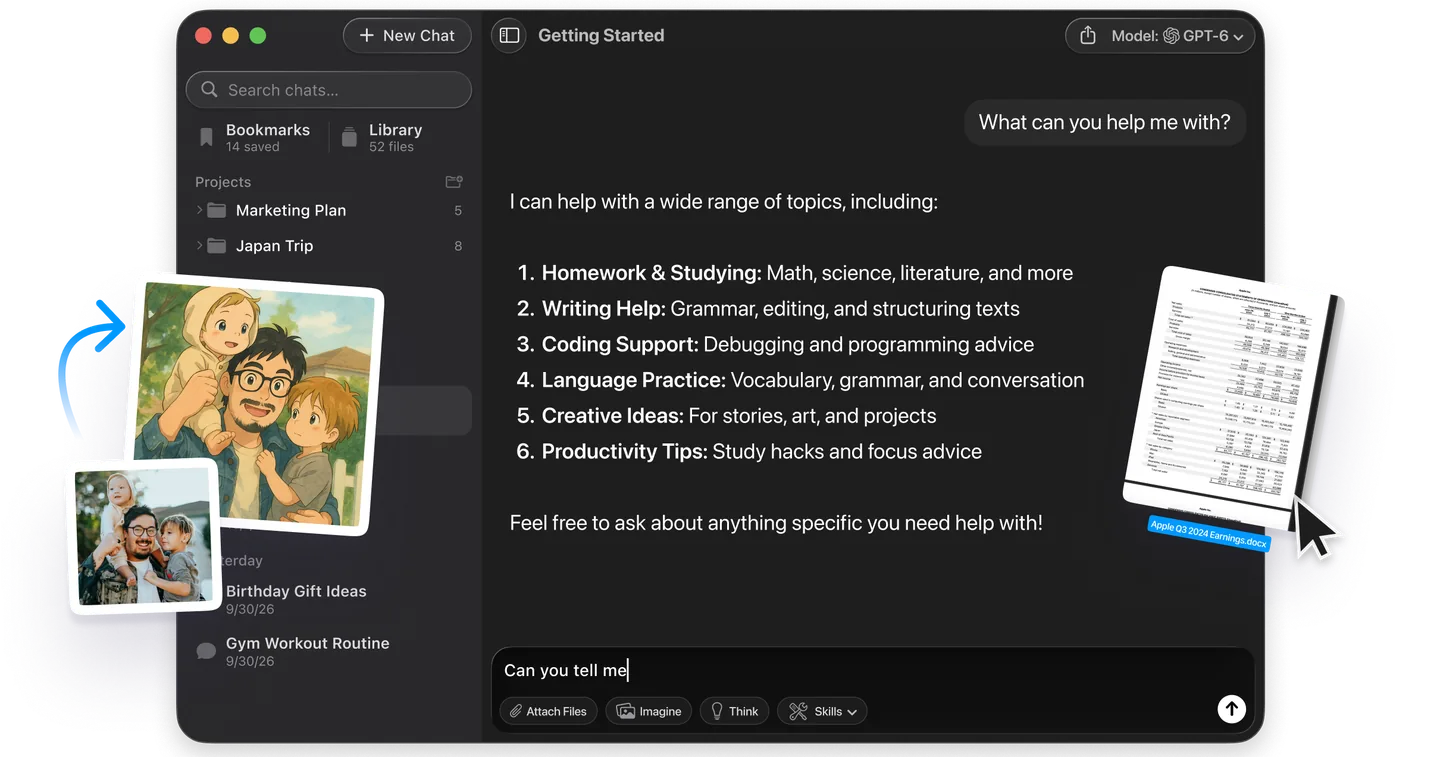
If you are outside the U.S. or teaching at a university, the free K-12 plan will not reach you, and paying full price for several AI tools adds up fast. Fello AI is one way to keep costs down: ChatGPT, Claude, Gemini, Grok, and DeepSeek together in a single Mac, iPhone, and iPad app for $9.99/month, so you can build lesson plans, rubrics, and feedback across models without separate subscriptions for each one. It will not replace an institutional Edu license, but for educators with no free path it is a low-cost way to use the major models; you can try Fello AI on the App Store. If you would rather run the official app on your Mac, our guide to the ChatGPT desktop client for Mac walks through the setup.
Conclusion
The ChatGPT for Teachers plan is a major upgrade for U.S. educators, offering education-grade tools and privacy at zero cost through June 2028. It lifts the free plan’s caps on files and images and adds a layer of safety that schools genuinely need for real classroom material.
More than a productivity tool, it is a low-risk environment to build AI into your workflow before pricing decisions arrive in 2028. Securing your account now gets you a private, school-ready workspace without dipping into your own pocket or your school’s budget.
Next step for U.S. teachers: if you have a U.S. K-12 school email address, go to chatgpt.com/k12-verification, get verified, and set up your free ChatGPT for Teachers workspace before your next planning session.
FAQ
Is ChatGPT really free for teachers, and until when?
Yes. The ChatGPT for Teachers plan is completely free for verified U.S. K-12 educators through June 2028. After that date, OpenAI may introduce pricing, but it has committed to giving schools advance notice.
Who exactly qualifies for the ChatGPT for Teachers free plan?
You must be an employee of an accredited K-12 school or district in the United States. That includes teachers, support staff, school leaders, and district administrators. It is not currently open to students or university staff.
Is ChatGPT for Teachers FERPA compliant?
OpenAI states the workspace is designed to help schools meet FERPA requirements, with education-grade security and compliance programs. You must still follow your specific district policies on data handling.
Does ChatGPT for Teachers replace ChatGPT Edu?
No. ChatGPT for Teachers is specifically for K-12 educators. ChatGPT Edu is an enterprise-style offering typically used by universities and larger institutions for campus-wide deployments.
Does ChatGPT for Teachers use my classroom data to train AI models?
No, not by default. Unlike the standard consumer free plan, the ChatGPT for Teachers workspace is FERPA-aligned, and OpenAI states data in these workspaces is not used to train its models.
How do I sign up and get verified as a teacher?
Visit the OpenAI K-12 verification page and enter your school email address. The system uses SheerID to verify your employment status. Once verified, you can create or join your district’s workspace.
Can I use ChatGPT for Teachers for grading and IEPs?
Yes. The stronger privacy protections make it much safer for sensitive tasks like drafting IEP goals or giving feedback on student work. You should still anonymize student data, for example by removing names, to stay compliant with local district policies.