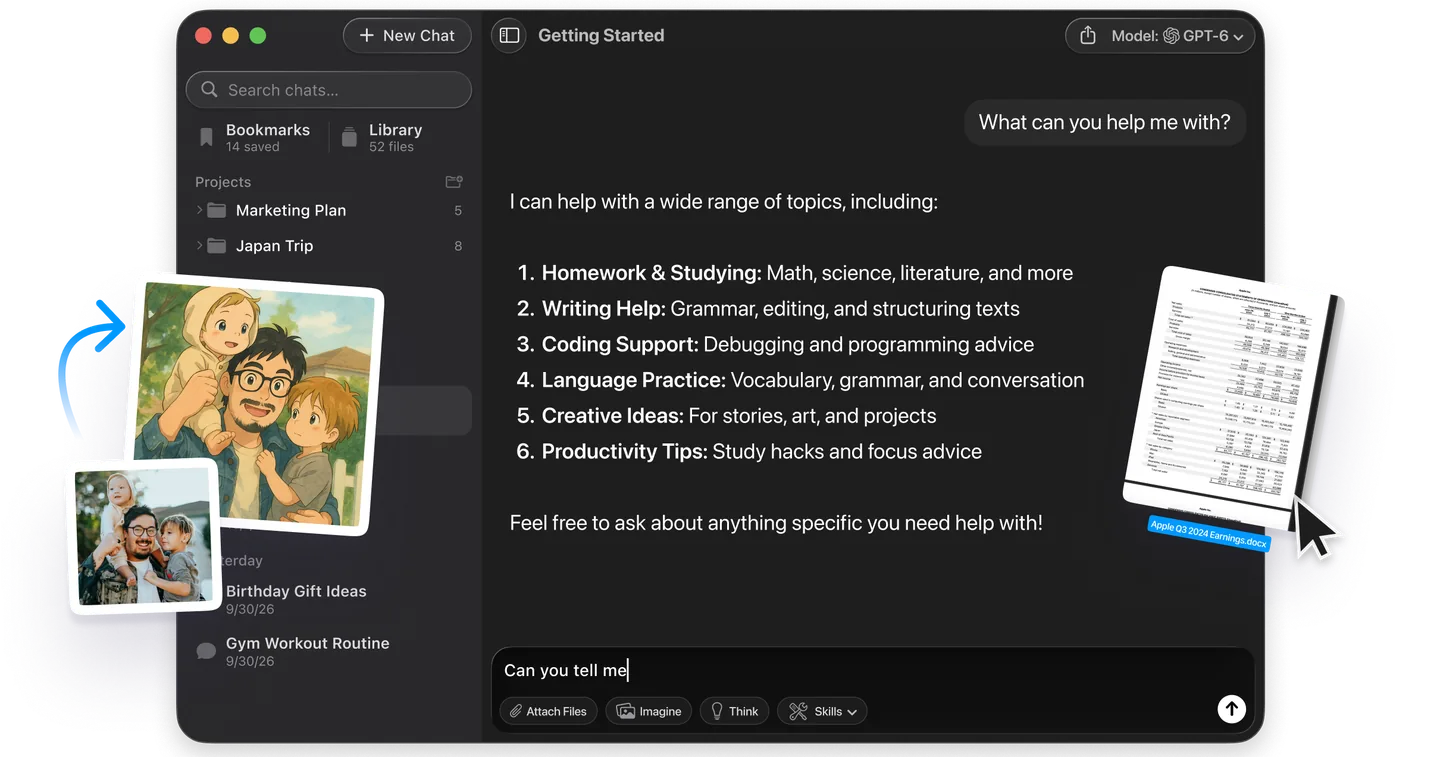
Stop guessing what to type. These 20 proven prompts will save you hours on homework, essays, notes, and studying.
ChatGPT has quickly become one of the most widely used study tools among students. According to a 2023 survey by Intelligent.com, 85% of students said using AI like ChatGPT helped them study more effectively, and 95% reported improved academic performance.
But here’s the secret: the results depend entirely on the prompt you use. Type the wrong thing and you’ll get vague, generic answers. Ask the right way and ChatGPT can become your personal tutor, writing assistant, and study buddy all in one. We walk through the built-in version of this in ChatGPT Study Mode. For the wider toolkit beyond prompts, see our guide to the best AI study tools for students.
This guide brings together the 20 most effective prompts every student should know, covering writing, exam prep, note review, and homework help. Whether you’re in high school or university, these copy-paste examples will give you back hours of time, lower your stress, and help you hit those top grades.
1. Prompts For Writing Essays
Writing essays can be one of the most time-consuming and mentally draining parts of school. Staring at a blank page, not knowing how to start, or feeling like your ideas sound too basic is a struggle most students know well.
ChatGPT can help with every stage of the writing process—from brainstorming and outlining to editing your final draft. But here’s the key: the quality of the answer depends entirely on the quality of the prompt you give it.
If your prompt is too vague (like “write an essay about climate change”), you’ll likely get something that sounds generic, overly formal, and a bit robotic, as that’s the default way AI writes. It tends to mirror textbook-style explanations unless you guide it with clear context, purpose, and tone.
The good news? With the right prompt, you can make ChatGPT write in a style that sounds natural, persuasive, and even creative. The prompts below are designed exactly for that—to help you sound like you, just with a little AI boost when you need it most.
Thesis Building:
“Help me create a strong thesis statement for an essay on [topic]. It should take a clear stance and hint at my main arguments.”
Structure Guide:
“Give me a clear essay outline for a 5-paragraph argumentative essay on [topic]. Include what each paragraph should cover.”
Evidence Suggestions:
“What are 3 strong pieces of evidence or examples I can use to support an essay arguing that [your thesis]?”
Style Fixing:
“Rewrite this paragraph to sound more academic and formal: [paste text].”
Conclusion Help:
“Write a conclusion paragraph that restates my thesis and summarizes the key points from this essay: [paste outline or essay].”
2. AI Summary and Reviewing Notes
Long readings, messy lecture notes, or dozens of scattered PDFs? No worries. These prompts help you compress, clarify, and organize all that chaos into clean, study-ready formats.
ChatGPT can turn a 10-page article into a crisp bullet-point list, extract key definitions from your notes, or even highlight what’s most important for a specific exam topic. You can ask it to summarize by relevance, not just length, or create comparison tables, timelines, or glossaries from raw content.
Instead of spending hours sorting through files, you can instantly reshape information into something you’ll actually use. Less noise, more clarity—and way less time wasted before you even start studying.
Lecture Summarizer:
“Summarize this lecture into a bullet-point list of main takeaways: [paste lecture notes or transcript].”
PDF Breakdown:
“Summarize the most important points from this PDF article. [Upload or paste content]”
Topic Comparison:
“Compare and contrast [Topic A] and [Topic B] in a table format.”
Review Sheet Maker:
“Create a study guide from these notes. Focus on key facts, formulas, and definitions: [paste notes].”
Condensed Summary:
“Turn this 3-page document into a 200-word summary that includes all the essential information: [paste document].”
3. Studying for Exams With AI
Exam prep isn’t just about rereading notes—it’s about actively engaging with the material. Studies show that active recall (the process of testing yourself) boosts memory far more than just reviewing. For the longer game, before cramming starts, six prompts that turn ChatGPT into a tutor, coach and course planner cover the weeks leading up to the exam.
These prompts help you do exactly that: simulate quick quizzes, spot weak spots, and turn notes into knowledge. You can ask ChatGPT to test you one question at a time, rephrase difficult topics, or even explain things back in simpler words, just like a personal tutor.
Whether you’re prepping for finals, reviewing a tricky chapter, or trying to memorize formulas, using AI this way helps you study smarter, not longer—and it actually sticks.
Mock Exam Creation:
“Create a short-answer practice test (10 questions) for [subject/topic] based on this material: [paste notes or textbook excerpt].”
Flashcard Generator:
“Make flashcards (term + definition) from this list of key terms in [subject]: [paste list].”
Concept Clarity:
“Explain the concept of [topic] in simple terms, as if you were teaching it to someone new to the subject.”
Quiz Me:
“Quiz me on this content: [paste topic or study guide]. Ask one question at a time and wait for my answer before continuing.”
Weak Spot Review:
“I struggle with understanding [concept]. Can you explain it with real-life examples and analogies?”
4. AI Homework Helper
Homework doesn’t have to take hours—especially when you use AI the right way. These prompts are designed not just to give you answers, but to guide you through the process step by step, helping you understand the why, not just the what. One warning before you start: math is the subject where models diverge most, so check which one we found best at AI for solving math problems before you trust a worked answer.
You can ask ChatGPT to explain confusing instructions, break down multi-part problems, or rephrase tasks in simpler terms when you’re not sure what’s even being asked. It’s like having a patient study-buddy on standby, ready to walk you through tricky questions without judgment. If you would rather learn one prompt properly than keep twenty to hand, start with the ChatGPT homework prompt that actually works.
Step-by-Step Math Help:
“Solve this math problem step-by-step and explain each part: [insert problem].”
Historical Context:
“What caused [event] and what were its effects on [region or group]? Explain in simple terms.”
Code Debugging:
“This Python code isn’t working. Can you help me fix the error and explain what went wrong? [paste code]”
Grammar Fixes:
“Check this paragraph for grammar and punctuation errors, and explain why you made each change: [insert text].”
Reading Comprehension:
“Ask me 5 comprehension questions based on this reading passage: [insert passage].”
5. How to Create Your Own Effective Prompts
Once you understand how ChatGPT thinks, you can create your own powerful prompts for nearly any school task. Custom prompts are especially helpful when you need something very specific—like writing in a certain tone, focusing on only one part of a topic, or targeting a particular audience.
To get the best results, you need to treat prompt-writing as a skill in itself. The more clearly you describe your intent, the more helpful and relevant the AI’s answer will be. Here’s a refined formula that includes the most effective prompting strategies:
1. Be Specific – Don’t say “explain photosynthesis”; say “explain photosynthesis in 150 words to a 14-year-old who struggles with science.”
2. Add Context – Paste in your notes, assignment instructions, or background info. The more the AI knows, the better it can tailor the answer.
3. Set a Role – Frame the AI’s persona. For example: “You are a college writing tutor,” or “Act like a high school history teacher.”
4. Break it into Steps – If the task is complex, ask for the response in parts. For example: “First, list 3 key points. Then, write an intro paragraph.”
5. Choose a Format & Tone – Do you want a table, list, summary, or essay-style text? Should it sound academic, casual, persuasive, or playful?
6. Add Constraints – Set boundaries like word count, level of difficulty, or what to include/exclude.
7. Ask for Self-Check – You can even say: “List 3 possible weaknesses in your response and improve them.”
Example prompt:
“You’re a biology teacher. Summarize this 6-page article into a 250-word bullet list for a high school student. Define any difficult terms, include one real-life analogy per point, and end with 3 quiz questions. [paste article]”
Using this kind of structured prompt doesn’t just get you better answers—it teaches you how to think clearly, define goals, and improve your own communication skills. That’s why mastering prompt design is one of the smartest study hacks you can learn.
Conclusion
Whether you’re racing against a deadline or trying to actually understand what’s going on in class, ChatGPT can be your secret academic weapon—if you use it right.
These 20 prompts are just the beginning. Understand them, adapt them, and build your own. You’ll save time, reduce stress, and maybe even enjoy studying again.
But beyond speed and convenience, what AI really gives you is clarity. Instead of sitting in front of a blank page or re-reading the same sentence five times without getting it, you can turn confusion into direction. You get immediate feedback, personalized explanations, and fresh ways to approach even the hardest material.
Plus, learning how to prompt properly teaches you how to think critically and ask better questions—a skill that’s valuable far beyond school.
So don’t just use these prompts—learn from them. Notice how they’re structured. See how specific instructions lead to better results. Start tweaking them to suit your subject, your goals, and your workflow.
And if you ever feel stuck, just ask ChatGPT: “How would a top student use you to study for this?” – The answer might just surprise you with something new.