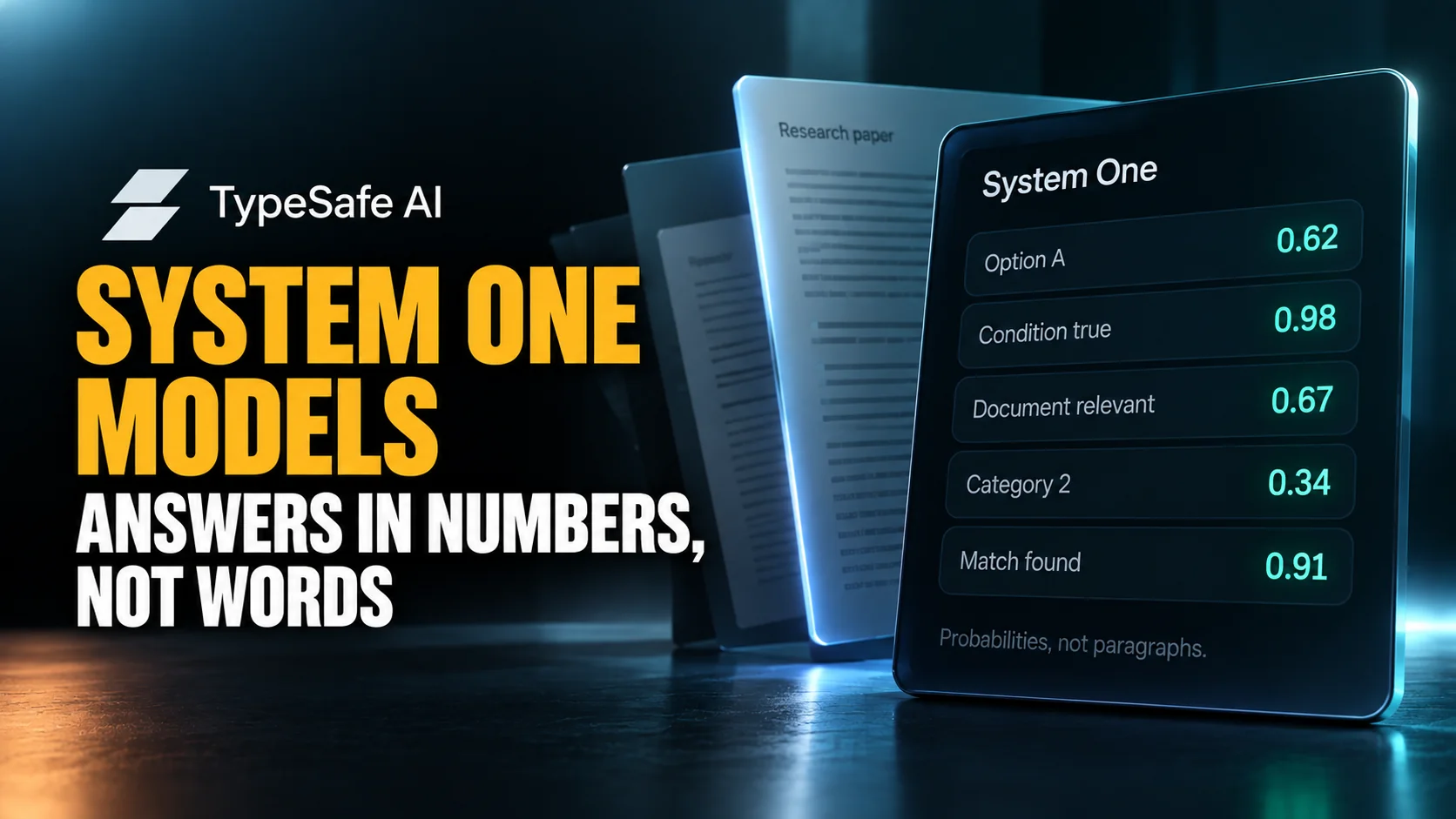
On 15 September 2026 a lab that nobody had heard of a week earlier announced a model that does not write. No sentences, no paragraphs, no code. You hand it a block of text and a list of questions, and it hands back numbers: this option, 0.62, that condition true at 0.98, this document a 2 out of 3. The company, TypeSafe AI, calls these System One models, and it emerged from two years of stealth with $40 million and a homepage claiming its model is 193.6 times faster and 444.6 times cheaper than the alternatives.
Those numbers travelled further than the caveats did. Within four days the internet filled up with explainers repeating the headline and TypeSafe's line that Jev "can't hallucinate". Almost none of them mentioned the five separate boxes in which TypeSafe undercuts its own figures, or the line in its own documentation saying plainly that a confident answer is not a correct one. This piece covers what a System One model actually is, where those numbers come from, and what two people with early access found when they ran the thing themselves.
The Key Takeaways
- It answers, it does not write: a System One model takes your text plus a fixed set of questions and returns a typed answer to each one, every answer carrying a probability. There is no sentence to parse.
- The price is real and it is tiny: $0.042 per million input tokens, with output tokens free, confirmed in TypeSafe's own model documentation.
- "Can't hallucinate" means something narrower than it sounds: Jev cannot return an answer outside the shape you defined. It can still pick the wrong one, and TypeSafe's docs say so.
- The company published four different speed claims in its first three days, ranging from "up to 100 times faster" to 193.6x, and its own footnote calls the big numbers "the higher end of real world gains".
- Two independent testers found roughly 6x to 8x, not 200x, against a cheap model with reasoning switched off. What held up perfectly was the confidence score.
What Is a System One Model?
A System One model is a class of AI that returns typed decisions instead of text. You give it a state, which is just the material it should look at, plus a set of questions defined in advance. It evaluates every question against that state at the same time and returns one answer per question, each with a probability attached. Nothing is generated, so nothing has to be parsed, and the answer cannot arrive in a shape your code was not expecting.
That is the whole idea, and it is deliberately narrow. TypeSafe's documentation is blunt about the trade: System One models "do not write replies, produce code, or generate explanations of their reasoning". Jev, the first one, currently accepts text only, with no image, audio or video input, and works within a 64k token budget per request.
The three kinds of question it can answer
Everything you can ask a System One model collapses into three primitives, which TypeSafe documents as Choice, Score and Noul. A Choice picks one option from a list you supply and returns a probability for every option. A Score places the state on an ordered scale you describe in plain words, such as 0 for calm and 2 for very frustrated. A Noul answers a single yes-or-no condition and returns the probability of yes.
Put together, those three cover a surprising amount of the work software actually needs from AI: routing a support ticket, scoring how urgent something is, deciding whether a document mentions a particular topic. They cover none of the work people use chatbots for. This is the boundary between an assistant and a component, and it is roughly the same boundary described in our guide to where agentic AI ends and ordinary automation begins.
Where the name comes from
Both names are borrowed. "System One" comes from Daniel Kahneman's Thinking, Fast and Slow, where System 1 is fast, intuitive judgment and System 2 is slow deliberation. TypeSafe acknowledges the awkward part in its own FAQ, that System 1 thinking has historically also implied error-prone, and argues its version will prove more reliable than the alternative.
The model is named after William Stanley Jevons, the economist behind the observation that making a resource cheaper usually increases total consumption rather than reducing it. TypeSafe's stated bet is that every order of magnitude drop in the cost of intelligence unlocks orders of magnitude more uses for it.
How System One Models Differ From an LLM
The clearest way to see the difference is side by side. Every figure in the right-hand column is TypeSafe's own, taken from its launch post and its model documentation.
| Dimension | Ordinary LLM | System One model (Jev) |
|---|---|---|
| What it returns | Text: a chat reply, code, a refusal, or a structured value you still have to validate | A typed answer per question, from a set of possible answers fixed in advance |
| How it produces it | One token at a time, each conditioned on the last | All answers in a single parallel pass |
| Input price | $0.20 to $10 per million tokens | $0.042 per million tokens |
| Output price | Around 5x the input price | Free |
| Response time | 3 to 329 seconds for frontier models | 70ms to 500ms |
| When it is unsure | Usually answers anyway, in the same confident register | Returns a probability distribution, so uncertainty is visible |
| Can it break your schema | Yes, and you have to handle that | No, the answer space is defined before the call |
| What it is for | People. Chat, drafting, coding, anything open-ended | Software. Classifying, routing, scoring, extracting |
Note what is not in that table: quality. Speed, price and shape are all easy to state. Whether the answer is right is the hard part, and it is where the rest of this article goes.
Who Built Jev and What They Raised
TypeSafe AI was founded in 2024 and is based in San Francisco. Its chief executive is Diogo Almeida, who according to SiliconANGLE's report on the launch previously worked on reinforcement learning from human feedback, InstructGPT, ChatGPT and GPT-4 at OpenAI. Forbes reports he spent four years there improving ChatGPT's responses before leaving in 2024. His co-founders are Erik Gafni and Sasha Sheng.
The company came out of stealth with roughly $40 million in seed funding led by DCVC. Forbes put the valuation at $200 million, citing a person familiar with the deal, which is worth flagging as a single-sourced figure rather than one the company confirmed. Almeida's pitch to Forbes was about honesty rather than horsepower: current models are overconfident, every answer is presented as though it were certain, and, in his words, "we've been optimizing for humans and we're super human at pleasing humans".
TypeSafe marked the moment on its own account the same evening, quote-posting Almeida's launch thread to its followers.
we are officially out of stealth! join the frontier and get access to Jev on our website (link on profile)
— TypeSafe AI (@typesafeai) September 15, 2026
The launch landed hard. The announcement had reached 1,900 points and 497 comments on Hacker News by 19 September, and developers were publishing full tutorials within 48 hours.
Full Jev Tutorial
— Moritz Kremb (@moritzkremb) September 17, 2026
What it is, how you can build with it and what new applications it can unlock
→ 0:00 Intro
→ 0:34 Jev explained
→ 4:06 API setup
→ 5:59 Demo 1: Voice-controlled browser
→ 11:33 Demo 2: AI memory
→ 17:27 Demo 3: YouTube predictor
The "Can't Hallucinate" Claim, Read Carefully
This is the claim doing most of the work in the coverage, and it is the one most worth slowing down on, because it is simultaneously true and much smaller than it sounds.
What type safety actually guarantees
Because the possible answers are fixed before the call, the model has nothing to invent. It cannot return a category you did not define, a malformed object, or a tool call to something that does not exist. TypeSafe is careful about the status of this claim, noting that the zero it plots for its own type-error rate "is not empirical" because schema matching is guaranteed by construction. That is an honest way to present it. It is a property of the design, not a test result.
What it does not guarantee
It does not guarantee the answer is right. TypeSafe's own documentation states the limit directly: calibration "is measured across groups of predictions; it does not guarantee that an individual answer is correct". SiliconANGLE made the same point in its launch coverage, that Jev's constrained output does not guarantee correct decisions.
One of the independent testers below put it more bluntly, writing that "it can't hallucinate" is marketing, because the model cannot return the wrong shape of answer but can still return the wrong answer with full confidence.
So the useful translation is this. A chatbot can fail in two ways, by saying something untrue and by saying it in a format your program cannot use. A System One model removes the second failure completely and leaves the first one intact. That is a genuine engineering win, and it is not the same as an AI that stops being wrong. If you want the broader picture of how often models behave in ways their makers did not intend, we covered that separately in what the misalignment research actually found.
Where the Headline Numbers Come From
The speed and cost claims are the reason this launch travelled, so it is worth knowing exactly what sits underneath them.
Four different sets of numbers in three days
TypeSafe published four versions of its own headline claim. The press release said the model delivers results in "less than 100 milliseconds" and is "up to 100 times faster and less expensive". The launch blog post said 40x to 200x faster, with end-to-end times of 70ms to 500ms. The homepage said 193.6x faster and 444.6x cheaper. And the founder's own launch post said something different again.
After co-inventing ChatGPT, I kept asking myself: why have superhuman chat models not led to AGI?
— Diogo Almeida (@CompleteSkeptic) September 15, 2026
I’ve spent the last 2 years in stealth building a new way to train models (RLCD), and a new type of frontier AI model that we are releasing today: Jev
• 20-200x faster
• 40-400x cheaper (w/ output tokens free)
• Frontier composable intelligence optimized for decisions
AFAICT the shortest path to AI-based economic revolution
None of those are lies. They are different workloads measured different ways and against different rivals: the side-by-side demo runs against GPT-5.6 Terra, the workflow evals against GPT-6 Astra and Fable 5.1, and the homepage cost comparison against GPT-5.6 Luna and Claude Haiku 4.5. That is precisely the problem with a single multiplier as a headline. To TypeSafe's credit, its own footnote says the 193.6x and 444.6x figures "are on the higher end of real world gains".
The benchmark that scores against two other models
TypeSafe declines to publish public benchmark scores at all, and says so as a matter of policy: "Put no weight on public benchmarks." Instead it built its own workflow evaluation. The critical detail, which the company states openly and most coverage dropped, is how the right answer was decided. There was no ground truth. The reference answer is the average of two other models, GPT-6 Astra and Fable 5.1, and TypeSafe notes this "biases answers towards OpenAI and Anthropic's models".
That makes the result a measure of agreement with two frontier models, not of correctness. It is a defensible way to evaluate a workflow and a poor way to claim accuracy, and it is exactly the kind of distinction we unpack in our guide to what AI benchmark scores actually measure. The pricing side is cleaner: at $0.042 per million input tokens with free output, the arithmetic is checkable, and if per-token pricing is unfamiliar territory, here is what a token is and why everything is billed in them.
What Independent Testers Actually Found
Jev is waitlisted early access, so independent numbers are scarce. Two people with keys published tests three days after launch, and both are more useful than the launch post.
Twenty-four Norwegian documents for half a cent
The first test ran Jev over 24 responses to a Norwegian government hearing on salmon farming tax, asking eleven questions of each, and compared it with DeepSeek V4.1 Flash with reasoning on and off. The full write-up is an early-access test of TypeSafe's Jev, and the author states plainly that TypeSafe had not seen the post or its numbers.
The cost and speed gaps were real but nothing like the headline. Jev read all 24 documents for $0.22 per thousand against $1.31 for DeepSeek with reasoning off and $3.08 with it on, and its median response was 0.32 seconds against 2.7 seconds and 26 seconds. That is roughly six times cheaper and eight times faster than a cheap model without reasoning, not four hundred times. On accuracy nothing separated them. Jev scored 20 of 24, DeepSeek 20 with reasoning off and 22 with it on, against a margin of error the author puts at roughly 15 points either way on a sample of 24. The one clear win was the ordered scale question, where Jev scored 19 of 24 against 14.
The thing that did hold up completely was the confidence number. When Jev reported a probability between 0.7 and 0.9, the reference agreed 97 percent of the time; above 0.9, 98 percent. The practical shape that suggests is to accept the confident answers automatically and route the rest to something slower or to a person. One caveat the author flags himself, and it matters: the reference labels were written by a frontier model, so the test measures agreement rather than truth, the same limitation as TypeSafe's own eval.
A pre-registered test where Claude won on accuracy
The second test was pre-registered, which means the method was fixed before the results were known, after the author threw away an earlier run whose method did not hold up. On two real jobs it found that Claude Opus 5 was statistically inseparable from Jev, and that Claude Haiku 4.5 beat Jev outright on raw accuracy.
The interesting result was what happened next. Then every model was allowed to skip the answers it was least sure about. Jev pulled ahead on both jobs, including the one it had lost, because its confidence number carried real signal where a chatbot's self-reported confidence mostly does not. That is the actual product. Not a smarter model, a model that tells you which of its answers to doubt, which is a different and more automatable thing. It is also the mirror image of the problem we described in why AI gives you a different answer every time.
Where System One Models Fall Down, in TypeSafe's Own Words
One unusual thing about this launch is a documentation page titled "Jev 1.13 jaggedness", which lists nine ways the company's own model falls down. It reads literally and answers the question you wrote rather than the one you meant. It is bad at arithmetic and at comparing dates, so TypeSafe tells you to keep both in code. It struggles when a question requires several hops of indirection, when the state is large and full of irrelevant detail, and when instructions and criteria contradict each other. And it does not generate, so if you need text you need a different model.
The independent Norwegian test ran straight into one of these. Rewriting the questions more carefully, with extra qualifying clauses, made the results worse rather than better, pushing probabilities toward the middle and roughly tripling the calibration error. The advice that follows is to write questions the way you would ask a colleague across a desk and keep the fine print in your own code.
Does This Matter If You Just Use AI Apps?
Directly, no. There is no Jev app, no chat window, and no consumer plan. You cannot install this, and if you want an AI that writes an email or explains a contract, a System One model is the wrong tool by design.
Indirectly it matters quite a lot, because the argument behind it is about a problem you have already met. Every time a chatbot gives you a confident, fluent, wrong answer, you are meeting the thing TypeSafe is reacting against: models trained to produce responses people like rather than responses that are reliable. Nothing about a typed decision model fixes that for the chat window. The practical consumer move is still the boring one, which is asking more than one model when the answer matters, and a multi-model Mac app like Fello AI is built to make that cheap. Where this may reach you is underneath the apps you already use, in the routing and triage and scoring that currently costs a support tool a few seconds and a few cents per ticket.
The Verdict
Strip out the multipliers and something solid remains. A model that returns typed answers with probabilities that mean what they say is a real piece of engineering. The two independent tests agree on the part that matters: the confidence number holds up, which is the one thing a chatbot's self-reported certainty never has. On price, $0.042 per million tokens with free output is checkable arithmetic, and cheap.
The multipliers themselves should be treated as marketing until someone outside the company reproduces them, and the company's own footnotes half say so. "Cannot hallucinate" means cannot break your schema, and nothing more. The honest summary is that TypeSafe has not built an AI that stops being wrong. It has built one that knows when it might be, and tells you in a number your code can act on. Whether that is worth a new category name is a question the next six months will answer better than the launch post did.
Frequently Asked Questions
Is a System One model just a small LLM?
TypeSafe says no on both counts, answering in its launch FAQ that Jev "is neither small nor an LLM". It uses a different architecture, a parallel sampler rather than token-by-token generation, and a training method the company calls Reinforcement Learning for Calibrated Decisions. TypeSafe has not published a paper on that method, so the claim currently rests on the company's description of its own work.
Can I use Jev instead of ChatGPT?
No. Jev does not generate text at all, so it cannot answer a question in prose, write anything, or hold a conversation. It also accepts text input only, with no images, audio or video. It is a component for software, available through a developer waitlist rather than an app.
Does Jev really never hallucinate?
It cannot return an answer outside the options defined before the call, so it cannot invent a category or produce a malformed result. It can still choose the wrong option. TypeSafe's own documentation states that calibration is measured across groups of predictions and "does not guarantee that an individual answer is correct".
How much does Jev cost?
TypeSafe's model documentation lists $42 per billion input tokens, which is $0.042 per million, with output tokens free. That is early-access pricing for version jev-1.13.0 as of September 2026, and the company says it expects prices to fall rather than rise.
Why won't TypeSafe publish benchmark scores?
It says the decision is deliberate, urging developers to "put no weight on public benchmarks" and to build evaluations for their own use cases instead. The trade-off is that its performance claims rest on an internal evaluation whose reference answers come from averaging two other models, which measures agreement rather than correctness.