Yes, AI companies are destroying books, and the paperwork is public. Internal documents unsealed in January 2026 as part of a copyright lawsuit show that Anthropic bought millions of used print books, sliced the spines off, ran the loose pages through high-speed scanners and threw the originals away. The programme had a codename, Project Panama, and a one-line mission statement: “Project Panama is our effort to destructively scan all the books in the world.” In August 2026 a second company was caught doing the same thing. Days later, 18 advocacy groups asked the Federal Trade Commission to open an investigation.
The version of this story going around social media adds something the evidence does not support: that AI companies are hunting rare books in order to take them out of circulation. That part is not established, and the advocacy groups pushing hardest on the issue say so themselves in their own complaint. This article separates the documented facts from the allegations, explains why an AI lab wants a 1998 engineering textbook badly enough to shred it, and covers the part almost nobody mentions: destroying the book is precisely what made the practice legal.
The Key Takeaways
- It is real and documented: Anthropic ran Project Panama from early 2024, buying millions of used print books to destructively scan them. The internal memo said “we don’t want it to be known that we are working on this.”
- It is not just one company: in August 2026, 404 Media hid an AirTag in a shipment of about 1,000 books and followed it to an Amazon warehouse in North Las Vegas where spines are cut off and pages scanned.
- The motive is data quality, not censorship: print published before 2022 is uncontaminated by AI-generated text, which makes it valuable protection against model collapse.
- Destruction is what made it lawful: in June 2025 a federal judge held that scanning a legally bought book was fair use specifically because “the print original was destroyed. One replaced the other.”
- The rare-book claim is unproven: Snopes rates the viral version “Mostly True” with undetermined elements, and the FTC complaint filed on 21 August 2026 admits the public record cannot show how often a destroyed book was a last surviving copy.
What Project Panama Actually Was
Anthropic, the company behind Claude, started buying print books in bulk in early 2024. The effort was run by Tom Turvey, who had previously spent years at Google building the partnerships behind Google Books, and it was deliberately kept quiet.
The memo that gave it away
A planning document dated 13 April 2024 spelled out both the ambition and the secrecy. “Project Panama is our effort to destructively scan all the books in the world,” it read. On the choice of a codename it was blunter still: “We use a ‘soft codename’ for it because we don’t want it to be known that we are working on this. This document is visible to all Anthropic employees, but you should avoid talking about it in public areas, and the fact that we are working on this should not be shared with anyone outside Anthropic.”
Those documents were unsealed in January 2026 in Bartz v. Anthropic, a class action brought by the novelist Andrea Bartz and the nonfiction writers Charles Graeber and Kirk Wallace Johnson. The Washington Post published the first detailed account on 27 January 2026. Anthropic bought bulk lots from second-hand dealers including Better World Books, World of Books and Wonder Book, and one vendor proposal described the capacity to convert up to two million books in six months. By an internal memo in October 2024, the company had already bought millions of them. The exact figure is redacted, so nobody outside Anthropic can put a real number on it.
How a book gets destructively scanned
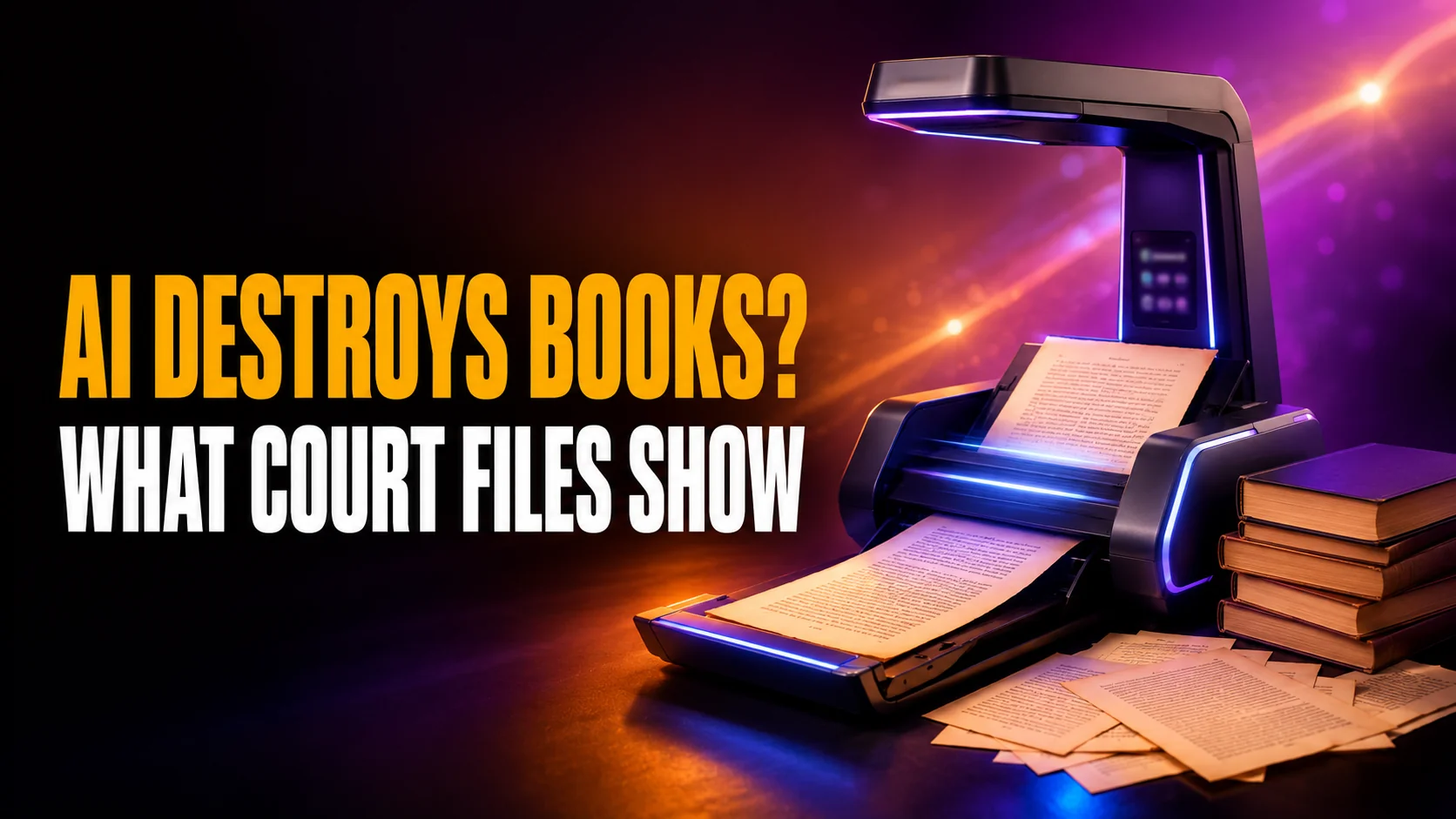
Destructive scanning is a boring industrial process with an ugly name. A hydraulic cutter takes the spine off the book, which turns a bound object into a stack of loose sheets. Those sheets go through a high-speed sheet-fed scanner in a single pass, the way an office scans a contract. The paper is then pulped or recycled.
The alternative, photographing a bound book page by page on a cradle, is what libraries and archives use when the object matters. It is slower and it costs considerably more per volume. At the scale of millions of books, that gap is the whole argument. Storage costs money too, which is why the physical copy does not survive the process.
Amazon Is Doing It Too
For most of 2026 this looked like an Anthropic story. That changed on 17 August 2026, when 404 Media traced the same practice to Amazon. The method was worth appreciating. A bookseller agreed to hide an Apple AirTag inside a shipment of roughly 1,000 books, and the reporters watched where it went. The signal stopped at Amazon’s LAS8 warehouse in North Las Vegas, at the end of the building housing a unit designated VGT3, where workers cut the bindings off incoming shipments of printed books to speed the pages through the scanners.
Amazon did not deny it. The company told 404 Media that it “purchases books through commercial channels to help develop and improve the products and services our customers use.” There is a certain irony in the company that began life as an online bookstore now running a book-shredding line, and the coverage did not let it pass unremarked.
That second confirmation matters more than it might seem. One company doing this is a scandal about one company. Two independently confirmed cases, using different sourcing routes, suggests an industry practice with a supply chain behind it. Anthropic sits at the centre of several other 2026 controversies. They run from Claude Code being used to run an autonomous hacking campaign to the protests covered in our piece on the activists who went on hunger strike outside Anthropic and DeepMind.
The AI Companies Destroying Books: Who Is Documented Doing What
| Company | What is documented | How it came out | Date |
|---|---|---|---|
| Anthropic | Bought millions of used print books, removed spines, scanned and discarded them under Project Panama | Internal documents unsealed in Bartz v. Anthropic | Jan 2026 |
| Amazon | Cuts bindings and scans books at a North Las Vegas facility for AI training | 404 Media tracking-device investigation | Aug 2026 |
| ISBNdb | Advertised sourcing 1,000 to 1,000,000 printed books for AI datasets, then removed the page and said no such service ever launched | 404 Media, then the company’s own statement | Jul 2026 |
| 2077AI | Named by a Dutch bookseller as the sender of a 3,001-title bulk request shipping to China. Unconfirmed, the company did not respond to Fortune | Fortune | Jul 2026 |
| Unidentified buyers | Bulk orders for thousands of obscure titles placed with shops in Ireland, the Netherlands, Germany, Sweden and Switzerland | Bookseller accounts to RTÉ, the Irish Times and Fortune | May to Aug 2026 |
Why AI Companies Want Old Printed Books
The obvious question is why a company with the entire internet already scraped would go to the trouble and expense of buying physical books at all. There are two answers, and neither of them is about keeping anyone from reading.
Old print is the last clean text
Since late 2022, a growing share of everything published online has been written or rewritten by AI. Training a new model on that output creates a feedback loop researchers call model collapse, where each generation learns from the last one’s mistakes and quality degrades. A book printed in 1998 cannot contain AI-generated text. That makes pre-2022 print a chemically clean sample of human writing, and there is a finite supply of it.
Books are also unusually good material regardless of their age. They are edited, fact-checked, structured and dense in a way a forum thread is not. Textbooks, professional manuals and academic monographs carry exactly the sort of specialist knowledge that never made it onto the open web. If you want to understand what these models are built from, our explainer on how Claude works and where its training data comes from covers the wider picture. Our comparison of the leading AI models shows how closely matched the frontier labs now are, which is exactly why data supply has become the competitive edge.
Buying is safer than pirating
The second reason is legal, and Anthropic learned it the hard way. Buying a physical copy gives you clear ownership of that object. Downloading a pirated scan does not. As the next section shows, that distinction turned out to be worth more than a billion dollars.
Why Destroying the Book Was the Legal Move
Here is the part that inverts most people’s intuition. Anthropic did not get away with destroying the books despite the destruction. It won that half of the case because of it.
On 23 June 2025, US District Judge William Alsup ruled on fair use in Bartz v. Anthropic. Scanning legally purchased print books to build an internal library was fair use, he held, and the reasoning turned on the fact that only one copy ever existed at a time. “Every purchased print copy was copied in order to save storage space and to enable searchability as a digital copy,” the order reads. “The print original was destroyed. One replaced the other.” No extra copy entered the world. Had Anthropic kept the printed book and the scan, it would have had two copies where it had paid for one, and the analysis would have looked very different.
The half Anthropic lost
The same ruling went the other way on everything Anthropic had downloaded rather than bought. Before Project Panama, the company had taken more than seven million pirated books from shadow libraries: roughly 200,000 from Books3, at least five million from Library Genesis and at least two million from the Pirate Library Mirror. Alsup found no fair use there, whatever the books were later used for.
That exposure produced the largest copyright settlement in the history of the technology industry. Anthropic agreed to pay $1.5 billion, covering 482,460 works at roughly $3,000 each. The court granted final approval on 20 July 2026, and according to the Authors Guild about 91% of eligible works had been claimed by the deadline. Seen in that light, Project Panama reads less like a data-gathering exercise and more like a very expensive lesson in buying what you use. If you would rather your own writing stayed out of the next dataset, our guide on how to stop AI companies training on your data covers the options that actually work.
The FTC Complaint: “Hoard and Destroy”
On 21 August 2026, 18 advocacy organisations including the Demand Progress Education Fund, the Consumer Federation of America and the Institute for Local Self-Reliance wrote to FTC Chair Andrew Ferguson and Commissioner Melissa Holyoak asking for an investigation. Their argument is not about copyright, which has largely been settled in the labs’ favour. It is about competition.
The letter frames book destruction as an unfair method of competition under Section 5 of the FTC Act. “Through their practice of permanently destroying books en masse and thus removing those non-renewable resources from broader access, AI companies are engineering a future where only the wealthiest incumbents can build high-quality AI models and operate as the sole holders of humanity’s written works, after having destroyed the originals to get there,” it argues. In other words, the concern is not that Anthropic read the book. It is that a shredded book cannot be bought by the next startup, or by a library, and the scan sits on a private server nobody else can query.
As The Register reported, neither Anthropic nor Amazon responded to requests for comment, and the FTC has not said whether it will open an inquiry. We track developments like this in our running list of AI safety incidents in 2026.
What Is Not Proven About AI Companies Destroying Books
The viral version of this story is stronger than the evidence, and it is worth being precise about where the line falls.
Snopes reviewed the unsealed Anthropic exhibits directly and rated the claim “Mostly True” with undetermined elements on 3 August 2026. What it could not confirm was whether other AI companies ran comparable programmes, and what “less common” actually meant in commercial terms. That phrase comes from an email Turvey sent a bulk dealer on 27 August 2024 saying “less common books are a great place to start,” which is suggestive but not the same as targeting collectibles.
Anthropic denies that reading. “None of our data acquisition programs buy and destroy ‘rare’ or ‘antiquarian’ books,” a spokesperson told Snopes, drawing a distinction between collectible volumes and merely hard-to-find professional or academic titles. That distinction is self-serving, but it is also plausible: a scanning pipeline optimised for cost wants cheap unwanted stock, not first editions.
The claim that destroyed books were sometimes the last surviving copies of a work is an allegation, not a finding. The FTC letter is refreshingly honest about this: “What the public record does not establish, and cannot, from the outside, is how often the destroyed physical books are the last or among the last surviving copies of a given work.” And no document in any of this shows an intent to suppress anything. The motives on record are cost, storage and data quality. A widely shared claim that librarians watched rare items disappear from their networks traces back only to AI-generated aggregator sites with no named source, which is its own small joke.
What Booksellers Are Seeing
The most concrete evidence that this continued past the court case comes from second-hand shops. In May 2026, Kenny’s Bookshop in Galway received an order for roughly 5,000 books. Tomás Kenny described the list to RTÉ as “scattergun, anything and everything,” heavy on outdated and poor-quality non-fiction, including old driving manuals and guides to a defunct Irish savings scheme. He had no proof of who was behind it, but the pattern was hard to read any other way.
In the Netherlands, the Haarlem bookseller Pieter de Vries received a spreadsheet listing 3,001 ISBNs, mostly academic titles published in 2020 and 2021 from Emerald, Elsevier, Wiley, Routledge and Oxford University Press, to be shipped to China. According to Fortune, the requester was a company called 2077AI, which did not respond to questions. De Vries assumed it was spam. Booksellers in Germany, Sweden and Switzerland have reported near-identical approaches.
Not everyone in the trade objects. One dealer told 404 Media that the buying cleared dead inventory, taking weekly sales from around 20 books to several hundred, while still worrying that uncommon titles were being pulped. Both things are true at once, which is why this is a harder story than the headlines suggest.
What It Means If You Own or Sell Books
For ordinary readers, nothing about your shelf changes. Nobody is coming for the paperback you already own, and mass-market titles exist in numbers that make any of this irrelevant to their survival.
If you sell used books, the practical advice from the trade is simple: treat an unusually large, oddly assorted bulk order as what it probably is, ask where the stock is going, and price accordingly. Some sellers are happy to clear dead inventory this way. Others have started refusing orders they believe end at a shredder. Either is a legitimate choice, and it is currently the only real check on the practice, because no law prevents someone destroying a book they own.
The wider point is about where knowledge ends up. Google Books and the Internet Archive also digitised at scale, but the results were at least partly accessible to the public. A Project Panama scan is a private corporate asset. The book stops existing, and the copy that replaces it belongs to one company. That, far more than the shredder itself, is the thing worth arguing about, and it is the argument the FTC has now been asked to settle.
The Verdict
The claim is true in its essentials and wrong in its motive. AI companies are buying used books in bulk, cutting them apart, scanning them and destroying what is left. Anthropic did it deliberately, at scale, and tried to keep it quiet. Amazon does it too. But they are doing it because clean pre-AI text is scarce and valuable, not to deny anyone access, and the destruction that reads as barbaric is the same feature a federal judge pointed to when he found the practice lawful.
What remains unresolved is whether irreplaceable titles are going through the cutter, and whether locking humanity’s back catalogue inside private datasets is a competition problem. Nobody outside these companies can answer the first question, which is exactly why the second one is now in front of the FTC. To see how the labs at the centre of this compare on everything else, start with our Anthropic versus OpenAI breakdown. And Fello AI’s Claude desktop client for macOS lets you use the model itself without a browser tab in sight.
Frequently Asked Questions
Are AI companies really destroying books?
Yes. Court documents unsealed in January 2026 show Anthropic bought millions of used print books, cut off the spines, scanned the pages and discarded the originals under a secret programme called Project Panama. In August 2026, 404 Media traced the same practice to an Amazon warehouse in North Las Vegas.
What is destructive scanning?
Destructive scanning means cutting the binding off a physical book so a high-speed sheet scanner takes the loose pages in one pass. It is much faster and cheaper than photographing a bound book page by page, and the paper is pulped or recycled afterwards.
Is it legal to buy a book and destroy it?
Yes. You own the physical object and may dispose of it as you like. In June 2025 Judge William Alsup went further and held that scanning a legally bought book for AI training was fair use precisely because the print original was destroyed, so one copy simply replaced another.
Are rare or last-surviving books being destroyed?
That is alleged but not proven. Anthropic says none of its programmes buy and destroy rare or antiquarian books. The advocacy groups who complained to the FTC concede that the public record cannot show how often a destroyed copy was among the last of its kind.
Why do AI companies want printed books at all?
Because print published before 2022 contains no AI-generated text, which protects models against the quality decay known as model collapse. Books are also edited, dense and full of specialist knowledge that never reached the open web, and buying them avoids the piracy liability that cost Anthropic $1.5 billion.