Only 5% of American travelers can tell a real destination photo from an AI-generated one. That figure comes from a Talker Research survey of 2,000 US adults, conducted on June 2 and 3, 2026 for the Tennessee Department of Tourist Development. The gap it exposes is the interesting part, because a full 52% of those same people had said they were confident they could spot AI imagery. The AI travel photo prompts below are why that confidence is misplaced.
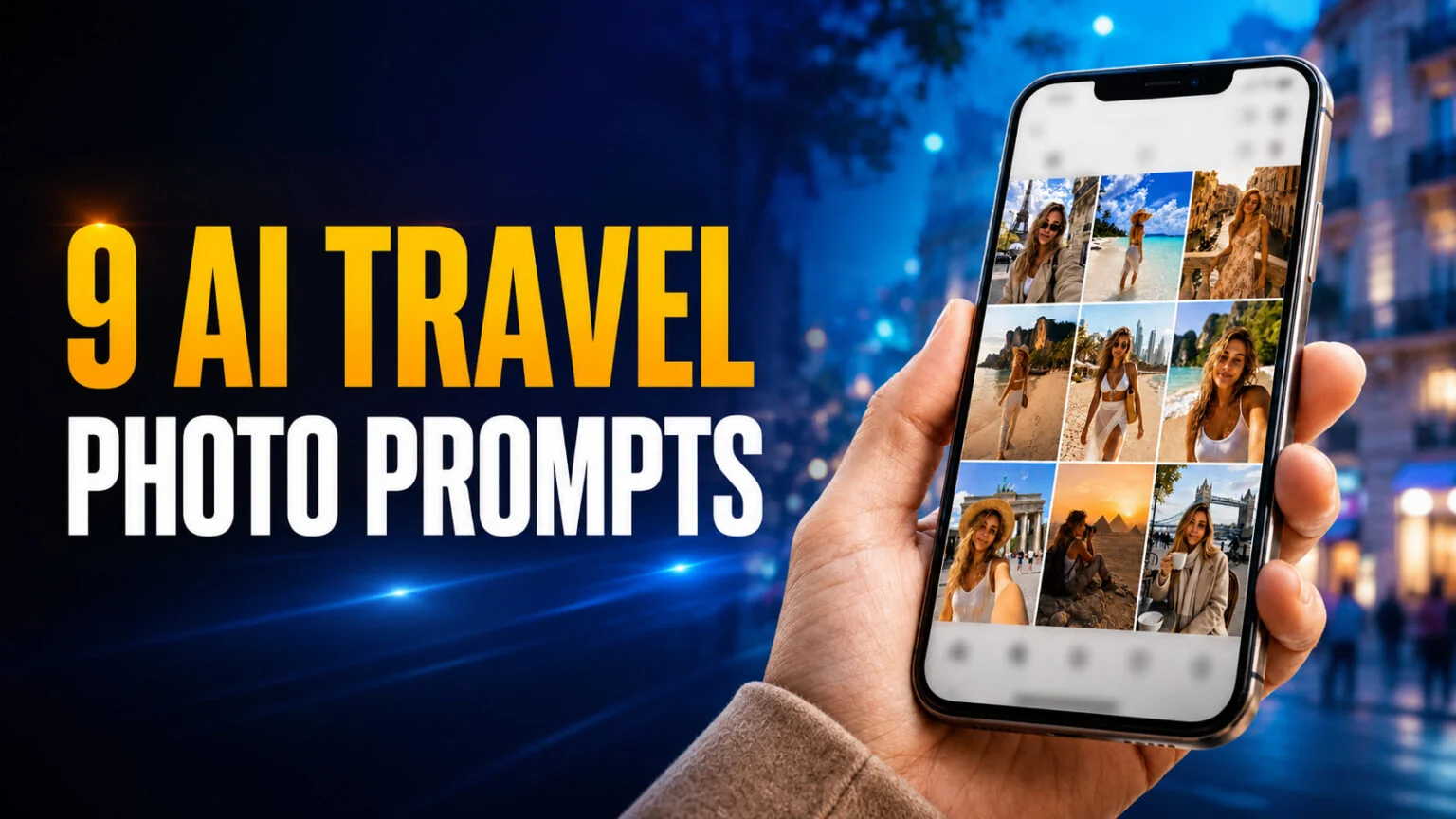
Everything you are about to see started as one ordinary selfie taken in a bedroom with an air conditioning unit on the wall. We ran nine prompts against that single photo in ChatGPT and got back a beach in Thailand, a bridge in Venice, the Brandenburg Gate and the Pyramids of Giza. This guide gives you all nine prompts to copy and the structure that makes them work. It also covers the fix for the failure that ruins most attempts, and an honest answer on whether posting the results is a reasonable thing to do.
The Key Takeaways
- Just 5% of 2,000 surveyed US travelers correctly identified all three real destination photos against AI fakes, while 52% believed they could spot them.
- All 9 prompts here were run against one single source selfie, which is shown unedited so you can judge the results honestly.
- The order of the sentences matters more than the wording. Leading with “keep my face the same” is the single most common reason the model hands your original photo straight back.
- GPT-Image-2 launched on April 21, 2026 and can hold a face steady across up to 8 images from one prompt, but only in Thinking mode, which free accounts do not get.
- Every prompt below is written transformation-first, with an identity lock and an explicit anti-passthrough line already built in.
The One Photo Behind All Nine AI Travel Photos
Most prompt roundups show you a gallery of beautiful results and never show you the input. That makes the prompts impossible to judge, because a stunning output from a professionally lit studio portrait proves nothing about what will happen to the photo on your phone.
So here is the input. One selfie, flat indoor light, messy hair, a plain white wall and an air conditioner in the frame. Every image further down this page came from this file and nothing else.
That is the point. If these prompts work on this photo, they will work on yours.

The unedited source photo. Every AI travel photo in this guide was generated from this one image.
How to Write an AI Travel Photo Prompt That Actually Works
A travel prompt has to do two contradictory things at once. It has to change almost everything in the frame, and it has to leave one thing completely alone. Get the order of those two instructions wrong and the model picks the safest reading, which is usually to change nothing at all.
Every prompt here follows the same five-part skeleton. Learn it once and you can write your own for any destination in about a minute.
Lead With the Transformation, Never With Your Face
Image models weight the opening instruction heaviest. When a prompt starts with “keep my face and identity exactly the same”, a lot of models read the whole request as conservative and return something almost identical to what you uploaded. We hit exactly this when testing our Gemini AI photo prompt pack, where a preservation-first prompt handed back the original selfie untouched.
Open with the edit instead. “Restyle the uploaded photo into a realistic vacation photograph on a tropical island” tells the model its job before it hears any restrictions. The identity lock still goes in, just later, where it reads as a constraint on the edit rather than an instruction to sit still.
Same words. Different order. Completely different result.
Give the Destination Two or Three Concrete Anchors
“Put me in Italy” produces a generic warm-toned street that could be anywhere. “A narrow canal lined with weathered Venetian buildings, with gondolas blurred behind her” produces Venice.
The difference is anchors, meaning specific physical things the model can actually render.
Pick two or three per scene and vary the type. A landmark gives the location away instantly, a ground surface sells the realism, and the time of day sets the entire colour palette. Weather and background human activity are the two cheapest ways to stop a scene feeling like an empty film set.
Close With an Anti-Passthrough Line and a Realism Tag
After the identity lock, add one blunt sentence stating that this is an edit and that the background and lighting must visibly change. It feels redundant when you write it. It is the difference between a new photo and a slightly warmer version of the one you already had.
Write it anyway.
Finish with realism cues rather than quality adjectives. “Natural skin texture, true-to-life shadows, shallow depth of field” does far more than “8K, ultra HD, masterpiece”, which mostly pushes output toward the over-processed look that makes AI photos obvious at a glance.
9 AI Travel Photo Prompts You Can Copy and Paste
Each prompt below is ready to paste as-is. Upload your selfie first, then send the prompt as a separate message.
There is nothing to fill in. Bracketed placeholders get pasted literally more often than they get replaced, so we baked sensible defaults into every one of these instead.
| # | Scene | Destination | Framing | Light | Difficulty |
|---|---|---|---|---|---|
| 1 | Tropical Beach Paradise | Generic island | From behind, side profile | Bright midday sun | Easy |
| 2 | Venice Golden Hour | Venice, Italy | Waist-up portrait | Low golden hour | Easy |
| 3 | Pyramids of Giza | Giza, Egypt | Seated, profile from behind | Hazy desert sunset | Medium |
| 4 | London Cafe | London, UK | Seated candid | Flat overcast | Medium |
| 5 | Brandenburg Gate | Berlin, Germany | Selfie distance | Hard direct sun | Easy |
| 6 | Dubai Luxury Beach | Dubai, UAE | Full body, walking | Warm late afternoon | Easy |
| 7 | Tropical Beach Portrait | Generic island | Close-up | Warm low sun | Easy |
| 8 | Eiffel Tower Selfie | Paris, France | Arm’s length wide angle | Bright spring afternoon | Medium |
| 9 | Thailand Sunset Beach | Krabi, Thailand | Full body, glancing back | Golden hour | Medium |
1. Tropical Beach Paradise
Start here. It is the most forgiving prompt in the set, because the subject faces away from the camera, and any small identity drift becomes invisible when all you see is a cheekbone. Get one win under your belt before attempting anything with a full face.
Prompt: Restyle the uploaded photo into a realistic luxury vacation photograph on a tropical island. Place the subject walking barefoot through ankle-deep, crystal-clear turquoise water along a pristine white sand beach, seen from behind in a subtle side profile as she looks out toward the open ocean. Dress her in elegant beachwear with a wide straw sun hat, under bright tropical midday sun, a vivid blue sky filled with dramatic white clouds, and gentle waves breaking around her feet. Keep her face, bone structure, skin tone and hair colour exactly as they are in the original. This is an edit, not a copy, so the background, wardrobe and lighting must all visibly change. Highly realistic DSLR travel photography, natural skin texture, true-to-life shadows.

2. Venice Golden Hour
This is the prompt that most often passes as real, because golden hour hides the two things AI gets wrong. Warm low light flattens skin detail naturally, so smoothing artifacts stop looking synthetic, and the shallow depth of field means the background never has to survive close inspection.
Prompt: Restyle the uploaded photo into an elegant travel portrait taken in Venice, Italy. Place the subject standing on a stone bridge above a narrow canal lined with weathered Venetian buildings, with gondolas and warm reflected light blurred softly behind her. Dress her in a stylish floral summer dress suited to a European holiday, lit by low golden-hour sun falling across her face. Keep her facial identity, age and natural features unchanged. This is an edit, so the setting, outfit and lighting must all visibly change from the original. Warm cinematic colour grading, shallow depth of field, luxury travel magazine photography.

3. Pyramids of Giza at Sunset
Landmarks with famous geometry are where AI photos usually fall apart, because the model knows what a pyramid looks like but not how big it should be relative to a person sitting 400 metres away. This prompt solves that by putting a camera in the subject’s hands and turning her away from the lens.
The result reads as a documentary frame shot by a travelling companion, which is a far easier illusion to sustain than a posed portrait. Note that this prompt asks for a full scene rebuild rather than an edit, which gives the model permission to change the pose entirely.
Prompt: Recreate the uploaded photo as a realistic travel documentary photograph at the Great Pyramids of Giza. Place the subject sitting on rocky desert terrain overlooking the pyramids at sunset, photographing them with a DSLR camera, framed from slightly behind so her face reads in profile. Dress her in practical travel clothing with hiking boots and a small backpack, surrounded by warm desert tones, soft golden light and light atmospheric haze. Preserve her facial identity, natural features and age, but build an entirely new pose, camera angle and composition around her. This is a full scene rebuild, not a filter, so the location, wardrobe and light must all change. Highly realistic, as though another traveller captured the moment.

4. London Cafe by Tower Bridge
Flat overcast light is the hardest lighting for an image model to fake convincingly, which is exactly why this one is worth trying. There is no golden glow to hide behind, so any plastic skin texture shows up immediately and tells you whether your source photo is good enough.
Prompt: Recreate the uploaded photo as a candid travel lifestyle photograph beside the River Thames in London. Place the subject at a cosy outdoor cafe table, smiling naturally over a cup of coffee during a relaxed morning break, with Tower Bridge behind her and pedestrians, cyclists and passing boats filling the scene. Dress her in a stylish wool coat and soft scarf for cool London weather, under flat overcast daylight. Keep her facial identity and natural appearance intact while generating a completely new candid moment rather than retouching the original frame. The background, clothing and light must visibly change. Authentic street photography, natural pose, realistic snapshot taken by a friend.

5. Berlin Brandenburg Gate
Hard midday sun is unflattering in real photography and useful in AI photography. Harsh directional light produces crisp shadow edges that read as authentic, and the blurred tourists behind her do most of the remaining believability work.
Prompt: Restyle the uploaded photo into a cheerful vacation portrait in front of the Brandenburg Gate in Berlin. Place the subject in the square with the columns and the quadriga rising behind her and other tourists blurred softly out of focus. Dress her in a light summer outfit with a wide straw hat, under bright direct sun and a clear blue sky, wearing a relaxed natural smile. Keep her face, features and hair colour exactly as in the original photo. This is an edit, so the location, outfit and lighting must all visibly change. Realistic DSLR portrait with shallow depth of field and vibrant European city colour.

6. Dubai Luxury Beach
Dubai works well because the skyline is distinctive enough to identify the city instantly without needing one specific building rendered accurately. Palm trees in the middle distance give the model something easy to place between the subject and the towers, which builds depth.
Prompt: Restyle the uploaded photo into a luxury beach travel photograph in Dubai. Place the subject walking confidently along clean pale sand carrying a woven tote, with rows of palm trees and modern skyscrapers rising behind her. Dress her in fashionable beachwear and sunglasses, lit by warm late-afternoon sun with a crisp resort atmosphere. Preserve her facial identity, skin tone and hair exactly as they appear in the original. This is an edit, not a passthrough, so the background, wardrobe and lighting must visibly change. Editorial fashion photography, sharp realistic colour and contrast.

7. Tropical Beach Close-Up Portrait
This is the hardest prompt in the set and the best test of whether a model is really preserving your identity. A close-up leaves nowhere to hide. If the face comes back subtly wrong, you will see it here before you see it anywhere else.
The instruction to add “only sun and salt, not a different face” is doing real work. Without it, models tend to interpret “sun-kissed skin” and “genuine smile” as licence to rebuild the features underneath.
Prompt: Restyle the uploaded photo into a close-up portrait on a tropical beach. Fill the frame with the subject’s face and shoulders, giving her naturally sun-kissed skin, slightly damp beach hair and a genuine relaxed smile, with crystal-clear turquoise water, lush green cliffs and white sand falling out of focus behind her. Light the scene with warm low golden sun and a shallow depth of field. Keep her bone structure, eye colour and facial identity unchanged, and add only sun and salt, not a different face. This is an edit, so the background and lighting must visibly change from the original. Authentic vacation portrait, natural skin texture, vivid tropical colour.

8. Paris Eiffel Tower Selfie
Naming the lens is the whole trick in this one. A wide-angle phone lens held at arm’s length introduces mild facial distortion and a slightly tilted horizon, the two things everyone unconsciously reads as a real selfie. Ask for it explicitly, or the model hands you a clean DSLR portrait that fools nobody.
Prompt: Restyle the uploaded photo into a realistic tourist selfie in Paris. Position the camera as though she is holding a phone at arm’s length on a wide-angle smartphone lens, with the Eiffel Tower standing prominently behind her and a lively Paris street running off to one side. Dress her in a cosy beige jacket and sunglasses under a bright spring afternoon sky with scattered cloud. Keep her facial identity and natural features exactly as they are. This is an edit, so the location, outfit, lens character and lighting must all visibly change. Authentic vacation selfie with natural wide-angle perspective and true phone-camera colour.

9. Thailand Sunset Beach
The strongest result of the nine. It shows what happens when you stack anchors, because limestone cliffs, long-tail boats and palm trees together pin the location to the Andaman coast without ever naming a specific beach.
The glance back over the shoulder is also deliberate. It gives you a recognisable face at an angle that is more forgiving than a straight-on portrait, which is the sweet spot between proving it is you and hiding the seams.
Prompt: Recreate the uploaded photo as a realistic golden-hour vacation photograph on a beach in southern Thailand. Place the subject walking barefoot along the shoreline, glancing back over her shoulder toward the camera with a genuine smile, as warm sunset light spreads across calm turquoise water. Dress her in relaxed beachwear with a straw hat and a small crossbody travel bag, framed by towering limestone cliffs, long-tail boats and palm trees. Preserve her facial identity and natural appearance while building an entirely new pose, composition and lighting setup. This is a full rebuild, not an edited selfie, so every element behind her must change. Cinematic golden-hour colour, highly realistic DSLR image that reads as a genuine travel memory.

When Your AI Travel Photo Goes Wrong
Four failures account for almost every disappointing result. None of them mean the prompt is broken. All four have a one-line fix you can send as a follow-up message rather than starting again from scratch, which also saves you an image against whatever quota you are on.
The Model Handed Back Your Original Photo
This is the most common failure and it is almost always caused by preservation-first phrasing. If you wrote your own prompt and opened it with anything resembling “keep my face exactly the same”, the model has read the request as an instruction to change as little as possible.
Reply with a single line. “Apply the edit, change the lighting and background, keep only my face.” That usually breaks the deadlock without needing the full prompt again. It works on the prompts above too, if a particular run comes back too conservative.
The Face Is No Longer Yours
Identity drift is the opposite problem and it gets worse the further you push the transformation. A full scene rebuild, like the Giza or Thailand prompts, gives the model more freedom than a background swap, and some of that freedom leaks into the face.
Fix it by naming specific features rather than repeating the word identity. Bone structure, eye colour, nose shape and hairline give the model something concrete to hold onto. Upload a second, clearer photo of the same person as well if your first one was poorly lit, because a weak reference is the root cause more often than a weak prompt.
The Skin Looks Plastic
Over-smoothed skin is the single biggest giveaway that a photo is synthetic, and it is usually self-inflicted. Quality adjectives cause it. Words like “8K”, “ultra HD”, “flawless” and “masterpiece” all nudge output toward an airbrushed look.
Strip them out and ask for the opposite. “Natural skin texture, visible pores, no beauty smoothing” produces a far more convincing result, and adding a real film or sensor reference gives the model a texture target to aim at.
The Landmark Is the Wrong Size or Shape
Famous structures come out subtly wrong surprisingly often, with the Eiffel Tower too short, pyramids too close together, or a bridge missing a span. The model knows what the landmark looks like but is guessing at the spatial relationship between it and a person standing in front of it.
State the distance explicitly. Telling the model the subject is roughly 300 metres from the tower, or that the pyramids sit on the horizon rather than directly behind her, fixes most scale errors in one pass. Pushing the landmark further into the background also helps, because distance and haze forgive a lot of geometric error.
Which AI Model Handles Travel Photo Edits Best
The nine images above were generated in ChatGPT, which runs on GPT-Image-2. That model launched on April 21, 2026 and brought two things that matter for a travel series. It reasons about the structure of an image before generating it, and it can hold a character consistent across up to eight images from a single prompt. We covered everything that changed in ChatGPT Images 2.0 when it shipped.
There is a catch. The eight-image consistency batch lives in Thinking mode, which requires a paid ChatGPT plan. Free accounts get Instant mode only, so a nine-destination series has to be generated one image at a time, and your face will drift a little between them. OpenAI does not publish a fixed image quota for free accounts either, so the in-app banner is the only reliable guide to how many you have left.
| Model | Best for | Identity preservation | Free access | Where it struggles |
|---|---|---|---|---|
| GPT-Image-2 (Instant) | Fast single scenes | Good | Yes, quota not published | Drift across a long series |
| GPT-Image-2 (Thinking) | Multi-scene travel sets | Strongest | Paid plans only | Slower per image |
| Nano Banana 2 | Quick everyday edits | Good | Yes, in the Gemini app | Preservation-first passthrough |
| Nano Banana Pro | Detailed scene rebuilds | Very good | Limited | Occasional over-stylising |
| Midjourney | Stylised travel imagery | Weakest of the five | No free tier | Editing a specific real face |
If you want to compare the two leading families in more depth, our Nano Banana Pro comparison breaks down where each one wins. For prompts built around a face rather than a place, these AI headshot prompts use the same identity-lock structure applied to studio lighting. For makeup, hairstyle and outfit changes on the same selfie, try these ChatGPT photo editing prompts for women. If you would rather use a finished tool than a prompt, we tested the best free AI headshot generators. On desktop, you can run these prompts through the Nano Banana Mac client.
Running the Same Prompt Across Several Models
Working through nine prompts exposes an awkward truth about image models. No single one wins every scene.
The model that nails the Venice bridge is often not the model that gets the pyramid scale right, and you will not know which is which until you have run the same prompt through both.
That is the case for a multi-model app rather than a single subscription. Fello AI puts the major image and chat models behind one interface on Mac, iPhone and iPad. You paste a travel prompt once, run it against several models, and keep whichever result holds your face best. It carries a 4.7 star rating across more than 27,000 reviews, and the full multi-model plan is $9.99 a month, less than a single pro plan at most individual providers.
There is also a Free AI model with no message limits if you want to test the workflow before paying for anything. If you would rather stay entirely on free tools, the best free AI image generators and editors covers what each one actually allows before it starts asking for a card.
Can Anyone Tell Your AI Travel Photos Are Fake?
Mostly, no. The Talker Research survey of 2,000 American travelers ran on June 2 and 3, 2026 for the Tennessee Department of Tourist Development. Only 5% correctly identified all three real destination photographs when shown side by side with AI-generated versions, as reported by Scripps News. Just 25% picked the authentic image on any given test, which is worse than guessing.
The confidence gap is the striking part. 52% had described themselves as extremely or very confident in their ability to spot AI imagery before taking the test, and 39% of those who got it wrong said they were genuinely surprised. Only 38% correctly identified the real Grand Canyon photo, and that was the easiest of the three.
How to Spot an AI Travel Photo
Skin texture is the first place to look, because over-smoothing survives compression better than most artifacts. Hands and jewellery come second, since fingers and thin metal are still where models fail most visibly. Background text is third. Signage in a foreign language gives it away fastest of all.
Beyond the image itself, check whether the light agrees with itself. If the sun sits low and behind the subject but her face is evenly lit with no rim light in her hair, something has been composited that was never photographed together.
None of these tests are reliable on a phone screen at social media resolution, which is rather the point.
Where the Line Is on Posting Them
This is worth being straight about. Making AI travel photos for fun, for a creative project or to see yourself somewhere you would like to go is harmless, and the appetite for it is real. An app called Endless Summer does nothing but generate fake vacation photos. Built by designer Laurent Del Rey and launched in October 2025, it was covered by TechCrunch as a response to burnout among people who cannot afford to travel.
Passing them off as a trip you actually took is a different thing, and it stops being harmless the moment money or trust is involved. The same survey found that 70% of travelers had arrived somewhere that looked noticeably different from the photos that sold it to them, and more than 80% of those suspected AI was involved.
Label them. Or at least do not deny it when someone asks.
Start With Prompt Nine
If you only run one of these AI travel photo prompts, make it the Thailand sunset. It stacks three location anchors, uses the most forgiving light of the nine, and puts the face at the angle that best balances recognisability against the risk of drift. It is also the one that came out strongest from our own flatly lit, entirely unglamorous source selfie.
Upload a clear photo, paste the prompt exactly as written, and if the first result comes back looking suspiciously like the picture you uploaded, send the one-line passthrough fix and go again. Once that clicks, the other eight are variations on the same skeleton, and writing a tenth for wherever you actually want to go takes about a minute.
FAQ
How do I turn my selfie into an AI travel photo?
Upload one clear, well-lit photo where your face is unobstructed, then send the prompt as a separate message. Open with the edit you want rather than an instruction to keep your face the same. Name two or three concrete details about the destination, then close with a line stating that the background and lighting must visibly change.
Why does ChatGPT give me back my original photo unchanged?
Because the prompt led with preservation. Image models weight the first instruction most heavily, so opening with something like keep my face exactly the same reads as an instruction to change nothing. Reply with a single line saying apply the edit, change the lighting and background, keep only my face, and the next attempt will usually work.
Can I make AI travel photos for free?
Yes, though with limits. Free ChatGPT accounts get Instant mode only, so you lose the multi-image consistency batch that keeps a face stable across a whole travel series, and OpenAI does not publish a fixed free image quota. The Gemini app is free to use for photo edits as well, so running the same prompt in both is a reasonable free workflow.
Why doesn’t the AI travel photo look like me?
Identity drift usually comes from a weak reference photo rather than a weak prompt. A dark, blurry or heavily filtered source gives the model very little to hold onto. Upload a sharper photo and name specific features such as bone structure, eye colour and hairline instead of repeating the word identity.
Is it OK to post AI travel photos on social media?
Posting them for fun or as a creative project is harmless, and plenty of people do it. Presenting them as a trip you really took is a different matter, particularly if money, sponsorship or someone’s booking decision depends on it. The straightforward approach is to label them, or at minimum not to deny it when someone asks.