ChatGPT now has over 900 million weekly active users, and its mobile app crossed 1 billion monthly active users in May 2026, the fastest any app in history has reached that mark. Despite that scale, most people only scratch the surface of what it can do. This ChatGPT for beginners guide walks you through sign-up, model selection, what you can build with it, and how to write prompts that get better results.
As of September 2026, ChatGPT opens on GPT-5.6 Luna on free accounts and GPT-5.6 Sol on paid ones, with a Thinking slider on paid plans that decides how long the model thinks before it answers. Whether you want to draft emails, write code, summarize documents, or just have a smarter conversation, the steps below will get you set up in minutes. If you want a structured way to learn ChatGPT from scratch, our full guide on how to learn ChatGPT takes you the rest of the way.
The Key Takeaways
- ChatGPT has over 900 million weekly active users, and Sensor Tower data reported by Reuters put its mobile app past 1 billion monthly active users in May 2026.
- GPT-5.6 Luna is the default on Free and Go; Plus at $20/month moves you to GPT-5.6 Sol and adds the Thinking slider.
- The free tier gives you unlimited everyday text chats on GPT-5.6 Luna, and it still includes web search, file uploads, and a small daily image allowance, each with its own limit.
- Paid plans now differ mostly by usage, not features: Go $8, Plus $20, and three Pro tiers at $100, $200 and $500, each with more headroom than the one below; Pro $200 reopened to new sign-ups on 29 September 2026 after a pause.
- Mac users can reach ChatGPT inside Fello AI, which combines ChatGPT, Claude, Gemini, Grok, and Perplexity models in one app from $9.99/month.
What Is ChatGPT?
ChatGPT is an AI assistant built by OpenAI that understands and generates human-like text. It is based on the GPT (Generative Pre-trained Transformer) architecture, a type of large language model trained on vast amounts of text data. The result is a system that can draft messages, write and debug code, answer questions, summarize documents, translate languages, and hold extended conversations with equal competence. To understand the technology behind it in more depth, read our guide on how ChatGPT actually works.
Unlike basic chatbots that follow rigid scripts, ChatGPT understands context and intent. It maintains memory across a conversation, so follow-up questions build on what came before rather than starting from scratch. It adapts its tone to match the task, writing formally for business emails and casually for brainstorming sessions. Even the free tier includes web search, file uploads, and a small daily image-generation allowance; paying mainly buys you higher limits and deeper reasoning rather than entirely new abilities.
OpenAI launched ChatGPT in November 2022, and it became the fastest-growing consumer application in history, reaching 100 million users in two months. OpenAI’s most recent official figure is 900 million weekly active users, and in May 2026 the mobile app passed 1 billion monthly active users according to Sensor Tower estimates reported by Reuters. It is not an exaggeration to say it changed how people work with information.
What You Can Do with ChatGPT
ChatGPT is one of the most versatile tools available to anyone with an internet connection. The range of tasks it handles well is broad enough that most beginners underestimate it significantly in the first week of use. Understanding the full scope of what it can do helps you build habits around it faster.
Writing and editing is where most beginners start. ChatGPT can draft emails, cover letters, social media posts, product descriptions, blog outlines, and reports. More usefully, it can rewrite your existing text to be shorter, more formal, friendlier, or better structured. Paste a paragraph and ask it to “tighten this up and make it more direct” and you will immediately see the difference.
Research and learning is another strong suit. You can ask ChatGPT to explain any concept from first principles, give you a quick overview of a complex topic, compare two approaches, or summarize a long document you paste in. It is particularly good at breaking down technical subjects into plain language, which makes it a useful study partner or a fast way to get up to speed on an unfamiliar topic.
Coding and technical work is one of ChatGPT’s most powerful applications, even for non-developers. You can ask it to write a Python script to rename files, create a formula for a spreadsheet, explain what a block of code does, or debug an error message you have copied from your terminal. For deeper engineering work, Codex, OpenAI’s coding agent, is included on every plan, with far higher limits and GPT-6.1 Sol from Plus up.
Brainstorming and creative work rounds out the everyday use cases. ChatGPT is good at generating options quickly, whether that is ten names for a new product, five angles for a blog post, or three ways to restructure a presentation. It does not replace creative judgment, but it removes the blank-page problem and gives you something to react to immediately.
ChatGPT Models for Beginners: Which One Should You Use in 2026?
Which model you open on now depends on your plan. On Free and Go it is GPT-5.6 Luna; on Plus and Pro it is GPT-5.6 Sol. That is the model you are talking to unless you deliberately pick something else, and it handles writing, Q&A, summarizing, and light coding well. What a paid plan buys you is not a different chatbot but the ability to make the model think for longer before it answers. GPT-6 Astra, which OpenAI launched on September 3, 2026, reaches Chat only as GPT-6 Pro, the Pro option on the Pro, Business and Enterprise plans. Plus gets Astra in ChatGPT Work and Codex but not in Chat, and Free and Go get no Astra at all (full breakdown).
This changed recently, so ignore any guide written before August. OpenAI rebuilt the picker on June 10, 2026 around reasoning levels rather than model names, with a bottom Instant level that ran GPT-5.5. Then on 6 August 2026 it went further and moved the fast and the deep replies onto a single GPT-5.6 Sol for Plus and Pro, controlled by a Thinking slider rather than a menu. Instant is still the bottom setting, now running on Sol, but since 14 September it no longer steps up to a thinking level by itself on Plus and Pro, so for a harder question you move the slider yourself. GPT-5.5 retires from ChatGPT on 14 October 2026.
| What you get | Runs on | Available on | Best for |
|---|---|---|---|
| Default chat | GPT-5.6 Luna | Free and Go | Everyday writing, quick questions |
| Think button | GPT-5.6 Luna | Free and Go | One harder question at a time |
| Slider: Instant | GPT-5.6 Sol | Plus and above | Fast everyday replies |
| Slider: Medium and High | GPT-5.6 Sol | Plus and above | Multi-step reasoning, harder coding |
| Slider: Extra High and Pro | GPT-5.6 Sol, Sol Pro or GPT-6 Pro | Pro, Business, Enterprise | Heaviest reasoning, slowest answers |
What Free and Go Users Get
Free and Go accounts run on GPT-5.6 Luna and have no Thinking slider. Neither plan can reach GPT-5.6 Sol in standard chat, so the difference between them is volume rather than intelligence. Both get unlimited everyday text chats, subject to OpenAI’s abuse guardrails, while file uploads, image generation, voice and data analysis keep separate limits. Go at $8/month keeps the same model but raises those tool limits far enough that most people stop noticing them.
Two changes that began rolling out in the week of 10 August 2026 made that better. OpenAI replaced the old cap of roughly 10 messages per five hours with unlimited text chats, and added a Think button for Free and Go that makes Luna work harder on a difficult question. Think still runs on Luna, not on Sol.
That is a better deal than it sounds. Luna is a current-generation frontier model, not a stripped-down demo version, and it is genuinely good at the tasks beginners actually do. If you mostly write, summarize, translate, and ask questions, you may never need more than it. Our breakdown of exactly what the free plan covers lives in is ChatGPT free and what the limits are.
What Plus and Pro Add
Plus at $20/month is the first plan that puts GPT-5.6 Sol in front of you, along with the Thinking slider that controls it. Raising the slider is what you do when a quick answer comes back shallow or wrong on something that needs actual thought, such as a multi-step calculation, a tricky bug, or a document you need genuinely analysed rather than summarized. On Plus the slider stops at High; Extra High and the Pro option, which runs GPT-5.6 Sol Pro or GPT-6 Pro, are reserved for Pro, Business, and Enterprise accounts.
One model name you will see in headlines does not appear in normal chat at all. GPT-5.6 Terra is the balanced member of the same family and shows up only in ChatGPT Work, in Codex, and in the API. GPT-5.6 Luna used to sit in that same category, but since 6 August 2026 it is the default on Free and Go, so most ChatGPT users are now talking to it directly. Since 22 September 2026, Work and Codex also carry the newer GPT-6 Sol and GPT-6 Luna, which are not in Chat either. For the full family breakdown read our guide to GPT-5.6 Sol, Terra, and Luna, or compare every generation side by side in our complete ChatGPT model comparison.
ChatGPT Plans in 2026: Free, Go, Plus, and Pro
ChatGPT’s free tier is a genuine starting point, not a crippled demo. That said, understanding exactly what each plan gives you avoids frustration later. The free plan runs GPT-5.6 Luna with unlimited everyday text chats; what it caps is tools such as file uploads, image generation and voice. Since February 9, 2026, logged-in adult users in the US on the Free and Go plans also see ads labelled “sponsored” beneath some answers. Here is the full plan comparison.
| Plan | Price | Model access | Message limit | Key extras |
|---|---|---|---|---|
| Free | $0/mo | GPT-5.6 Luna | Unlimited text chats, tools capped | Web search, file uploads, small image allowance, ads in the US and Europe |
| Go | $8/mo | GPT-5.6 Luna | Unlimited text chats, higher tool limits | More uploads and image generations, longer memory, ads in the US and Europe |
| Plus | $20/mo | GPT-5.6 Sol + Thinking slider (Instant to High) | Higher again, and it falls as you raise the effort | No ads, deeper memory, full image generation, higher Codex limits, GPT-6 Astra in Work and Codex |
| Pro | $100/mo | Adds Extra High, Sol Pro and GPT-6 Pro | Far above Plus; GPT-6 Pro and Sol Pro share one weekly allowance | Same features as Plus with far more headroom |
| Pro | $200/mo | Adds Extra High, Sol Pro and GPT-6 Pro | More than Pro $100; GPT-6 Pro has its own weekly limit | Open to new sign-ups again since 29 September 2026, at a lower allowance than existing subscribers keep |
| Pro | $500/mo | Adds Extra High, Sol Pro and GPT-6 Pro | The highest Pro allowance, 25x Plus | Adds Astra Ultrafast in Work and Codex; new on 29 September 2026 |
The important shift for 2026 is that the paid tiers now separate mostly on usage, not features, with GPT-6 Pro in Chat the main exception above Plus. OpenAI added the $100 Pro tier on April 9, 2026, sitting between Plus and the original $200 Pro; a third tier, Pro $500, followed on 29 September 2026. All three ship the same core capabilities and differ mainly in how much of them you get, with Astra Ultrafast in Work and Codex only on Pro $500. New sign-ups to the $200 tier were paused from 10 to 29 September 2026; they are open again, at a lower allowance for new subscribers. There are also team plans, with Business at $25 per user per month billed monthly or $20 billed annually, plus Enterprise and Edu on request.
Most beginners do not need Plus from day one. Spend a week on the free tier to see how you actually use ChatGPT, then upgrade based on what you hit first. If you keep running into the upload or image limits, Go at $8/month is the cheapest fix, though it still carries ads. Only Plus and above are ad free, and there is also a no-cost ad-free route on the Free plan that trades ads for lower limits. If Luna keeps giving you shallow answers on work that matters, that is the signal to move to Plus and start raising the Thinking slider on Sol. Our full ChatGPT pricing guide breaks down every tier in detail.
How to Sign Up for ChatGPT
Creating a ChatGPT account takes about two minutes. The whole process runs inside your browser at chatgpt.com, and you have the option to use an existing Google or Microsoft account to skip the email steps entirely.
- Go to chatgpt.com and click Sign up.
- Enter your email address, or click Continue with Google or Continue with Microsoft for a faster setup.
- Check your inbox and click the verification link OpenAI sends you.
- Fill in your name and date of birth.
- Verify your phone number via SMS.
- Click New chat in the left sidebar and type your first message.
ChatGPT responds in seconds. During busy periods, the free tier may feel slower than usual. If responses regularly crawl, our guide to why ChatGPT is so slow and how to fix it walks through the causes. Text chats on Free and Go are no longer capped, so the limits you can still run into are on tools such as file uploads and image generation.
Using the ChatGPT Desktop App
You do not need to install anything, but the desktop app changed meaningfully on July 9, 2026, when OpenAI folded the standalone Codex app into ChatGPT for macOS and Windows. The rebuilt app has three surfaces in one window: Chat for normal conversation, Work for longer agentic tasks that run in the background, and Codex for coding. A July 16 update added a global switcher, unified recent chats, and Projects across Mac and Windows.
Two things are worth knowing before you download it. The new app installs alongside the old one, now renamed ChatGPT Classic, so you can end up with two icons and no migration prompt; OpenAI says Classic keeps working and keeps receiving updates, with no shutdown date announced. It also requires macOS 14 or later. Work mode is the surprising part for beginners, since it is available in the desktop app on every plan including Free and Go, while on the web and mobile it is limited to paid plans. Our guide to ChatGPT Work and what it actually does covers the details. Our full guide to the ChatGPT desktop client for Mac walks through the download, the permissions and the shortcut you will use most.
Via Fello AI on Mac
If you are on a Mac, Fello AI is the fastest way to reach ChatGPT without creating an OpenAI account at all. Open the Mac App Store, search for Fello AI, download it, and open it. You can use ChatGPT immediately, alongside Claude, Gemini, Grok, and Perplexity models in the same interface, with no separate accounts to manage.
Navigating the ChatGPT Interface
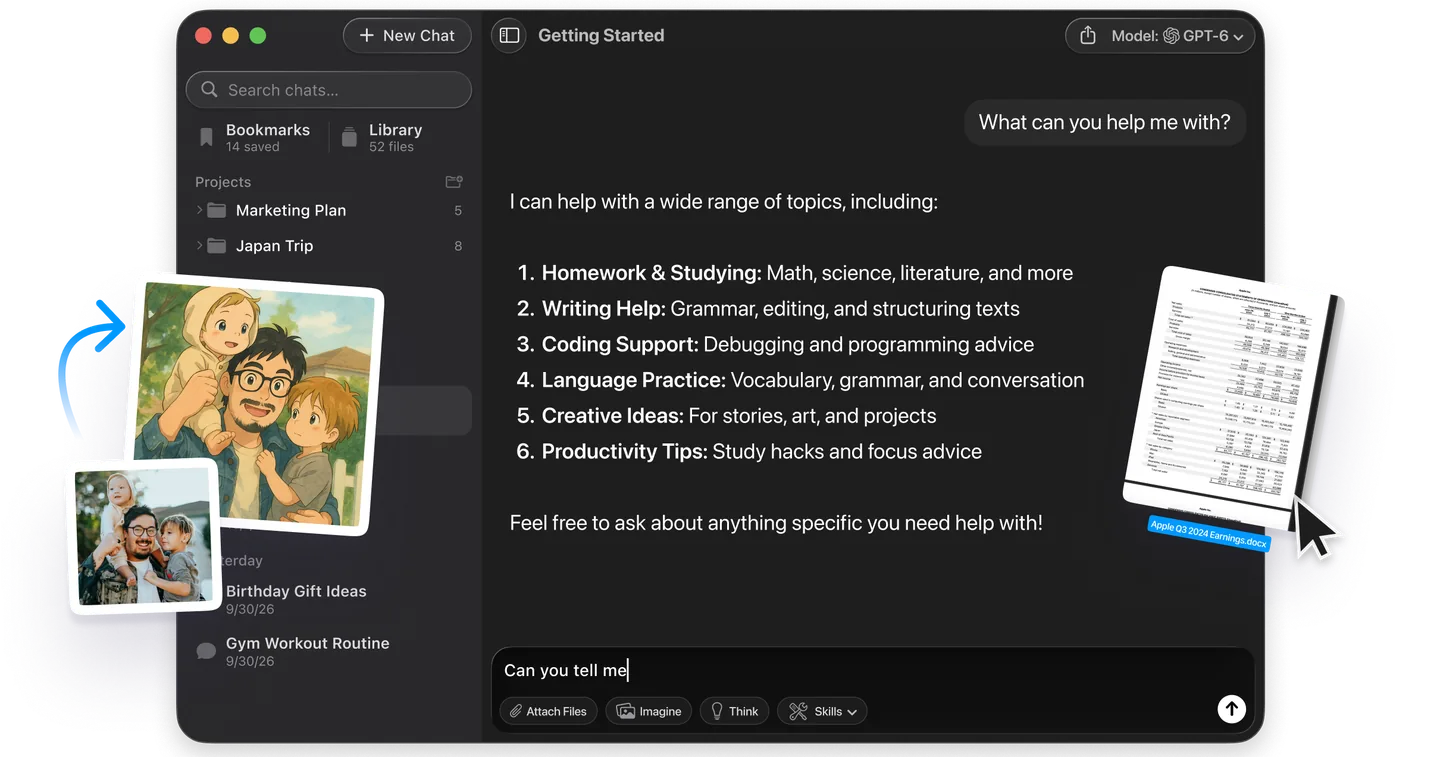
Once you are logged in, the interface is straightforward. The left sidebar holds your conversation history, organized by date, and a button to start a new chat. At the top of the page, paid plans show the Thinking slider that sets how hard the model works, while Free and Go get a Think button in its place. The center area is the conversation itself, with your messages on the right and ChatGPT’s responses on the left. Once that history grows past a few dozen chats, it is worth learning what ChatGPT Projects are, which group related conversations into one workspace.
The input box at the bottom is where you type. You can also attach files, images, or documents here if your plan supports it. After ChatGPT responds, small icons below each message let you copy the text, rate the response, or ask for a regenerated answer. Getting familiar with that regenerate button early is worth it; a second attempt at the same prompt often produces a noticeably different result.
How Prompting Works
Prompting is the core skill in using ChatGPT well. Every interaction starts with an input you type, and the quality of that input determines almost everything about the output you get back. A prompt can be as simple as a question (“What is compound interest?”) or as structured as a detailed brief (“You are a financial advisor. Explain compound interest to a 16-year-old in three bullet points with a worked example using $1,000 at 5% over 10 years”). Both are valid; the second one produces a far more useful answer.
Continued conversations are one of ChatGPT’s most underused features. Because it remembers context within a conversation, you do not need to repeat yourself in every message. Start broad and narrow down with follow-up questions. Ask it to revise its answer, change the tone, make it shorter, or approach the problem differently. The back-and-forth is where real value gets extracted. For a deeper look at advanced techniques, see our guide on 7 ways to use ChatGPT better than 99% of people.
The concept of prompt engineering sounds technical but the practical version is not. It is simply the habit of writing clearer, more specific inputs. Specify the format you want (“give me a table”, “write this as a bullet list”, “keep it under 100 words”). Give it a role (“you are an expert copywriter”). Provide context (“I am writing for an audience of non-technical HR managers”). These small additions consistently produce better outputs without requiring any technical knowledge.
Tips for Better Results With ChatGPT
Most people who feel underwhelmed by ChatGPT are writing prompts that are too vague. The model is only as good as the instructions it receives. These five habits make a noticeable difference from your very first conversation.
- Be specific about format and length: Instead of “Tell me about WW2,” try “Summarize the three main causes of World War 2 in bullet points for a high school student, keeping each point under 30 words.”
- Set a role or context: Prefix complex queries with a situation, such as “You are a senior marketing manager. Help me write a campaign brief for a fitness app targeting people over 40.”
- Use follow-up questions: If the first answer is not quite right, tell ChatGPT what to fix rather than starting over. “Make this shorter,” “add a concrete example,” or “rewrite this in a more casual tone” all work well.
- Break down complex tasks: Ask for one thing at a time. A long multi-part prompt usually returns shallow answers to each part; a sequence of focused prompts produces better results across the board.
- Avoid sharing sensitive data: Never paste passwords, personal ID numbers, financial account details, or confidential client information into any AI chat interface.
The fastest way to improve is to revisit your past prompts and identify which of these habits you skipped. Nearly every weak output traces back to vagueness, missing context, or asking too many things at once. Fixing those three things alone will make ChatGPT significantly more useful in your day-to-day work.
Common ChatGPT Beginner Mistakes (and How to Fix Them)
Accepting the first answer without refining it is the single biggest missed opportunity. ChatGPT improves substantially with follow-up feedback; treating the first response as a starting point rather than a final answer is the habit that separates power users from casual ones. Overloading one prompt with multiple unrelated questions produces shallow answers to each; splitting them into separate turns is almost always better. Vague prompts produce vague answers, and adding specifics about format, length, audience, and tone costs nothing but a few extra words.
Two more mistakes are worth knowing about before they catch you out. Trusting numbers and facts without checking is a common trap. ChatGPT can state incorrect statistics, wrong dates, and fabricated citations with complete confidence, a behaviour known as “hallucination.” Always cross-check factual claims against a reliable source before acting on them, especially for medical, legal, or financial decisions.
Sharing sensitive data is the other one; OpenAI may use conversations to improve its models unless you opt out in your account settings, so treat the chat window the same way you would treat a public forum when deciding what to type. For a broader look at how AI fits into your daily routine, see 10 smart ways to use AI to make your life easier.
What ChatGPT Cannot Do
Understanding ChatGPT’s limitations makes you a more effective user. The most important one is hallucination: ChatGPT can generate plausible-sounding text that is factually wrong. It does not “know” things the way a database does; it predicts likely text based on patterns. When it does not know something, it will often make something up rather than say “I don’t know.” This is not a bug being fixed soon; it is a structural property of how large language models work. Treat any specific fact, figure, or citation it provides as a starting point for verification, not a final source.
ChatGPT is also not a substitute for professional advice. It can explain legal concepts, outline medical conditions, or help you understand financial instruments, but it should not replace a lawyer, doctor, or financial advisor for decisions with real consequences. Use it to get informed, then take important decisions to a qualified professional. That is not a limitation to work around; it is the right way to use any information tool. That caveat matters most when you are configuring ChatGPT for somebody else, which our guide to AI for seniors covers step by step.
Fello AI: The Best ChatGPT Alternative for Mac
Fello AI is a Mac-native app that gives you multiple frontier AI models in one interface, including ChatGPT, Claude, Gemini, Grok, and Perplexity. Instead of switching between five apps and five accounts, you run the same prompt across models and compare the answers side by side. It holds a 4.7-star rating across more than 27,000 reviews and starts at $9.99/month, and you can grab it from the Mac App Store listing.
For beginners, Fello AI removes the friction of managing multiple accounts and the overhead of switching between tools. For heavier users, the side-by-side comparison is genuinely useful when you need the best answer rather than a good-enough one. It also generates more than text, producing images, documents, spreadsheets, presentations, and podcasts inside the same chat. You can bookmark important replies, search past conversations, and pin threads, none of which the standard ChatGPT web interface offers.
Once you are past the basics, read our complete playbook for using ChatGPT effectively.
Conclusion
ChatGPT is the most accessible entry point into AI available in 2026. With 900 million weekly users, a mobile app past 1 billion monthly actives, and a free tier that runs a recent frontier model rather than a watered-down demo, there is no friction left in getting started. Sign up, spend 20 minutes running a few prompts, and pay attention to how the quality of your input affects the quality of the output. That feedback loop is where most of the learning happens, and it happens fast.
Once you are comfortable with the basics, the next step is building sharper prompts. Use the guides linked throughout this article, experiment with one new technique at a time, and remember that every conversation you have is practice. The gap between a casual user and a power user comes down almost entirely to prompting habits, and those habits take days, not months, to develop.
FAQ
Is ChatGPT free to use in 2026?
Yes. The free plan runs GPT-5.6 Luna with unlimited everyday text chats, a cap OpenAI lifted in August 2026 (it used to be roughly 10 messages per five hours). It still includes web search, file uploads, and a small daily image allowance, and those tools keep their own limits. Since February 9, 2026, US users on Free and Go also see sponsored ads under some answers.
Do beginners need to pay for ChatGPT?
No. Start free and upgrade only when you hit a wall. If the wall is upload or image limits, ChatGPT Go at $8/month raises them, but Go shows ads too. Plus at $20/month is the first ad-free tier. If the wall is answer quality on complex work, Plus at $20/month moves you to GPT-5.6 Sol with the Thinking slider. Pro starts at $100 a month, with $200 and $500 tiers above it, and buys mostly usage headroom plus GPT-6 Pro in Chat.
What is the best ChatGPT model right now?
It depends on your plan. GPT-5.6 Luna is the default on Free and Go and is the right choice for most everyday work. Plus and Pro run GPT-5.6 Sol in Chat and set how hard it works with a Thinking slider rather than by picking a model. Extra High and the Pro option are limited to Pro, Business, and Enterprise. OpenAI’s most capable model, GPT-6 Astra, reaches Chat only as GPT-6 Pro on those plans; Plus gets Astra in ChatGPT Work and Codex instead.
Do I need to download anything to use ChatGPT?
No. ChatGPT works in any web browser at chatgpt.com with no download required. OpenAI also ships desktop apps for Mac and Windows, rebuilt on July 9, 2026 to combine Chat, Work, and Codex in one window, plus mobile apps for iOS and Android. Mac users can also reach ChatGPT through Fello AI without an OpenAI account.
Why does ChatGPT sometimes give wrong answers?
ChatGPT can “hallucinate,” meaning it generates confident-sounding text that is factually incorrect. This is a structural property of large language models, not a bug. Always verify specific facts, statistics, and citations from ChatGPT against a reliable external source before using them for anything important.
Is ChatGPT safe for personal information?
Do not paste sensitive personal data, passwords, or confidential work information into ChatGPT. OpenAI may use conversations to improve its models unless you opt out in your privacy settings. For high-stakes business use, enterprise plans include explicit data-use controls and confidentiality guarantees.