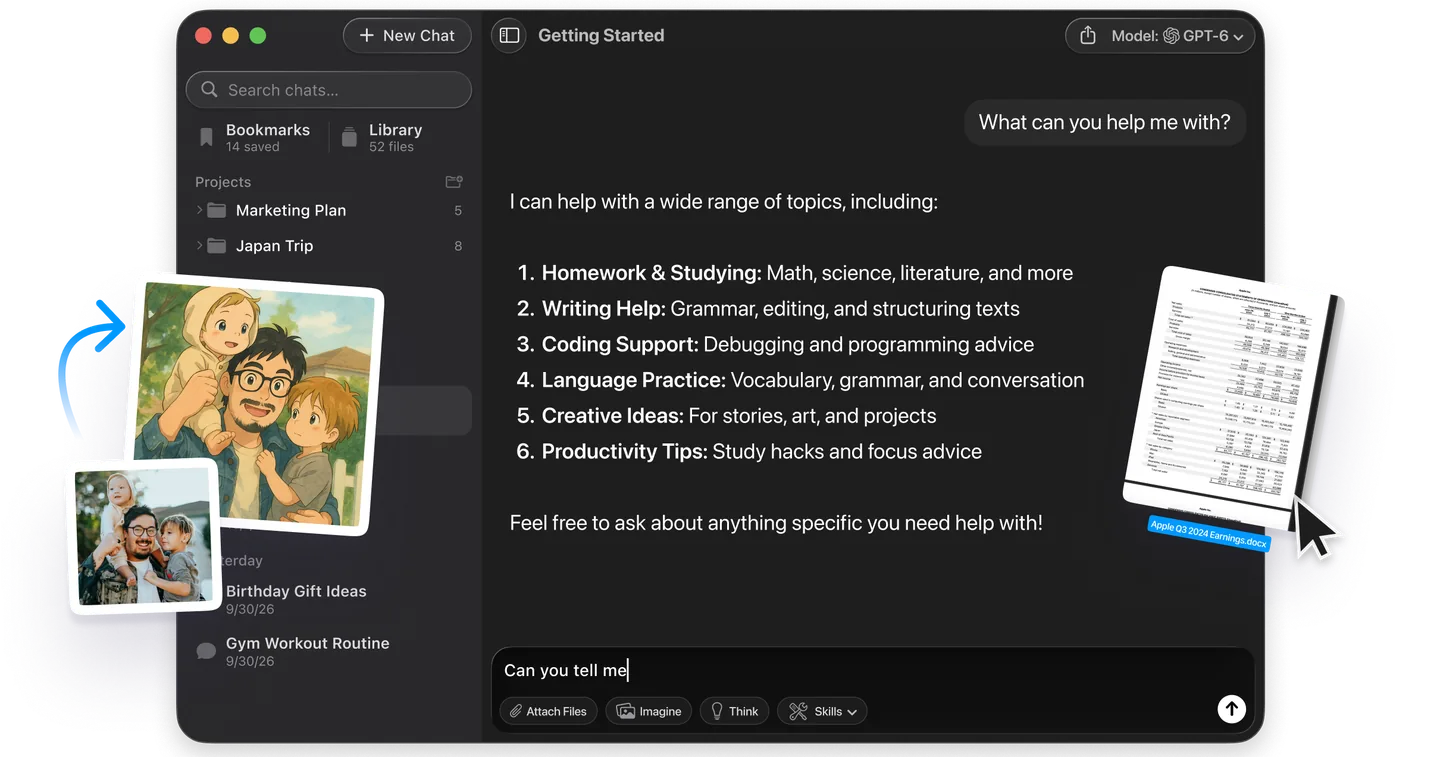
TL;DR: ChatGPT productivity hacks in 2026 are no longer about clever one-off prompts. They are about building repeatable workflows using Projects, Tasks, and Apps to automate professional work. The most effective users treat ChatGPT as an operating system for work – connecting it to files, scheduling tasks, and using persistent context – rather than just a chatbot. For a complete setup guide, check out getting started with Fello AI.
Quick reference table
| Goal | Best Feature | Setup Time | Verification Needed |
|---|---|---|---|
| Manage ongoing context | Projects | 5 mins | Low |
| Research complex topics | Deep Research | 0 mins | High (Check sources) |
| Recurring reminders | Tasks | 1 min | Low |
| Connect Drive/SharePoint | Apps | 2 mins | Low |
| Summarize documents | File Upload / Chat with PDFs using AI | 0 mins | Medium |
| Draft email/Slack | Chat + Custom Instructions | 10 mins (One-time) | Medium |
Moving Beyond Basic Prompts
If you are still pasting the same context into ChatGPT every time you start a new chat, you are working harder than necessary. By 2026, the platform has evolved from a simple text generator into a connected workspace. The professionals gaining the most leverage aren’t just “prompt engineering” – they are “workflow engineering.”
This guide covers 15 practical, high-impact workflows designed for professional environments. These tactics focus on security, repeatability, and integration with your existing tools.
The Key Takeaways
- Context is King: Use Projects to store instructions and files so you don’t have to repeat yourself.
- Automate the Mundane: Use Tasks to schedule recurring briefings or reminders.
- Connect Your Data: Use Apps (formerly Connectors) to safely search your Google Drive or SharePoint without uploading files manually.
- Verify Everything: Deep Research is powerful but requires human review of citations.
- Security First: Always check your workspace settings to ensure business data is excluded from model training.
1. ChatGPT Projects for persistent context
One of the biggest time-sinks is explaining your role, tone, and project details in every new chat. Projects solve this by acting as a container for specific workstreams. Projects can be shared within a workspace with roles like chat or edit, making them ideal for team collaboration. If you have not used them before, our guide explains how to set Projects up properly, including the instructions trap that silently overrides your global settings.
The Workflow: Create a Project for every major responsibility (e.g., “Q1 Marketing Campaign,” “Monthly Reporting,” “Client X Account”). Upload your brand guidelines, past reports, and strategy documents into the Project knowledge base.
Why it works: Every chat started inside this Project automatically “knows” the background information.
Pro Tip: Keep a “General Work” Project populated with your bio, company description, and preferred email formatting.
2. ChatGPT Tasks for recurring work
ChatGPT can now handle time-based actions. Tasks allow you to set reminders or schedule prompt executions, turning the AI into a proactive assistant. Tasks run later, can execute while you are offline, and notify you via push notification or email when complete.
The Workflow: Instead of remembering to ask for a summary every Monday, set a recurring task.
Copy-Paste Prompt:
“Set a recurring task for every Monday at 9:00 AM: Ask me to paste the latest project status update, then generate a bulleted summary of risks and blockers for the weekly standup.”
System Note: Tasks have system limits on the number of active tasks and cannot process file uploads directly; you must paste text content for analysis.
3. ChatGPT Apps for Google Drive and SharePoint
Stop downloading files just to upload them to ChatGPT. The Apps feature (renamed from Connectors on Dec 17, 2025) allows you to authorize access to your cloud storage.
The Workflow:
- Go to Settings > Apps.
- Connect Google Drive or Microsoft SharePoint.
- In chat, invoke apps via
@mentionsor the+menu (names vary by app).
Security Note: OpenAI Help Center documentation confirms that Apps respect your organization’s existing permissions, and users authenticate with the connected service. Some apps can also take write actions (with confirmation), and workspace admins can restrict which apps and actions are allowed. Note that some apps may be unavailable in EEA/GB/CH depending on the partner.
4. ChatGPT Deep Research for analyst reports
Standard chat is great for summaries, but Deep Research is designed for heavy lifting.
The Workflow: Use this for competitor analysis, market trends, or technical vetting.
How it works: Deep Research is built for multi-step research: it searches the public web (and your connected sources if enabled) and synthesizes a documented report with citations. It’s powerful, but you should still open citations and validate key claims before acting.
Copy-Paste Prompt:
“Run Deep Research on the current state of [Industry X] in Europe for 2026. Focus on regulatory changes and major competitor moves. Cite all sources and flag any conflicting data points.”
5. Chat with PDFs and documents
Analyzing long documents is a staple workflow. While ChatGPT handles this natively, using a dedicated desktop shell like Fello AI can streamline the experience by allowing you to chat with multiple PDFs side-by-side or retain file context across different AI models.
The Workflow: Upload a 50+ page contract or technical paper and ask for specific extractions rather than generic summaries.
Copy-Paste Prompt:
“Review this PDF. Extract all dates, financial obligations, and termination clauses into a table. Do not summarize; quote the exact text for each entry.”
6. Custom Instructions user manual
Custom Instructions remain the global set of rules for how ChatGPT interacts with you. Think of this as your “User Manual” for the AI.
The Workflow: Configure your Custom Instructions to eliminate fluff. For more techniques, see our guide on how to write better prompts in 2026.
Template to use:
- What would you like ChatGPT to know about you? [Insert Job Title], [Industry], [Key OKRs].
- How would you like ChatGPT to respond? “Be concise. No moralizing. No ‘As an AI’ filler. Use h2 headers for structure. Default to tables for data.”
7. Critic workflow for output verification
AI can hallucinate. The best way to catch errors is to ask the AI to critique its own work before you see the final result.
The Workflow: Don’t just ask for a blog post. Ask for the post, then a critique, then a revision.
Copy-Paste Prompt:
“Draft a cold outreach email for [Product]. Then, acting as a skeptical CTO receiving this email, critique the draft for fluff and lack of clarity. Finally, rewrite the email implementing those improvements.”
8. Role prompting for specific perspectives
General intelligence is good; specific expertise is better. Assigning a persona helps narrow the model’s focus and vocabulary.
The Workflow: Start complex problem-solving tasks by defining the expert role.
Copy-Paste Prompt:
“Act as a Senior Product Manager with 10 years of experience in SaaS. We are facing [Problem]. Propose 3 strategic solutions, prioritizing speed to market.”
9. ChatGPT Slack integration for action items
With the ChatGPT Slack app, you can turn messy, long-winded threads into clean to-do lists without leaving the chat interface.
Availability Note: The ChatGPT Slack app isn’t available to Plus/Pro users in the EEA/GB/Switzerland (Business/Enterprise workspaces aren’t affected).
Privacy Note: Enabling the Slack app transmits data to Slack and is subject to Slack’s own privacy policies.
The Workflow: Connect the Slack App. Point ChatGPT to a specific channel or thread URL (if permissions allow) to extract decisions.
Copy-Paste Prompt:
“Summarize the ‘Q1 Launch’ channel discussion from the last 24 hours. List only the decisions made and the action items assigned to specific people.”
10. Multi-model A/B testing
Sometimes GPT-5.2 isn’t the best tool for the job. To find the right fit, check the best AI models right now. Using a tool like Fello AI allows you to run the same prompt across multiple models simultaneously. You can also use specific desktop clients:
The Workflow: Run a critical prompt through 2-3 models. Merge the best parts of each response.
11. Data cleaning and formatting
ChatGPT is an excellent data processor. It can convert unstructured text into clean CSVs or tables ready for Excel.
The Workflow: Paste messy notes or a list of items and request a specific format.
Copy-Paste Prompt:
“Convert the text below into a CSV format with columns: Name, Title, Company, Email. If a field is missing, write ‘N/A’. [Paste Text]”
12. ChatGPT Projects for prompt libraries
Instead of saving prompts in a Google Doc, save them in a dedicated ChatGPT Project called “Prompt Library.” (Need inspiration? Check 400+ AI prompts for marketing).
The Workflow: Store your best recurring prompts as text files inside this Project. When you need to write a newsletter or check code, open the Project and ask it to “Run the Newsletter Prompt.”
13. Voice Mode for brainstorming
Typing can be a bottleneck. The advanced Voice Mode allows for rapid-fire Q&A, making it perfect for brainstorming sessions during a commute.
The Workflow: Use the mobile app Voice Mode to “interview” yourself about a topic, then ask it to transcribe the session into a structured outline.
14. Meeting notes to Jira tickets
For Project Managers, translating rough notes into structured tickets is tedious.
The Workflow: Paste your raw meeting notes and ask for structured output compatible with your project management tool.
Copy-Paste Prompt:
“Based on these notes, write 5 user stories in standard format (As a… I want to… So that…). Include acceptance criteria for each.”
15. Safe use at work check
Before implementing these hacks – or exploring AI shortcuts and automations for Mac – ensure you are compliant with your company’s data policies.
The Checklist:
- Check your plan: Enterprise and Business plans default to not training on your data. Personal workspaces (Free/Plus/Pro) have data sharing on by default; you can opt out in Data Controls via Settings > Data Controls > “Improve the model for everyone”.
- PII Removal: Never paste Social Security numbers, passwords, or customer PII, even if you trust the vendor.
- Verify Accuracy: Always assume the AI could be wrong, especially with math or citations.
Conclusion
The most productive professionals in 2026 aren’t the ones who type the fastest – they are the ones who build the best systems. By using Projects to freeze context, Tasks to automate reminders, and Apps to connect your data, you can turn ChatGPT into a reliable work engine.
If you are looking for a streamlined way to run these workflows on your desktop – including chatting with PDFs and accessing multiple AI models in one interface – try Fello AI, the best alternative to the ChatGPT macOS app.
Frequently Asked Questions (FAQ)
What is the difference between ChatGPT Projects and GPTs?
Projects are private workspaces for you (or your team) that hold files and instructions for specific tasks. GPTs are standalone apps that can be shared publicly or across a store. For most internal work, Projects are faster to set up and easier to manage.
Is it safe to use ChatGPT for work?
It depends on your plan and settings. OpenAI Enterprise and Business plans exclude customer data from model training by default. If you are on a personal plan, you should disable “Improve the model for everyone” in your Data Controls settings to keep your chats private.
Can ChatGPT really schedule tasks?
Yes, the Tasks feature allows for scheduled prompts and reminders. However, it functions as a notification system within the ChatGPT interface and does not currently have write-access to your Outlook or Google Calendar without specific third-party integrations via Apps.
How accurate is Deep Research?
Deep Research searches the web and synthesizes findings into a report with citations, which improves reliability over standard chat. However, it is not infallible. You should always click the citations to verify the source material matches the claim.
Methodology & Sources
These workflows were selected based on three criteria: repeatability (can you use it every week?), time saved (does it reduce manual effort?), and safety (does it fit professional data standards).
- Last updated: Jan 2026.
- Feature availability varies by plan and region.
Feature capabilities and safety guidelines are based on OpenAI’s official documentation. Key references include: