Most lists of NotebookLM alternatives answer the wrong question. They rank twelve note-taking apps and leave you to work out which one solves the thing that actually annoyed you. The useful question is narrower: what is Gemini Notebook refusing to do for you, and which single tool fixes that?
Google renamed NotebookLM to Gemini Notebook on 16 July 2026, and at the time of the rename it had 30 million users and more than 600,000 organizations on it. That is a lot of people who suddenly had a new name for a tool whose limits had not moved. This guide starts with those limits, verified against Google’s own support documentation, and then names the best replacement for each one.
The Key Takeaways
- Same product, new name: NotebookLM became Gemini Notebook on 16 July 2026. Nothing was shut down and old links still resolve.
- The free cap is 50 sources per notebook: Plus raises it to 100, Pro to 300, Ultra to between 500 and 600.
- There is no Mac app: Google’s Gemini Notebook app is listed for iPhone and iPad only. On a desktop it is a browser tab.
- You cannot change the model: Gemini Notebook runs Gemini. If you want Claude or GPT reading your own files, you have to leave.
- Fello AI is the strongest all-round replacement: it is the only pick that fixes both gaps at once, on Mac, iPhone and iPad, with every major model and podcasts from your own files.
NotebookLM Is Now Gemini Notebook
Before anything else, clear up the name, because half the guides you will find still use the old one and the other half use the new one. On 16 July 2026 Josh Woodward, VP of Google Labs, Gemini app and AI Studio, wrote: “We’re renaming NotebookLM to Gemini Notebook. It remains a standalone product focused on being your premier research tool.”
That is the whole story. It is a rename, not a retirement. Google’s own announcement of the Gemini Notebook name told administrators there was no action required, and confirmed that automatic redirects would keep existing shared notebooks and links working.
One real feature did arrive with the new label. Every notebook now gets a secure cloud computer, which lets the product write and run code against your sources instead of only summarising them.
If you want the full before-and-after, we covered it separately in what the Gemini Notebook rename changed and what stayed the same. For the rest of this guide, treat the two names as the same product.
Why People Look for NotebookLM Alternatives
Gemini Notebook is very good at one job: answering questions that are grounded strictly in documents you gave it. Nearly every reason to leave comes from a boundary around that job rather than from the quality of the answers.
The source and daily caps
These are the numbers people hit first, and Google publishes them. On the free tier you get 50 sources per notebook and 50 chats per day. Plus doubles sources to 100, Pro takes them to 300, and Ultra sits between 500 and 600 depending on which storage plan you are on. Audio Overviews are capped separately at three per day on free.
| Plan | Sources per notebook | Chats per day | Audio Overviews per day |
|---|---|---|---|
| Standard (free) | 50 | 50 | 3 |
| Plus | 100 | 200 | 6 |
| Pro | 300 | 500 | 20 |
| Ultra | 500 to 600 | 2,500 to 5,000 | 100 to 200 |
Those figures come from Google’s published usage limits, which the company marks as subject to change. If the caps are your only problem, paying usually beats migrating. We break down what each tier is worth in our guide to NotebookLM pricing across Free, Plus, Pro and Ultra.
Fifty sources sounds generous until you are three weeks into a literature review.
There is no desktop app
This one surprises people. Google does publish a Gemini Notebook app, and it is a real Google product, but the App Store listing covers iPhone and iPad only. There is no Mac build.
On any desktop, then, Gemini Notebook is a browser tab. No global shortcut, no menu bar presence, and nothing to reach for when the browser is closed.
For a tool built around long research sessions, that is a strange place to leave desktop users.
Google did ship a native Gemini app for Mac in April 2026, and it is easy to assume notebooks came with it. They did not. That launch was about chat, a global shortcut and window sharing, and Google’s own announcement of it does not mention notebooks at all.
One model, and no live web
Two design decisions account for most of the remaining complaints. First, Gemini Notebook runs Gemini, and only Gemini. You cannot point Claude or GPT at the same set of documents to see whether you get a better read on them.
Second, grounding is the entire point of the product, so it deliberately will not go and find new material for you. That is a feature when you are writing a literature review and a wall when you need this week’s news.
The Best NotebookLM Alternatives, by the Problem They Solve
Here is the summary, then the detail. No price column, deliberately: several of these vendors render pricing in ways that cannot be verified reliably, and a wrong number is worse than no number.
| The wall you hit | Best replacement | Usable free? |
|---|---|---|
| Browser tab, not an app | Fello AI | Trial |
| Stuck on one model | Fello AI, or Open Notebook | Trial, or free and self-hosted |
| Wants the audio version | Fello AI | Trial |
| 50-source cap | Claude Projects | Yes, five projects |
| Needs live web research | Perplexity | Yes |
| Academic literature discovery | Elicit | Yes, limited credits |
| Privacy or self-hosting | Open Notebook | Yes, MIT licensed |
| Wants documents inside normal chat | ChatGPT Projects | Yes |
Fello AI, the closest all-round replacement
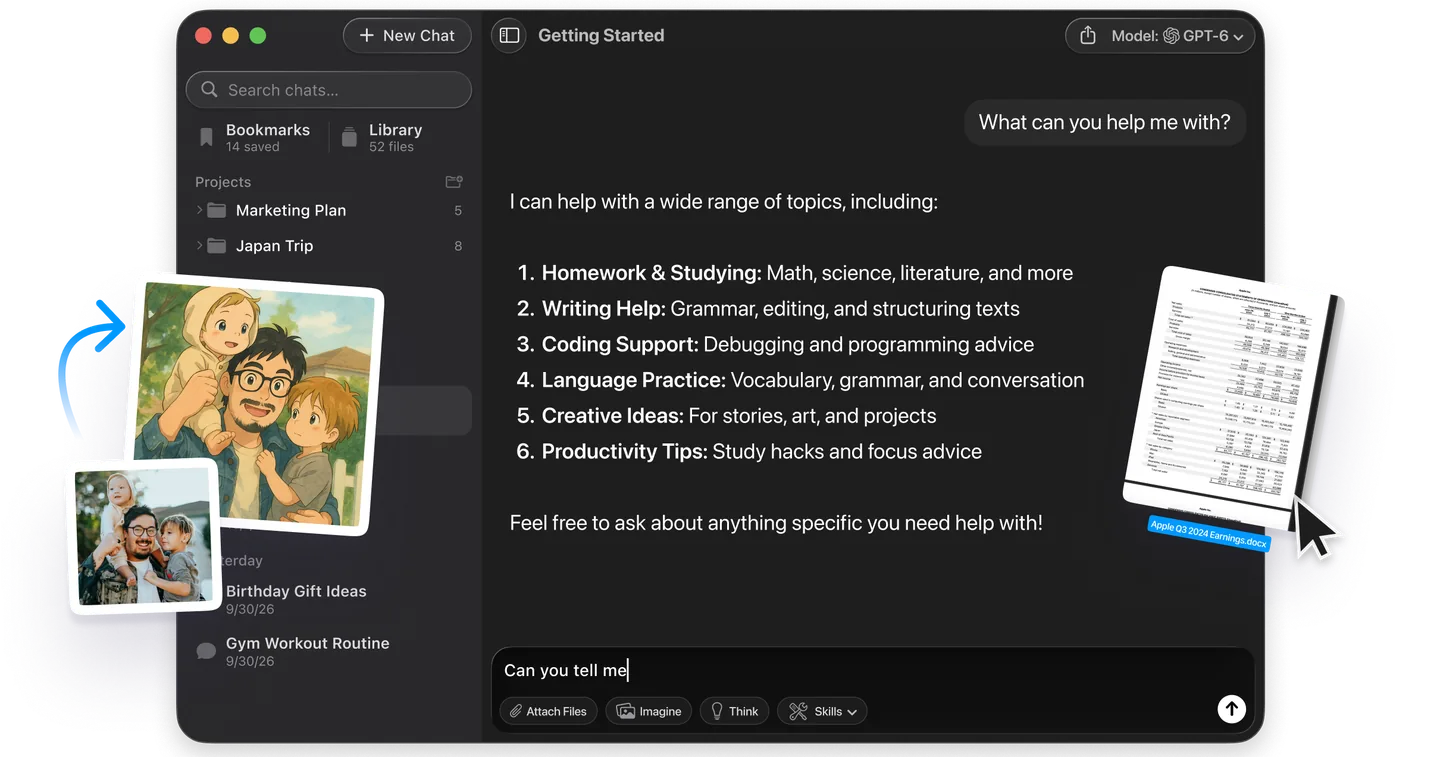
Of everything here, this is the one that closes the most gaps at once. Gemini Notebook has no Mac build and runs a single model. Fello AI is a native Mac app that runs every major model, including ChatGPT, Claude, Gemini, Grok and Nano Banana. Point two of them at the same PDF, ask the same question, compare the answers.
Press ⌥ Space anywhere on your Mac and it opens over whatever you are working on, which is the part a browser tab structurally cannot do. It reads the files people actually have, meaning PDFs, Word documents, spreadsheets, slide decks and folders of code, and our guide to chatting with your own PDFs on a Mac walks through that workflow.
It also covers the feature most people assume they would lose. The Podcast Skill turns a PDF, a link or your own notes into a two-host episode you can play back, set to the length of your commute, which is the same job Audio Overviews do. Unlike Gemini Notebook, it runs on Mac, iPhone and iPad rather than mobile alone. You can try Fello AI on the App Store.
Fello AI is our own app, so the disclosure matters, and so does the one real difference. Gemini Notebook answers strictly from the sources you gave it and cites them. Fello AI is a general assistant that reads your files, so it will also answer from what the model already knows. If locked-down source grounding is the reason you picked the notebook, that distinction is the one to weigh.
Claude Projects, for the source cap
Claude Projects is the closest structural match. You create a workspace, load documents into project knowledge, and every chat inside it starts with that context.
The important difference is that Anthropic does not cap you by file count. Its help centre explains that when project knowledge approaches the context limit, Claude switches on retrieval mode to expand capacity by up to ten times. The ceiling is about total volume, not a file tally.
Anthropic’s documentation states that free users can create up to five projects, which is enough to test the idea properly before paying. Our full write-up of how Claude Projects works and what the caps really are covers the details.
Open Notebook, for privacy and model choice
If your objection is that research material leaves your machine at all, this is the answer. Open Notebook is MIT licensed and describes itself as a private, multi-model, fully local alternative to Notebook LM. It keeps the shape you already know, which is sources in, chat and notes and multi-speaker podcasts out, and it runs on your own hardware.
It also solves the single-model problem outright. The project supports well over a dozen providers, including OpenAI, Anthropic, Google, Mistral, DeepSeek, xAI and local models through Ollama. The trade-off is honest: this is self-hosted software, so you are the one running Docker and holding the API keys.
Perplexity and Elicit, for research the notebook will not do
These two fix the grounding boundary from opposite ends. Perplexity is built to go and find sources with citations, which is precisely what Gemini Notebook declines to do, so it is the better first stop when you do not yet have the documents. Elicit works the other way, searching academic literature specifically, and it has a free tier built on one-time credits that is enough to run a real question through it.
Neither is a full replacement. Once you have collected the material, you still want something that reads only that material, which is the job Gemini Notebook does well.
ChatGPT Projects, for keeping it in one chat
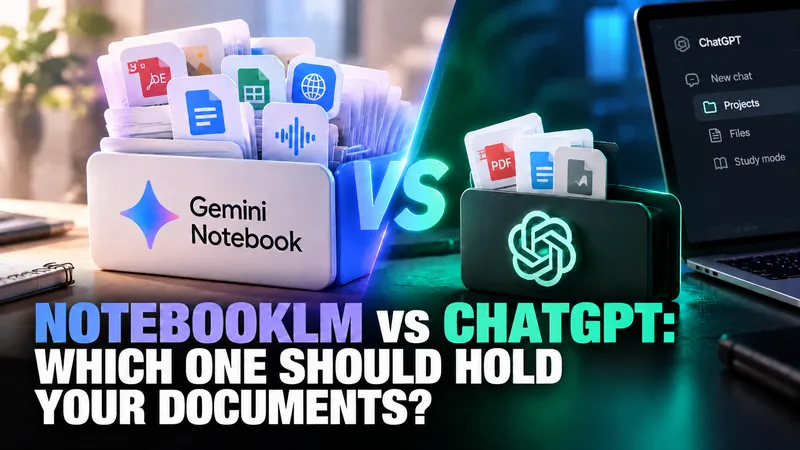
If the notebook metaphor itself is the friction, and you would rather your documents just lived in the assistant you already use, ChatGPT Projects is the least disruptive move. It is weaker at strict source grounding than Gemini Notebook, and it will happily answer from general knowledge, so it suits drafting and thinking more than it suits citation work. Our NotebookLM vs ChatGPT comparison puts the two side by side, from file limits to study tools.
When You Should Stay on Gemini Notebook
Nobody writing one of these lists has any incentive to tell you this, so here it is. Stay if the caps are your only issue and a paid tier clears them, because migrating costs more time than the upgrade costs money. Stay if strict grounding is the reason you chose it, since most alternatives will also answer from general knowledge and that is exactly the failure mode you were avoiding.
The honest test is whether you can name the specific thing you cannot do. If you can, the table above points at the fix. If you cannot, you are probably shopping rather than solving a problem, and the free tier limits are worth checking first in our breakdown of what the free tier actually restricts. If you are staying, our guide to NotebookLM prompts is the fastest way to get more out of it.
Which NotebookLM Alternative Should You Pick
For most people leaving Gemini Notebook, the answer is Fello AI. Two complaints drive people out: the missing desktop app and the single locked model. It is the only option here that fixes both, and it keeps the podcast output you would otherwise give up. It runs on iPhone and iPad too, where Gemini Notebook is mobile-only and a browser tab everywhere else.
The rest are specialists, and they win where they are pointed.
Take Claude Projects if the source cap is your single problem and you want the same working style. Run Open Notebook if the material must never leave your own hardware. Reach for Perplexity when you still have to find the sources, or Elicit when those sources are academic papers. Use ChatGPT Projects if you would rather your documents just lived in the assistant you already open.
And if strict source grounding is the whole reason you chose the notebook, stay where you are. A rename is not a reason to move. If you are weighing the underlying models rather than the apps around them, our comparison of the best AI models is the better starting point.
Frequently Asked Questions
Is Gemini Notebook the same as NotebookLM?
Yes. Google renamed NotebookLM to Gemini Notebook on 16 July 2026. Google described it as the same standalone research product, and told administrators that automatic redirects would keep existing shared notebooks and links working. Nothing was discontinued, and your old notebooks are still there under the new name and logo.
Is there a free NotebookLM alternative?
Yes, two kinds. Claude Projects is free for up to five projects and is the closest match in how it works. Open Notebook is MIT licensed and free to run yourself, with the trade-off that you host it and supply your own API keys. Perplexity and Elicit both have free tiers, but they find sources rather than reason over a fixed set.
Does Gemini Notebook have a Mac app?
No. Google publishes a Gemini Notebook app, but its App Store listing covers iPhone and iPad only, with no Mac build. On a Mac you use it in a browser. The separate Gemini app for Mac that launched in April 2026 is a different product, and Google’s announcement of it does not mention notebooks. If a real Mac app is what you want, Fello AI is the closest replacement, and it runs on iPhone and iPad as well.
How many sources can one notebook hold?
Fifty on the free Standard tier, 100 on Plus, 300 on Pro, and between 500 and 600 on Ultra depending on the storage plan. Daily chats scale the same way, from 50 on free up to several thousand on Ultra. Google publishes these figures and marks them as subject to change, so check before you plan around them.
Can I use Claude or GPT instead of Gemini on my own documents?
Not inside Gemini Notebook, which runs Gemini only. You need something model-agnostic. Fello AI is the simplest route, since it runs ChatGPT, Claude, Gemini, Grok and others against the same file inside one Mac app, so you can compare two answers on the same document. Open Notebook does it too, if you would rather self-host and bring your own API keys.