The short version: Use Apple Intelligence for private on-device rewrites and summaries. Use ChatGPT for Mac, Fello AI, or Raycast as a global “Ask AI” hotkey (⌥Space). Make Shortcuts that generate daily briefings, summarize PDFs, and send meeting notes to your task manager.
| Feature | Details |
|---|---|
| Native AI | Apple Intelligence (macOS Sequoia 15.1+ on M-series Macs) |
| Top Launchers | Raycast, Alfred, Keyboard Maestro |
| Key Shortcut | Option (⌥) + Space (ChatGPT default) |
| Best For | Summaries, Coding, Email, Meetings |
| Privacy | High (On-device for Apple Intelligence) |
(Note: While ⌥Space is the default for ChatGPT, similar global hotkeys can be mapped Fello AI to suit your workflow.)
Privacy Note:
- Apple Intelligence runs primarily on-device and uses Private Cloud Compute for heavier tasks, with strong privacy guarantees.
- Third-party AI apps like ChatGPT and Otter send data to their own servers. Always review their privacy policies and choose where to keep sensitive information.
With these privacy considerations in mind, let’s look at how these tools fit into your daily workflow.
Opening
It is 2026, and using artificial intelligence on a Mac is no longer just about chatting with a bot in a web browser. If you are new to Apple automation, our guide on how to use Siri Shortcuts covers the basics before you build the Mac workflows below. Today, AI is woven directly into the operating system, allowing you to fix grammar, summarize emails, and organize files without ever copying and pasting. Whether you are a student trying to study faster or a developer writing code, setting up a few smart workflows can save you hours every week.
This guide covers:
- How can you set up the global “Ask AI” command bar?
- Which workflows combine Apple Intelligence with third-party apps?
- What are the best shortcuts to automate boring administrative tasks?
The Key Takeaways
- Apple Intelligence is the foundation: It handles privacy-centric tasks like rewriting and summarizing directly on-device.
- One hotkey rules them all: Mapping a global key (like ⌥Space) to ChatGPT, Fello AI, or Raycast creates an instant “brain” layer over any app.
- Meetings don’t need scribes: Tools like Otter and Notion AI now automate transcription, summaries, and action items effortlessly.
- Context is king: The best 2026 shortcuts read what is currently on your screen (PDFs, code, emails) to give relevant answers.
Now that we have covered the high-level benefits, let’s dive into the essential tools you need to get started.
Mac AI Automation Basics
In 2026, automation on the Mac rests on three main pillars:
- Apple Intelligence: Built into macOS Sequoia 15.1+ (on M-series Macs) to handle system-wide tasks like writing tools and notification summaries securely.
- Power Launchers: Apps like Raycast and Alfred that act as the glue between apps, allowing you to run scripts and AI commands instantly.
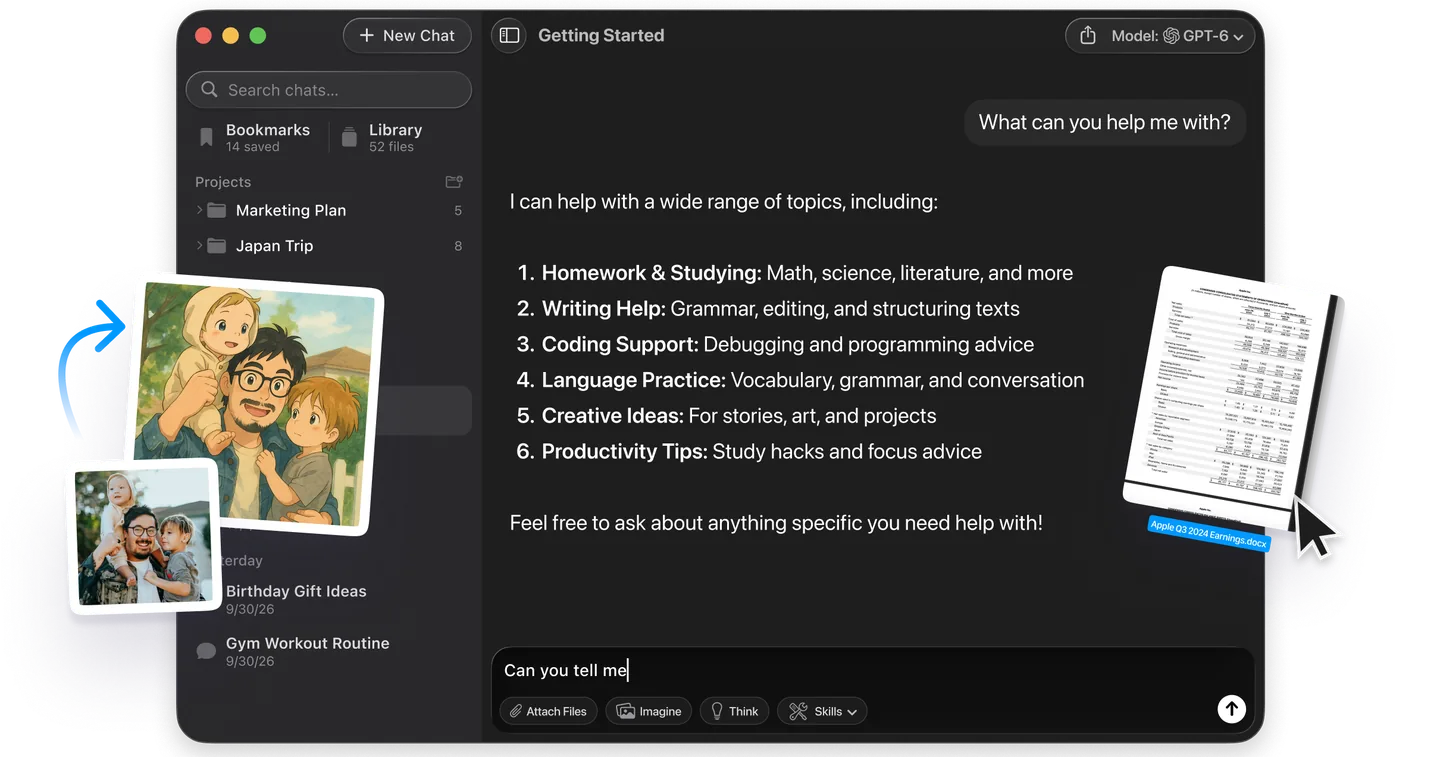
- Dedicated AI Tools: Apps like the ChatGPT desktop app or Fello AI that provide heavy-lifting for creative work, research, and file-based chats. Fello is a native Mac app that lets you use multiple top AI models (like ChatGPT, Claude, Gemini, or Perplexity) in one place and chat with PDFs, images, and screenshots without juggling browser tabs.
Getting started requires simple ingredients:
- A Mac with Apple Silicon (M-series) running macOS Sequoia 15.1 or later.
- The Shortcuts app (pre-installed).
- Optional third-party tools like Raycast or OpenAI’s desktop client.
Note: On macOS 15.3 and later, Apple Intelligence is enabled by default on compatible Macs, but you can always turn specific features off in Apple Intelligence & Siri settings.
1. Global Ask-AI Hotkey on Mac
The most impactful change you can make is setting up a “Global Command Bar.” This allows you to hit a single key, type a question, and get an answer without switching windows. It essentially turns your computer into a thinking partner that is always one keypress away.
Setting Up ChatGPT for Mac
The official desktop app from OpenAI has become a staple for Mac users because it integrates deeper than the web version ever could.
- Install the App: Download the ChatGPT for Mac desktop app.
- Verify the Shortcut: The default shortcut is usually Option (⌥) + Space.
- Activate: Press it to bring up a floating bar over your current work (Word, VS Code, Browser).
- Interact: It can work with whatever’s on your screen – you can share selected text, screenshots, or files from the active app to get instant help.
Once this is active, you have a powerful AI assistant ready to assist with any task on your screen.
Using Fello AI
If you prefer a multi-model chat hub, you can wire Fello AI into a similar global hotkey and summon any of your connected models (like Claude or Gemini) next to your current app. This prevents the distraction of opening a web browser just to ask a simple question. If you are still choosing, our roundup covers which menu bar app to put on that hotkey.
2. One-Click Rewrite & Tone Changer
We all spend too much time polishing emails or reading long documents. You can automate this using AI writing tools for Mac. A popular setup is the “One-Click Rewrite.” Instead of manually editing text, you select it and trigger a shortcut that runs it through an AI model to fix tone or grammar.
Apple Intelligence writing tools on Mac allow you to right-click any text field to proofread or rewrite without setting up a custom shortcut. However, for more control, you can create a custom Shortcut:
- Trigger: Set a keyboard shortcut (e.g.,
⌃⌥⌘W) to run a specific modification. - Action: Use the “Use Model” Apple Intelligence action. Feed it the selected text, and prompt it to rewrite (e.g., “Rewrite this to be more concise”).
- Result: The text is replaced instantly in your active window.
Example: Build a ‘Polish My Text’ Shortcut
- Open Shortcuts → New Shortcut.
- Add Get Selected Text (or take from clipboard).
- Add Use Model → Select ‘On-Device’ and prompt: “Rewrite this text to be clearer, shorter, and friendlier. Keep the meaning.”
- Add Copy to Clipboard (or Replace Text if available).
- Assign a keyboard shortcut like
⌃⌥⌘Win the Shortcut settings sidebar.
Third-Party Route
For more creative rewrites (like “Make this sound like a pirate”), you can use FelloAI or a custom Shortcut that calls the ChatGPT API:
- Select Text: Highlight the paragraph you are struggling with.
- Run Shortcut: Trigger “Tone Changer.”
- Prompt: The shortcut sends the text with the prompt “Rewrite this to be more professional.”
- Paste: The result is automatically pasted back into your email client.
This simple automation saves you from constantly switching context just to refine a quick email.
3. Daily Briefing Automation
Imagine sitting down at your desk and having a generated summary of your day waiting for you. A daily briefing shortcut using Apple Intelligence can fetch your calendar events, unread VIP emails, and top reminders. It then passes this data to a model to generate a natural language paragraph.
You can do this directly in the Mac Shortcuts app:
- Find Calendar Events: Set the filter to “is today.”
- Find Reminders: Set the filter to “is incomplete” and “due today.”
- Get Text: Combine these inputs into a text variable.
- Use Model: Pass the text to Apple Intelligence or ChatGPT with the prompt: “Summarize my day in 3 bullet points and warn me of any conflicts.”
- Show Notification: Display the result on your screen or append it to a daily note.
This workflow turns raw data into actionable advice, like “You have a tight turnaround between your 2 PM and 3 PM meetings.”
4. Summarize Page/PDF Research Pipeline
Research often involves drowning in open tabs and PDFs. This summarize-PDF-with-AI pipeline on Mac is perfect for students and researchers. You can turn a 50-page paper into a 7-bullet summary and 3 quiz questions in seconds. If you would rather compare the tools first, we ranked them in our guide to the best AI PDF readers.
The Workflow
- Input: Share a PDF or web article from Safari to the Shortcuts app.
- Action: Use the “Summarize Text” action (powered by Apple Intelligence) or pass the text to a ChatGPT action.
- Output: Save the bullet points directly to Apple Notes or Obsidian.
This is distinct from general summarization because it handles large files and formats the output specifically for your knowledge base.
Using Fello as your research hub
If you prefer one AI hub instead of multiple browser tabs, you can also send those PDFs or copied text directly into Fello AI. Because Fello runs natively on macOS and supports chatting with documents and screenshots, it works well as the “front-end” for this summarize-PDF-with-AI pipeline—especially if you want to compare answers from different models in the same window.
5. Automated Meeting Notes with AI on Mac
Meetings are often where productivity goes to die. In 2026, AI meeting assistants on Mac ensure you never have to scramble to write down what was said.
The Tools
- Otter.ai: Excellent for pure transcription and distinguishing between speakers. It can connect to your calendar to auto-join Zoom or Teams calls.
- Notion AI: If you live in Notion, its meeting assistant can summarize notes and immediately generate “Next Steps” checklists inside your project pages.
- Apple Notes: On Macs with M-series chips, Notes can record and transcribe audio directly in a note. With Apple Intelligence turned on, you can then generate a summary of that transcript in one click.
With your tools selected, the next step is connecting them to your task management system.
The Automation
- Capture: The app transcribes audio in real-time.
- Process: AI analyzes the transcript for “Action Items” and “Decisions Made.”
- Action: A shortcut or integration automatically pushes these tasks into your To-Do list (Reminders, Things, or Asana).
This AI note taking strategy on Mac ensures you never miss a follow-up task while staying fully present during the conversation. For a ranked look at the apps themselves, see our guide to the best AI note takers.
6. Voice-Driven Mac Automations
Siri has evolved from a basic assistant to a complex automation handler thanks to Apple Intelligence. You can now chain commands together using natural language.
Example Commands
- “Hey Siri, summarize the last email from John and draft a reply saying I’m interested.”
- “Hey Siri, turn these photos into a PDF and email it to Sarah.”
These commands work because Apple Intelligence lets Siri use more context from your apps and data, not just simple keywords.
Because Apple Intelligence lets Siri act across apps and use personal context, in many cases it can understand requests like “summarize the last email from John.” For edge cases, you can always fall back to a custom Shortcut triggered by a voice phrase.
7. Raycast & Keyboard Maestro Macro Chains
For those who want to go beyond Apple’s guardrails, Raycast and Keyboard Maestro offer “Macro Chains.” These are sequences of actions that can be triggered by a single keyword, often guided by AI decisions.
Scenario: Publishing a Blog Post
- Trigger: You type publish in Raycast.
- Step 1: The automation grabs your Markdown file from Obsidian.
- Step 2 (AI): It asks AI to generate an SEO-friendly title and a 160-character meta description based on the content.
- Step 3: It renames the file, moves it to your website’s folder, and pushes the changes to Git.
This moves from “dumb” automation (just moving files) to “smart” automation (understanding content).
8. AI Shortcuts for Developers
For technical users, AI shortcuts for developers on Mac have transformed IDEs into intelligent copilots. Tools like GitHub Copilot Xcode Mac or Cursor allow you to generate code, write tests, and refactor functions using simple keyboard commands.
IDE Integrations
- Xcode: With Copilot integration, you can type a comment like // function to fetch user data and hit Tab to see the implementation.
- Cursor: This AI-first editor lets you highlight code and hit Cmd+K to ask “Where is the bug here?” or “Refactor this to be more readable.”
- Terminal: Tools like generic CLI AI wrappers allow you to ask “How do I untar this file?” and get the exact command ready to execute.
By integrating these shortcuts, you spend less time on boilerplate code and more time solving complex logic problems.
9. Screenshot to Data (OCR)
Another massive time-saver is the Mac screenshot shortcuts powered by AI. We often take screenshots of data that we can’t copy-paste, like text inside a video or a chart in a presentation.
The Workflow
- Trigger: Take a screenshot of a table, error message, or receipt.
- OCR: A folder action or shortcut triggers Optical Character Recognition to extract the text.
- AI Analysis: The text is passed to an AI model with a prompt like “Convert this table to CSV format” or “Explain this error message.”
- Result: The clean text or explanation is copied to your clipboard.
Device Tip: If you use an iPhone, these shortcuts sync via iCloud. You can take a photo of a document on your phone, and the Apple Intelligence shortcuts on your Mac can process and file it instantly.
10. Personal Knowledge Base Management
Finally, your Mac can act as a “Second Brain” that actually thinks. By combining tools like Obsidian or Notion with AI, you can retrieve information semantically, not just by keyword matching.
Instead of searching for “meeting notes March 12,” you can ask your system: “What did we decide about the marketing budget last month?” AI tools connected to your notes can scan the content, synthesize the answer, and link you to the source documents.
When you write a new note, AI plugins can suggest: “This seems related to your Project X idea from last year,” helping you connect dots you might have missed.
Conclusion
In 2026, Mac AI automations have moved beyond novelty to become essential productivity tools. By setting up just one or two of these shortcuts, like the Global Command Bar or the Daily Briefing, you can reclaim hours of your life every week.
Next Step: Open your Shortcuts app today and try building the “One-Click Rewrite” shortcut using the standard Apple Intelligence actions to see how easy it is.
FAQ
What are the best AI shortcuts for Mac in 2026?
The most valuable AI shortcuts on Mac in 2026 are a global Ask-AI command bar, a one-click rewrite shortcut, a daily briefing, and automated meeting notes.
How do I use Apple Intelligence to automate my Mac?
You can use the Shortcuts app to build workflows that utilize the “Use Model” or “Summarize” actions. These run natively on your Mac to process text, images, and notifications without sending data to the cloud.
Is the ChatGPT Mac app better than the web version?
Yes, for automation. The desktop app supports global hotkeys (Option+Space) and can work with whatever is on your screen when you share it, making it much faster for context-aware tasks than a browser tab.
Can I use Fello AI instead of the ChatGPT Mac app?
Yes. Fello AI is a native Mac app that lets you connect to multiple AI providers (ChatGPT, Claude, Gemini, Perplexity, and others) from one place. If you often switch between models, or want to chat with PDFs and screenshots in a single multi-model inbox, Fello can replace a browser-only workflow or live alongside the official ChatGPT app.
Do AI shortcuts on Mac work offline?
Yes, providing you are using on-device models. Apple Intelligence actions and certain local LLMs (via apps like Ollama) can run offline. Shortcuts that call ChatGPT or other web APIs will require an internet connection.
How do I automatically summarize PDFs with AI on my Mac?
Create a shortcut that accepts “PDF” as input. Add an action to “Get Text from PDF,” then pass that text to an AI summary action (Apple or ChatGPT), and save the result to Notes.
Methodology & Sources
We analyzed the top automation trends and software capabilities available in the 2026 ecosystem to curate this list.
- Testing: Workflows were tested on macOS Sequoia 15.x, ChatGPT for Mac, and Raycast Pro, and extrapolated to 2026 based on Apple’s announced Apple Intelligence and Shortcuts roadmap.
- Criteria: Shortcuts selected had to save measurable time (minimum 5+ minutes per use) and be accessible to non-coders.
- Sources:
These criteria ensure that every recommendation in this guide is practical, reliable, and ready for daily use.