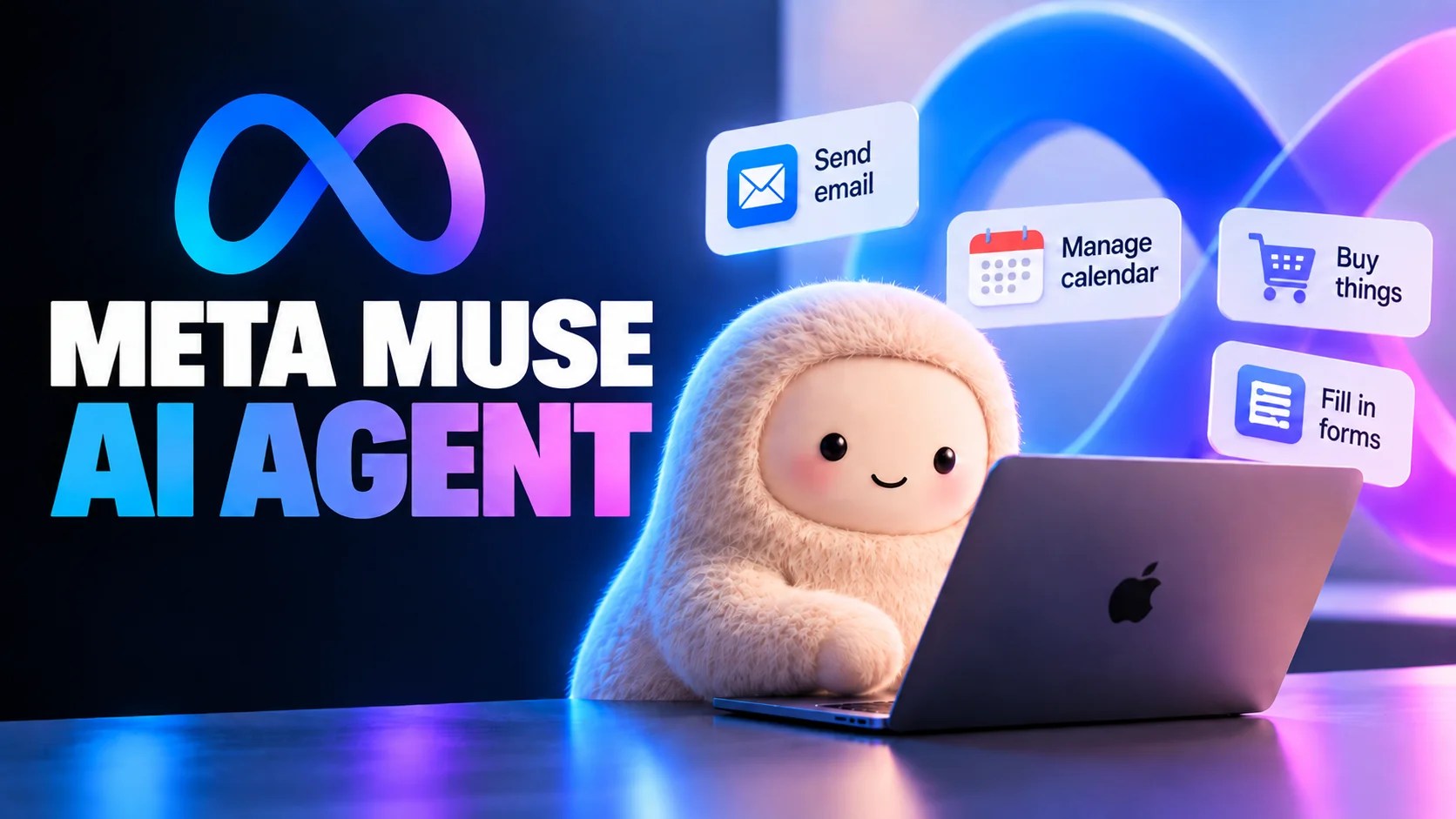
Meta launched Muse on 8 September 2026, and within ten days it had pushed ChatGPT off the top of the US App Store. The Meta Muse AI agent does not just answer questions. It sends email, books tables, fills in forms and buys things for you, from a cloud computer Meta runs on your behalf.
That is a bigger ask than any chatbot has made, because Muse only works once you connect your inbox, your calendar and a way to pay. Below: what Muse is and how it differs from the Muse Spark model and the Meta AI app, and what the free tier and the $20 and $100 plans get you. Then the new Mac app, what Meta added at Connect on 23 September, and where Muse still falls over.
The Key Takeaways
- What it is: Muse is Meta’s personal AI agent, launched 8 September 2026 on iPhone, Android, muse.ai and WhatsApp, and powered by the Muse Spark model.
- What it costs: free for up to 100 million tokens a week, then Power at $20 a month (500 million Muse tokens a week) or Maximum at $100 a month (3 billion a week).
- How it works: every user gets a Muse Secure VM, a dedicated cloud computer with its own browser, plus a separate Sentinel agent that has to approve anything Muse sends to the internet.
- On a Mac: a separate desktop app, downloaded from Meta and not the Mac App Store, can read Messages, Calendar and Notes, and since Connect it can drive any app on your Mac.
- Where it breaks: Amazon blocks it outright, and CNN’s hands-on test caught it recommending restaurants that had closed years earlier.
What Is the Meta Muse AI Agent?
Muse is an AI agent. Meta’s launch post says it “doesn’t just answer questions, it actually does the work.” You tell it what needs doing, the way you would message a person. It works out the steps itself: searching, opening websites, filling in forms, writing the email, and coming back to you when it needs a yes.
The difference from a chatbot is that Muse keeps going after you close the app. Ask it to watch for a price drop, chase a refund or rebook a table, and it keeps the task running in the background until something changes. Meta’s own examples include turning a recipe reel you saved on Instagram into a grocery list, selling a car for more, and lowering a bill.
Meta announced Muse with a short video on its official account the same day:
Introducing Muse, your personal AI agent from Meta that gets things done across every part of life.
— Muse (@Muse) September 8, 2026
Download the Muse app and get started: https://Muse.ai
Muse, Muse Spark and Meta AI are three different things
Meta has put the Muse name on a lot of products this year, and search results often mix them up. Muse is the agent app. Muse Spark is the model underneath it, the model line Meta Superintelligence Labs introduced in April. Meta AI is the older assistant app built into Facebook, Instagram and WhatsApp. It also runs on Muse Spark, but it chats rather than acting for you. Since October 12, 2026 there is also Muse Wonder, a larger model line that Meta says will power Muse for subscribers first.
| Muse | Muse Spark | Meta AI | |
|---|---|---|---|
| What it is | Personal agent app | AI model family | Chat assistant |
| What it does | Takes actions: email, bookings, forms, purchases | Powers Muse, Meta AI and Meta’s API | Answers questions, makes images |
| Where you use it | Muse app, muse.ai, WhatsApp, Mac app | Inside other products | Meta’s apps, meta.ai, its own Mac app |
| Price | Free with a limit, $20 or $100 a month | API pricing | Free |
How Muse Works: Secure VM, Sentinel and Approvals
The part of Muse that matters most is also the part Meta spent longest explaining, because an agent that can spend your money needs more than a privacy policy.
Your own cloud computer
Every user gets a Muse Secure VM. Meta’s product page describes it as “a persistent, isolated Linux computer with a full browser that you and your agent can use to complete tasks.” The agent lives there, and so do the data and logins for any service you connect. Because it is a real browser on a real machine, you can watch Muse click through a website and take over at any point. CNN’s reviewer had to do just that when a checkout needed details typed by hand.
Alongside Muse on the same machine runs a second program Meta calls the Sentinel. It is kept apart from Muse at the system level. In Meta’s words, “Nothing Muse does reaches the internet unless the Sentinel approves it.” Muse does the work, and a second, separate program decides what is allowed to leave the machine.
What Muse can and cannot see
Passwords and card details go into a separate credential store that Muse can use but not read. When it checks out, it pays through Link by Stripe, which generates a one-time card number so neither the agent nor the merchant sees your real card. Meta says Muse is the first AI agent covered by Link’s purchase protections, which cover damaged or lost items, price drops and returns on eligible purchases.
On data, Meta makes three commitments. Your Muse conversations and VM data are not shared with Meta’s ad systems. You can opt out of your interactions training Meta’s models. And you can tell Muse to forget specific things. A stronger version, Muse Confidential VM, is promised for later this year. It encrypts the whole machine with a key only you hold, “so not even Meta can access it.” Until it ships, the promise implies, Meta itself can still reach your VM. For now you are relying on its policy.
Approvals and the audit trail
You pick which apps Muse connects to and how far each one goes. For email, for example, you decide whether Muse can only read your mail or can also send it. Before a sensitive action such as sending a message, making a purchase or sharing data with a connected app, Muse asks, and you can allow it once, always allow it, or deny it. Everything it has done, and everything it plans to do, is kept in an activity log you can review.
How Much Does the Meta Muse AI Agent Cost?
Muse is free up to a usage limit. When you hit it, Meta’s help center gives you two options: wait for the limit to refresh, or upgrade. Meta describes the two paid plans only by their weekly allowance:
| Plan | Price | Weekly allowance |
|---|---|---|
| Free | $0 | Up to 100 million tokens |
| Power | $20 a month | 500 million Muse tokens |
| Maximum | $100 a month | 3 billion Muse tokens |
The prices come from Meta’s Muse subscriptions page. Both plans renew monthly, and you have to be 18 or over to subscribe. The help page does not give a free allowance, but Zuckerberg put it at “up to 100M tokens per week” in his launch post on X. Meta does not say how many Muse tokens a typical task uses, so there is no honest way yet to turn “500 million a week” into a number of bookings or emails. The app shows a meter with the percentage of your allowance left, which is the only practical guide.
One thing to know before you install it: TechCrunch reported at launch that Muse asks for a payment card to get started, even on the free tier, although some later guides say otherwise. Zuckerberg was open about why the free tier exists. At Connect he said Meta is making Muse “free for a huge number of tokens, with the expectation that over time we will profit by taking a small fee from transactions.” The business model is a cut of what Muse buys for you, not ads.
Where You Can Use Muse
At launch Muse was US only, on iPhone, Android and the web at muse.ai. On 18 September iPhone in Canada reported that it had reached Canada on iOS and the web, citing a post from Meta, with Android to follow. Meta’s help center only says the Muse app and website “are not yet available everywhere”, and there is no word on the UK or the EU.
Muse on iPhone and Android
The phone app is where most people meet Muse, and it is the one that topped the charts. According to Sensor Tower figures reported by CNBC, it passed 2.5 million downloads in its first 13 days. Over their own first 13 days, ChatGPT managed 3.1 million, Claude 400,000 and Grok 200,000. The App Store listing carries an 18+ age rating.
Muse on WhatsApp
Meta also lets you talk to your Muse “directly in WhatsApp”. It is the least effort of any surface: no new app to install, and the agent replies in the same chat list as your friends.
Muse on Mac
The Mac app arrived on 17 September. Meta’s download page says it “organizes files, fills out forms, and pulls from Messages, Calendar and Notes, all with your permission.” It is a direct download from Meta’s servers, not a Mac App Store app. The iOS listing is marked “Only for iPhone”, so installing Muse on a Mac means trusting a DMG file from Meta and granting it macOS permissions yourself.
At Connect, Meta added the feature that makes the Mac version different from the phone: computer use. Chief AI officer Alexandr Wang announced it on stage and on X. With your permission, Muse can now operate any app on the Mac, not just the ones it has a connector for.
MUSE FEATURE ALERT: muse for mac now has computer use! queue up your jobs, walk away, and it keeps going.
— Alexandr Wang (@alexandr_wang) September 24, 2026
muse loves laptop ♥️
This is not the same program as the Meta AI Mac app, which is a chat assistant. Meta now ships two Mac apps with overlapping names, and only Muse can act on your behalf. SpaceXAI’s Grok Bot for Mac and iPhone takes the same cloud-computer approach, and our round-up of the best AI agents we tested covers the rest. OpenAI joined on 29 September 2026 with dots, always-on agents inside ChatGPT, which start at $100 a month on ChatGPT Pro.
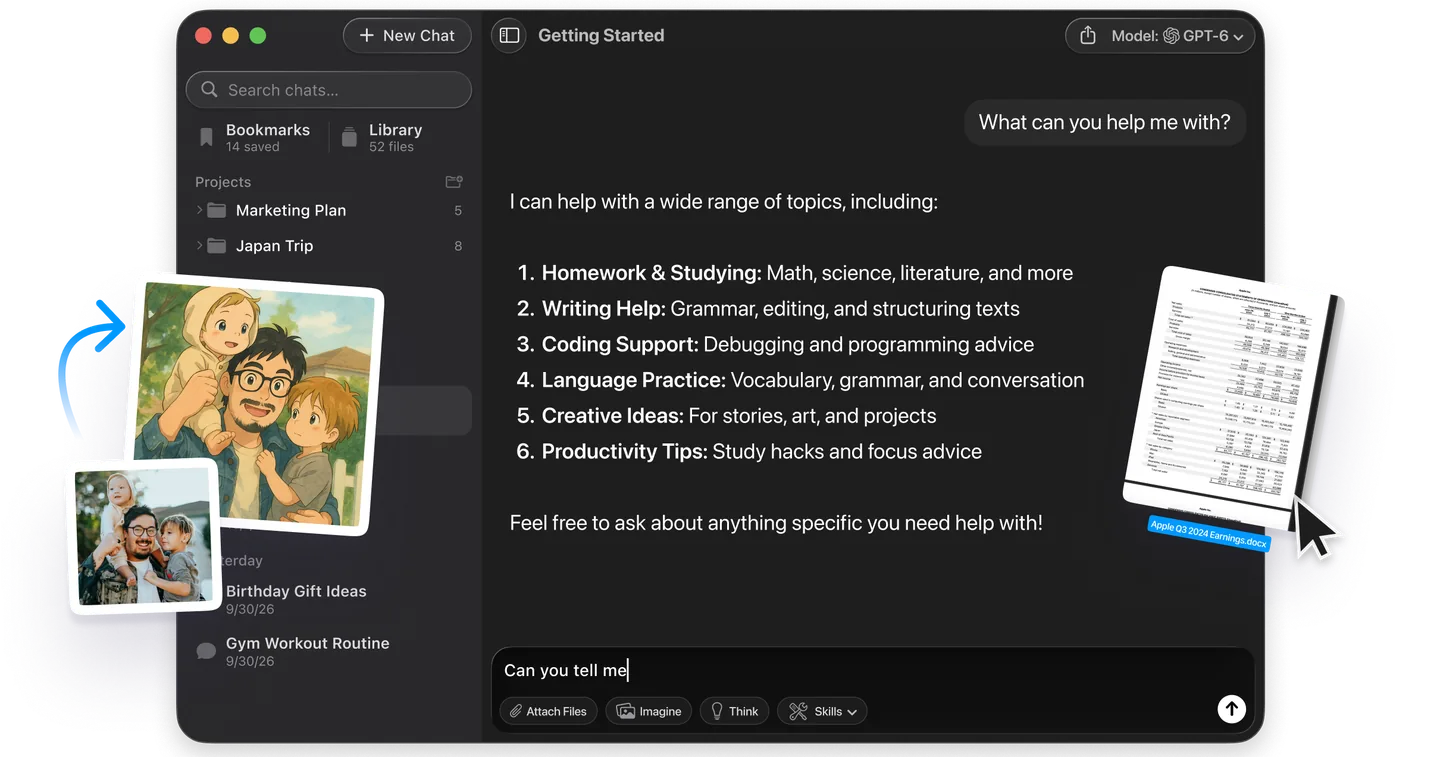
Not every job needs an agent with access to your Messages, though. Maybe what you actually want on your Mac is a fast way to ask ChatGPT, Claude, Gemini or Grok a question, summarise a PDF or draft a document. Fello AI puts those models in one native app without connecting your accounts to anything.
What Meta Added to Muse at Connect 2026
Muse was the centre of Meta’s Connect keynote on 23 September, and Meta’s own recap lists more than the Mac update.
Shopping connectors
Muse launched with dozens of connectors and access to the whole Shopify catalogue. Meta has now added Walmart, Best Buy, American Eagle Outfitters, DICK’S Sporting Goods, Fanatics, Gap, Michael Kors, Sephora, Ulta and Wayfair, plus Shop Pay and PayPal for payment. Meta lists Instacart for groceries, Expedia is coming soon, and on the work side there are connectors for Notion, Granola, GitHub and Box. Shopify’s CEO announced the checkout side of the deal two days before the keynote:
We are excited to announce we are partnering deeply with Muse to enable agentic checkout with Shop Pay on all Shopify stores, offering people an easy and delightful way to shop and check out with Muse.
— tobi lutke (@tobi) September 21, 2026
Voice, avatars, glasses and Muse Charm
The rest of the list is about reaching Muse in more places. A new voice mode lets you hold a long conversation while Muse works in the background, and you can design its voice just by describing it. Muse Realtime Avatar gives your agent a face you can video-call. In the coming months Muse is coming to Meta’s AI glasses, woken by saying its name, and it can act on whatever you are looking at. Muse is also getting its own email address, so you can copy it into a thread or forward it a job. Finally, Meta previewed Muse Charm, a pocket-sized device built only for talking to your Muse, with “more to share later this year.”
What Muse Gets Wrong
Meta’s own App Store listing carries the fairest warning: Muse might be “inaccurate or take unexpected actions, so check in to keep it on track and intervene as needed.” Early testing shows where that bites.
What CNN’s hands-on test found
In CNN’s hands-on review, Muse did well on planning: a day-by-day packing schedule for a move, an email to a friend about a trip, and a tidy Google Doc of the friend’s restaurant picks. When a shampoo purchase failed, it worked out why: the store sold only to licensed professionals. But when asked for date-night ideas, it suggested two neighbourhood places that had been closed for years. And although the app’s Ideas tab said Muse could haggle with Facebook Marketplace sellers, in the test it would only vet listings and draft a message for the reviewer to send. Meta told CNN the description is accurate within parameters the user sets.
Amazon blocks it, and others may follow
The biggest practical limit is outside Muse’s control. Amazon has blocked Muse from its store. As reported by Fortune, Amazon said that “continued access by an unauthorized AI agent violates Amazon’s Conditions of Use” and that Meta never asked permission. Target let Muse browse in CNN’s test but blocked its automated clicks at checkout. This is the same fight Amazon picked with Perplexity, covered in our look at Amazon and Perplexity Comet, and it means Muse shops best where a retailer has signed up as a connector.
Then there is trust. TechCrunch’s launch coverage argued that Muse “requires significantly more trust than social media ever did” and recounted Meta’s privacy settlements with the FTC. The Secure VM design is a serious answer, but the encryption that would keep Meta itself out has not shipped yet.
How to Set Up Muse Safely
Muse asks for a lot on day one. This order keeps you in control while you find out what it is good for:
- Install the app from the App Store or Google Play, or go to muse.ai, and sign in with your Meta account. Meta lets you create one with a Facebook or Instagram login, an email address or a phone number.
- Give your Muse one small, low-stakes job first, such as a packing list or a price watch, before you connect anything.
- Connect one service at a time. For email, start with read-only access and add sending later if you need it.
- When Muse asks to act, choose “allow once” rather than “always allow” for anything that sends a message or spends money.
- Open the activity log after each task to see what Muse did and what it plans to do next, and disconnect any service you stop using.
- If you do not want your interactions used to train Meta’s models, use the opt-out Meta offers for exactly that.
Is the Meta Muse AI Agent Worth Using?
For errands that take ten browser tabs and three emails (booking, comparing, chasing, cancelling), Muse is one of the easiest agents to start with. The free tier costs nothing to find out. Start with one connection, not five, keep purchases on approve-every-time, and treat anything it recommends from memory as a lead to check. If you are not comfortable handing Meta your inbox until Confidential VM ships, that is a reasonable line to hold, and you can turn Meta AI off across Meta’s apps in the meantime.
FAQ
Is the Meta Muse AI agent free?
Yes, up to a weekly limit that Zuckerberg put at 100 million tokens. Beyond that, Power costs $20 a month for 500 million Muse tokens a week and Maximum costs $100 a month for 3 billion.
Is Muse the same as Meta AI?
No. Meta AI is a chat assistant inside Meta’s apps. Muse is a separate agent app that takes actions for you. Both run on Meta’s Muse Spark model.
Is Meta Muse safe to use?
Meta keeps your passwords and card details in a store Muse cannot read, pays with one-time card numbers, and asks before sensitive actions. Your data still lives on Meta’s servers, and the encryption that would lock Meta out is promised for later this year.
Does Muse work on a Mac?
Yes. A free desktop app, downloaded from Meta rather than the Mac App Store, can work with your files, Messages, Calendar and Notes, and since 23 September it can operate other Mac apps with your permission.
Is Muse available outside the US?
It launched in the US only and was reported to have reached Canada on 18 September. Meta has not announced dates for the UK, the EU or anywhere else.