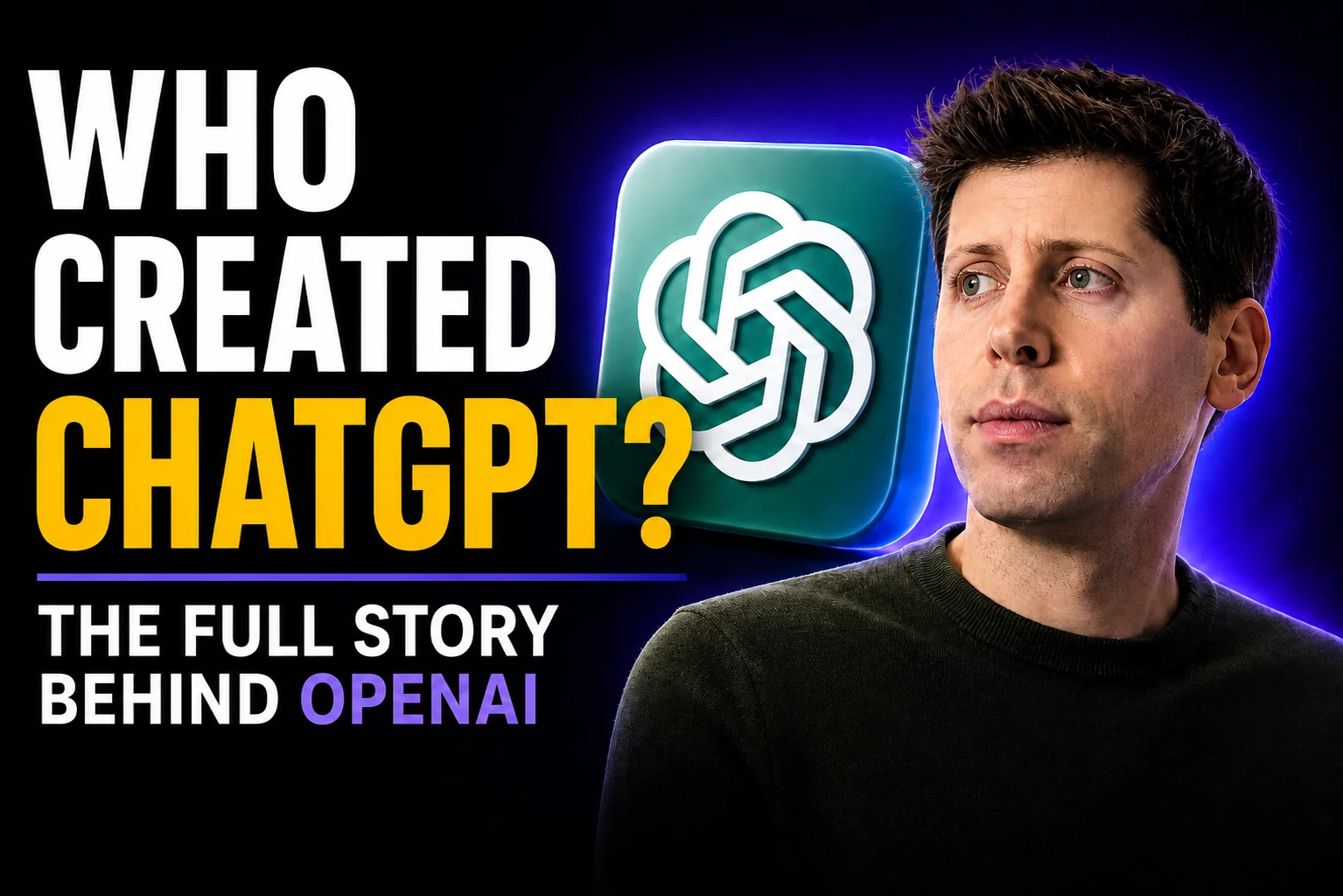
ChatGPT was created by OpenAI, an artificial intelligence research company founded on December 11, 2015 by Sam Altman, Greg Brockman, Ilya Sutskever, Elon Musk, Wojciech Zaremba, John Schulman and a small group of researchers. ChatGPT itself was built by OpenAI’s research team and launched publicly on November 30, 2022. It reached 1 million users in 5 days and 100 million monthly users in 2 months, the fastest consumer product adoption in history at that point.
The short answer is “OpenAI built it,” but the longer answer is more interesting. ChatGPT sat on top of a decade of work, a controversial Elon Musk exit, a Microsoft partnership worth tens of billions of dollars, a board firing of CEO Sam Altman, and a 2025 corporate restructure that changed who owns OpenAI. In 2026 the story added two more chapters: a jury threw out Musk’s lawsuit against OpenAI in May, and OpenAI said in August that ChatGPT serves more than 1 billion people every week. This guide covers the founders, the timeline, who owns ChatGPT now, and the answers to the questions people ask most.
The Key Takeaways
- OpenAI created ChatGPT. The company was founded on December 11, 2015 in San Francisco.
- Sam Altman, Greg Brockman, Ilya Sutskever, and Elon Musk are the four most prominent co-founders. Around 11 people are listed on the original founding team.
- ChatGPT launched on November 30, 2022 and hit 100 million monthly users in 2 months.
- OpenAI owns ChatGPT, and the non-profit OpenAI Foundation controls OpenAI. Microsoft received roughly 27% of OpenAI in the October 2025 restructure, then worth about $135 billion, but it does not control the company. OpenAI was valued at $852 billion in March 2026.
- Elon Musk co-founded OpenAI but left the board in February 2018. A jury rejected his lawsuit against OpenAI on May 18, 2026, and he now competes with OpenAI through his own AI lab, xAI.
Who Created ChatGPT? Meet the Founders of OpenAI
ChatGPT was built by OpenAI, but OpenAI itself was built by a small group of people who met at a private dinner in 2015. They wanted to keep artificial intelligence in a non-profit research lab instead of letting big tech control it. The result was OpenAI, formally announced as a non-profit on December 11, 2015 with $1 billion in pledged funding from a mix of individuals and tech companies, including Amazon Web Services, Infosys and YC Research.
The original founding team was eleven people, but four names dominate the public history: Sam Altman, Greg Brockman, Ilya Sutskever, and Elon Musk. Each played a distinct role in turning the lab into the company that eventually shipped ChatGPT.
| Founder | Role at founding | Background | Status in 2026 |
|---|---|---|---|
| Sam Altman | Co-chair, then CEO from 2019 | Former president of startup accelerator Y Combinator | CEO of OpenAI |
| Greg Brockman | Co-founder, CTO, then President | First CTO of payments company Stripe | President of OpenAI |
| Ilya Sutskever | Co-founder and Chief Scientist | PhD under Geoffrey Hinton; ex-Google Brain | Left OpenAI May 2024; now runs Safe Superintelligence Inc |
| Elon Musk | Co-founder and co-chair | CEO of Tesla and SpaceX | Left board Feb 2018; runs xAI; lost his lawsuit against OpenAI in May 2026 |
| Wojciech Zaremba | Co-founding researcher | PhD from NYU; ex-Google Brain and Facebook AI | Head of AI Resilience at the OpenAI Foundation since March 2026 |
| John Schulman | Co-founding researcher | PhD from UC Berkeley | Left OpenAI for Anthropic in August 2024; now chief scientist at Thinking Machines Lab |
| Andrej Karpathy | Founding research scientist | PhD from Stanford, former Tesla AI director | Joined Anthropic’s pre-training team in May 2026 |
A few names are less famous but worth knowing: Trevor Blackwell, Vicki Cheung, Pamela Vagata and Durk Kingma all signed on as part of the founding team. Reid Hoffman, Peter Thiel, Jessica Livingston and Y Combinator Research were among the original financial backers.
Sam Altman, the CEO who took ChatGPT to the world
If you ask “who is the founder of ChatGPT,” most people answer Sam Altman, and that is roughly accurate. Sam Altman, the CEO of OpenAI, has been the public face of the company since he took over as CEO in 2019. He had already spent five years running Y Combinator, the startup accelerator behind Airbnb, Stripe, and Reddit, before he turned full-time to OpenAI.
Altman is not the person who wrote the GPT model architecture, but he is the one who pushed OpenAI to release ChatGPT to the public in 2022, signed the multi-billion-dollar Microsoft deal, and steered the company through its restructure into a public benefit corporation in 2025. He was famously fired by the board on November 17, 2023 and reinstated five days later, after employee and investor pressure forced the board’s hand.
Greg Brockman, Ilya Sutskever and the technical core
Greg Brockman is the co-founder most people forget but who arguably built the engineering culture at OpenAI. He came in as CTO after serving as the first CTO of Stripe, and is now President of OpenAI. Ilya Sutskever was the chief scientist behind much of the deep learning research that led to GPT-3 and GPT-4. He left in May 2024 after the fallout from the Altman firing and now runs his own lab, Safe Superintelligence Inc.
Wojciech Zaremba and John Schulman were quieter but equally important on the research side. Schulman says on his own homepage that he led the creation of ChatGPT, and his team’s work on reinforcement learning from human feedback (RLHF) is what made ChatGPT feel conversational rather than robotic. Zaremba moved to the OpenAI Foundation in March 2026 to lead its AI resilience work. Founding research scientist Andrej Karpathy later left for Tesla to lead Autopilot, returned briefly, and in May 2026 joined Anthropic’s pre-training team.
Why Was ChatGPT Created?
OpenAI’s original mission was simple and ambitious. The founders wanted to build artificial general intelligence (AGI) that benefits all of humanity, and they wanted it built in the open instead of behind the walls of a single company. The non-profit structure was a deliberate hedge against a future where AI was controlled by Google, Microsoft, or any single corporation.
ChatGPT itself was not the original product plan. It was launched as a “research preview” of GPT-3.5 in November 2022, designed to gather public feedback on a chatbot that used reinforcement learning from human feedback. OpenAI staff reportedly expected modest traction; the explosive growth that followed redrew the company’s roadmap and pulled it into a commercial direction nobody had fully planned for.
The mission shift since then has been real. The non-profit still sits at the top, but OpenAI now ships paid products, takes outside investment, and runs its business through OpenAI Group PBC, a for-profit public benefit corporation that the non-profit controls. Sam Altman has repeatedly defended this as the only way to fund the compute costs of building AGI safely.
Timeline: From OpenAI’s 2015 Founding to ChatGPT in 2026
| Date | Event |
|---|---|
| December 11, 2015 | OpenAI founded as a non-profit with $1B pledged. Sam Altman and Elon Musk co-chair. |
| February 2018 | Elon Musk steps down from the OpenAI board citing a Tesla AI conflict of interest. |
| June 2018 | OpenAI publishes GPT-1, the first generative pre-trained transformer. |
| February 2019 | GPT-2 released, initially in restricted form over safety concerns. |
| March 2019 | OpenAI creates a “capped-profit” arm called OpenAI LP to attract investment. |
| July 2019 | Microsoft invests $1 billion and becomes OpenAI’s exclusive cloud provider. |
| June 2020 | GPT-3 launched via API; first commercial OpenAI product at scale. |
| November 30, 2022 | ChatGPT launches as a free research preview. |
| January 2023 | ChatGPT crosses 100 million monthly active users. |
| March 2023 | GPT-4 released; multimodal text and image input. |
| November 17, 2023 | OpenAI board fires Sam Altman; he is reinstated 5 days later. |
| February 2024 | Elon Musk sues OpenAI alleging breach of the original non-profit mission. |
| February 2025 | A Musk-led group offers $97.4 billion for OpenAI’s non-profit; the board rejects it. |
| October 28, 2025 | OpenAI completes restructure into a public benefit corporation (OpenAI Group PBC) under the OpenAI Foundation. |
| March 31, 2026 | OpenAI closes a $122 billion funding round at an $852 billion valuation. |
| April 23, 2026 | OpenAI ships GPT-5.5, its most capable model at the time. |
| April 27, 2026 | Microsoft-OpenAI partnership renegotiated; OpenAI’s revenue-share payments are capped and Microsoft’s IP licence through 2032 becomes non-exclusive. |
| May 18, 2026 | A jury in Oakland finds Musk sued too late, and the judge dismisses his case against OpenAI. |
| August 2026 | OpenAI says ChatGPT has more than 1 billion weekly active users. |
| September 3, 2026 | OpenAI launches GPT-6 Astra, the first GPT-6 model, in a staged rollout. |
Did Elon Musk Create ChatGPT?
No. Elon Musk co-founded OpenAI in December 2015 alongside Sam Altman and was a founding co-chair. He gave OpenAI $38 million over several years, according to evidence reported from his 2026 trial, and was deeply involved in the early strategy, including hiring debates and the public framing of the lab’s mission. He did not write any of the code behind ChatGPT, and he was not at OpenAI when ChatGPT was built.
Musk left the board in February 2018, citing a potential conflict of interest with Tesla’s growing in-house AI work on autonomous driving. The split was not entirely amicable. He later said he had wanted to take over OpenAI directly and merge it with Tesla, a proposal the rest of the founders rejected. Musk also reportedly cut off promised future funding when his takeover bid failed.
Musk now runs his own AI company, xAI, which builds the Grok chatbot, a direct ChatGPT competitor. In February 2025 he also led a $97.4 billion bid to buy OpenAI’s non-profit, which the board rejected.
How Elon Musk’s lawsuit against OpenAI ended
Musk lost. On May 18, 2026, a nine-member advisory jury in Oakland took less than two hours to decide unanimously that he had waited too long to sue, and Judge Yvonne Gonzalez Rogers adopted the finding and dismissed the case, as NPR reported. The jury never ruled on his core claim that Altman and Brockman broke a charitable trust, and his claim against Microsoft was dismissed too.
Musk first sued OpenAI, Sam Altman and Greg Brockman in February 2024, dropped the suit, and refiled it in federal court in August 2024. He sought up to $150 billion in damages for OpenAI’s non-profit and the removal of Altman and Brockman. His lawyers said on the day of the verdict that they would appeal the dismissal to the Ninth Circuit; no ruling on an appeal had been reported as of October 2026.
Who Owns ChatGPT and OpenAI in 2026?
OpenAI owns ChatGPT, and the non-profit OpenAI Foundation controls OpenAI. The product, the GPT models, the trademarks and the user data all sit with OpenAI. The more interesting question is who owns OpenAI, because that picture changed completely in October 2025.
In October 2025, OpenAI completed a long-debated corporate restructure. The company is now organised as a public benefit corporation (PBC) called OpenAI Group, controlled by a non-profit parent, the OpenAI Foundation. The Foundation appoints the directors of the PBC and keeps control even though it owns only about a quarter of the equity. This was the structure OpenAI eventually settled on after first abandoning a full for-profit conversion plan in May 2025.
OpenAI is valued at $852 billion after a $122 billion funding round that closed on March 31, 2026. SoftBank, Amazon and Nvidia were among the biggest backers. The table below shows the ownership split disclosed at the October 2025 restructure, when OpenAI was valued at about $500 billion.
| Stakeholder | Approximate ownership | Notes |
|---|---|---|
| Microsoft | ~27% | Largest single shareholder at the restructure. Stake valued at about $135 billion in October 2025. |
| OpenAI Foundation | ~26% | Controls OpenAI regardless of its equity share. Stake valued at about $130 billion in October 2025, plus a warrant for more shares if OpenAI’s share price rises more than tenfold over 15 years. |
| Employees and investors | ~47% | Current and former staff plus funding-round investors such as SoftBank, Thrive Capital and MGX. |
The March 2026 round brought in new shareholders, so every holder in the table now owns a somewhat smaller percentage than it did in October 2025.
Does Microsoft own ChatGPT?
No. Microsoft is one of OpenAI’s two largest shareholders, but it does not control the company and it does not own ChatGPT. Under the April 27, 2026 partnership reset, OpenAI still pays Microsoft a share of its revenue through 2030, but those payments are now capped, and Microsoft no longer pays a revenue share to OpenAI. Microsoft keeps a licence to OpenAI’s models and products through 2032, now non-exclusive. Microsoft can ship products like Copilot using GPT models, and OpenAI can now serve its products on any cloud provider, with Azure remaining its primary cloud partner.
The October 2025 agreement that set Microsoft’s 27% stake is laid out in the official next chapter announcement from OpenAI.
Who Runs OpenAI Today?
Sam Altman is still CEO, despite the November 2023 board drama that briefly removed him. Greg Brockman is President. Mira Murati, who served as CTO during the launch of ChatGPT and briefly as interim CEO during the firing, left in 2024 and founded Thinking Machines Lab in 2025. The board has been rebuilt since 2023. According to OpenAI, the OpenAI Foundation board is chaired by Bret Taylor and includes Adam D’Angelo, Paul Christiano, Sue Desmond-Hellmann, Zico Kolter, Paul M. Nakasone, Adebayo Ogunlesi, Nicole Seligman, David Vélez, Robin Vince and Sam Altman.
Day-to-day product leadership rotates across senior figures who have stayed through the transitions, while research is led by a smaller core team after the departures of Ilya Sutskever and several alignment researchers in 2024.
Looking for ChatGPT and More? Try Fello AI
You don’t have to pick a side in the OpenAI story. If you came here asking who created ChatGPT, you probably use ChatGPT already, and the next question is whether ChatGPT alone is enough or whether Claude, Gemini or Grok would answer some of your questions better. For the bigger picture of how OpenAI stacks up against its main rival, see our Anthropic vs OpenAI comparison.
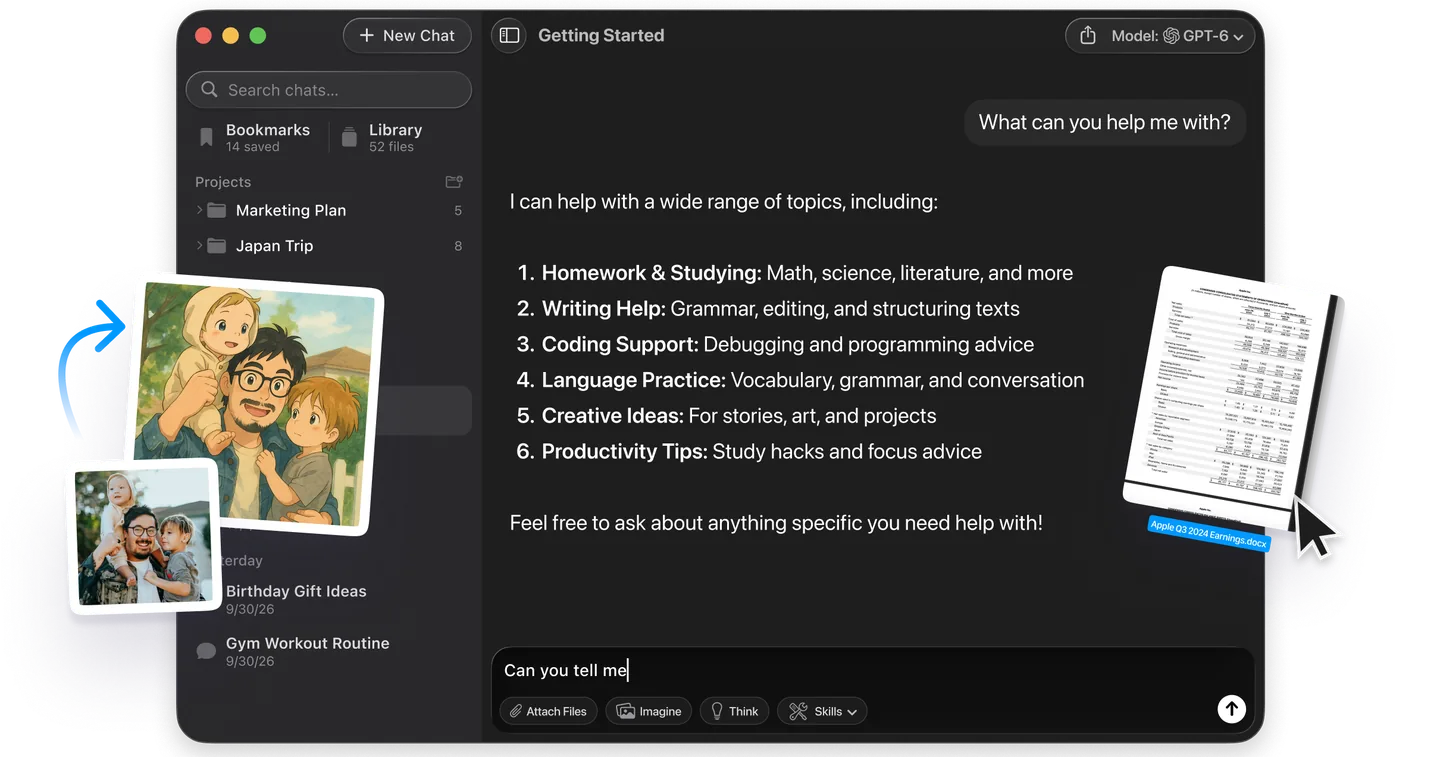
With Fello AI, you ask ChatGPT, and when the answer looks off, you ask Claude or Gemini the same question in the same window, without a second account or a second bill. It is one app for Mac, iPhone and iPad that puts GPT, Claude, Gemini, Grok, DeepSeek and other leading models behind one subscription.
The full picture of what is shipping right now is on the best AI models of 2026 ranking, and if you mainly use ChatGPT on a Mac, the ChatGPT desktop app for Mac comparison is worth a read.
Conclusion
ChatGPT was created by OpenAI, a research company that began in 2015 as a non-profit and is now a public benefit corporation valued at $852 billion and controlled by the non-profit OpenAI Foundation. Sam Altman, Greg Brockman, Ilya Sutskever and Elon Musk are the four most recognisable co-founders, but the actual product was the work of a much larger research and engineering team across nearly a decade.
The next time someone asks you who made ChatGPT, you can answer with the short version (OpenAI), the names (Altman, Brockman, Sutskever, Musk and others) and the date (November 30, 2022), and have the full backstory in your head. If you want to keep using ChatGPT alongside other top AI models in one app, try Fello AI on your Mac as the simplest way to get there.
FAQ
Who is the founder of ChatGPT?
ChatGPT was built by OpenAI, which was co-founded by Sam Altman, Greg Brockman, Ilya Sutskever, Elon Musk, Wojciech Zaremba and John Schulman among others. Sam Altman, the current CEO, is the public figure most often called “the founder of ChatGPT.”
When was ChatGPT created?
ChatGPT launched as a free research preview on November 30, 2022. The underlying GPT model line started with GPT-1 in 2018, GPT-2 in 2019, GPT-3 in 2020 and GPT-3.5 in 2022.
Did Elon Musk create ChatGPT?
No. Elon Musk co-founded OpenAI in 2015 and helped fund the early years, but he left the board in February 2018, four years before ChatGPT launched. He did not build the product, he lost his lawsuit against OpenAI in May 2026, and he now runs a competing AI lab called xAI.
Does Microsoft own ChatGPT?
No. Microsoft received roughly 27% of OpenAI in the 2025 restructure, but it does not own ChatGPT or control OpenAI. The April 2026 partnership reset made its licence to OpenAI’s models non-exclusive through 2032.
Who owns ChatGPT now?
OpenAI owns ChatGPT. OpenAI is controlled by the non-profit OpenAI Foundation, which held about 26% of the company after the October 2025 restructure, while Microsoft held about 27% and employees and investors the rest. OpenAI was valued at $852 billion in March 2026.
Why was Sam Altman fired in 2023?
The OpenAI board fired Altman on November 17, 2023 citing a lack of “consistent candour” in his communications. He was reinstated five days later after near-unanimous employee pushback and pressure from investors including Microsoft. Of the four directors who voted to remove him, only Adam D’Angelo is still on the board.