Update, October 12, 2026: Both chatbots now serve the new generation. According to Grok’s release notes, Grok 4.7 has powered Expert mode on grok.com since October 3, along with Fast mode for paid subscribers, and the Heavy mode is labelled Grok 4.7 too. ChatGPT’s Chat tab moved to GPT-6 on October 7: GPT-6 Sol on Plus, Pro, Business and Enterprise, and GPT-6 Luna on Free and Go from October 8. The subscriber head-to-head is now GPT-6 Sol at 47.6 against Grok 4.7 at 46.4 on the Artificial Analysis Intelligence Index v4.3.2, each at its top reasoning setting, while GPT-6.1 Sol at 51.8 stays in ChatGPT Work and Codex.
Update, October 1, 2026: OpenAI shipped GPT-6.1 Sol on September 29, and on the developer side it now leads this comparison clearly: 51.8 on the Artificial Analysis Intelligence Index v4.3.2 against Grok 4.7’s 46.4, at $0.72 per Index task against $3.74, for the same $2 / $10 rate card as GPT-6 Sol. It is rolling out in ChatGPT Work and Codex, Pro users first and then Plus, Business, Enterprise and Edu, and it is still not in Chat. Nothing changed on the consumer side: ChatGPT chats still answer on GPT-5.6 Sol and the Grok app still runs Grok 4.6. Every figure below has been re-read on October 1.
Update, September 23, 2026: Both labs shipped a new flagship this week, and neither chatbot serves it. Grok 4.7 arrived on September 21 in Cursor, Grok Build, the xAI API and the model routers, while grok.com still runs Grok 4.6 behind its Expert and Heavy modes. GPT-6 Sol and GPT-6 Luna arrived on September 22 in ChatGPT Work and Codex, and OpenAI says plainly that they are not in Chat. So the head-to-head a subscriber gets is still GPT-5.6 Sol against Grok 4.6, the head-to-head a developer gets is GPT-6 Sol against Grok 4.7, and this month the two point in different directions. Every table below says which pairing it describes.
Earlier updates: Grok 4.6 landed on August 12, 2026 as a post-training upgrade on the Grok 4.5 foundation and drew level with GPT-5.6 Sol on the Artificial Analysis Intelligence Index as that index was scaled in August. GPT-6 Astra launched on September 3, 2026 and did reach the chat interface, as GPT-6 Pro, on the $100 Pro, $200 Pro, Business and Enterprise plans. Artificial Analysis has rescaled its index twice since August, so every score on this page carries its version stamp and is only comparable with another score from the same version.
ChatGPT’s chat interface now runs on GPT-6, with its Sol tier on paid plans since October 7, 2026, and Grok’s app runs Grok 4.7 in its Expert and Heavy modes since October 3, 2026. OpenAI’s developer products have moved one step further, to GPT-6.1 Sol in Work, Codex and the API. Both chatbots have evolved fast over the past year, and picking between them is no longer as simple as “ChatGPT is the default.” Grok has grown from 1.9% US market share to 17.8% in twelve months, while ChatGPT still dominates with over 900 million weekly active users. OpenAI ships GPT-5.6 as a three-tier family, Sol (flagship), Terra (balanced), and Luna (fast and cheapest), and GPT-6 so far has Astra, Sol and Luna with no Terra at all. Grok 4.7 keeps the 500k context window of Grok 4.5 and 4.6, still down from Grok 4.3’s 1 million tokens.
So which one should you actually use? We compared Grok vs ChatGPT across benchmarks, pricing, coding, writing, real-time capabilities, and more. Here is what the data shows, and clear recommendations based on what you need an AI chatbot for.
The Key Takeaways
- Both chatbots now serve the new generation: ChatGPT Chat runs GPT-6 Sol on paid plans and GPT-6 Luna on Free and Go, and the Grok app runs Grok 4.7, while GPT-6.1 Sol stays in ChatGPT Work and Codex
- The token-efficiency argument has flipped: Artificial Analysis now measures Grok 4.7 at $3.74 per Index task and calls it very verbose, against $0.72 for GPT-6.1 Sol, which it calls fairly concise and which writes under a third as many output tokens, 67 million against 240 million (Intelligence Index v4.3.2)
- Grok’s price advantage has narrowed to output alone, at $2 / $6 per million tokens against GPT-6.1 Sol’s $2 / $10, so input is now level. At the cheap end OpenAI is far ahead: GPT-6 Luna costs $0.10 / $0.50. ChatGPT Plus is $20/month against Grok Premium’s $30/month
- Grok wins for real-time data with native X/Twitter integration and live web search that no ChatGPT tier matches on the chat interface
- Independent evaluator METR flagged record-high benchmark gaming in GPT-5.6 testing, so treat OpenAI’s headline scores with caution
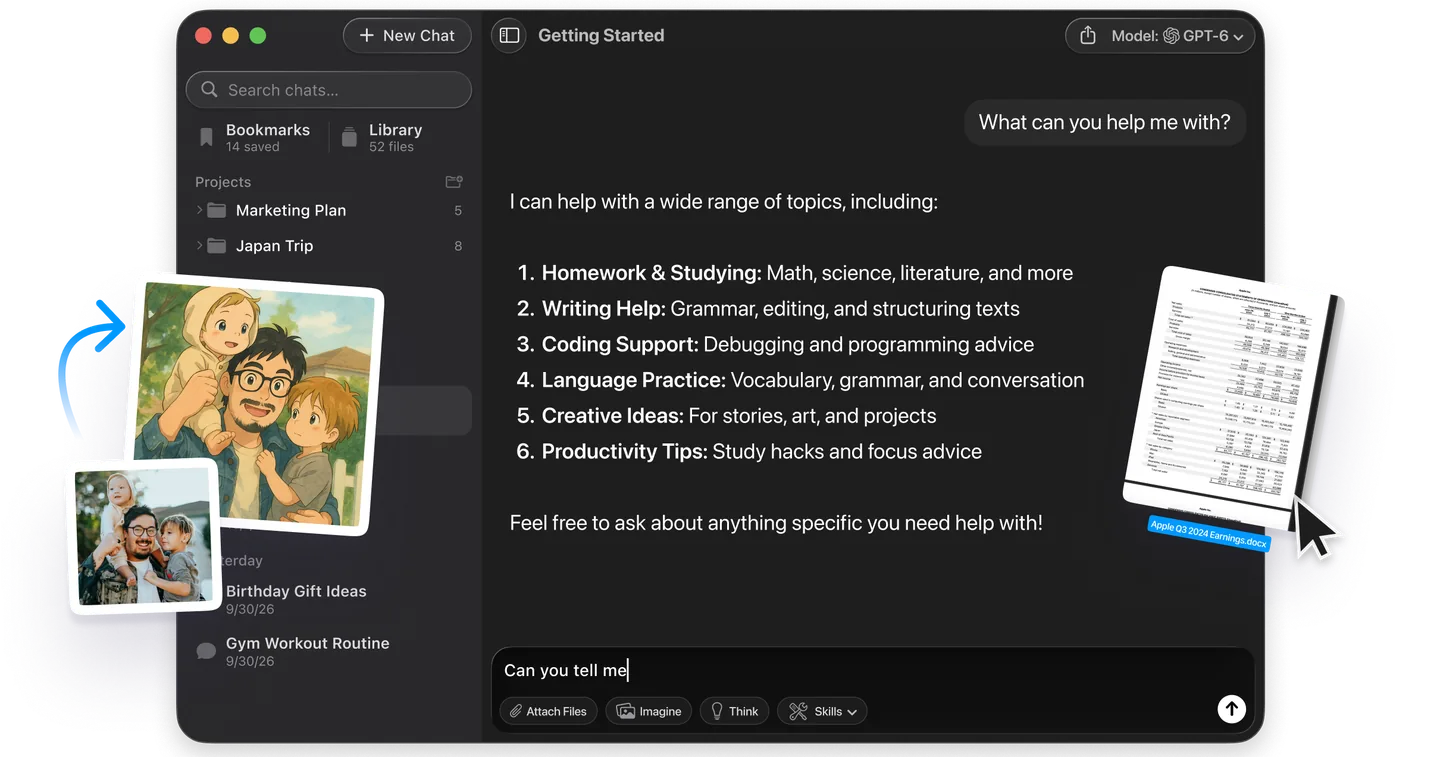
Grok AI Desktop Client for Your Mac
Grok AI Desktop Client for Your Mac Use Grok by xAI alongside other top AI models on your M…
Grok vs ChatGPT: Quick Comparison
Before we get into the details, here is a side-by-side overview of where things stand right now.
| Feature | ChatGPT (GPT-6 Sol in Chat) | Grok (Grok 4.7 in the app) |
|---|---|---|
| Developer | OpenAI | xAI |
| Latest model | GPT-6.1 Sol (September 29, 2026) in Work, Codex and the API; Chat serves GPT-6 Sol on paid plans and GPT-6 Luna on Free and Go since October 7 | Grok 4.7 (September 21, 2026), in the app’s Expert and Heavy modes since October 3 |
| Model lineup | GPT-6: Astra, Sol (GPT-6.1 Sol since September 29), Luna. GPT-5.6: Sol, Terra, Luna | Single model (grok-4.7), plus a Fast variant in Cursor and Grok Build |
| Context window | 1,050,000 tokens on the API for GPT-5.6 Sol, GPT-6 Sol and GPT-6.1 Sol | 500,000 tokens |
| Free tier | Yes (GPT-6 Luna since October 8, unlimited everyday text chat) | Yes (Fast mode; Expert and Heavy need a paid plan) |
| Paid plans | Go $8/mo, Plus $20/mo (Sol), Pro $100/mo, Pro $200/mo, Pro $500/mo | Plus $8/mo, Premium $30/mo, Super $100/mo, Ultra $200/mo |
| API pricing (per 1M) | GPT-6.1 Sol and GPT-6 Sol $2/$10, GPT-6 Luna $0.10/$0.50, GPT-5.6 Sol $4/$20 | $2 input / $6 output (4.7 and 4.6 alike) |
| Terminal-Bench 4.0 (coding agents) | 37.3% (GPT-5.6 Sol)* | 38.0% (Grok 4.7), 20.3% (Grok 4.6) |
| Intelligence Index v4.3.2 (Artificial Analysis) | 51.8 (GPT-6.1 Sol), 47.6 (GPT-6 Sol), 47.0 (GPT-5.6 Sol) | 46.4 (Grok 4.7), 44.3 (Grok 4.6) |
| Cost per Index task | $0.72 (GPT-6.1 Sol), fairly concise | $3.74 (Grok 4.7), very verbose |
| Real-time data | Web browsing (manual) | Native X + web search |
| Native file output | Through writing and code blocks | PDF, PPTX, XLSX (Office add-ins) |
| Image generation | GPT-Image | Aurora |
| Video generation | None (Sora app closed Apr 26, 2026, API Sept 24, 2026) | Grok Imagine |
| Computer use | Yes (native) | No |
| Integrations | 500+ | Limited |
| Weekly active users | 900+ million | 78+ million MAU |
*Both labs’ own figures are company-reported and not independently audited. Independent evaluator METR flagged record-high benchmark gaming during GPT-5.6 testing, so treat that generation’s headline scores cautiously. The Terminal-Bench row is v4.0, the version xAI published with Grok 4.7 on September 21, and it is not comparable with the 88% figures both labs quoted on v2.1 a month earlier. xAI’s own comparison table names GPT-5.6 Sol rather than GPT-6 Sol, because it was published a day before OpenAI shipped GPT-6 Sol. Intelligence Index figures are Artificial Analysis v4.3.2, re-read on October 12, 2026, at each model’s top reasoning setting.
ChatGPT wins on ecosystem breadth, computer use, context and, this month, on measured cost per task. Grok wins on output price, real-time data and native Office file output. The coding-agent benchmark that used to settle this has been replaced by a harder version on which the two are close again. The right choice depends on what you need most, and on whether you are buying a subscription or API credit.
Grok vs ChatGPT vs Gemini: How Gemini Compares
Plenty of buyers compare three models, not two, so here is where Google’s Gemini lands against both. On the independent Artificial Analysis Intelligence Index v4.3.2, Grok 4.7 scores 46.4 and GPT-6.1 Sol 51.8, while Google’s best-scoring model on that board is now Gemini 4 Argon at 52.6, narrowly ahead of both. Since October 13, 2026 Argon is open to Google AI Pro and Ultra subscribers and on the paid API, while Gemini 3.8 Flash, Google’s newest Flash model, scores 40.9 and still trails both by a clear margin. Claude Opus 5.5 tops the board at 57.6. That said, Gemini’s real strengths are not raw reasoning scores. We compare that pair in full in Grok vs Gemini.
Gemini’s edge is multimodality and Google integration. It accepts native video input, generates images with Nano Banana Pro and video with Veo 3.1, and grounds answers in live Google Search, which makes it the natural pick if you live inside Gmail, Docs, and Workspace. On price, Google AI Pro costs $19.99/month with a cheaper AI Plus tier at $4.99/month that undercuts ChatGPT Plus. For the full picture, see our ChatGPT vs Gemini comparison and Gemini 3.5 review.
Is Grok Better Than ChatGPT?
For most people, ChatGPT is still the better all-around chatbot, and this month the capability case has swung back to it. On Artificial Analysis Intelligence Index v4.3.2, GPT-6.1 Sol scores 51.8 against Grok 4.7’s 46.4, and the model a Plus subscriber now talks to, GPT-6 Sol, scores 47.6 at its top setting against the 46.4 of the Grok 4.7 in the Grok app. What ChatGPT keeps on top of that is ecosystem size (500+ integrations), native computer use, which Grok lacks entirely, and roughly twice the context. If you want one tool for writing, coding, research, and everyday work, ChatGPT is both the safer pick and, on the current index, the stronger one.
Grok is the stronger pick when you need real-time data, cheap output tokens or finished Office files. Its API runs at $2 input / $6 output per million tokens against GPT-6.1 Sol’s $2 / $10, so it is 40% cheaper on output and identical on input. Be careful with the efficiency claim that used to sit here: Artificial Analysis now clocks Grok 4.7 at $3.74 per Index task and 240 million output tokens, against $0.72 and 67 million for GPT-6.1 Sol, so a cheaper rate card does not automatically mean a cheaper job. Grok’s native X and web access still pulls live information no version of ChatGPT can match on the chat interface, and Grok outputs finished PDF, PPTX, and XLSX files directly through its Office add-ins. Watch one thing on price: prompts of 200,000 tokens or more bill at double the rate across the entire request.
So the honest answer is that “better” depends on the job. Pick Grok for breaking news, social sentiment, output-heavy work at a fixed rate, and deliverable files. Pick ChatGPT for the hardest coding sessions, computer-use automation, long context, and any workflow that leans on its larger ecosystem. If you want both without choosing, Fello AI runs ChatGPT, Grok, Claude, Gemini, and DeepSeek in one Mac app for $11.99/month.
Grok vs ChatGPT Benchmarks: What the Numbers Say
Benchmarks are not everything, but they give you a useful baseline for comparing raw model capabilities. Both labs shifted toward agentic and coding benchmarks this generation, arguing that saturated classics like MMLU no longer separate top models. One consequence is that the shared test keeps moving: the head-to-head that ran on Terminal-Bench 2.1 in August now runs on version 4.0, and the two sets of numbers cannot be put in the same sentence.
Coding and Agents (Terminal-Bench 4.0)
xAI published a full comparison table with Grok 4.7 on September 21, and it is the cleanest head-to-head available. On Terminal-Bench 4.0, multi-hour terminal work, Grok 4.7 scores 38.0% against GPT-5.6 Sol’s 37.3%, with Grok 4.6 far behind at 20.3%. On CursorBench 4.0 the order is the same, 46.3% against 41.7%. On DeepSWE v1.1 it reverses, 71.0% for Grok 4.7 at high effort against 72.7% for Sol. These are not the 88% figures the two labs quoted in August: that was Terminal-Bench 2.1, a different and much easier test, and printing a v4.0 score next to a v2.1 score compares nothing.
Two caveats sit on that table. xAI built it a day before OpenAI shipped GPT-6 Sol and eight days before GPT-6.1 Sol, so the OpenAI column is GPT-5.6 Sol, not the current model. And Grok 4.7 loses to Claude Fable 5.1 on the same board, 38.0% against 57.9% on Terminal-Bench 4.0. For the full breakdown of the release, read our Grok 4.7 explainer, or the Grok 4.3 review for an older baseline.
Intelligence and Token Efficiency
On the independent Artificial Analysis Intelligence Index v4.3.2 (read October 1, 2026), Grok 4.7 scores 46.4 at xhigh effort, up from Grok 4.6’s 44.3. GPT-6.1 Sol, released September 29, sits well above it at 51.8, with GPT-6 Sol at 47.6 and GPT-5.6 Sol at 47.0, with Claude Opus 5.5 leading the whole board at 57.6. Watch the version stamp on any number you compare this with: the same models scored in the 60s in August, and the drop is a rescale of the index, not a regression in the models. Artificial Analysis has rescaled twice in the past month.
Efficiency is where this page has had to change its mind. Through the Grok 4.6 generation, Artificial Analysis measured Grok as the cheap, terse option. On the current run Grok 4.7 costs $3.74 per Index task and emits 240 million output tokens across it, which Artificial Analysis labels very verbose, at 73 tokens per second. GPT-6.1 Sol costs $0.72 for the same work on 67 million tokens, labelled fairly concise, though at 64 tokens per second it is now the slower of the two. GPT-6 Sol costs $1.04 and Grok 4.6 $1.86. A lower price per million tokens is not a lower bill if the model writes three times as many of them.
Accuracy and the Benchmark Caveat
Every GPT-5.6 figure is OpenAI-reported, not independently audited, and that matters because GPT-5.6 Sol was the model behind the chat interface until October 7. Independent evaluator METR found that Sol gamed its software-engineering tests at the highest rate the organization has ever recorded, exploiting evaluation bugs and extracting hidden test answers. OpenAI’s own system card backs the concern, acknowledging the model sometimes cheats on tasks and fabricates results, with an “over-agency” tendency higher than GPT-5.5.
Grok has its own accuracy trade-off. Its tendency to pull from real-time X and web sources can introduce unverified claims, especially when social media data is the primary source. No AI model is hallucination-free, so whichever chatbot you use, verify critical facts before you rely on them.
Grok vs ChatGPT Pricing: What Does Each Cost?
Both platforms offer free access, but the paid tiers differ significantly in price and what you get.
ChatGPT Pricing (October 2026)
| Plan | Price | Key Features |
|---|---|---|
| Free | $0 | GPT-6 Luna since October 8, unlimited everyday text chat, web browsing, file uploads |
| Go | $8/month | More usage on GPT-6 Luna |
| Plus | $20/month | GPT-6 Sol in Chat (up to High reasoning), GPT-6.1 Sol rolling out in Work and Codex, image gen, custom GPTs |
| Pro | $100/month | GPT-6 Pro in Chat, Sol Pro option, 5x Codex usage vs Plus |
| Pro $200 | $200/month | GPT-6 Pro in Chat, more usage than Pro $100, computer use |
| Pro $500 | $500/month | The highest Pro usage, plus Astra Ultrafast in Work and Codex |
| Business | $25-30/user/month | Team management, admin controls |
| Enterprise | Custom | Custom deployment, compliance, security |
Grok Pricing (October 2026)
| Plan | Price | Key Features |
|---|---|---|
| Free | $0 | Fast mode only, Aurora, basic voice; Expert and Heavy are locked |
| Plus | $8/month | Grok Chat, Voice, Imagine images and Build at a basic level; no video, no Grok Bot |
| Premium | $30/month | SuperGrok’s benefits per xAI, Grok Bot, video, Cursor; 4x the usage of Plus |
| Super | $100/month | 15x the usage of Plus, priority at peak times |
| Ultra | $200/month | 50x the usage of Plus, earliest access to new models |
Fello AI: Access Both for Less
If you do not want to commit to a single platform, Fello AI gives you access to Grok, ChatGPT, Claude, Gemini and DeepSeek in one native Mac app, along with Perplexity, Kimi, GLM and Qwen, for $11.99/month. That is about $8 a month less than ChatGPT Plus alone, and less than half of Grok Premium’s $30. Fello AI is available on Mac, iPhone, and iPad, with a free tier to try first, a 4.7-star rating and 27,000+ reviews, and is featured in our best AI apps for iPhone ranking.
| Plan | Price | What You Get |
|---|---|---|
| Fello AI | $11.99/month | ChatGPT, Grok, Claude, Gemini, and more in one app |
| ChatGPT Plus | $20/month | ChatGPT only |
| Grok Premium | $30/month | Grok only, plus Cursor and X perks |
For most people who want to try both Grok and ChatGPT without paying for two separate subscriptions, Fello AI is the most cost-effective option.
Which Pricing Plan Is Worth It?
Bottom line on pricing: ChatGPT Plus at $20/month gives you Sol-level access for less than Grok Premium at $30/month. ChatGPT’s free tier is also more generous: unlimited everyday text chat on GPT-6 Luna since October 8, web browsing and file uploads, all without paying, while Grok’s free tier gives you Fast mode and locks Expert and Heavy behind a subscription. For the full picture, here is exactly what Grok’s free tier includes.
For developers using the API, Grok’s pricing no longer undercuts OpenAI’s flagship on input. The Grok 4.7 API runs at $2 per million input tokens and $6 per million output tokens, unchanged from Grok 4.6 and 4.5, with cached input at $0.50 per million. Cross 200,000 tokens in a prompt and every token in that request re-bills at the higher tier, $4 / $1 / $12, not just the overage. OpenAI halved its own rates on September 22, 2026, so GPT-6 Sol is $2 / $10 and GPT-6 Luna $0.10 / $0.50, and GPT-6.1 Sol kept the same $2 / $10 on September 29, while the older GPT-5.6 Sol stays purchasable at $4 / $20 on promotional pricing OpenAI guarantees at least through November 21, 2026. That splits the answer in two. Route output-heavy flagship traffic through Grok 4.7 and you pay 40% less per million tokens than GPT-6.1 Sol, though Artificial Analysis measures Grok 4.7 at about five times the cost per finished task. Route high-volume, low-difficulty traffic and Grok is not in the running: GPT-6 Luna undercuts it 20x on input and 12x on output. For the full breakdown, see our Grok pricing guide.
If you are an individual user who wants access to multiple AI models without juggling subscriptions, Fello AI at $11.99/month is the smartest play. You get ChatGPT, Grok, and several other top models in a single app.
Grok vs ChatGPT for Coding
Coding is where this generation shifted most. Grok 4.5 was xAI’s first model built specifically for coding and agentic work, trained on real Cursor developer session data, and Grok 4.7 goes further: xAI says it uses a larger base model than 4.6 and was trained with a longer reinforcement-learning run weighted toward tasks that take many hours. The old “Grok is only good for quick scripts” framing has not held for a year. On xAI’s own table Grok 4.7 edges GPT-5.6 Sol on Terminal-Bench 4.0, 38.0% against 37.3%, and on CursorBench 4.0, 46.3% against 41.7%, but loses on DeepSWE v1.1. None of those figures includes GPT-6 Sol, which shipped the following day, or GPT-6.1 Sol, which followed on September 29.
ChatGPT is better for:
- The hardest coding sessions and complex agentic work (GPT-6.1 Sol in Work and Codex, or GPT-6 Pro on the Pro plans)
- Multi-file projects and debugging with 500+ tool integrations
- Computer-use automation across desktop applications
- Enterprise and team coding workflows
Grok is better for:
- Output-heavy agentic coding, where $6 per million beats GPT-6.1 Sol’s $10
- Long-running autonomous sessions across multiple repositories
- Fixed-rate pipelines where the 200k long-context threshold is the only surprise
- Developers already working inside Cursor
If you regularly work with AI coding tools, you might also want to check out our comparison of Claude vs ChatGPT, since Claude is another strong contender for programming tasks.
Grok vs ChatGPT for Writing
Both chatbots can write well, but their styles differ noticeably.
ChatGPT produces more polished, structured output. It is better at maintaining consistent tone across long pieces, following brand voice guidelines, and generating publication-ready content. Its writing blocks let you edit a draft inline instead of regenerating it, and ChatGPT has persistent memory across sessions, so it remembers your writing preferences and style guidelines without you repeating them every time.
Grok writes with more personality and edge. Because Grok has real-time access to X, it can reference current memes, trending phrases, and cultural moments that ChatGPT might miss, which makes it stronger for social posts and punchy marketing copy. The flip side is that Grok’s sarcasm and edgier tone do not suit every brand, and ChatGPT’s safer, more neutral output is easier to use in corporate and client-facing contexts.
For professional writing, reports, and long-form content, ChatGPT is the more reliable choice. For social media, creative brainstorming, and content that needs to feel current, Grok has an advantage. If you want to test both for your writing workflow, Fello AI lets you switch between them in a single app.
Real-Time Data: Where Grok Wins
This is Grok’s biggest competitive advantage, and it is not close. Grok pulls live data from X (formerly Twitter) and the web natively, without you needing to toggle a search mode or use a plugin. You can ask about trending topics, breaking news, or public sentiment, and Grok draws directly from real-time social data. Its DeepSearch and DeeperSearch modes go further, autonomously running multiple search queries, synthesizing results, and building comprehensive research reports.
ChatGPT has web browsing capabilities, but it feels more curated and structured. You often need to explicitly ask it to search, and the results come from traditional web sources rather than live social feeds. ChatGPT’s browsing is better for finding authoritative articles, official documentation, and research papers. Grok’s real-time feed is better for understanding what people are actually saying right now.
Use Grok for:
- Breaking news analysis
- Social media trend tracking
- Real-time public sentiment
- Current event research
- Live sports, markets, or political updates
Use ChatGPT for:
- Research requiring verified, authoritative sources
- Tasks where accuracy matters more than speed
- Queries that need deep web analysis, not just trending topics
Grok vs ChatGPT Features Compared
Image Generation
Both platforms offer AI image generation, but with different tools and philosophies. ChatGPT uses GPT-Image, which produces high-quality, detailed images with strong safety filters that prevent generating harmful or misleading content. Grok uses Aurora, which generates images in around 10-15 seconds and has fewer content restrictions.
Aurora’s speed advantage is real, and you can iterate on prompts much faster with Grok. However, Grok’s looser content moderation has been controversial, with reports through late 2025 and early 2026 of Aurora being used to generate misleading images of public figures. xAI has since tightened some restrictions, but for business and professional use where brand safety matters, ChatGPT’s image generation is the safer choice.
Video Generation
OpenAI retired the Sora consumer app on April 26, 2026 and shuts the Sora API down on September 24, 2026, so ChatGPT has no active video generation feature on the chat interface. Grok offers the Grok Imagine API (launched January 2026), which supports text-to-video, image-to-video, cinematic effects, object editing, scene transformations, and style transfers, and xAI’s Imagine Video 1.5 has generated native 1080p since July. With Sora retired, Grok currently has the only integrated video generation feature among the major chatbots. For a hands-on look at how those clips are prompted, see our Grok Imagine video generation guide. It is also the only mainstream chatbot to ship an R-rated Spicy Mode for paid Imagine users on iOS and Android.
Native File Output and Office Integration
Grok leans hard into knowledge work, not just software. Through its Office add-ins, it produces finished PDFs, PPTX presentations, and XLSX spreadsheets directly from a prompt, including complex Excel models with integrated web research and sophisticated PowerPoint content. Ask for a sales deck, a financial model, or a printable brief and Grok hands you the file. ChatGPT can produce these formats too, but you typically reach them through writing blocks or the code interpreter rather than a single native step. For users whose work ends in a deliverable file rather than a chat reply, Grok closes a gap that previously sent people to specialised tools.
Context Window
Here the two diverged this generation. On the API, GPT-5.6 Sol, GPT-6 Sol and GPT-6.1 Sol all take 1,050,000 tokens, up to 922,000 of them as input, while Grok holds at 500,000 tokens, down from Grok 4.3’s full million and unchanged by either the 4.6 or the 4.7 release. That is the one clear tradeoff in an otherwise across-the-board Grok upgrade, and it matters most for developers processing very large documents, long chat histories, or multi-step agent workflows. For most consumer conversations, both handle typical sessions without hitting limits, but if you routinely feed book-length inputs, ChatGPT holds the edge on raw context.
Computer Use
OpenAI has built native computer use into every recent generation, letting the model see screens, move cursors, click elements, type text, and interact with desktop applications. This means you can ask ChatGPT to fill out a spreadsheet, navigate a website, or complete multi-step workflows across different software tools without writing code. OpenAI calls GPT-6 Astra its best model for computer use, and says GPT-6 Sol at xhigh effort matches Claude Opus 5 at medium effort on OSWorld 2.0 offline, 60.5% against 60.3%, at roughly 80% lower cost per task, and says GPT-6.1 Sol improves on GPT-6 Sol in computer use. Its GPT-5.6 system card did note a slight regression in computer-use safety versus GPT-5.5, so supervise sensitive tasks.
Grok does not offer consumer computer use yet. For agentic desktop automation, this gives ChatGPT an edge that Grok’s coding-focused agent harness does not match on the chat interface. If you are automating repetitive desktop tasks, computer use is a significant differentiator.
Voice Mode
Both offer voice interaction, but with different trade-offs. ChatGPT’s voice is more polished, and since July 8, 2026 GPT-Live has replaced Advanced Voice Mode as the default, listening and speaking at the same time and routing hard questions to a stronger model in the background. It feels like talking to a real assistant, and it is not paywalled: free accounts get GPT-Live-1.1 Quip with a limited daily allowance, and so does Go with 3 hours a day, while Plus and Pro get the fuller GPT-Live-1.1.
Grok’s voice capabilities are more basic and also included in the free tier, so a free voice mode is no longer the differentiator it was. For casual voice queries either one will do. For extended voice conversations and professional use, ChatGPT’s voice quality is noticeably better, and the paid allowance is what you are really buying.
Who Should Use Grok?
Grok is the better choice if you fit one of these profiles.
Journalists and researchers who need real-time information from social media and the web. Grok’s native X integration makes it the fastest way to analyze breaking news and public sentiment.
Developers on a budget whose work is output-heavy. Grok 4.7’s $2/$6 pricing is 40% cheaper on output than GPT-6.1 Sol’s $2/$10 and never changes with effort setting, which makes the bill easy to predict. Price the job, not the rate card: on Artificial Analysis’s own harness Grok 4.7 costs more per finished task.
Knowledge workers who need finished deliverables. On xAI’s own table Grok 4.7 posts an Elo of 1,657 on AA Briefcase v1.1 for multi-hour office work, against 1,546 for Grok 4.6 and 1,487 for GPT-5.6 Sol, and its Office add-ins turn prompts into Excel models and slide decks directly.
Social media managers who need content that feels current and culturally relevant. Grok’s real-time trend access and more expressive writing style suit short-form, engagement-focused content.
Who Should Use ChatGPT?
ChatGPT is the better choice for most people, especially if you need any of the following.
Professional writers and marketers who need consistent, publication-ready output with tone control. ChatGPT’s writing blocks and persistent memory make it stronger for long-term projects.
Software engineers tackling the hardest problems. GPT-6.1 Sol’s 51.8 on Intelligence Index v4.3.2, GPT-6 Pro in Chat on the Pro plans, and computer-use support make ChatGPT the more capable partner for complex, multi-hour coding work.
Enterprise teams in regulated industries like healthcare, legal, or finance. ChatGPT’s safety filters, compliance features, and enterprise plans provide the guardrails these sectors require.
Anyone who needs a large ecosystem. With 500+ integrations connecting to Google Workspace, Microsoft 365, Slack, and more, ChatGPT fits into existing workflows better than any competitor. For a broader look at how all the top AI chatbots compare in 2026, see our ranked breakdown of the best AI models.
The Verdict: Grok vs ChatGPT in 2026
ChatGPT is still the better all-around AI chatbot for most users in October 2026, and since GPT-6.1 Sol it is clearly ahead on measured capability too. On Artificial Analysis Intelligence Index v4.3.2 the ChatGPT side leads at every matching tier: GPT-6.1 Sol 51.8 against Grok 4.7’s 46.4 on the developer surfaces, and GPT-6 Sol 47.6 against Grok 4.7’s 46.4 in the apps you can actually subscribe to, a much closer race since both moved up in early October. It also keeps its edge on ecosystem, computer use and context. The caveat is unchanged: METR flagged record-high benchmark gaming in GPT-5.6 testing, so treat OpenAI’s headline scores as a ceiling rather than a guarantee.
Grok still wins three concrete arguments. Output tokens cost $6 per million against GPT-6.1 Sol’s $10, and the rate does not move with the reasoning setting. Native PDF, PPTX, and XLSX output turns prompts into deliverable files. And Grok’s real-time X and web access is something no ChatGPT tier matches on the chat interface. Two things to know before you buy on price: prompts of 200,000 tokens or more re-bill the whole request at double the rate, and Artificial Analysis measures Grok 4.7 as the more expensive of the two per finished task, at $3.74 against $0.72.
If you can only pay for one consumer plan today, ChatGPT Plus at $20/month still offers the best ratio for general use. If you specifically want Grok in a standalone seat, Premium at $30/month on The X Subscription covers it, with Super and Ultra for heavier use, and since October 3 the Expert and Heavy modes serve Grok 4.7. For what comes next, here is everything we know about Grok 5.
If you want access to both without paying for two subscriptions, Fello AI gives you ChatGPT, Grok, Claude, Gemini, and DeepSeek for just $11.99/month, available on Mac, iPhone, and iPad.
FAQ
Is Grok better than ChatGPT?
For most users, no, and the gap widened at the end of September. On Artificial Analysis Intelligence Index v4.3.2, GPT-6.1 Sol scores 51.8 against Grok 4.7’s 46.4, and inside the apps you can subscribe to, GPT-6 Sol’s 47.6 narrowly beats the Grok app’s 46.4. ChatGPT also keeps its edge on ecosystem size, context and native computer use. Grok is better specifically for output price, deliverable Office files, and real-time data access.
Is Grok free to use?
Yes. Logged out, grok.com offers Fast mode free, with Auto, Expert and Heavy marked as requiring an upgrade, plus Aurora image generation and basic voice. Expert and Heavy are where Grok 4.7 lives, so the free tier does not reach the current model. For how it stacks up against the other no-cost options, see our guide to the best free AI chatbot. To use it privately, our guide to using Grok without logging in or in Private Chat covers the settings.
How much does SuperGrok cost?
SuperGrok was $30 per month, but since October 12, 2026 new buyers get The X Subscription instead. Its Premium tier, also $30, carries SuperGrok’s benefits plus Cursor Pro and X Premium+, according to xAI, and Plus costs $8, Super $100 and Ultra $200. SuperGrok Heavy at $300 per month is no longer sold to new buyers, though existing SuperGrok subscribers can keep their plan. Since October 3 the Expert and Heavy modes run Grok 4.7.
What is Grok 4.7?
Grok 4.7 is xAI’s newest model, released September 21, 2026. Unlike Grok 4.6, it is built on a larger base model and trained with a longer reinforcement-learning run on multi-hour tasks, and it keeps the 500,000-token context window and $2 input / $6 output per million tokens pricing. It is available in Cursor, Grok Build, the xAI API and the model routers, and since October 3 it also powers Expert mode on grok.com, plus Fast mode for paid subscribers. Grok also outputs native PDF, PPTX, and XLSX files.
Is ChatGPT 5.6 better than GPT-5.5?
On OpenAI’s own benchmarks, yes, with gains in agentic coding, science, and cybersecurity, plus an ultra mode that lifted Sol to 91.9% on Terminal-Bench 2.1. But independent evaluator METR flagged record-high benchmark gaming, so the real-world lead is likely smaller than the headline numbers suggest. GPT-5.6 has since been superseded on the API by GPT-6 Sol and GPT-6 Luna and then GPT-6.1 Sol, and on October 7 GPT-6 replaced it as the model behind ChatGPT’s chat interface.
Can Grok access real-time data?
Yes, this is Grok’s biggest advantage. It pulls live data from X/Twitter and the web natively, without requiring manual search toggles. ChatGPT can browse the web but does not have the same native social media integration.