Open your bank statement and search for the last three months of AI charges. Most people who do this find two or three active subscriptions, at least one they forgot about, and no clear reason why they are paying for any of them beyond the month they signed up. If you suspect you have too many AI subscriptions, the arithmetic is probably worse than you think, and the reason is not overspending. It is that the products changed underneath you.
One fact should reset the whole decision. OpenAI's release notes for 6 August 2026 gave Free and Go users unlimited text chats the following week. The comparison table on OpenAI's own pricing page now repeats that for every tier including Free. Anthropic has moved in the same direction, with memory, web search, file creation and connectors now sitting on the free Claude plan. Running out of messages was the reason most people upgraded in the first place. That reason is gone, and almost nothing written about AI subscription costs has caught up.
The Key Takeaways
- Message limits are no longer the reason to pay: ChatGPT's pricing page lists unlimited everyday text chats on Free, Go, Plus and Pro alike, subject to abuse guardrails.
- ChatGPT Go buys capacity, not intelligence: Go and Free run the same models. What Go adds is context (27K to 54K), uploads, images and scheduled tasks, and OpenAI notes the plan may include ads.
- Claude's free tier is no longer a demo: it now includes memory across conversations, web search, file creation with code execution, connectors over MCP and extended thinking.
- Annual billing is the cheapest real saving: Claude Pro is $17 a month on an annual plan at $200 up front, against $20 billed monthly.
- Two paid plans is the number to question: one paid assistant plus free tiers covers most people, and one app with every model at $9.99 covers most of the rest.
Why You Probably Have Too Many AI Subscriptions
Nobody sets out to buy four AI assistants. It happens one defensible decision at a time.
You start with ChatGPT because everyone starts with ChatGPT. A few months later you read that Claude writes better prose, so you add it for the writing you care about. Then a research project sends you to Perplexity for a fortnight. Somewhere in there Google puts a plan in front of you that also carries cloud storage you already needed. Each purchase made sense on the day. None of them was ever reviewed.
The overlap is the part people underestimate. Every one of those products now writes, summarises, reads documents, searches the web and generates images. The differences that justified a second subscription in early 2026 have narrowed to preferences about tone and interface, which are real but rarely worth twenty dollars a month on their own. What you are usually paying for the second and third time is capability you already have.
The other half of the problem is that the free tiers moved. Both Anthropic and OpenAI spent 2026 pushing substantial features down into their free plans, and neither of them sent you an email about it. Your subscription renews silently against a product you evaluated a year ago. So before you cancel anything, find out what the current free versions do. For a lot of readers the honest answer to this whole question is that one paid plan is enough.
If you want the raw figures for every tier of every major assistant before you start, our complete guide to what AI actually costs in 2026 is the reference. This article is about a different question: not what things cost, but which of yours deserves to renew.
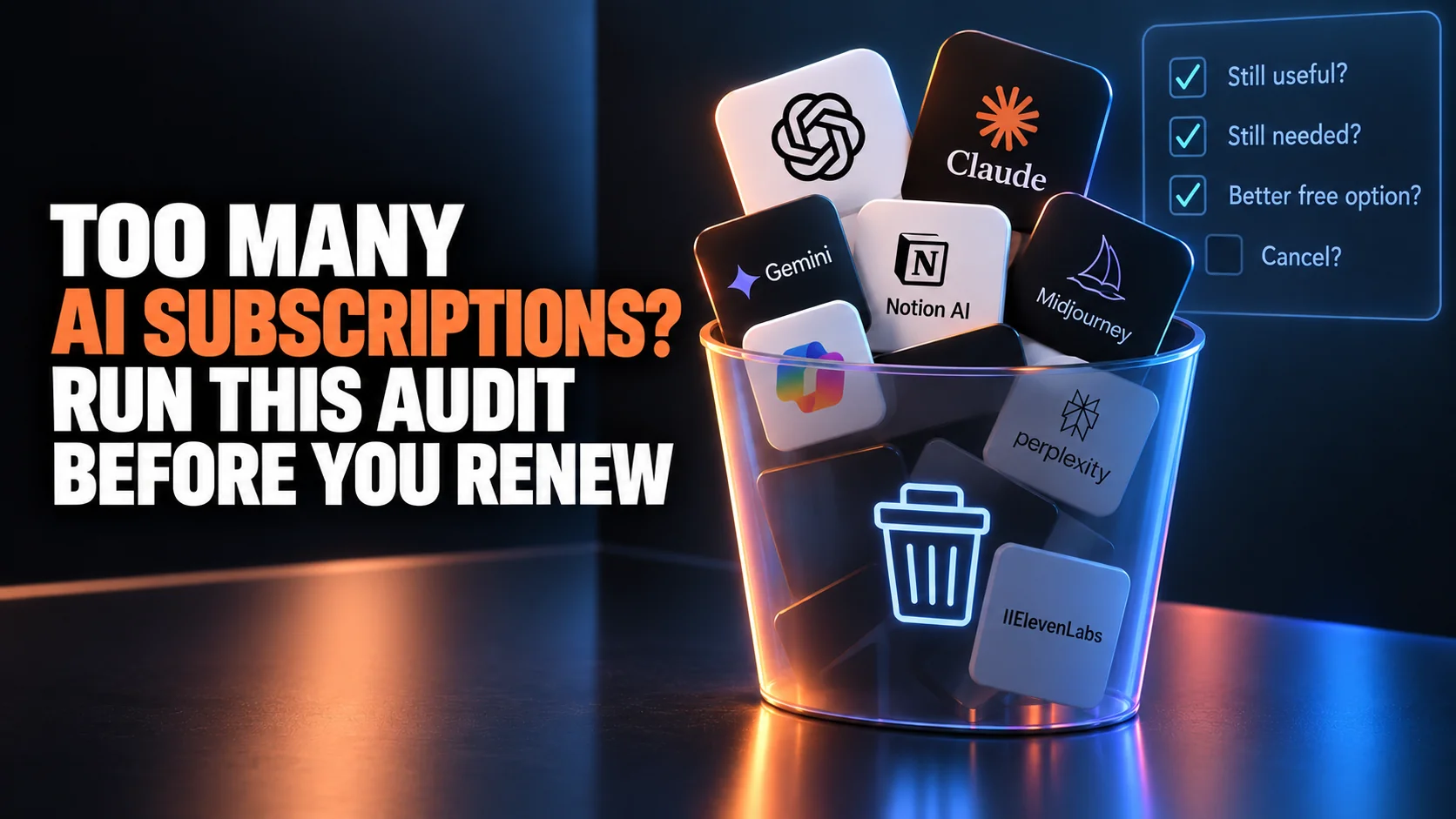
Too Many AI Subscriptions? Start With This Four-Step Audit
This takes about twenty minutes and it works on your numbers rather than an average from somebody else's article.
- Find every charge. Search your bank and card statements for the last three months. Then check your App Store subscriptions separately, on iPhone under Settings and your name, because App Store billing does not always look like the vendor's name on a statement. Write down each product, the amount, and the renewal date.
- Sort each one into three buckets. Used this week, used this month, or cannot remember opening it. Be honest rather than aspirational. The subscription you keep meaning to use properly belongs in bucket three.
- Name the one thing each product does that the others cannot. Say it out loud in a sentence. If the sentence is "the writing is nicer" or "I like the interface", that is a preference, and preferences are worth paying for only once. If the sentence names a feature, like a coding agent or a research mode with citations, that is a real reason.
- Check the renewal dates and act in order. Cancel bucket three today, before the next charge. Downgrade bucket two to the free tier and give yourself a month to find out whether you notice. Keep bucket one. If you need the mechanics for the largest one, we have a step-by-step for cancelling a ChatGPT subscription on iPhone, Android and the web.
The order matters. Cancelling first and evaluating afterwards is much easier than the reverse, because these are monthly products with no lock-in and you can always resubscribe. Nothing you lose in step four is permanent. The mechanics are worth knowing before you start, because most failed cancellations are cancelled in the wrong place: our guide to cancelling an AI subscription on a Mac or iPhone covers who is actually billing you and why a refund request does not stop the charge.
What The Free Tiers Actually Do Now
This is the section that decides most audits, and it is the one nobody writing about AI subscription costs has updated. The details below come from the vendors' own pricing pages as they stood in the first week of September 2026.
ChatGPT free
OpenAI's pricing page describes the free plan as unlimited text chats with GPT-5.6 Luna, with a footnote that unlimited is subject to abuse guardrails. Chat history is unlimited too, and the release note that introduced the change also gave Free and Go users a Think button for harder questions. The plan runs on web, iOS and Android, reaches GPT-5 Thinking Mini alongside Luna, and includes Projects and shared projects, which are marked available on every tier.
What it does not give you is everything else, and OpenAI is blunt about it. Uploads, image generation, voice chats, deep research, memory and Codex access are each listed as limited, and response times depend on available bandwidth. The instant model's total context window sits at 27K, which the page translates as roughly twelve pages of text. GPT-6 Astra is not on the free plan at all.
Claude free
Anthropic's free tier has changed more than any other this year. It now covers chat on web, iOS, Android and desktop, code generation, data visualisation and web search. It also covers memory across conversations, creating files and executing code, desktop extensions, connecting any tool through remote MCP connectors, and extended thinking for complex work.
Read that list against what people were paying twenty dollars for in 2025 and the shift is obvious. What Claude Pro adds is more usage plus four products that are absent from the free plan entirely: Claude Code, Claude Cowork, Claude Design and Claude Science. Unlimited projects and access to more models come with it. That is a coherent reason to pay. Wanting to send more messages, on its own, is not any more. Our guide to what Claude's free plan covers goes through the caps in detail, and the same question for OpenAI is answered in is ChatGPT free.
What Your Twenty Dollars Actually Buys
If message counts are off the table, the paid tiers need a new justification. Here is what each one is actually selling in September 2026.
ChatGPT Go buys pages, not intelligence
This is the finding that surprised me most. Go and Free run the same models. GPT-6 Astra is marked unavailable on both, GPT-5.6 Sol is unavailable on both, and both reach Luna and GPT-5 Thinking Mini. What Go delivers is capacity. The instant model's context window doubles from 27K to 54K, described on the page as about twelve pages of input rising to about forty. File uploads, image generation and memory each move from limited to available, and scheduled tasks switch on here rather than at Plus. OpenAI also notes that the plan may include ads.
Go is therefore the right purchase for one specific person: someone who feeds long documents and images to a fast model and does not need frontier reasoning. Anyone buying it expecting a smarter assistant has misread the page, because the model list is identical to the one they already have for nothing.
Plus is where the models change
The jump from Go to Plus is the real one. Plus is where GPT-6 Astra and GPT-5.6 Sol appear, where legacy models come back, and where GPT-5.6 Terra becomes generally available rather than limited to Work and Codex on the desktop. It is also where response times are listed as fast rather than dependent on bandwidth, where deep research stops being capped, and where image generation with Thinking unlocks. Reasoning context goes to 256K. If you pay for ChatGPT at all, this is the tier that changes what the product can do. The case for the step above it is laid out in our comparison of ChatGPT Plus and Pro.
Claude Pro is usage plus four products
Anthropic's pricing page lists Pro at $17 a month on an annual subscription billed at $200 up front, or $20 if billed monthly. Max starts at $100 and asks you to choose five times or twenty times the usage of Pro, which is structurally the same offer OpenAI makes at its top tier.
The annual discount deserves a moment, because it is the one saving in this entire article that requires no behaviour change. If you are certain you will still want Claude in six months, paying yearly costs three dollars a month less than paying monthly. If you are not certain, the monthly price is the cost of that uncertainty, and after this audit you may not be paying it at all.
Keep, Downgrade Or Cancel
Match yourself to a row. The recommendation assumes you have already run the four steps above and know which bucket each product landed in.
| Your situation | What to do | Why |
|---|---|---|
| One assistant, light daily use | Drop to the free tier for a month | Unlimited text chat plus memory covers ordinary questions. You will find out fast if you miss anything |
| One assistant, heavy use of one feature | Keep the single paid plan, take the annual discount | Deep research, image generation and long uploads are all hard-capped on free plans |
| Two or more, light use of each | Cancel all but one, or move to a multi-model app | This is the classic overlap case and the most expensive mistake on this page |
| Two or more, one used heavily | Keep that one paid, free-tier the rest | The free tiers now handle second-opinion work perfectly well |
| You need a coding agent | Keep Claude Pro specifically | Claude Code, Cowork, Design and Science are absent from the free plan entirely |
| You already pay for cloud storage | Price the Google plan against what it replaces | Google AI Pro bundles 5 TB of storage, YouTube Premium Lite and Google Home Premium Standard |
When Paying Direct Is Still The Right Call
Consolidation is not automatically correct, and any article that says otherwise is selling you something. There are three situations where a direct subscription earns its money. Underneath all of them sits one more question: whether a key would be cheaper than the plan.
You use a vendor-only product
Claude Code, Claude Cowork, Claude Science and ChatGPT's Codex exist inside one company's app and nowhere else. If your week runs through any of them, the subscription that contains them is not negotiable, and no amount of model access elsewhere substitutes for it.
You actually hit the ceiling
Some people do exhaust a paid tier. If you are hitting documented caps rather than guessing at them, the top tiers are priced as usage multipliers for exactly that reason. Our guide to how Claude's usage limits actually work explains what running out looks like in practice. Paying for headroom you have never touched is the thing to stop doing. Paying for headroom you hit every Thursday is not.
You want the newest thing on day one
Vendors ship to their own subscribers first. If being three weeks late to a new model is a problem for your work, that is a legitimate reason to pay the company directly. It is the honest trade-off in every consolidation decision, including ours.
When One App Beats Three Subscriptions
Now the case for the other side, with the same honesty.
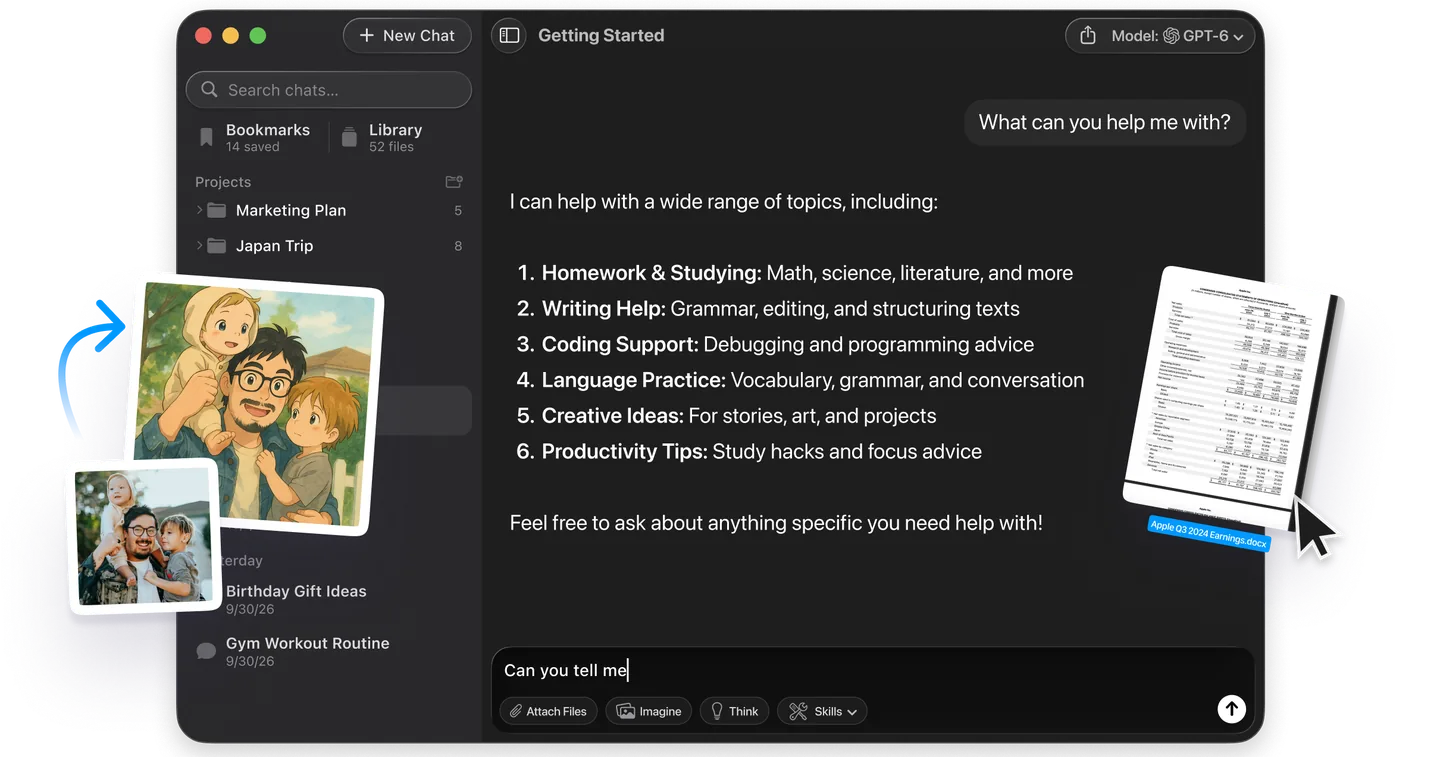
Suppose your audit ended with two or three paid plans you use lightly, and none of them earned its place with a feature only it has. You are paying two or three times for the same capability. That is the situation a multi-model app is built for. Fello AI is a native Mac, iPhone and iPad app that puts more than thirty frontier models behind one subscription at $9.99 a month, ChatGPT, Claude, Gemini, Grok and DeepSeek among them. A keyboard shortcut switches between them, and one searchable history covers all of them.
The practical difference is not only the bill. When two models disagree, you find out in the same window instead of paying two companies to keep the answers apart. When one vendor has a bad month, you move. Our comparison of the three big Mac desktop apps covers what you give up by leaving any of them, and it is worth reading before you decide.
The trade-off is the one named above. A bundled app is not always first to a brand new flagship, and it does not contain vendor-exclusive products like Claude Code. For the reader whose audit produced three lightly used twenty-dollar plans, that trade is straightforwardly worth making. For the reader running a coding agent all day, it is not.
The Verdict
Run the audit before your next renewal date rather than after it. Twenty minutes with a bank statement beats any average spending figure you will read online, including the ones in the articles ranking above this one.
For most people the answer is one paid plan and free tiers for everything else, because the free tiers in September 2026 do what paid tiers did in 2025. If your audit found two or three lightly used subscriptions instead, consolidate them into one app and stop paying three companies for the same paragraph. And if you found a single subscription you use every day for something only it does, keep it, pay annually, and stop feeling guilty about it. That one is working.
FAQ
How many AI subscriptions do I actually need?
For most people, one paid plan plus free tiers. Since ChatGPT made text chat unlimited on its free plan and Claude added memory, web search and file creation to its own, a second twenty-dollar subscription usually buys overlap rather than capability. Pay twice only when you hit a documented cap, or when you need a product that exists on one plan alone.
Which AI subscription should I cancel first?
The one you cannot remember opening. Sort every AI charge into used this week, used this month, and cannot remember, then cancel the third bucket before its next renewal date. Downgrade the second bucket to its free tier and wait a month before deciding. These are monthly products with no lock-in, so a wrong call costs you one month.
Is ChatGPT Plus still worth paying for in 2026?
Only if you use what it adds. ChatGPT's free plan now lists unlimited text chats, so Plus is no longer about message counts. It buys advanced reasoning models including GPT-6 Astra and GPT-5.6 Sol, uncapped deep research, a much larger context window, faster responses, legacy models and image generation with Thinking. Projects are on every tier including Free, and scheduled tasks arrive at Go, so neither is a reason to buy Plus.
Is an all-in-one AI subscription actually cheaper?
It is cheaper when you were paying for two or more assistants and using each of them lightly. It is not cheaper when one paid plan already covers you, because a bundle replacing a single subscription saves nothing. Work out your own total from your statement first, then compare, rather than trusting a savings figure from a company that sells bundles.
Does paying annually for AI save enough to matter?
On a single plan, modestly. Anthropic prices Claude Pro at seventeen dollars a month on an annual subscription billed at two hundred dollars up front, against twenty dollars billed monthly. That is three dollars a month for committing a year in advance. Take it on the one subscription you are certain about, and never on the ones this audit put in bucket two.