Ecosia AI is the free generative AI inside the Ecosia search engine. It has two parts, AI Overviews and AI Chat, and both run on small Mistral models from France. Ecosia launched them in December 2025, and the move split its audience instantly. Some users welcomed a greener way to use AI. Many long-time fans pushed back hard, calling it the one thing a climate-focused search engine should never touch. Since July 2026, one setting called AI-free search switches all of it off.
This guide explains what Ecosia AI is, which models run it, what Ecosia AI Chat can and cannot do, whether it uses water, and how it compares with ChatGPT. It also shows both ways to turn AI off on Ecosia. Every figure comes from Ecosia’s own Help Center and blog, checked in October 2026, alongside the critics who think the “green AI” label is a stretch.
The Key Takeaways
- Ecosia AI launched in December 2025 with two parts, AI Overviews (search summaries) and AI Chat (a conversational assistant).
- AI Chat runs on Mistral Small 4 and AI Overviews on Mistral Small 3.2, both small, efficient models chosen to keep energy and water use low.
- Ecosia says it generates more renewable energy than its AI consumes and has invested €18 million in solar and wind projects.
- AI Chat is no longer purely click-to-use. Auto-routing can send a complex search straight into the chat, and logged-in users can now generate images.
- AI-free search, added in July 2026, turns off every AI feature in one click on desktop. You can also switch off AI Overviews alone in four steps.
What Is Ecosia AI?
Ecosia AI is the set of generative-AI tools built into the Ecosia search engine. It has two parts. AI Overviews summarize the most relevant information from your search results and place cited sources above the standard blue links. AI Chat, which Ecosia also calls AI Search, is a full conversational assistant, similar to ChatGPT, that answers questions, plans trips, and helps you research a topic in depth.
Both features launched in December 2025, alongside a refreshed look for the whole site. Ecosia is not new to AI. It first tested a chatbot at the COP28 climate summit in December 2023, and that pilot ran on OpenAI’s API. The 2025 relaunch is when AI became a core part of Ecosia search. AI Overviews are switched on by default where they are available. AI Chat is optional, but it is no longer strictly click-to-use, as the next section explains.
The sustainability angle is what sets Ecosia AI apart. The 2023 pilot had a “green answers” option that suggested a train over a flight. The December 2025 launch offered opt-in eco tips “rooted in the latest environmental science”, a concept Ecosia earlier called Climate Intelligence. Ecosia’s current help page does not list eco tips among the chat modes, so treat them as a launch feature rather than a setting you can count on finding.
What Can Ecosia AI Chat Do?
Ecosia AI Chat now covers most of what a mainstream chatbot does, apart from video and deep research. You open it from the star symbol on ecosia.org, from the navigation bar, or from your search results. It is free, and it is available in 35 countries, including the US, the UK, Germany, France, Spain, the Czech Republic, Portugal and Brazil. Ecosia still calls it a beta that only some users see.
Three chat modes sit behind the “+” icon in the chat bar. Web Source pulls answers from the live web. Guided Learning works like a tutor and breaks a topic down step by step. Think Longer spends more time reasoning before it answers.
File upload accepts up to 5 files per conversation, at 5 MB each, in PDF, TXT, DOCX, CSV, XLSX, JPG and PNG. Ecosia deletes uploaded files within 7 days. Image generation is limited to logged-in Ecosia account users and runs on Black Forest Labs, a European provider using EU data centres. Generated images carry C2PA content credentials and are deleted after 7 days.
Ecosia AI Chat cannot generate video, cannot share a conversation with other people, and has no deep research mode. Chat history is opt-in and needs an Ecosia account. Turning it off permanently deletes the history you saved.
How Does Ecosia AI Work?
Ecosia AI runs existing, already-trained models instead of a model Ecosia built itself. Training a bespoke model would burn enormous amounts of energy and money, so Ecosia picks models that are small and efficient. This is the core of its environmental argument. Smaller models draw far less power and water than the giant flagship systems behind tools like ChatGPT.
AI Chat is powered by Mistral Small 4, a compact model from the French AI lab Mistral. AI Overviews use Mistral Small 3.2, delivered through a European provider called Staan as part of EUSP, according to Ecosia’s Help Center. Ecosia used a small OpenAI model for chat before the switch. In May 2026 it said its AI now runs “almost entirely on a European model provider”. Ecosia added that third parties do not store your queries, and that the move opens a path to hosting its own AI.
AI Chat also has auto-routing. When Ecosia detects a complex question or a request for a detailed explanation, it can send your search from the normal results page straight into AI Chat. You can disable auto-routing the first time it triggers. This changes the old promise that the AI only runs when you click it.
Ecosia AI still avoids energy-heavy capabilities like video generation. Standard web results come from Ecosia’s search partners and from EUSP, the European search index Ecosia runs as a joint venture with Qwant. EUSP already answers most French traffic, went live in Germany on 30 July 2026, and should answer most German queries by the end of 2026. For the bigger picture on model costs, our breakdown of how much energy AI really uses puts these choices in context.
Does Ecosia AI Use Water?
Yes, Ecosia AI uses water indirectly. All generative AI runs in data centers, and those data centers consume water to cool their servers. No version of AI, green or otherwise, uses zero water. Ecosia does not claim a perfect footprint. Its goal is to keep that footprint as small as possible.
Ecosia limits water and energy use in three ways. It picks smaller Mistral models instead of power-hungry flagships, it skips video generation, and it lets you switch the AI off entirely. Ecosia also says it generates more renewable energy from solar and wind than its AI features consume, with the surplus fed into the grid to displace fossil fuels. It estimates the impact of each AI request with the EcoLogits methodology, a life-cycle assessment that counts energy, emissions and water for running the models. EcoLogits leaves out model training, networks and your own device, and Ecosia’s help page describes the method without publishing a per-query water figure.
The scale of the wider problem is real. United Nations researchers warn that by 2030, the global data centers powering AI could have a water footprint matching the basic annual domestic water needs of the 1.3 billion people living in Sub-Saharan Africa. Against that backdrop, Ecosia’s efficiency-first approach is a real attempt to do less harm, even if it cannot erase the cost. For the full picture, see our guide on whether AI is bad for the environment.
Is Ecosia AI Environmentally Friendly?
Ecosia AI is greener than most chatbots, but not environmentally free, and opinions split sharply on how much that matters. Ecosia’s case rests on three claims. By its own figures, it has invested €18 million in renewable energy projects. It says it produces more clean power than its AI uses, a claim it repeated in July 2026. It also uses tools like the AI Energy Score and EcoLogits to pick efficient models and track their energy use. The often-quoted estimate that AI raised Ecosia’s CO₂ emissions by about 5% comes from the 2023 OpenAI-based pilot, not from the current Mistral setup.
Critics are not convinced. Climate writers have called Ecosia’s “green AI” a false comfort. They argue that any AI rollout normalizes a technology with a heavy environmental cost, and that planting trees does not cancel out the emissions of building and running AI at scale. Some long-time users felt betrayed, viewing the launch as exactly the kind of mission creep a values-led company should resist. The 2026 additions give critics more to point at, because image generation is a heavier task than text and auto-routing pulls some searches into AI Chat without a click.
The honest answer sits in the middle. Ecosia AI is almost certainly greener than running the same query through a large flagship model, because the underlying models are smaller and Ecosia produces more renewable energy than its AI consumes. It is not environmentally free, and no efficiency story changes the fact that the most sustainable AI query is the one you never make. If Ecosia’s effort interests you, our EcoGPT review looks at another tool chasing the same greener-AI goal.
How to Turn Off AI on Ecosia
The fastest way to turn off AI on Ecosia is the AI-free search setting, launched on 2 July 2026. One click disables AI Overviews, removes AI Chat from the navigation and the autocomplete dropdown, turns off auto-routing, and brings back the traditional search box. AI-free search works on desktop for now. Ecosia says mobile support is coming in a future update.
Here is how to turn on AI-free search on Ecosia.
- Go to ecosia.org on your computer.
- Click the profile icon at the top right.
- Select Settings.
- Turn on AI-free searching.
To switch off only the AI summaries and keep AI Chat available, turn off AI Overviews instead.
- Open your Ecosia search settings.
- Scroll to the Overviews section.
- Uncheck the box to disable AI Overviews.
- Save your settings so the change sticks.
Ecosia stores these settings in a browser cookie, not in your account. If you clear cookies or search in a private window, the AI comes back. Set your preferences in a normal browser window first. The Overviews toggle also appears only where AI Overviews run. That is now 13 countries: the US, the UK, Canada, France, Germany, Spain, Italy, Austria, Belgium, the Netherlands, Switzerland, Portugal and Brazil. If you use AI Chat but want nothing saved, leave chat history switched off.
Ecosia AI vs ChatGPT
Ecosia AI is the greener, lighter option, and ChatGPT is the more capable one. Ecosia AI is a sustainability-first search assistant built into a tree-planting search engine. ChatGPT is a general-purpose chatbot built for raw capability. If you want the most powerful answers, ChatGPT’s larger models win. If you want a lighter footprint and search-linked sources, Ecosia makes a stronger case.
| Feature | Ecosia AI | ChatGPT (free) |
|---|---|---|
| Underlying model | Mistral Small 4 (chat), Mistral Small 3.2 (overviews) | GPT-5.6 Luna |
| Eco focus | Smaller models, more renewable energy than its AI uses, no AI video | None stated; large flagship models |
| Privacy | GDPR-bound, does not sell personal data | OpenAI data policy; ads on the Free and Go plans |
| Price | Free | Free, with paid tiers for more |
| Sources cited | Yes, links sources above results | Limited unless using search mode |
| Image generation | Yes, logged-in accounts only | Yes |
| Switch AI off | Yes, AI-free search (desktop) | Not applicable |
Use Several AI Models in One App
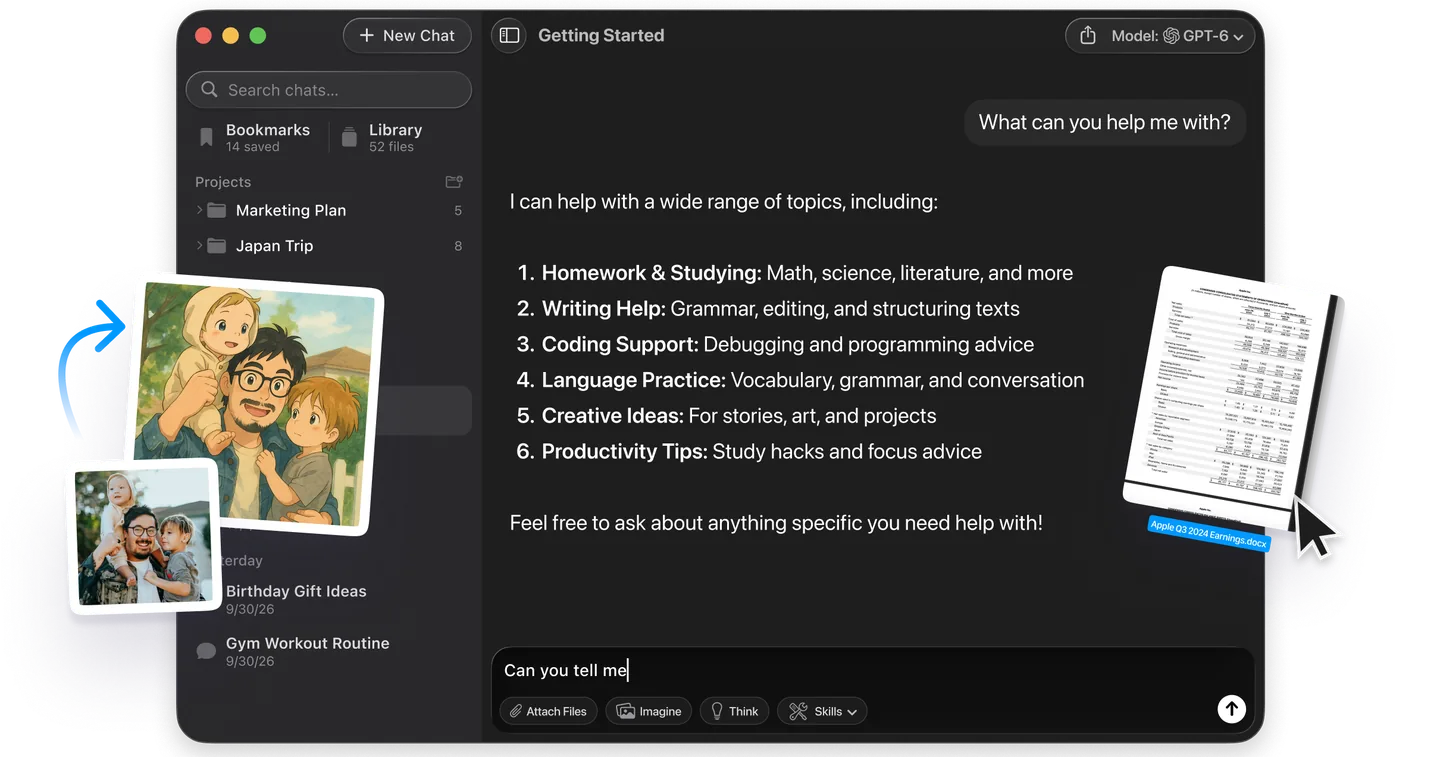
Ecosia AI and ChatGPT are not the only choice, and you do not have to pick one app per task. Fello AI puts ChatGPT, Claude, Gemini, Grok and DeepSeek behind one subscription on Mac, iPhone and iPad. You pick the model for each question instead of paying for several services. It also handles web search, PDFs and image generation, starts with a free tier, and costs $9.99 a month after that. To see how the leading labs differ, our Anthropic vs OpenAI comparison breaks down the field.
Is Ecosia AI Worth Using?
Ecosia AI is worth using if you already search with Ecosia and want an AI assistant that matches its values. It is free, low-footprint, and now useful for real work, with web-sourced answers, a tutor-style Guided Learning mode and file upload. The sources-above-results format also makes AI Overviews feel more trustworthy than a chatbot that answers from nowhere.
If you need the most powerful model on the market, or you are uneasy about any AI on a climate-focused platform, Ecosia AI is not for you, and Ecosia respects that with AI-free search. The best move is to try AI Chat for a week, then decide. Want to test several AI tools before committing? Our roundup of the best AI free trials is a good place to start.
Conclusion
Ecosia AI is a real attempt to do generative AI more responsibly, built on small Mistral models, a European model provider, and more renewable energy than its AI consumes. It is not perfect. The critics have a fair point that no AI is free of environmental cost, and auto-routing and image generation make the AI harder to avoid than it was at launch. It is still almost certainly lighter than running the same query through a giant flagship model. And if ocean plastic matters to you more than trees, the OceanHero search engine uses the same ad-funded model to pull bottles from the sea.
Our verdict is to keep Ecosia AI on if you search with Ecosia anyway, and to switch on AI-free search the moment it stops helping. Whichever route you pick, the smartest habit is the same. Use AI when it helps, and skip it when a normal search will do.
FAQ
What is Ecosia AI?
Ecosia AI is the generative-AI toolset inside the Ecosia search engine, launched in December 2025. It includes AI Overviews, which summarize search results, and AI Chat, a conversational assistant with web sourcing, file upload and image generation.
What AI model does Ecosia use?
AI Chat runs on Mistral Small 4 and AI Overviews run on Mistral Small 3.2. Both are small, efficient models from the French lab Mistral, chosen to keep energy and water use low. Ecosia used a small OpenAI model for chat before it moved to Mistral.
Does Ecosia AI use water?
Yes, indirectly. Ecosia AI runs in data centers that use water for cooling, like all AI. Ecosia limits this with smaller models, no video generation, and renewable energy that it says exceeds what its AI consumes. It does not publish a per-query water figure.
Is Ecosia AI free?
Yes. AI Overviews and AI Chat are both free, and there is no paid tier for the AI features. Image generation and chat history need a free Ecosia account.
How do I turn off AI on Ecosia?
On desktop, click the profile icon on ecosia.org, open Settings, and turn on AI-free searching. That disables AI Overviews, AI Chat and auto-routing in one click. To remove only the summaries, uncheck the Overviews box in your search settings.