Claude hit #1 on the App Store free chart on February 28, 2026, pushing ChatGPT out of the top spot for the first time. The catalyst was Anthropic refusing the Pentagon’s demand to strip the guardrails off Claude for autonomous weapons and mass surveillance. The administration then told federal agencies to stop buying Anthropic products, and the Defense Secretary labelled the company a “supply chain risk.” It backfired. TechCrunch reported free users up more than 60% since January and paid subscribers more than doubled over the same stretch. For how the two companies’ philosophies shape what you actually see in the chat window, we broke down how Claude and ChatGPT approach content policies differently.
Both sides have shipped a new flagship since, and the two landed three weeks apart. Anthropic released Claude Opus 5.5 on September 22, 2026, and it tops the Artificial Analysis Intelligence Index v4.3.2 at 57.6 while costing 40% less to run than the Opus 5 it replaces, which Anthropic moved to its legacy list the same day. Claude Fable 5.1 still sits above it on price and below it on the index at 53.4, and no Fable model is included in a Claude Pro subscription, so Opus 5.5 is what $20 buys you. OpenAI shipped GPT-6 Astra on September 3 and GPT-6 Sol and Luna on September 22 and GPT-6.1 Sol on September 29, but OpenAI says none of the three is available in Chat yet, so the chat box on a $20 Plus plan answers on GPT-5.6 Sol. Both plans still cost $20 per month and they are not interchangeable, because Claude leads on overall intelligence, long-document work and writing quality while ChatGPT leads on image generation, ecosystem breadth and price per token. This guide breaks down exactly where each one wins so you can pick for how you actually work.
The Key Takeaways
- Claude Opus 5.5 is what $20 buys, and it tops the Artificial Analysis Intelligence Index v4.3.2 at 57.6; the model ChatGPT Plus serves in the chat box, GPT-5.6 Sol, reads 47.0 and is flagged deprecated on the same board
- Artificial Analysis no longer publishes a separate coding index. On Terminal-Bench 4.0, one of the ten evaluations inside v4.3.2, it measures Sonnet 5.5 at 63.6%, Opus 5.5 at 59.6%, GPT-6 Astra at 59.1% and GPT-5.6 Sol at 39.9%
- Both Claude Pro and ChatGPT Plus cost $20 per month, and Claude Pro falls to $17 a month if you pay $200 up front for a year; ChatGPT Go is $8/month and Claude has no budget tier
- Claude runs a 1M token window at $20 on Opus 5.5, Opus 5, Sonnet 5.5 and Fable 5.1, and OpenAI now publishes per-tier figures of its own: 256K on reasoning and 54K on Instant for ChatGPT Plus
- ChatGPT generates images with ChatGPT Images 2.5; Claude still cannot create images at all
- ChatGPT Free and Go show ads in the US since February 9, 2026, in 31 European markets since August 24, 2026 and in Southeast Asia and Taiwan since September 23, 2026; Claude is ad-free on every tier

The Best AI in April 2026: Ultimate AI Comparison for Text, Code, Images & More
The Best AI to Use In April 2026 Compare leading AI models & Understand which is the best model for you…
Claude vs ChatGPT: Quick Comparison
| Feature | Claude Pro ($20/mo) | ChatGPT Plus ($20/mo) |
|---|---|---|
| Default model | None named by Anthropic, Sonnet 5.5 and Opus 5.5 on Pro | GPT-5.6 Sol on Instant, Medium and High |
| Top model (usage-limited) | Claude Opus 5.5 (Fable 5.1 on usage credits) | GPT-5.6 Sol at High; GPT-6 models in Work and Codex only |
| Context window | 1M tokens (Opus 5.5, Opus 5, Sonnet 5.5, Fable 5.1) | 256K reasoning, 54K Instant |
| AA Intelligence Index v4.3.2 | 57.6 (Opus 5.5, max effort) | 47.0 (GPT-5.6 Sol, max effort) |
| Terminal-Bench 4.0 (AA harness) | 63.6% (Sonnet 5.5) | 39.9% (GPT-5.6 Sol) |
| Image generation | No | Yes (ChatGPT Images 2.5) |
| Voice mode | Yes | Yes |
| Web search | Yes | Yes |
| Code interpreter | Yes | Yes |
| Ads | No | No (Plus tier) |
| Premium tier | Claude Max, from $100/mo (5x or 20x) | ChatGPT Pro, from $100/mo (5x or 20x) |
Claude vs ChatGPT for Coding
Coding is the hardest part of this comparison to answer honestly, because the scoreboards themselves moved in September. Artificial Analysis retired the separate coding and agentic indexes it used to publish and folded those tasks into a single Intelligence Index, and both labs shipped a new model on the same day, so each one’s launch table measures itself against the other’s previous flagship. What follows is what the current comparable numbers say, and where they stop being comparable.
What the benchmarks actually say
On the Artificial Analysis Intelligence Index v4.3.2, which weights agentic tasks at 30% and coding at 20% across ten evaluations, Claude Opus 5.5 leads the entire board at 57.6, with Claude Sonnet 5.5 at 56.0, GPT-6 Astra at 52.7, GPT-6.1 Sol at 51.8, GPT-6 Sol at 47.5 and the GPT-5.6 Sol that ChatGPT Plus serves in the chat box at 47.0. On Terminal-Bench 4.0, the agentic terminal benchmark inside that index, AA’s own runs put Sonnet 5.5 at 63.6% and Opus 5.5 at 59.6% against Astra’s 59.1% and GPT-5.6 Sol’s 39.9%. One thing to know before you read any other coding comparison. Anthropic has published no SWE-bench score for Opus 5 or Opus 5.5 at all, only relative claims against its own earlier models. Any specific SWE-bench figure quoted for either is not coming from Anthropic.
The last full head-to-head on SWE-bench Pro, the harder private-codebase benchmark, went to Claude by a wide margin. Claude Opus 4.8 posted 69.3% against GPT-5.5 at 58.6% and GPT-5.4 at 57.7%. That was the April 2026 round, all three models are legacy now, and neither lab put SWE-bench on its September launch table, so read those numbers as the record of that generation rather than as today’s scoreboard.
Agentic coding and the command line
The older Terminal-Bench numbers still in circulation, GPT-5.5 at 82.7% on version 2.0 and GPT-5.6 Sol at 88.8% on 2.1, are not comparable to the 4.0 figures above. The benchmark was rebuilt and scores on 4.0 are far lower across the board, so a 2.1 percentage set beside a 4.0 one will always flatter the older model. On 4.0 itself the two labs disagree about each other. Anthropic’s own harness reports Opus 5.5 at 66.4% against 57.9% for GPT-6 Astra, using OpenAI’s reported figure for Astra, while Artificial Analysis measures Opus 5.5 at 59.6% on its own setup. Both are real numbers from different harnesses, and neither is a correction of the other.
Claude Code and Codex: what is included
One correction worth making loudly, because it is widely misreported. Claude Code is included in your Claude Pro subscription, not sold separately. Anthropic’s own wording is that “with Pro and Max plans, you now have access to both Claude on the web, desktop, and mobile apps and Claude Code in your terminal with one unified subscription.” That covers supported IDEs too, including VS Code, Cursor and the JetBrains family. OpenAI’s Codex is included the same way, and its own pricing page puts Codex on the web, the CLI, the IDE extension and iOS on the $20 Plus plan running GPT-6 Sol and GPT-6 Luna, though it has had its own SSD-wear problems on Mac. Neither requires a second bill, and Codex is the one place a Plus subscriber reaches the GPT-6 generation.
Verdict: Claude, and on the index it is no longer close. Opus 5.5 leads Intelligence Index v4.3.2 at 57.6 against the 47.0 of the GPT-5.6 Sol in ChatGPT’s chat box, and Claude Sonnet 5.5 now tops Terminal-Bench 4.0 at 63.6% on Artificial Analysis’s runs. ChatGPT narrows it slightly inside Codex, where a $20 Plus plan reaches GPT-6.1 Sol at 51.8.
What About Gemini?
The third major player deserves a mention, with one correction to the record. Google’s newest model is Gemini 4 Argon, announced on September 30, 2026 and scoring 52.6 on Intelligence Index v4.3.2, just behind GPT-6 Astra, and since October 13, 2026 it is available to Google AI Pro and Ultra subscribers and paid API customers. The newest Flash model is Gemini 3.8 Flash, generally available since September 2, 2026 and described by Google as its most intelligent Flash model. On the Pro line there is still no Gemini 3.5, 3.6, 3.7 or 3.8 Pro, despite widespread reporting to the contrary; the newest Pro-tier model in Google’s own catalog is Gemini 3.1 Pro, still marked Preview. The result is counter-intuitive and worth stating plainly: on Intelligence Index v4.3.2 the Flash model reads 40.9 and the Pro model 29.7. We unpicked the delay and the invented launch dates in our Gemini 3.5 review.
None of that makes Gemini irrelevant here. It remains deeply wired into Search, Docs, Gmail and Android, so if you already live in Google’s ecosystem it belongs on your shortlist alongside these two. Our full AI model comparison covers it and Grok in more detail. We also compare how Claude compares with Gemini head to head.
Claude vs ChatGPT for Writing
Claude produces more natural, human-sounding prose, a finding that has stayed consistent across independent writing tests including hands-on evaluations by Tom’s Guide. Claude Sonnet 5.5 writes with a distinct voice and a degree of stylistic intent; ChatGPT delivers logically structured output that is competent but more formulaic. The gap shows up most in long-form work, where holding coherence across thousands of words is the actual difficulty. Anthropic made prose a headline claim for Opus 5.5, saying early testers found its writing clearer and easier to follow than Opus 5’s, and early testers described Sonnet 5.5 as a more natural conversational partner.
One behavioural difference is worth knowing before you commit. Claude pushes back. If a prompt is vague, self-contradictory or touches something it flags, it will tell you rather than quietly comply. Writers who work with precise, multi-constraint instructions tend to find that useful. Anyone who wants instant, no-questions-asked output will prefer ChatGPT’s more agreeable style.
For long-form articles, research summaries and anything needing a consistent voice, Claude is the stronger pick. For rapid-fire short outputs and high-volume production, ChatGPT is equally capable and more permissive about what it will write.
Verdict: Claude wins for writing quality; ChatGPT wins for speed and compliance.
Claude vs ChatGPT for Image Generation
This is ChatGPT’s clearest advantage and the gap has not narrowed. Claude cannot generate images. Anthropic’s help centre says so in as many words: Claude “doesn’t generate photos or illustrations the way image-generation tools do.” What it does instead is build diagrams, charts and interactive visuals out of HTML and SVG inside the conversation, a beta feature now open to every Claude user on web and desktop, and we walked through the workarounds in our guide to Claude and image generation. ChatGPT creates images directly in the chat with ChatGPT Images 2.5, released September 8, 2026, which succeeded the ChatGPT Images 2.0 generation from April.
If image generation is anywhere in your workflow, whether that is marketing assets, illustrations or quick visual mockups, ChatGPT is the only option between these two. Claude users have to reach for an external tool such as Midjourney or Adobe Firefly and paste the results back in.
Verdict: ChatGPT wins, clearly.
Claude vs ChatGPT: Context Window and Long Documents
Claude’s context window at the $20 tier grew by five times in 2026, and it is still the most concrete advantage either product holds. Anthropic states that Opus 5.5, Opus 5, Sonnet 5.5 and Fable 5.1 all run a 1M token context window on paid plans when you are chatting with Claude. In plain terms 1M tokens is roughly 555,000 words, or about five full-length novels in a single conversation, and it lands on the $20 Pro plan rather than being reserved for Max.
The ChatGPT side of this changed in September, and it is worth knowing because most comparisons still say the figure is unpublished. It is not. OpenAI’s plan comparison page now lists an in-app context window for every tier: ChatGPT Plus gets 256K on reasoning models and 54K on Instant, Pro gets 400K and 128K, Go matches Plus, and Free gets 27K on Instant with a reasoning window OpenAI marks as varying. All of those sit well below the API, where GPT-6.1 Sol carries a 1.05M token window with 128K max output.
The practical upshot is that Claude holds roughly a four-to-one lead where it counts. At $20 a month a Claude conversation takes about four times the reasoning context a ChatGPT Plus conversation does, which is the difference between holding an entire codebase or a stack of long PDFs in one thread and chunking it by hand. Inside Claude Code the same 1M window applies on Pro, Max, Team and Enterprise across the Opus and Sonnet lines. Memory across sessions is the next frontier here, and we looked at how Claude Dreaming consolidates agent memory between conversations.
Verdict: Claude wins on context, by about four to one. 1M tokens on the $20 plan against the 256K reasoning window OpenAI now publishes for ChatGPT Plus.
Claude vs ChatGPT: Pricing
| Plan | Claude | ChatGPT |
|---|---|---|
| Free tier | Yes (limited) | Yes (limited, with ads in the US, Europe, Southeast Asia and Taiwan) |
| Budget plan | N/A | ChatGPT Go, $8/month (OpenAI says this plan may include ads) |
| Standard paid | Claude Pro, $20/month or $17 billed annually | ChatGPT Plus, $20/month |
| Power user tier | Claude Max, from $100/month (5x or 20x Pro usage) | ChatGPT Pro, from $100/month (5x or 20x Plus limits) |
| API (flagship) | Opus 5.5: $4 / $20 per M tokens (Fable 5.1: $10 / $50) | GPT-6.1 Sol: $2 / $10 per M tokens (Astra: $10 / $50) |
What you get at $20
The headline prices are identical, so the decision comes down to what each $20 actually buys. Claude Pro gives you Sonnet 5.5 plus usage-limited access to Opus 5.5, Fable 5.1 only on pay-as-you-go usage credits, the 1M token window, and Claude Code in the same subscription; paying a year up front drops it to $17 a month. ChatGPT Plus gives you GPT-5.6 Sol in the chat box, GPT-6.1 Sol and Luna in Codex and ChatGPT Work, image generation, voice, and the wider tool ecosystem. On the API OpenAI is now the cheaper of the two by a wide margin, $2 against $4 on input and $10 against $20 on output, after it halved the Sol and Luna rates on September 22, 2026.
One meaningful difference since February 2026 is advertising. OpenAI started running ads on ChatGPT Free and Go on February 9, 2026, beginning with US users, reaching 31 European markets on August 24, 2026 and Southeast Asia and Taiwan on September 23, 2026. They sit below the reply and are labelled as sponsored rather than woven into the answer, and Plus, Pro, Business, Enterprise and Education accounts are exempt; OpenAI’s own price list carries the line “this plan may include ads” under Go. Claude is ad-free across every tier including the free plan. ChatGPT Go at $8/month is the cheapest way into either product and is worth a look before you commit to a $20 plan, as long as you can live with the ads.
The premium tiers
Above $20 both companies sell power-user plans in two sizes, and both now describe them the same way. Claude Max starts at $100 a month and comes in 5x and 20x Pro usage, though Anthropic no longer prints the 20x price on its pricing page. ChatGPT Pro also starts at $100, sold as 5x or 20x higher rate limits than Plus in OpenAI’s own wording. At the $20 tier Claude’s Opus access is usage-limited, and heavy users routinely find they need Max sooner than they expected once they start routing agentic work to Opus 5.5. Claude’s rate limits have surprised people migrating from ChatGPT, which is more generous at the standard tier.
Verdict: Tie at $20/month. ChatGPT Go ($8/month) wins on price for casual users and OpenAI is half Anthropic’s price on the API; Claude wins on ad-free access and on the annual discount.
Claude vs ChatGPT: Features and Ecosystem
Feature breadth is the clearest structural difference between these two products. OpenAI has built outward into a platform that touches images, voice, browsing and Office. Anthropic has built downward into text, code and agents, and has deliberately skipped whole categories. Which approach suits you depends entirely on how many different jobs you want one subscription to cover.
Where ChatGPT is ahead
Image generation is the big one, since Claude has no equivalent at all. Beyond that, ChatGPT’s voice mode covers more languages and has had longer to mature, the custom GPT marketplace gives you a library of prebuilt specialised assistants, and a built-in browser ChatGPT can drive is on every tier including Free. The Microsoft Copilot integration also pushes GPT models into Word, Excel and the rest of Office, though that is no longer a category Anthropic has ceded, since Claude for Microsoft 365 and Claude for Outlook are both included from Pro upwards. If you want one subscription that covers the widest possible spread of tasks, this is still the side of the table to be on.
Where Claude is ahead
Artifacts is the standout, a built-in workspace that previews code, documents and visual output in a live split panel next to the chat. Projects sit alongside it, wrapping one long-running job with its own files, its own instructions and its own chat history. Opus 5.5 brings multi-agent orchestration with parallel sub-agent coordination through Claude Code, plus task budgets to cap token spend inside agentic loops. Claude follows complex multi-constraint prompts more reliably, stays more consistent across long multi-turn conversations, and offers Computer Use in beta for interacting directly with your screen. It is also ad-free everywhere and more predictable about refusing things, which matters more in production than it sounds. Our Claude feature and pricing guide walks through exactly what each tier includes.
Claude also closed a long-standing gap in July. Voice mode ran on Haiku alone until 23 July 2026, which meant talking to Claude got you a weaker model than typing to it. It now runs on Opus, Sonnet and Haiku across mobile, desktop and the web, and our guide to Claude voice mode covers which plan gets which model.
Verdict: ChatGPT wins on breadth; Claude wins on depth and agent orchestration.
Claude vs ChatGPT: Safety and the Pentagon Story
Anthropic built Claude around a framework it calls Constitutional AI, which ranks honesty, harmlessness and helpfulness above pure compliance. In practice Claude will sometimes decline a request ChatGPT answers without hesitation, and it is more willing to say “I am not sure” than to produce a confident wrong answer. That trade is the single most common reason people either love it or find it irritating.
The safety difference stopped being philosophical in early 2026. On February 27, 2026 Anthropic refused the Pentagon’s demand to remove the contractual restrictions that kept Claude out of mass surveillance of American citizens and fully autonomous lethal weapons. The administration directed federal agencies to stop using Anthropic products and the Defense Secretary designated the company a “supply chain risk.”
Rather than damaging Anthropic, it triggered a migration. Claude reached #1 on the App Store free chart on February 28 and topped Google Play on March 3, and Anthropic said daily sign-ups broke its all-time record every day that week. Claude’s ranking reflected a values-driven shift as much as it reflected product quality, and the commercial fallout is still playing out in our Anthropic vs OpenAI breakdown.
Verdict: Claude has a more actively tested safety posture. ChatGPT is more permissive.
Which AI Should You Choose?
The good news is that the split between these two is clean enough that most people can tell which side they belong on within a minute of reading their own workload back to themselves. Below is the honest sorting, including the case for paying for both.
Choose Claude if
You work with long documents, research papers or large codebases regularly, because the 1M token window at $20 is roughly four times what ChatGPT Plus publishes and the single biggest practical advantage either product has right now. Pick Claude too if you want the model that currently leads the Artificial Analysis Intelligence Index outright, or if writing quality and natural prose are what you are actually buying. It suits anyone who needs reliable multi-constraint instruction-following, or who wants Claude Code included rather than billed separately. It is also the answer if you want an ad-free experience on any tier including free, or if you want to back Anthropic’s approach to safety with your subscription. If you land on Claude and work on a Mac, our Claude desktop client guide for macOS covers running it natively.
Choose ChatGPT if
You need image generation, which rules Claude out entirely. It is also the better call if you live in Microsoft Office and want Copilot integration, or if you want the broadest ecosystem of tools, plugins and automations available. Casual users may prefer starting at $8/month with ChatGPT Go rather than committing to $20. And if you build on the API rather than chat in the app, OpenAI is half Anthropic’s price at the workhorse tier, $2 and $10 per million tokens on GPT-6.1 Sol against $4 and $20 on Opus 5.5. If your real alternative is Microsoft’s assistant rather than Claude, we weigh that up in Microsoft Copilot versus ChatGPT.
Or run both
Plenty of power users pay for both and route deep writing and code work to Claude while ChatGPT handles images and everything ecosystem-shaped. That costs $40 a month, which is only worth it if you do both kinds of work in volume. Gemini is the third name in this decision, and we cover all three in Claude vs Gemini vs ChatGPT compared. If ChatGPT is the one you want running natively, our ChatGPT desktop client guide for Mac covers that side. For a task-by-task map, we cover coding, writing, research and images in when to use which AI.
How to Use Both Without Two Subscriptions
That $40 is the part worth examining. Claude Pro is $20 a month and ChatGPT Plus is $20, so paying for both properly doubles the bill and leaves you moving between two apps all day just to decide which one gets the next question. If you are already paying for both, audit the subscriptions before the next renewal.
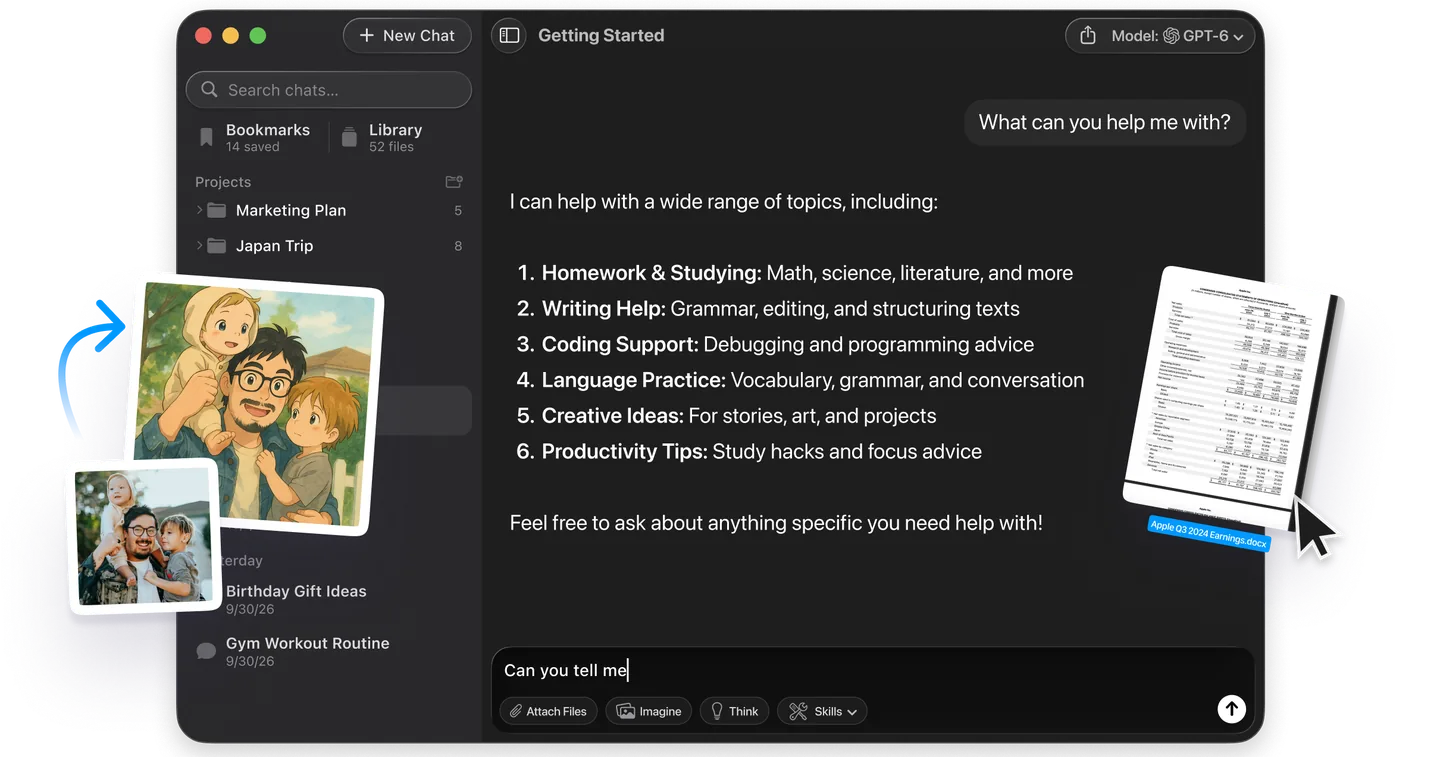
Fello AI is a native Mac, iPhone and iPad app that puts Claude and ChatGPT behind one subscription, along with Gemini, Grok, DeepSeek, Perplexity, Kimi, GLM and Qwen. It starts at $9.99 a month, roughly a quarter of what the two subscriptions cost separately, with a free tier to try first and a 4.7-star rating across 27,000+ reviews. You switch models inside a single conversation instead of routing work by hand between two accounts, which is the practical form of the run-both answer above.
Conclusion
The 2026 answer got tidier in September rather than messier. Claude Opus 5.5 leads the Artificial Analysis Intelligence Index outright at 57.6, Claude Sonnet 5.5 tops Terminal-Bench 4.0 at 63.6%, and Claude holds a real lead on context, with 1M tokens on the $20 plan against the 256K OpenAI now publishes for ChatGPT Plus. What ChatGPT has instead is reach: image generation Claude simply does not have, an ecosystem that touches Office, browsers and a marketplace of custom assistants, and an API that costs half as much per token. The split is cleaner than it has been all year, and it is a split between depth and breadth rather than between a winner and a loser.
Choosing an AI assistant in 2026 is also not purely a features decision. Claude’s App Store surge was not driven by a benchmark win, it was driven by millions of users deciding which company’s values they wanted to fund. Anthropic drew a line on autonomous weapons while the government threatened to punish it for doing so, and that changed the conversation. Your $20 a month is a vote for how you think AI should be built, which is worth weighing alongside the context windows.
Start on the free tier of both if you are undecided. Upgrade whichever one you find yourself opening more often, and check the benchmark you actually care about rather than the crown someone else has awarded.
FAQ
Is Claude better than ChatGPT in 2026?
It depends on the task, but on the headline measurement Claude is ahead. On the Artificial Analysis Intelligence Index v4.3.2, Claude Opus 5.5 tops the board at 57.6, while the GPT-5.6 Sol that ChatGPT Plus serves in the chat box reads 47.0 and is flagged deprecated; OpenAI’s best model, GPT-6 Astra, reads 52.7 and reaches Chat only on the Pro, Business and Enterprise plans. Claude also holds a context advantage at $20, where Opus 5.5 and Sonnet 5.5 run a 1M token window against the 256K OpenAI publishes for Plus, while ChatGPT wins outright on image generation, ecosystem breadth and API price. Neither is universally better.
Is Claude cheaper than ChatGPT?
At the standard tier they match exactly, with Claude Pro and ChatGPT Plus both at $20 per month, though Claude Pro falls to $17 a month if you pay $200 up front for a year. OpenAI undercuts both with ChatGPT Go at $8/month for casual users, and Claude has no equivalent budget plan. At the top, Claude Max and ChatGPT Pro both start at $100 and both come in 5x and 20x sizes. On the API, Claude Opus 5.5 is $4 / $20 per million input and output tokens against GPT-6.1 Sol at $2 / $10, so ChatGPT is half the price on both sides after OpenAI halved those rates on September 22, 2026.
Can Claude generate images?
No. Anthropic’s help centre says Claude “doesn’t generate photos or illustrations the way image-generation tools do.” It reads and analyses images you upload, and it builds diagrams, charts and interactive visuals out of HTML and SVG inside the conversation, but it has no native text-to-image model. ChatGPT generates images directly in the chat with ChatGPT Images 2.5. If image creation matters to your workflow, ChatGPT is the only option of the two.
Does ChatGPT have ads?
Yes, on the Free and Go tiers. OpenAI began showing ads to US users on those two plans on February 9, 2026, extended to 31 European markets on August 24, 2026 and to Southeast Asia and Taiwan on September 23, 2026, placed below the reply and labelled as sponsored rather than mixed into the answer. Plus, Pro, Business, Enterprise and Education accounts do not see them, and Claude shows no ads on any tier including its free plan.
Why are people switching from ChatGPT to Claude in 2026?
The trigger was Anthropic refusing the Pentagon’s demand to drop the guardrails on Claude for autonomous weapons and mass surveillance, on February 27, 2026. The administration told federal agencies to stop using Anthropic products and the Defense Secretary labelled the company a supply chain risk. It backfired publicly. Claude took the #1 spot on the App Store free chart the next day. TechCrunch reported free users up more than 60% since January, paid subscribers more than doubled, and daily sign-ups breaking Anthropic’s all-time record every day that week.
What is the context window difference between Claude and ChatGPT?
Claude has the clear edge at the $20 tier. Anthropic states that Opus 5.5, Opus 5, Sonnet 5.5 and Fable 5.1 all run a 1M token context window on paid plans when chatting with Claude, which is roughly 555,000 words. OpenAI publishes per-tier figures of its own on its plan comparison page: ChatGPT Plus gets 256K on reasoning and 54K on Instant, Pro gets 400K and 128K, and Free gets 27K on Instant. On the API, GPT-6.1 Sol carries a 1.05M token window.