Grok Imagine is the fastest AI video generator most people can actually use right now. It takes a text prompt, a voice command, or a still photo and turns it into a short video with synchronized audio in roughly 17 seconds. That’s faster than Veo 3.1 or Kling 3.0 by a wide margin. xAI launched it on July 28, 2025, shipped Grok Imagine 1.0 on February 1, 2026, and has since replaced both halves of the product: Imagine Video 1.5 with References on August 7, 2026, which generates up to 1080p, and Imagine Image 2.0 on August 11, 2026.
Curious how Grok’s chatbot stacks up against ChatGPT for everyday tasks? See our full Grok vs ChatGPT comparison.
This guide covers what Grok Imagine actually is, the five workflows it supports, and how to access it on the web and on your phone. You’ll also see what each subscription tier unlocks, how the output compares to Google’s Veo 3.1 and Kling 3.0 now that OpenAI has finished shutting Sora 2 down, what to expect from the new Imagine API, the four generation modes (including the controversial Spicy Mode), and where Grok Imagine still falls short.
The Key Takeaways
- Grok Imagine is xAI’s AI image and video generator, built into the Grok app and at grok.com/imagine.
- Generates a video with audio in roughly 17 seconds, several times faster than Veo 3.1 or Kling 3.0.
- Video generates up to 1080p on Imagine Video 1.5 (August 7, 2026), which replaced the 720p ceiling this guide and most others still quote.
- The free tier includes limited image generation but no video. Video starts at Premium ($30/month) on The X Subscription, which replaced SuperGrok on October 12, 2026, with Super at $100 and Ultra at $200 above it.
- Five workflows supported: text-to-image, image edit, text-to-video, image-to-video, and video-to-video.
What Is Grok Imagine?
Grok Imagine is xAI’s dedicated image and video generation tool. It lives inside the Grok mobile app and at grok.com/imagine, separate from the Grok chatbots but signed in with the same account. Keep the two tracks apart: Imagine runs a model family of its own, listed on xAI's API as grok-imagine-video-1.5, grok-imagine-image-2.0 and grok-imagine-image-quality, and it has never run the chat models. The chat side is currently Grok 4.7 on the API and Grok 4.6 in the app's paid Expert and Heavy modes; see our Grok 4.3 review for where that line started. The model handles five workflows in a single canvas, text-to-image, image editing, text-to-video, image-to-video, and video-to-video, and produces clips with native synchronized audio rather than silent video that needs a separate sound pass.
xAI shipped the first version on July 28, 2025 as a 6-second text-to-video tool. The Grok Imagine 1.0 release on February 1, 2026 doubled the clip length to 10 seconds and raised resolution to 720p. It also overhauled the audio pipeline so prompts can specify ambience, sound effects, and short dialogue. A March 2026 update added stylized templates including a Chibi style. The Imagine API opened on February 2, 2026 and Quality Mode, for higher realism and stronger text rendering, followed on May 6. The two releases that matter most came in August: Imagine Video 1.5 with References on August 7, 2026, which xAI calls "our best video model, now with text, image, and voice references, generating up to 1080p", and Imagine Image 2.0 on August 11, "precise image generation and editing, built for real creative work". An Imagine Agent that plans multi-step image and video sequences also rolled out during 2026.
How to Use Grok Imagine
You’ll be generating your first video in under a minute. Here is the fastest path.
- Open grok.com/imagine in any browser, or launch the Grok app on iPhone, Android, or your Mac.
- Sign in with X, Apple, Google, or a Grok account. Free users get a limited image allowance, Plus ($8/month) adds Imagine images at a basic usage level, and Premium ($30/month) and above add video.
- Pick Image or Video at the top of the canvas.
- Type a prompt, tap the microphone to dictate one with voice, or upload a still photo to animate.
- Choose a generation mode (Normal, Fun, Custom, or Spicy) and tap Generate.
The voice prompt option is one of the more useful additions. Hold the microphone, describe the scene the way you would describe it to a friend, and Grok Imagine turns the spoken description into a full prompt and feeds it to the model. For users who hate writing detailed prompt syntax, this alone is worth a try.
What Grok Imagine Can Do
The headline feature is video generation with native audio. You write a prompt like “a golden retriever wearing sunglasses surfing a turquoise wave at sunset, ocean spray, distant beach crowd cheering.” Grok Imagine returns a 6 to 10-second clip with matching ambient sound, foley, and (if requested) short dialogue. The audio is generated in the same pass as the video, so footsteps line up with steps and rain hits the ground when it should.
Image generation is the other half of the product. Grok Imagine produces multiple variations per prompt in roughly 5 seconds and supports several aspect ratios for vertical and horizontal use. Built-in editing lets you change a background, swap an outfit, or add an object to an existing image without re-running the full generation. xAI uses a hybrid stack built on Black Forest Labs‘ Flux models combined with its own Aurora research. The result lands in the middle of public image-quality leaderboards, behind OpenAI’s ChatGPT Images 2.5 but ahead of older Midjourney releases for speed-sensitive workflows.
The Imagine Agent is the newest piece. Instead of typing a single prompt, you describe a goal (“make me a 30-second product reel with three scenes and a voiceover”) and the agent plans the shots, generates each clip, and stitches them together. For a full walkthrough of how the Imagine Agent turns a single prompt into a finished clip, see our Grok Imagine video generation guide. It rolled out first to SuperGrok and SuperGrok Heavy subscribers, the plans The X Subscription replaced on October 12, 2026.
What Grok Imagine Cannot Do (Yet)
Native 4K is off the table; Imagine Video 1.5 tops out at 1080p, which the API prices at $0.25 per second against $0.14 for 720p and $0.08 for 480p. On clip length xAI publishes no ceiling for Video 1.5: the widely quoted 10 seconds is the Imagine 1.0 figure from February, and the API meters video by the second rather than in fixed lengths, so treat 10 seconds as the app's practical limit rather than a documented cap. Extend From Frame chains new generations onto the end. Realism is uneven, faces and hands sometimes warp, and longer scenes with consistent characters across cuts are still a weakness compared with Veo 3.1. For broadcast-grade output, you’ll still reach for other AI video generators like Kling 3.0 or Veo 3.1 and accept the longer wait.
Grok Imagine Modes Explained
Grok Imagine ships with four generation modes, and the mode you pick shapes the look and the rules.
Normal mode is the default and produces balanced, professional-looking output that aligns with xAI’s standard content policy. It is the right pick for marketing assets, social posts, product visuals, and anything you plan to publish on a brand account.
Fun mode loosens the dial toward creative variation. The same prompt produces wider stylistic interpretations and more cinematic camera moves, useful when you are still exploring an idea and want surprise.
Custom mode is the precision setting. You can fix lighting, mood, camera angle, motion path, and style with explicit parameters; it is the slowest mode but gives the most consistent output.
Spicy mode is xAI’s adult-content setting and is the most controversial part of the product. It generates artistic content with looser content rules and is gated behind paid subscriptions and age verification. It has also been at the center of safety incidents, including the non-consensual deepfake controversy that drew government criticism in early 2026. xAI has since added more aggressive moderation, but the feature remains divisive. Treat it as a liability if you are creating content for a brand account. If you are worried about misuse, learn how to detect AI deepfakes.
Grok Imagine Pricing
Pricing follows The X Subscription, which replaced SuperGrok and X Premium on October 12, 2026, and Imagine draws on the same weekly usage pool as the rest of Grok rather than being billed separately. Image generation has the most generous quotas; video generation hits caps the fastest. Before you upgrade, our guide to Grok’s free plan shows how much Imagine access you get at no cost.
| Plan | Price | Imagine access |
|---|---|---|
| Free | $0 | Limited image generation, no video |
| Plus | $8/mo | Imagine images at a basic usage level, no video |
| Premium | $30/mo | Images and video, 4x the usage of Plus |
| Super | $100/mo | 15x the usage of Plus, priority at peak times |
| Ultra | $200/mo | 50x the usage of Plus, earliest access to new models |
The table follows the feature grid on xAI's pricing page as read on October 14, 2026. Every tier draws on one usage pool shared across Grok and Cursor that refreshes weekly, with top-ups if it runs out. The old SuperGrok plans, from SuperGrok Lite at $10 to SuperGrok Heavy at $300, are no longer sold to new buyers, though existing subscribers can keep them. xAI does not publish which resolution each consumer tier unlocks now that 1080p exists, so the rows above describe access rather than a documented ceiling. For the full ladder including team plans and API credits, see the Grok pricing breakdown.
Grok Imagine vs Veo 3.1, Kling 3.0, and Sora 2
The question most people are really asking is whether Grok Imagine is good enough to skip Google DeepMind’s Veo 3.1 or Kuaishou’s Kling 3.0, the two heaviest live competitors. The honest answer is “depends on what you are optimizing for.”
Note on Sora 2: it is finished. OpenAI shut the consumer Sora app and site on April 26, 2026, and sora-2 and sora-2-pro were removed from the API on September 24, 2026, with no replacement named in OpenAI's deprecations doc. We have kept Sora 2 in the table below as a historical reference only; it cannot be called at all any more.
| Feature | Grok Imagine | Veo 3.1 | Kling 3.0 | Sora 2 (retired) |
|---|---|---|---|---|
| Max video length | 10 seconds in the app, extendable; no documented API cap | 8s base, up to 148s extended | up to 2 minutes | 20 seconds |
| Max resolution | 1080p (Video 1.5, Aug 2026) | 1080p | 4K native | 1080p |
| Native audio | Yes | Yes (with lip sync) | Yes (since 3.0) | Yes |
| Speed (prompt-to-video) | ~17 seconds | 1–2 minutes | 1–3 minutes | 1–3 minutes |
| Access | Grok app, web, API | Google AI Studio / Vertex | klingai.com, fal API | Removed from the API Sep 24, 2026 |
| Best for | Speed, social, iteration | Cinematic, lip-synced dialogue | 4K output, multi-shot continuity | (nothing; the models no longer exist) |
If you are testing ideas, posting to social, or iterating on a concept, Grok Imagine wins on raw cycle time and is hard to beat. The 1080p gap closed in August, so resolution is no longer the reason to leave. If you need native 4K output, multi-scene continuity across cuts, or believable lip sync for dialogue, Kling 3.0 and Veo 3.1 produce stronger output despite the longer waits, and with Sora gone they are the two live alternatives.
The Grok Imagine API
Developers got their first official entry point with the Imagine API on February 2, 2026, and Quality Mode followed on May 6. The endpoints cover image generation, image editing, text-to-video, image-to-video, and the audio pass. Unlike the chat models, Imagine is not billed per token. Video is priced per second by resolution: on grok-imagine-video-1.5, which takes text, image and audio input, that is $0.08 at 480p, $0.14 at 720p and $0.25 at 1080p, plus $0.01 per input image. Images are priced per image by resolution and quality: grok-imagine-image-2.0 runs $0.04 to $0.08 across 1K, 1.5K and 2K at low and medium quality. The older grok-imagine-image-quality, also aliased grok-imagine-image-pro, runs $0.05 to $0.07.
The API is the lever you reach for if you are building a product on top of generation rather than running prompts by hand. For a hand-run workflow, the Grok app and web canvas are still the easiest path.
Using Grok Imagine on a Mac
xAI does not ship a native Mac desktop app for Grok or Grok Imagine yet. The cleanest desktop options are grok.com/imagine in your browser or a Grok desktop client for macOS that wraps the web app in a window with menubar shortcuts, dock notifications, and keyboard control.
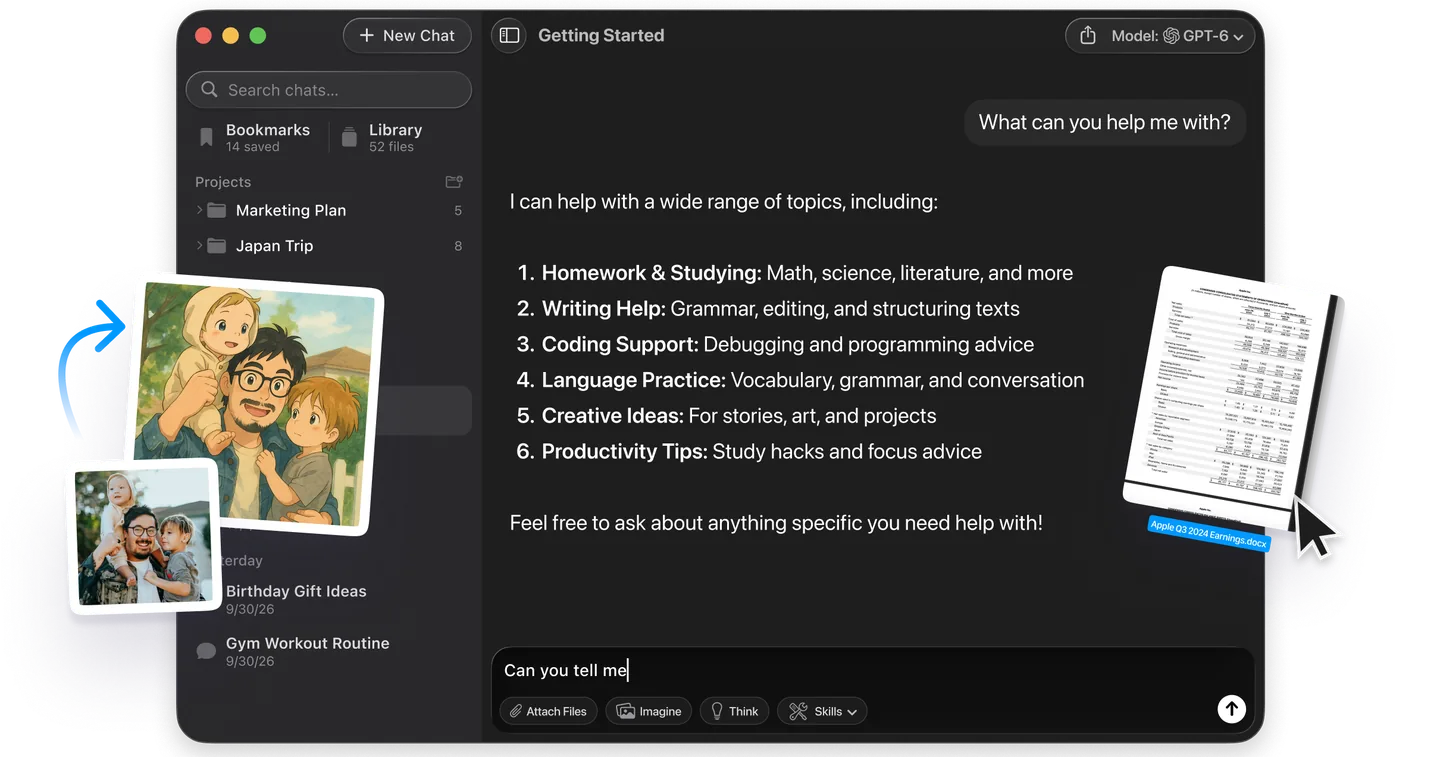
Want one place for chat across multiple models on your Mac? The Fello AI app on the Mac App Store gives you GPT-6, Claude 5, Gemini 3.8, Grok 4.7, DeepSeek V4.1, Kimi K3 and 20+ more models behind a single subscription at $9.99/month. That’s useful when you want to draft a prompt with one model and run it through Grok or another model in the same window. Grok Imagine itself still runs through Grok’s own canvas, but Fello AI removes the friction of bouncing between tabs when you are designing the prompt.
Should You Use Grok Imagine?
Pick Grok Imagine when speed beats polish. Iterating on social content, drafting visual concepts, animating a single still image, or making a short clip you can post in the next 60 seconds is exactly the workflow it is designed for. The combination of voice prompting, native audio, and ~17-second turnaround is fun, and the price is fair if you already pay for Premium on The X Subscription or an older SuperGrok plan.
Skip Grok Imagine when you need native 4K output, multi-scene continuity, accurate human anatomy, or believable lip-synced dialogue. Reach for Kling 3.0 or Veo 3.1, accept the longer wait, and pay the higher cost. For a fuller picture of where each tool fits, see the FelloAI best AI models hub. To see what comes after Grok Imagine, read everything we know about Grok 5.
FAQ
What is Grok Imagine?
Grok Imagine is xAI’s AI image and video generator. It produces images, animated images, and short videos with synchronized audio from text prompts, voice commands, or uploaded photos.
Is Grok Imagine free?
Partly. The free tier includes a limited image allowance but no video. Video generation starts at Premium, $30/month on The X Subscription, which replaced SuperGrok on October 12, 2026. Plus at $8/month includes Imagine images only, and Super at $100 and Ultra at $200 raise the limits.
How long can a Grok Imagine video be?
The app generates short clips, around 10 seconds, and Imagine Video 1.5 raised the resolution ceiling to 1080p in August 2026. xAI publishes no clip-length limit for Video 1.5; the 10-second figure comes from the Imagine 1.0 release in February, and the API charges by the second rather than per fixed clip. You can chain clips with Extend From Frame to build longer sequences.
How is Grok Imagine different from the Grok chatbot?
They are different models, not different modes of one model. The Grok chatbots run the chat line, currently Grok 4.7, on the API and, since October 3, in the app's paid modes, where it replaced Grok 4.6. Grok Imagine runs its own registry entries, grok-imagine-video-1.5 and grok-imagine-image-2.0, and always has. They share an xAI account and subscription but nothing underneath.
Does Grok Imagine have an API?
Yes, since February 2, 2026, with image, video, and audio endpoints and a Quality Mode for higher realism added on May 6. It is not billed per token: video costs $0.08 to $0.25 per second depending on resolution, and images $0.04 to $0.08 each.