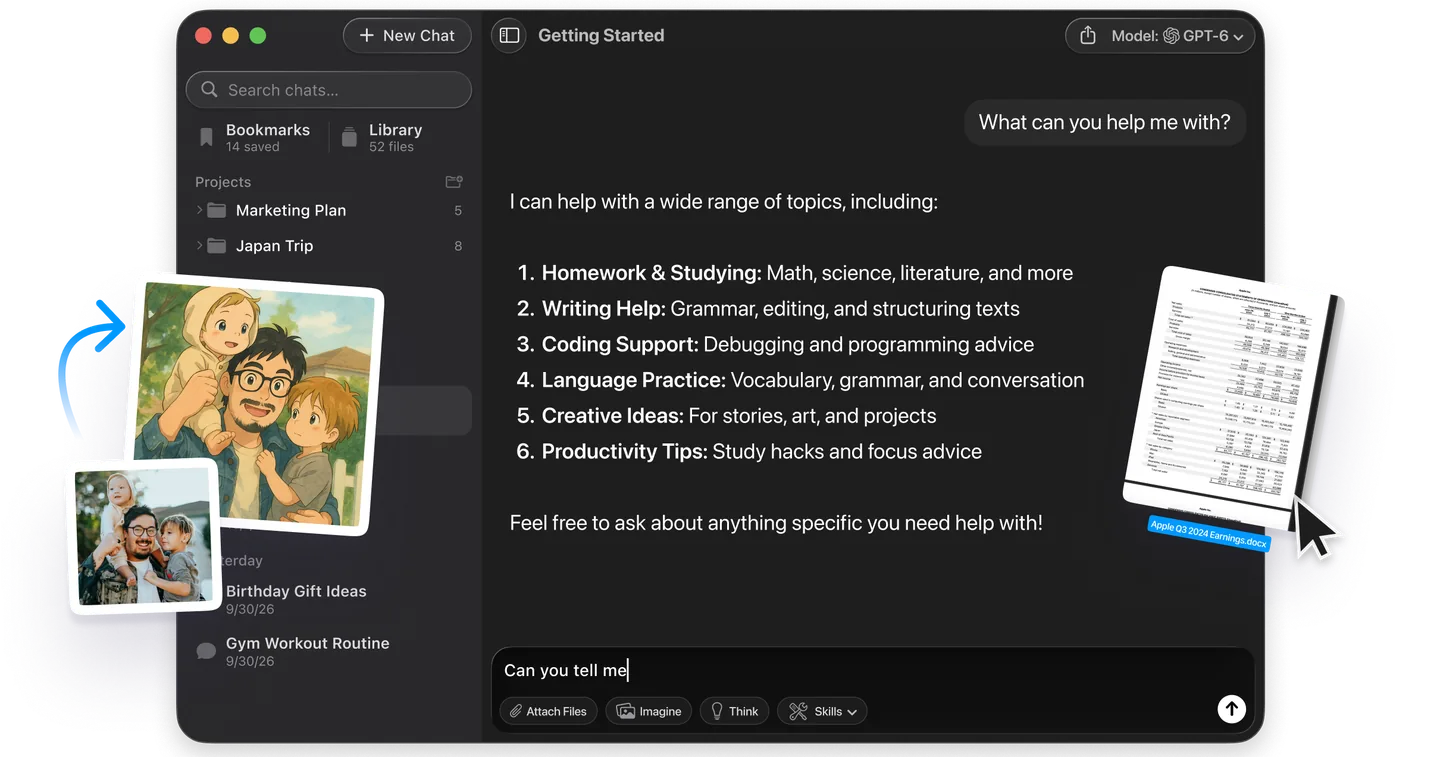
You’ve probably already tried using ChatGPT for homework help. Maybe you asked it to explain a math problem, summarize a chapter, or write a few sentences about the French Revolution. And the result? So vague, so generic, that you’d honestly be better off saying your dog ate your homework.
This guide is your fix. It is not about cheating, it is about asking the right questions, using smart prompts, and finally getting useful answers. Whether you are stuck on math, need to rewrite clunky paragraphs, or just want clearer explanations of complex topics, this one prompt can change how you study. One thing to get straight before you paste anything: a prompt that helps you understand the work and a prompt that writes the work are different things, and only one of them is safe to hand in. The AI rules that actually apply at school are set by your institution, not by ChatGPT, so read yours first.
Let’s get to it.
The Key Takeaways
- The role is the whole trick: opening with “you are an expert tutor” changes the shape of the answer from a block of text into an explanation you can follow.
- One prompt, then variations: the master prompt below handles most assignments, and the subject versions further down cover maths, code, summaries and essays.
- Rewriting is editing, not laundering: the tone prompts make a draft read like you because you then edit it. They are not a way to defeat a detector, and treating them as one is how students get caught.
- Your school’s policy outranks all of it: using AI to understand an assignment is allowed almost everywhere, submitting its text as yours is allowed almost nowhere.
The Prompt That Changed the Game
Here’s the exact homework prompt that helped me turn half-finished assignments into full on A-level submissions:
“You’re an expert tutor who’s great at explaining things in a simple, informative way. I’m going to paste a [type of assignment or question] below. Please help me solve and complete it by: Giving me a clear, finished example or solution I can learn from. [Paste your homework instructions or question here]”
Why This Prompt Works
- It sets the role. Framing the AI as a tutor changes how it responds: it explains, instead of just answering.
- It’s task-flexible. Whether it’s a math problem, science question, or English writing task, the AI knows how to handle it.
- It adjusts complexity. The “explaining things in a simple, informative way” part forces the AI to break things down clearly without dumbing it down.
- It combines explanation + execution. You do not just get the answer, you learn how to get to it.
When I tried it on a tough history assignment, it not only gave me bullet points for a summary but also helped me write the final paragraph in my own voice. It suggested specific historical examples I hadn’t considered, showed how to structure my argument for better flow, and even highlighted key phrases that would impress my teacher.
What made the difference wasn’t just the output, it was how the AI guided me through the thinking process. This prompt removes guesswork and replaces it with clarity, confidence, and submission-ready work that still feels like it came from me.
How to Make AI Homework Sound Human
Even when AI gives solid answers, they can sound robotic. Teachers notice when every sentence starts with “Furthermore,” or the vocabulary feels like it came from an encyclopedia. These responses often lack your natural phrasing, your rhythm, or the little imperfections that make student writing feel real. Schools increasingly run submissions through detection software as well, and it is worth knowing how AI detectors actually work before you assume a rewrite fixes anything.
Here are three ways to make AI-powered homework look (and sound) more like you:
Polish the Tone
Prompt: “Rewrite this like a student wrote it, casual but still smart. Keep the same ideas.”
Result: Simpler phrasing, fewer awkward transitions, more natural flow.
Add Your Own Touch
Prompt: “Insert a personal opinion or real-life example in this paragraph to make it feel more authentic.”
Great for essays, journal reflections, or social science tasks.
Simplify Smartly
Prompt: “Rewrite this using simpler language but keep all the main ideas. Don’t lose depth.”
Ideal when the AI’s response feels more academic than practical.
With just one or two of these tweaks, even a stiff, overly polished explanation transforms into something that sounds like a real student wrote it. You keep the structure and insight from the AI, then layer your own tone, experience, and expression on top. That’s what teachers actually want to see.
Copy-Paste Prompts for Every Type of Homework
You’re not always writing an essay or filling in a) b) c) options. Sometimes the assignment is way more practical: solving equations, explaining scientific processes, debugging a broken piece of code, or pulling key insights from a dense chapter. These types of tasks require different strategies, and more targeted AI prompts.
Here is a collection of tested, subject-specific prompts designed for the kinds of homework students get every day. Maths is the one subject where the choice of model still changes the answer, so if that is your problem set, compare the best AI for math before picking a chat window.
Math Problem
“You’re a math tutor. Show me how to solve this step by step, including formulas used. Then show the final answer: [Paste equation].”
History or Literature Summary
“Summarize this chapter in 5 bullet points. Highlight the most important events or ideas students should remember: [Paste chapter/text]”
Science Explanation
“Explain how [theme] works in simple terms. I need to understand it well enough to explain it back in class.”
Code Fix
“Here’s my code and what I want it to do – [paste code + what you need it to do]. Can you debug it, fix any errors, and explain what was wrong?”
Short Essay Help
“Give me a 5-paragraph essay about [topic]. Keep it under 600 words, use clear examples and give 3 credible sources to back my statements.”
These are structured questions that tell the AI exactly how to help. Think of them like templates that guide the AI to act as your study partner, not your replacement. Instead of replacing your thinking, they amplify it by giving you a strong base to build on. And when the task is structured, your results are too. For the longer-form version of this, essays included, see our full walkthrough of how to use ChatGPT for homework.
How to Create Your Own Homework Prompts
Templates are great, but what if your homework question is weirdly specific? Maybe it’s a two-part history analysis, a science explanation wrapped in a diagram, or a math problem that mixes topics. In those cases, even the best ready-made prompt might miss the mark. That’s when writing your own custom AI prompt becomes the most powerful skill because it lets you adapt the help exactly to your assignment.
Here’s how to write your own prompt from scratch:
- Set the Role
- “You are a tutor helping me study for biology class.”
- “You are a tutor helping me study for biology class.”
- Specifically Describe the Task
- “I need help answering a short-answer question about cell membranes.”
- “I need help answering a short-answer question about cell membranes.”
- Add Format & Style
- “Explain it in 3 clear sentences, no jargon, like you’re talking to a friend.”
- “Explain it in 3 clear sentences, no jargon, like you’re talking to a friend.”
- Include Extra Info
- “Here’s what I already know: [insert bullet points]. Fill in the gaps.”
- “Here’s what I already know: [insert bullet points]. Fill in the gaps.”
- Add a Final Check
- “What did I miss? Can you list 2 things I should double-check in my answer?”
- “What did I miss? Can you list 2 things I should double-check in my answer?”
With just a little practice, building these prompts becomes second nature. You’ll shift from getting half-useful, generic answers to getting help that actually mirrors your task, fills your knowledge gaps, and saves you time. It is not about hacking the system, it is about learning how to ask better questions so you can study smarter, not harder. If you would rather the model ran that loop for you, ChatGPT Study Mode builds the same step-by-step questioning into the product.
Pro Tips for Last-Minute AI Homework Fixes
So the assignment is almost done, but something feels off. Maybe the structure feels wobbly, the conclusion doesn’t hit hard enough, or the tone feels too flat compared to the rest. You’ve read it so many times that you can’t tell what’s working anymore. That’s exactly when AI becomes a powerful editing partner, one that’s fast, objective, and ready to spot what you’ve missed.
Use these prompts to quickly fix and improve your work:
Find Weak Spots
“What are 2 things this paragraph could explain clearer and how?”
Fix Flow
“Improve the flow of this text. Make the transitions smoother and more conversational.”
Tighten an Argument
“Rewrite this argument to sound stronger, include one extra example and give me 1 credible source that backs my argument.”
Get a Grade Prediction
“Act like a teacher. What grade would this answer get and why? Breakdown what I can improve to get a better grade”
It’s like having a second pair of eyes, but one that analyzes your writing without bias, fatigue, or guesswork. You get fast feedback, and a clearer sense of where your assignment can go from okay to excellent, even if it is due in 30 minutes.
Why AI is Surprisingly Good at Homework
ChatGPT and the models behind it are more than autocomplete with a chat window. Current frontier models hold a multi-step instruction together to the end, work a problem through rather than pattern-matching the nearest answer, and compress a dense chapter better than most study guides on the internet. A search engine hands you ten tabs and leaves the synthesis to you. These models do the synthesis, explain it in context, and shift register depending on how you framed the question.
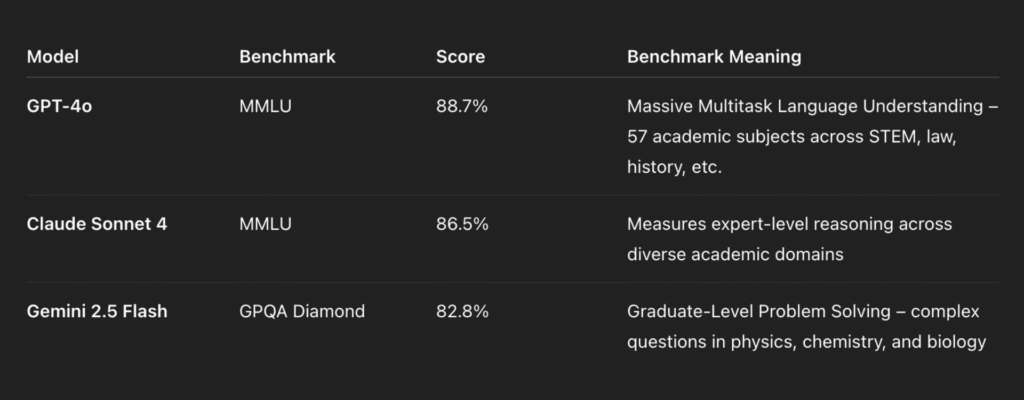
It is tempting to settle which model to use with benchmark scores, and every vendor publishes them. They are a poor guide for homework. The headline suites get swapped between index versions, scores are rescaled without the methodology changing, and retired benchmarks like MMLU hang around in old articles long after the labs stopped quoting them. None of them measure the thing that decides your grade, which is whether the model can explain your particular topic in a way you can reproduce in class on Monday. If you want to read the numbers anyway, our guide to what AI benchmarks actually measure sorts the live ones from the saturated ones.
The bar that matters for a homework prompt is much lower than any leaderboard: follow a five-part instruction, respect a word count, and show the working. Every current chat model clears it, on the free tiers included. The difference in what comes back is set by the prompt, not by the badge on the model picker, which is why this article is about the prompt.
Conclusion
If you’ve ever opened ChatGPT and gotten a response so vague it made you give up, you’re not alone. But the problem is not the tool, it is the prompt. This guide showed you how to unlock real value from AI, whether you’re solving math, understanding biology, or trying to write a clean, coherent answer five minutes before class.
With the right prompts, you’re not cheating. You’re collaborating. The AI gives structure, clarity, and momentum, and you bring the human touch. Together, that’s a powerful combo.
Using prompts like these also helps you learn faster. As you watch the AI solve problems, explain topics, or build arguments, you start to understand how to do it yourself. You are not simply blindly copy-pasting answers, you are really starting to get better at the process behind it.
So next time you feel stuck, don’t panic. Just scroll back, write a smart prompt, and get moving. A better grade (and less stress) is just one good question away.
FAQ
Is this prompt actually banned anywhere?
No. No school bans a specific string of text, and no AI tool refuses this one. What schools ban is submitting work you did not write. The prompt asks for a worked example to learn from, which sits on the allowed side of almost every policy, right up until you paste the output into the assignment box.
Will a teacher be able to tell?
Often, yes, and not because of software. A teacher who has read your work all term notices when the vocabulary jumps, the sentence rhythm flattens, or an argument arrives without the mistakes you usually make. That is also the reason the honest use of these prompts works better: an explanation you understood and rewrote reads like you, because it is you.
Which model should I run it on?
Whichever you already have open. This prompt asks for role, structure and an explanation, and every current chat model handles that on its free tier. Maths with several steps is the one place the choice still shows, and a model that shows its working beats one that states an answer.
What should I never paste into it?
Anything that identifies a classmate, anything from a take-home exam that says no outside help, and any assignment your course has flagged as AI-prohibited. The first is a privacy problem, the other two are academic misconduct regardless of how the output reads.