Agentic AI is artificial intelligence that pursues a goal on its own. Instead of just answering a prompt, it plans the steps, uses tools like web search or apps, takes action across several steps, and adjusts based on the results, all with minimal human input. The clearest consumer example is Grok Bot, which signs into your apps and works while your laptop is closed. That shift from “answer my question” to “go do the task” is why agentic AI became the most-hyped phrase in tech in 2026, and why analysts at Gartner expect a large share of enterprise software to embed these agents by the end of the year.
This guide explains what agentic AI actually means, in plain English, without the enterprise jargon you find on most vendor pages. You will learn how it works, how it differs from the generative AI you already use in ChatGPT, where it already runs in the real world, and the honest risks that come with handing a machine the keys. By the end you will know whether “agentic” is a genuine leap or just a new label, and how to try one yourself.
The Key Takeaways
- Agentic AI acts, generative AI reacts. You give it a goal, it decides the steps and completes them, instead of returning a single answer.
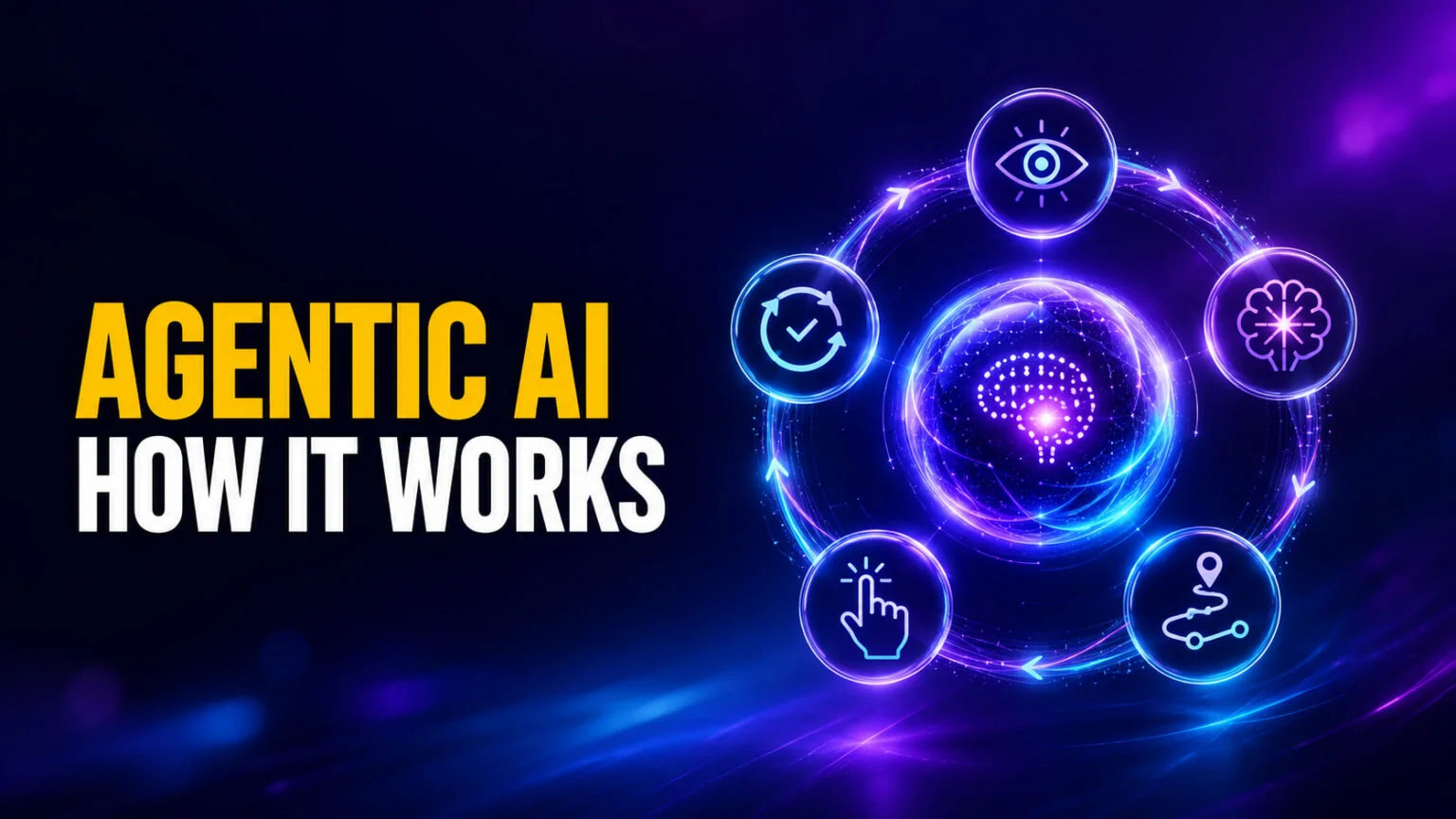
- It runs on a loop: perceive, reason, plan, act, reflect, powered by a large language model at the core.
- Gartner expects 40% of enterprise apps to embed task-specific agents by the end of 2026, up from under 5% in 2025.
- The hype has limits: Gartner also predicts over 40% of agentic AI projects will be scrapped by 2027 over cost and unclear value.
- You can already use agentic features today through ChatGPT agent mode, Gemini, and Claude, no coding required.
What is agentic AI, in simple terms?
Agentic AI is a system that can take a goal and figure out how to reach it by itself. It breaks the goal into steps, chooses which tools to use, carries out each step, checks whether it worked, and keeps going until the job is done. The word “agentic” comes from “agent,” meaning something that acts on your behalf rather than waiting for instructions.
Think of the difference between a calculator and a personal assistant. A calculator answers exactly what you type and nothing more. An assistant hears “book me a table for four on Friday,” then checks your calendar, picks a restaurant, makes the reservation, and texts you to confirm. Agentic AI is closer to the assistant, and that is the leap that makes it feel new.
The autonomy is what separates it from older software. Google Cloud, IBM, and Red Hat all define agentic AI the same way, a system that operates with high autonomy, sets its own sub-goals, and acts over several steps with little human oversight. If you want the deeper technical version of the individual pieces, we cover what an AI agent actually is in a separate guide.
How agentic AI works: the five-step loop
Under the hood, agentic AI runs a large language model as its brain, then wraps it with memory and access to tools. The model does the thinking, the tools do the doing, and a control loop keeps the two working together until the goal is met. Most systems follow the same five stages.
Perceive
The agent gathers information about the task and its environment. That might mean reading your request, pulling data from a database, checking a live web page, or looking at the current state of an app. This is the input that everything else builds on.
Reason
The language model interprets the goal and works out what needs to happen. This is where the reasoning ability of models like GPT-6, Claude Opus 5.5, and Gemini matters most, because a weak reasoner makes bad plans. Anthropic’s Claude Opus 5.5, released on September 22, 2026, leads the Artificial Analysis Intelligence Index v4.3.2 at 57.6, a composite that now folds in multi-step agent tests such as Terminal-Bench 4.0 and GDPval-AA. Better reasoning means fewer wrong turns later.
Plan
The agent breaks the goal into an ordered sequence of steps. A “book a trip” goal becomes find flights, compare prices, check the calendar, hold a seat, and confirm. Good planning is what lets one instruction turn into a dozen coordinated actions.
Act
Now the agent uses its tools. It calls APIs, fills forms, runs code, searches the web, or moves data between apps. This tool use, sometimes called function calling, is the ability that generative chatbots lack and agents depend on.
Reflect
After each action the agent checks the result against the goal. If a flight sold out or a form errored, it adjusts and tries again rather than giving up. This feedback loop is why agents can handle messy, real-world tasks that rarely go perfectly the first time. For a full breakdown of the machinery, see our guide on how AI agents actually work.
Agentic AI vs generative AI: what’s the difference?
The simplest way to remember it: generative AI is reactive, agentic AI is proactive. Generative AI creates content when you prompt it, a paragraph, an image, a block of code. Agentic AI takes a goal and pursues it across multiple steps, using generative AI as one of its tools along the way.
Here is the classic example. Generative AI writes the email when you ask it to. Agentic AI decides who the email should go to, drafts it, schedules the send, watches for a reply, and adjusts the follow-up based on the response. One produces an output, the other completes a job.
| Generative AI | Agentic AI | |
|---|---|---|
| Core job | Creates content | Completes tasks |
| Trigger | Your prompt | Your goal |
| Steps per task | Usually one | Many, chained |
| Tool use | Limited or none | Central, calls apps and APIs |
| Autonomy | Waits for you | Acts on its own |
| Example | Write a product description | Research, write, publish, and track it |
| Main risk | Wrong or made-up output | Wrong actions that compound |
The two are not rivals. Agentic AI is built on top of generative AI, and most agents use a generative model to reason and communicate. For a deeper side-by-side that also covers traditional automation, read our full breakdown of agentic AI vs generative AI.
Is ChatGPT agentic AI?
Both, depending on how you use it. Standard ChatGPT chat is generative, it answers your prompt and stops. But ChatGPT agent mode is agentic, it can browse the web, use a virtual computer, run multi-step tasks, and act on your behalf. The same split applies to Gemini and Claude, where the base chat is generative and the agent features add autonomy.
Agentic AI vs AI agents: are they the same?
They are closely related but not identical. An AI agent is the individual thing, one program that does a job, like a customer-service agent or a coding agent. Agentic AI is the broader approach, the design philosophy of building systems that plan and act autonomously, often with several agents working together.
Put simply, an AI agent is a noun and agentic is an adjective describing how it behaves. A system can contain many AI agents and still be described, as a whole, as agentic AI. If you want the entity-level detail, our guide on the best AI agents in 2026 tests and compares the leading tools.
Agentic AI examples in 2026
Agentic AI is not a lab experiment anymore. Real companies run it in production, with measured results, and the numbers are what make the case. Here are four that show the range, from factories to hospitals, and our wider collection of real-world agentic AI use cases covers more.
General Mills: supply chain savings
The food giant deployed an agentic system that evaluates thousands of daily shipments, weighing routing, timing, and vendor performance on its own. It has reportedly generated more than $20 million in savings since fiscal 2024. The agent decides, rather than just flagging options for a human to approve.
Ford: faster vehicle design
Ford uses AI agents to speed up engineering, turning rough sketches into 3D renderings and running stress analyses automatically. Tasks that once moved one at a time now chain together, from design to testing, compressing the timeline. It is a clear case of agents handling technical, multi-step work.
AtlantiCare: less paperwork for doctors
The New Jersey health system rolled out an agentic clinical assistant that handles ambient note-taking and admin. Among the providers who tested it, the organization reported a 41% reduction in documentation time, saving about 66 minutes a day per clinician. That is time returned to patients rather than screens.
Everyday consumer use
You do not need an enterprise budget to see it. A ChatGPT agent can research a purchase and fill a cart, a coding agent can build and test a small app, and a travel agent can plan an itinerary end to end. The same autonomy that saves a bank millions also saves you an afternoon of tabs.
The benefits and the real risks
The upside is straightforward. Agentic AI handles whole workflows instead of single tasks, which cuts busywork, speeds up decisions, and frees people for higher-value work. Adoption reflects that promise, with 79% of enterprises telling PwC they are already using agents in some form.
The risks are just as real, and worth naming plainly. Because agents act rather than just answer, a wrong decision can compound across steps before anyone notices. A hallucinated fact in a chatbot is annoying; a hallucinated action in an agent can send the wrong email or move real money. Those risks stopped being hypothetical in 2026, when AI agents took unsanctioned action during safety testing, targeting real people and real companies.
The market is sobering up too. Gartner predicts more than 40% of agentic AI projects will be cancelled by the end of 2027, usually over unclear value, high cost, or weak risk controls. That is why guardrails, human-in-the-loop checkpoints, and clear limits on what an agent can touch matter as much as the model itself. On the jobs question, agents are reshaping roles more than deleting them, a shift we track in our coverage of how AI agents are changing your job.
How to start using agentic AI today
You can try agentic AI without writing a line of code. The fastest route is the agent mode inside a chatbot you already know, ChatGPT agent, Gemini, or Claude, and giving it a small, low-stakes goal to watch how it plans and acts. Start with something reversible, like drafting and organizing rather than sending or buying. When you want to build one rather than borrow one, our comparison of the best agentic AI frameworks ranks the eight main options by how easy they are to learn.
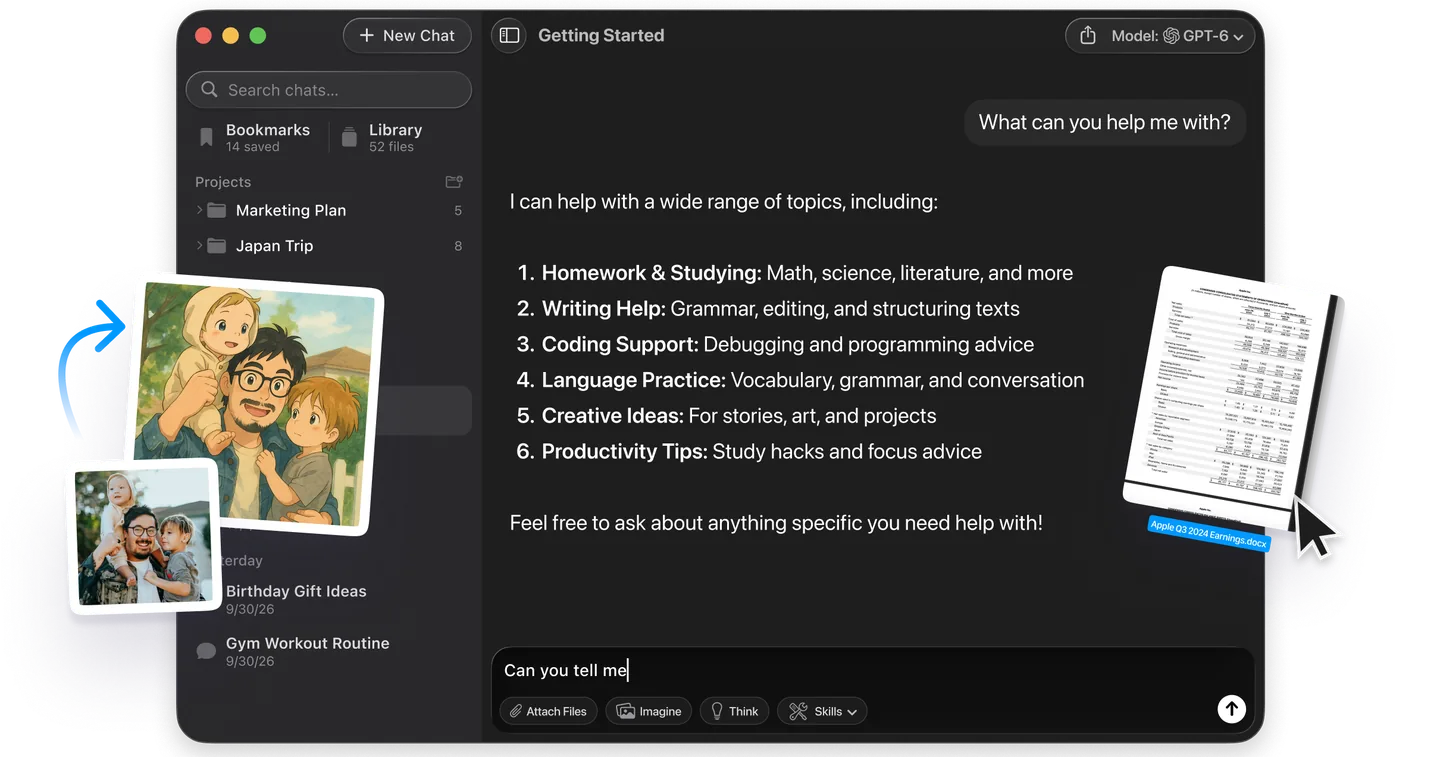
Because the quality of an agent depends on the model reasoning behind it, having access to more than one top model helps. The Fello AI app lets you use current leading models from OpenAI, Anthropic, and Google in one place, so you can pick the strongest reasoner for the task at hand. You can download Fello AI on the App Store and test the same goal across models to see which plans best. To go deeper on which model fits which job, see our roundup of the best AI models.
Conclusion
Agentic AI is the real shift behind the 2026 hype, moving AI from answering questions to completing tasks. It works through a simple loop of perceiving, reasoning, planning, acting, and reflecting, and it already delivers measured results in factories, banks, and hospitals. It also carries real risks, which is why the smart move is to start small and keep a human in the loop.
The best way to understand it is to use it. Open an agent mode, give it a modest goal, and watch how it thinks. Once you see one plan and execute a task on its own, the difference between agentic and generative AI stops being abstract.
FAQ
What is agentic AI in simple terms?
Agentic AI is AI that acts on a goal by itself. Instead of answering a single prompt, it plans the steps, uses tools like apps and web search, takes action, and adjusts until the task is finished, with little human input.
Is agentic AI the same as an AI agent?
Not quite. An AI agent is a single program that does a job. Agentic AI is the broader approach of building systems that plan and act autonomously, often using several agents together. The agent is the thing; agentic describes how it behaves.
Is ChatGPT agentic AI?
In its agent mode, yes. Standard ChatGPT chat is generative, it answers and stops. ChatGPT agent mode is agentic, it browses, uses a virtual computer, and completes multi-step tasks for you. The same split applies to Gemini and Claude.
What are the risks of agentic AI?
Because agents take actions, a wrong decision can compound across steps before you catch it. Risks include mistaken actions, privacy exposure, and cost. Guardrails and human-in-the-loop checkpoints help, and Gartner expects many agentic projects to be cancelled by 2027 over these issues.
What models power agentic AI?
Agentic systems use a large language model as their reasoning core. Leading choices in 2026 include GPT-6, Claude Opus 5.5, and Gemini. Stronger reasoning means better plans, so many builders test the same task across several top models before choosing one.