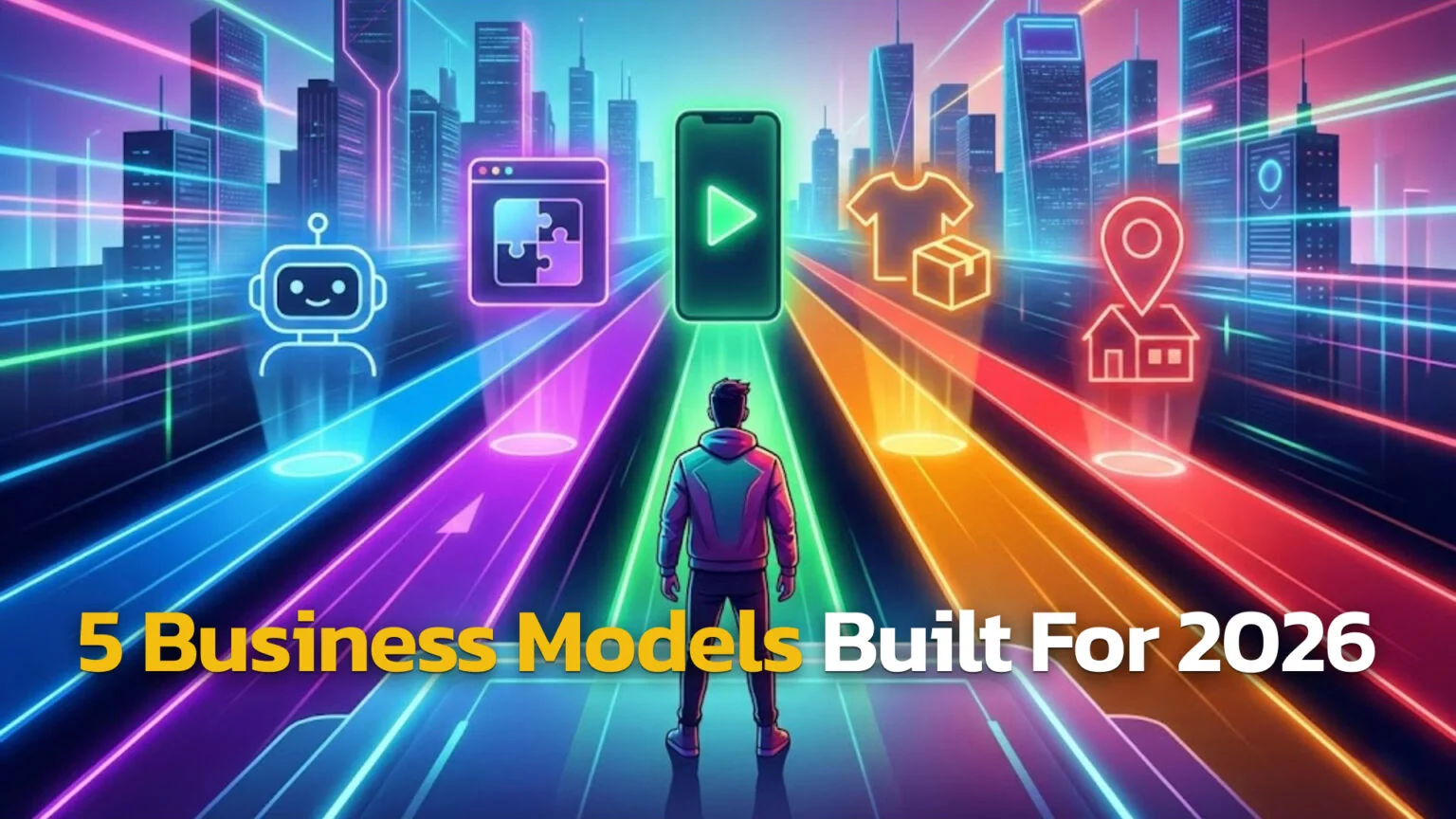
TL;DR: The most profitable “easy” business ideas for 2026 leverage AI, content creation, and automation. By focusing on low-capital models like AI agencies, micro-SaaS, and niche print-on-demand brands, entrepreneurs can build scalable wealth without needing a fortune to start.
| Business Model | Startup Cost | Tech Difficulty | Best For |
|---|---|---|---|
| AI Automation Agency | Low (€200–€500) | Medium | System thinkers |
| UGC Content Studio | Very Low (Phone) | Low | Creatives & Editors |
| No-Code Micro-SaaS | Low (Tools) | Medium | Problem Solvers |
| POD Microbrand | Very Low | Low | Designers/Trend Spotters |
| Local Lead-Gen | Low–Medium (Ads) | Medium | Sales & Marketing |
Opening
Are you looking for a way to break free from the 9-to-5 grind? In 2026, the barrier to entry for starting a profitable company has never been lower. You no longer need a factory, a massive loan, or a team of employees to build wealth. The right AI for small business is what makes that possible. The era of the “heavy” startup is ending, replaced by agile, tech-enabled solopreneurs who move fast and keep overheads near zero.
In this guide, ‘easy’ doesn’t mean effortless – it means low capital, simple tooling, and realistic for one person to start. If you want the full menu of options first, see our guide on how to make money with AI. If you would rather build something you make once and sell forever, browse our list of digital product ideas. And for the build itself, our guide on how to create digital products walks through it step by step.
Thanks to AI, no-code tools, and the exploding creator economy, “one-person businesses” are generating revenue that used to require a whole department. This article cuts through the hype to find the best business ideas 2026 has to offer. We aren’t talking about taking surveys or generic gig apps. We are analyzing scalable business models that can grow into six or seven-figure assets, not just beer-money side hustles.
This article will answer these key questions:
- Which low investment business ideas 2026 actually work?
- How can you leverage AI to do the heavy lifting?
- Can you really scale these into a full-time income?
1. AI Automation Agency for Small Businesses (Easy AI Business Idea 2026)
One of the biggest opportunities right now is helping regular companies keep up with technology. While big corporations are adopting AI at a rapid pace – with global AI spending expected to top $2 trillion by 2026 according to Gartner – your local florist, dentist, or gym is likely still doing everything manually. They are drowning in unread emails, missed calls, and messy spreadsheets. This gap creates massive demand for AI business ideas 2026.
You don’t need to be a coder. Act as the bridge. Use visual tools like Zapier, Make, or n8n to connect their email to their booking system, or set up a ChatGPT-powered bot to answer FAQs instantly. The rise of “Agentic AI” – software that can actively perform tasks rather than just chat – is the driving force here. The market for these AI agents is projected by some estimates to grow to over $50 billion by 2030, and small businesses will need experts to install them.
AI Consulting for Small Businesses
This is one of the most accessible AI business ideas for beginners because you aren’t building the tech yourself; you are simply implementing it. The market data backs this up. A Salesforce survey found that 91% of small businesses using AI saw a revenue boost, yet most struggle to implement it. By offering AI agents for small business – digital workers that handle boring tasks – you solve a painful problem. You aren’t selling “tech”; you are selling “time.”
Consider the pricing model, which makes this highly lucrative:
- Setup: You charge a fee (€500–€2,000) to build the system.
- Retainer: You charge a monthly fee (€200–€1,000) to keep it running and optimize it.
- Scale: Once you build a system for one dentist, you can sell that exact same system to 50 other dentists with minimal extra work.
Quick Start (This Week)
- Pick a niche: Choose one specific local business type (e.g., Dentists, Gyms, Accountants).
- List 3 pains: Identify their most annoying tasks (e.g., missed call callbacks, appointment reminders, FAQ replies).
- Prototype & Pitch: Build one simple automation in Make or Zapier. Offer it for free to the first 3 businesses in exchange for a case study and testimonial.
2. UGC & Short-Form Content Studio (Creator Economy Side Hustle)
The global creator economy is projected to reach about $1.3 trillion by 2033. Brands know they need to be on TikTok, Instagram Reels, and YouTube Shorts, but they don’t have the time or the “cool factor” to film themselves. Traditional, polished ads don’t work anymore; consumers trust authentic, raw videos shot on phones. This is where UGC business ideas come in.
You launch a studio that produces User Generated Content (UGC). This doesn’t mean you have to be the star. You can edit clips, write scripts, or manage a small team of creators who appear on camera. In 2026, the demand for “authentic” video ads is skyrocketing, with the global influencer marketing industry expected to reach around $33 billion in 2025. Brands are shifting budget away from TV and toward creators.
Faceless YouTube Automation Business (Optional Angle)
This model is perfect because it requires very little money to start. If you have a smartphone and basic editing apps like CapCut, you are ready. You act as a production house: brands send you products, and you turn them into engagement-ready videos.
Key components of this business include:
- The Service: Offer “content packs” (e.g., 15 short videos a month) to e-commerce brands.
- The Growth: Use AI video tools like OpusClip or Descript to speed up editing and captioning.
- The Trend: Even major brands are moving budget from TV ads to creator-style social videos because they feel more authentic.
Quick Start (This Week)
- Build a Portfolio: Create 3-5 example videos for a fake brand (or a product you own) to show your style.
- Outreach: DM 10 small e-commerce brands on Instagram. Send them a watermarked example of how you would edit their content.
- Offer: Propose a “Starter Pack” of 5 videos for a low entry price to get your first client.
Tip: Try these Youtube prompts.
3. No-Code Micro-SaaS for One Niche Problem
In the past, building software required expensive developers and months of coding. Today, no code business ideas let you build “Micro-SaaS” (Software as a Service) using drag-and-drop builders like Bubble, FlutterFlow, or Softr. The goal isn’t to build a massive platform; it’s to solve one tiny, specific problem for a specific group of people.
Reports indicate that by 2026, 70-75% of new enterprise applications will be built using low-code or no-code technologies. This democratization of software means you can build a recurring revenue machine from your bedroom. The “micro” aspect is key: you don’t need millions of users. You just need a few hundred loyal ones.
Micro SaaS Ideas 2026 & Recurring Revenue
Instead of trying to build the next Facebook, build a “compliance tracker for independent truck drivers” or a “shift scheduler for local cafes.” These vertical markets are often ignored by big tech companies because they are “too small,” but for a solo founder, they are a goldmine.
Here’s why this model can build serious wealth over time:
- Why it works: Benchmarks show that vertical and AI-native SaaS often grow up to ~2x faster than many horizontal peers, thanks to niche focus and better retention.
- The Money: It is a recurring revenue business idea. If you get 100 users paying €20/month, that is €2,000/month in passive-style income.
- Low Risk: You can build a prototype in a weekend for free before selling it.
Quick Start (This Week)
- Find the Pain: Join a Facebook group for a specific niche (e.g., “Mobile Pet Groomers”). Search for words like “hate,” “struggle,” or “spreadsheet.”
- The Fix: Build a simple tool using Softr (frontend) and Airtable (database) that solves that exact problem.
- Launch: Post in the group: “I built a simple tool to handle [Specific Problem]. Who wants to try it for free?”
4. Print-on-Demand Microbrand (POD Business 2026)
If you want to sell products but hate the idea of buying inventory and shipping boxes, print on demand business ideas 2026 are your best bet. You create the designs (or hire someone to do it), and a third-party supplier (like Printify or Gelato) prints and ships the item only when a customer buys it. Prefer zero inventory entirely? Our guide on how to sell digital products covers the download-only route. Most POD sellers list on Etsy, where the listing title and tags decide whether a design is ever seen, so our 400 AI prompts for Etsy shop owners are worth running before you upload.
The global Print-on-Demand (POD) market is forecast to reach nearly $38 billion by 2030. The growth isn’t in generic t-shirts, but in specialized items like eco-friendly home decor, custom pet accessories, and personalized tech gear. Because there is zero upfront cost for inventory, you can test hundreds of designs risk-free.
Best POD Niches 2026
The secret to getting rich here isn’t selling generic “Live Laugh Love” shirts. It is targeting deep micro-niches. Think “retro synth-wave cat lovers” or “gifts for exhausted math teachers.” In 2026, the trend is hyper-personalization powered by AI.
- Market Growth: Home decor is one of the fastest-growing POD product categories, with several reports showing strong double-digit annual growth as people personalise their living spaces.
- Strategy: Upload designs to Etsy, Amazon Merch, or your own Shopify store.
- Passive Potential: Once a design is uploaded, it can generate sales for years with zero extra work from you.
Quick Start (This Week)
- Identify a Trend: Use Google Trends or Pinterest to find a rising aesthetic (e.g., “Cottagecore” or “Dark Academia”).
- Create: Use AI tools like Midjourney to generate unique patterns or artwork that fits the trend.
- List: Create a free Printify account, put the design on a tote bag or mug, and list it on Etsy.
5. Local Lead-Gen & Hyperlocal Services Agency
Local businesses (plumbers, solar installers, luxury remodelers) love one thing: new customers. A local lead generation business focuses on finding these customers online and passing their details to the business owner for a fee. While global markets are competitive, local markets are often unoptimized and easy to win.
The hyperlocal services market is expected to grow to $4.9 trillion by 2030. As baby boomers retire, demand for “senior-focused services” (like home retrofitting for accessibility) is exploding. At the same time, high ticket local service niches like solar installation and luxury landscaping are booming.
High Ticket Local Service Niches
This is one of the best business ideas 2026 for high cash flow. A single lead for a roof replacement could be worth thousands to a contractor, so they are happy to pay you for it. You essentially become the digital marketing arm for businesses that are great at working with their hands but terrible at working with computers.
- The Model: You run ads (Google or Facebook) targeting a specific city and service.
- The Payout: Charge a monthly retainer (e.g., €1,000/month) or a fee per lead (e.g., €50 per verified phone number).
- Scalability: Once you crack the code for “pool cleaning leads in Miami,” you can copy that campaign to Orlando, Tampa, and Jacksonville.
Quick Start (This Week)
- Build: Create a simple website for “Best Solar Installers in [Your City].” Write helpful articles about tax credits and energy savings.
- Rank: Use local SEO to get this site to the top of Google Maps and search results.
- Rent: Once the phone starts ringing, find a top-rated local installer and say, “I have 10 leads calling me this week. Pay me €500/month, and I’ll forward them to you.”
Reality Check: “Easy” vs. “Get Rich”
We have listed easy business ideas 2026, but “easy” means low barrier to entry, not “zero work.” To truly build wealth, you must treat these as real companies. The internet is littered with people who tried “dropshipping” for two weeks and quit. If you do go that route, treat it as a real store and start from our 200 ChatGPT prompts for dropshipping and e-commerce rather than guessing at product research.
To succeed, you need to shift your mindset from “hustler” to “business owner.”
- Systems: Don’t just hustle; build workflows. Document everything you do so you can eventually outsource it.
- Patience: Most overnight successes take 2–5 years of groundwork. In practice, most of these ‘easy’ businesses behave like any other business: high failure rate, slow compounding, and lots of boring work before the money becomes meaningful.
- Success Rates: For example, some estimates suggest that only about one in four print-on-demand stores becomes sustainably profitable, which is why niching and positioning matter so much.
Ultimately, the difference between a side hustle and a wealth-building asset is your approach. By focusing on systems and long-term growth rather than quick wins, you position yourself to capture the upside of these growing markets while mitigating the risks that filter out the less committed entrepreneurs.
Conclusion
The opportunity to start profitable business ideas 2026 is wide open. Whether you choose to build a no-code micro-SaaS, launch a print-on-demand microbrand, or start an AI automation agency, the tools are ready and affordable. The only missing ingredient is action.
Next Step: Choose one idea from this list. Do not try three at once. Spend this weekend researching the top 3 competitors in that niche, write down what they’re doing well, and what gap you could fill. Then launch one tiny offer next week. Momentum is your best friend. Start small, but start today.
This article is for educational purposes only and is not financial or investment advice.
FAQ
What are the easiest businesses to start in 2026?
The easiest businesses are service-based online models like UGC content creation or print-on-demand. They require almost no upfront capital and use skills many people already have, like using social media or basic design. You don’t need to build a product or manage inventory, which eliminates the biggest headaches for beginners.
Which business is best to start in 2026 with little money?
A service agency (like AI automation or lead gen) is best. You are selling your time and skill, which costs nothing but effort. You can use free trials of software (like Zapier or HubSpot) to get your first client, then use their initial payment to cover the subscription costs. This is the classic “bootstrapping” model.
Can you really get rich from a small business started in 2026?
Yes, but usually through scaling. You don’t get rich doing everything yourself. You get rich by building a system – like a Micro-SaaS with thousands of users or an agency that hires contractors to do the work – that generates money while you sleep. Wealth comes from disconnecting your time from your income. For a full breakdown, see make money with ChatGPT.
How much money do I need to start a business in 2026?
For the digital-product ideas listed here, €100 to €500 is often enough. This covers domain registration, basic software subscriptions (like a website builder or design tool), and perhaps a small budget for testing ads. The biggest investment is your time spent learning the skills.
What is the safest business to start in 2026?
B2B (Business to Business) services are generally safer than B2C (Business to Consumer). Selling services to other businesses (like lead gen or AI help) is often more stable because businesses always have a budget for things that help them make more money. Selling t-shirts to consumers is riskier because their spending habits change with the economy.
Methodology & Sources
We analyzed current market trends, technology adoption rates, and financial forecasts to select these five ideas. We looked for intersections between high growth, low capital requirements, and accessibility for solopreneurs.
- AI & AI Agents: Gartner, McKinsey, Grand View Research (Global AI spending >$2T by 2026).
- Creator Economy: Grand View Research, Business Insider (Influencer marketing industry ~$33B in 2025).
- Low-Code/No-Code: Gartner forecast via Kissflow (70-75% of new apps built on low-code by 2026).
- Print-on-Demand: Mordor Intelligence, Blogging Wizard (~$38B market by 2030).
- Hyperlocal Services: Fairfield Market Research (Market projected to $4.9T by 2030).